

The Republic of North Macedonia 2026
Media Pluralism Monitor 2026 results
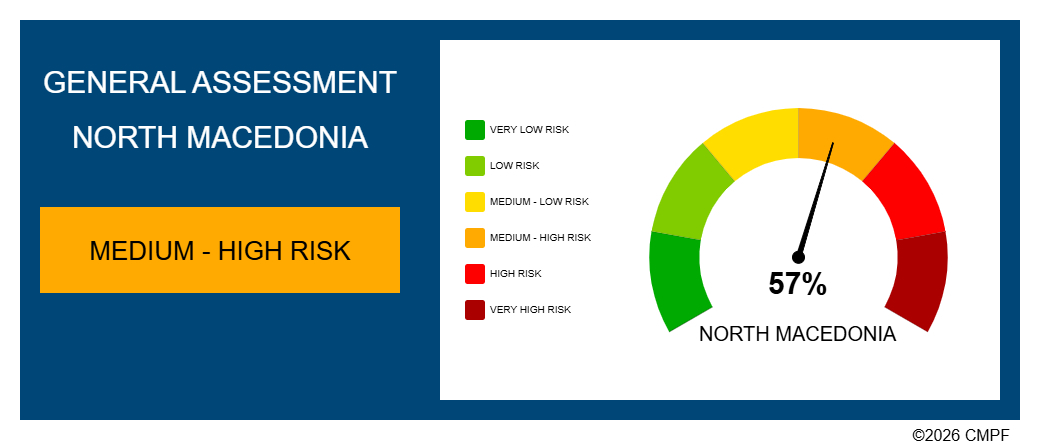
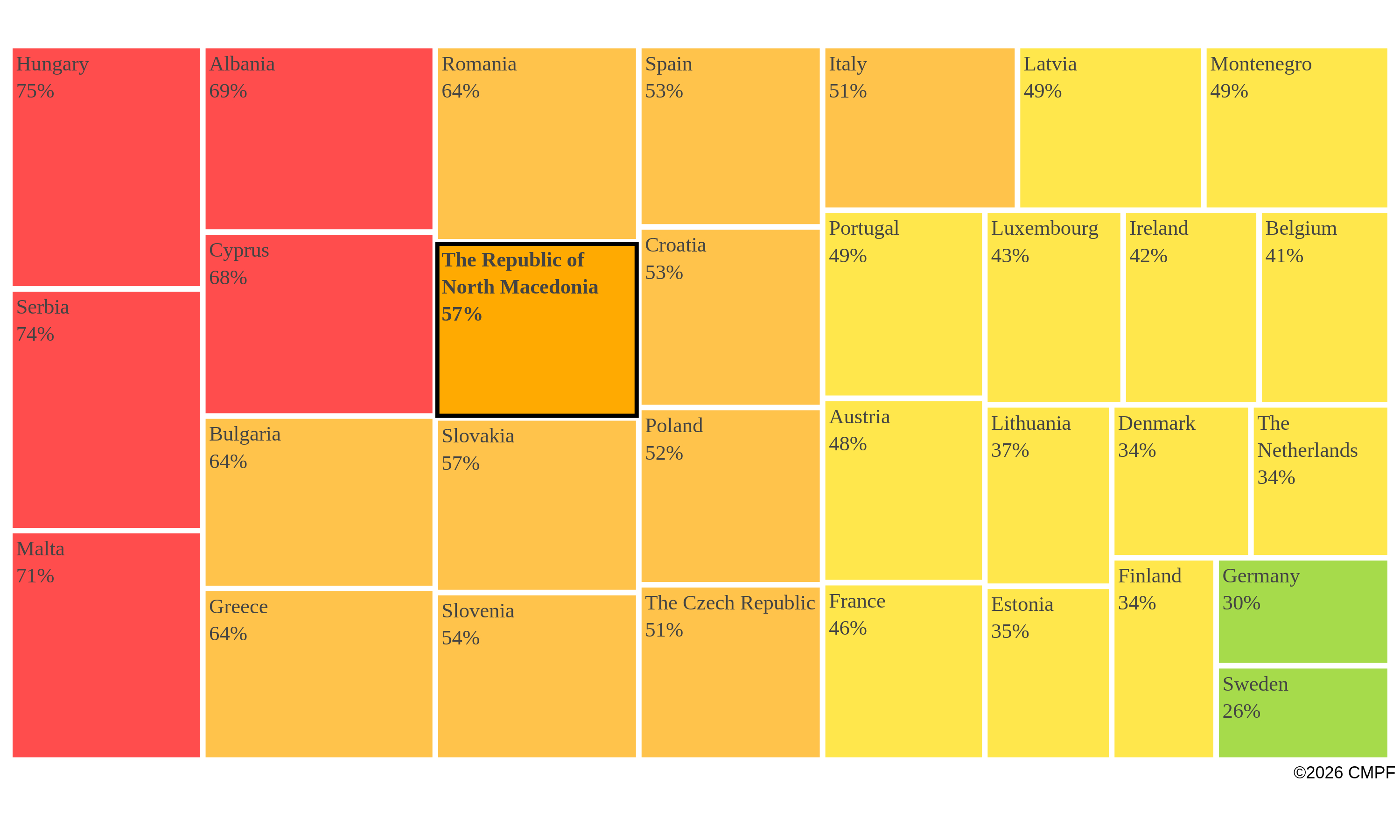
Risk score: 57%
| Fundamental Protection | 38% |
| Market Plurality | 71% |
| Political Independence | 52% |
| Social Inclusiveness | 68% |
In-depth analysis:
Read the full MPM2026 Country report
Country overview
Political developments and their effect on media pluralism: North Macedonia held local elections in 2025, which once again reflected entrenched structural problems in the media landscape. Issues such as unequal access to paid political advertising, lack of transparency in campaign spending – particularly online – and the clientelistic ties between political actors and media outlets continue to limit genuine media pluralism.
A serious concern for media pluralism and freedom of expression emerged from the government’s conduct during and after the Kochani nightclub fire in March 2025. In the aftermath of this tragic event in which more than 60 young or underaged people lost their lives, authorities engaged in what can reasonably be assessed as forms of indirect censorship and information control. These included restricting journalists’ ability to report freely from the site, the funerals, and subsequent protests, as well as pressuring media outlets to remove visual content under the justification of ethical concerns. Additional actions – such as coordinated complaints against media through self-regulatory bodies, public attacks on critical voices assigning institutional responsibility, and even the detention of reporters using drones – point to a broader pattern of interference with the free flow of information. This widespread influence of the government over information flows reinforced concerns that media pluralism is constrained not only by structural dependencies but also by active political pressure on critical reporting and public discourse.
Relevant legislation & regulatory changes: A key legislative development in 2025 was the amendment to the Law on Media, which introduced transparency requirements for digital media service providers. However, in practice, these changes proved insufficient, as many outlets failed to disclose ownership and financial data in line with European standards. Additionally, delays in harmonizing national laws with the EU’s European Media Freedom Act (EMFA) and Digital Services Act (DSA) left regulatory bodies without clear mandates, particularly regarding oversight of online platforms and content moderation. Although procedures for appointing members of the audiovisual regulator formally meet legal standards, their implementation in 2025 was criticized for lacking transparency and genuine political independence.
News media market developments: In 2025, the local media market continued to decline. Several local newsrooms reducing staff or ceased operations due to falling revenues – this underlines the lack of financial sustainability of the entire local media sector. This trend was particularly visible in smaller municipalities, where the number of active journalists continues to fall, limiting coverage of local issues.
At the same time, major digital media outlets were found not to be complying with new transparency obligations, leaving audiences without clear information about ownership structures. The absence of agreements between media publishers and large online platforms contributed to ongoing copyright concerns, as content was widely redistributed without fair compensation. Furthermore, the lifting of the ban on State advertising is expected to influence market dynamics, with larger, politically connected outlets benefiting disproportionately, while independent and non-profit investigative media remained excluded from public funding schemes. These developments further concentrated market power and weakened the diversity of available news sources.
Fundamental Protection
In 2025 the Fundamental Protection area remains within the medium-low risk band. The country needs to put more focused attention on several issues:
- In 2025 prominent cases emerged suggesting the re-surfacing of the practice of systemic institutional, as well as ruling party pressures towards critical voices – journalists, activists, academicians and human rights defenders. Though the number of these cases is still relatively small the cases are prominent and indicate a change in the pattern of political behaviour towards legally unfounded limitation of the freedom of expression.
- Strategic lawsuits against public participation are not frequent – in 2025 only one lawsuit has been suspected of being SLAPP by the journalists’ association. However, contrary to EU’s anti-SLAPP recommendations (EU, 2024) the country still lacks a specific anti-SLAPP legislation and its safeguards against SLAPPs are insufficient, as the capacity of the courts to recognise SLAPPs is weak.
- Very Large Online Platforms (VLOPs) and Very Large Online Search Engines (VLOSEs) lack transparency regarding their practices of moderation or removals of content originating from the Republic of North Macedonia. Dispute resolution mechanisms are not in place to address violations of freedom of expression and access to information resulting from content moderation practices.
- There is no single and coherent national anti-disinformation strategy — a range of fragmented documents and plans have been developed, although the NGO sector active in this field claims to have a coordinated and strategic approach to tackle disinformation.
- Insufficient institutional responsiveness upon requests for free access to public information and the weak practice of reporting wrongdoing in public institutions.
- The protection of journalistic labour rights is weak, while precarious working conditions of journalists remain a persistent challenge.
- The risk related to illegal surveillance of journalists remains high, as no reforms have been introduced to strengthen safeguards against this practice.
- Adequate appointment procedures for members of the Agency for Audio and Audiovisual Media Services (AAVMS) are incorporated in the legal framework; however, the execution of these procedures is insufficiently democratic and transparent.
- Tasks and responsibilities of the media authority in the relevant national law are not defined in compliance with the EMFA and the DSA, since the media reform process is delayed.
Market Plurality
In 2025 the Market Plurality area remains within the high-risk category. These are the most pressing issues:
- The legal requirements on ownership and financial transparency for digital media providers (DMSPs) introduced with the 2025 amendments to the Law on Media are inadequate in the sense that they do not impose explicitly all necessary obligations on them, as stipulated in the provisions of Article 6(1) of the EMFA.
- A large portion of DMSPs active in the Republic of North Macedonia do not effectively make ownership and financial information accessible to their audiences as required in EMFA, Article 6(1).
- The country lacks legally binding rules to prevent the concentration of ownership in the digital media sector.
- High level of concentration is assessed in the audiovisual market – for all other media markets vital data for assessing the level of ownership concentration is missing.
- Pro-competition measures aimed at balancing market power between media publishers and online platforms have not been introduced in 2025.
- Digital media providers are under risk of copy-right violations as a consequence of the general absence of financial agreements between them and the digital intermediaries.
- The revenue trends in the local audiovisual sector continue to decline, putting under increased risk media pluralism and diversity of news offer at local level.
- The number of journalists in the local media sector is declining along as the viability of this sector continues to deteriorate.
- Online news media sectors at local level – both profit and nonprofit, as well as non-profit investigative media outlets – are not covered by public support schemes.
- The legal arrangement lacks safeguards enabling newsrooms to defend their integrity in cases of changes of ownership or editorial line.
- Media are vulnerable to politico-business influences and a large portion of journalists across media sectors claim that the lifting of the ban on state advertising has further increased risks.
- Owners of the leading media have relevant interests to non-media businesses and rarely report in public about any business or professional links between them, their media outlets and entities or individuals mentioned in the editorial content.
Political Independence
In 2025 the Political Independence area is within the medium-high risk band. These are the most pressing issues:
- Media legislation does not contain sufficient safeguards against direct or indirect control over the digital and print media sectors.
- A clear case of political inclination of a national audiovisual media outlet was explicitly exposed in 2025 despite the clear regulatory rules for preventing party-political control in the audiovisual media sector.
- The organizational model of the Media Information Agency (MIA) puts it in a position of complete dependence on the decisions of the Government, which adopts key documents regulating its structure, management and operations.
- The major private media organisations still lack internal codes of ethics stipulating independence from political interference and have not formally adopted the Code of Ethics of Journalists of Macedonia.
- Lack of safeguards in the legislation to ensure independence regarding the appointments or dismissals of editors-in-chief increases the risks in practice.
- The Electoral Code rules related to paid political advertising (PPA) lack clarity for all media sectors, leading to inconsistent practices and irregularities by both media and political parties.
- Political parties are not transparent about the spending and techniques used in social media political campaigns
- No legal measures are in place regulating the activity of political advertising by influencers in electoral periods
- The lifting of the ban on state advertising from the LAAVMS exposes vulnerabilities – prior to the ban it has been deemed a source of corruption of all media sectors.
- Institutions are not transparent concerning their expenditures for state advertising on social media platforms and online media.
- There is a systematic political interference in the appointments and dismissals of PSM bodies.
- Growing concerns in relation to the representation of political actors and viewpoints in news programs of the PSM.
Social Inclusiveness
In 2025 the Social Inclusiveness presents a high-risk area. The country needs to focus on addressing the following issues:
- Though the media regulator is making incentives to support the improvement of accessibility of news audiovisual content for the audience segments living with sensory impairment (visual and hearing) – this segment of the audience still does not enjoy sufficient support in terms of access to to news content.
- The Public service broadcaster has no obligation to regularly produce and disseminate content on its internet platforms. The program services of the Macedonian Radio and Television are present on all traditional platforms for linear broadcasting, but it has poor content on its existing internet platforms.
- The overall deterioration of local and regional media sectors has had an evidently declining effect on the cultural minority media and the diversity of programmes intended for smaller cultural groups. Programmes in minority languages available in commercial media service providers are rare as the number of cultural minority media continues to plummet.
- Although a comprehensive and coordinated approach was established in 2019 – through the Network for Combating Hate Speech in the Media, which involves state institutions and the non-governmental sector, it was largely inactive in 2025 due to lack of support.
- Community media have achieved some legal recognition; however, they are still underdeveloped in terms of practice, neglected in terms of strategic policy making and the potential for their development is at a disadvantage due to lack of access to public funds (through a state subsidy scheme) or to capacity-building programs.
- Private local news media are unsustainable, a policy and regulatory response to the problem is missing and these media are not appropriately supported by public subsidies, grants or other financial incentives to support local news production.
- Public Service Media channels have insufficiently meaningful focus on the local, as their news programmes are largely failing to meet the critical information needs of local communities. Most local correspondents at MRT do not have stable employment status.
- The Public Service Broadcaster does not have a comprehensive gender equality policy in place and has not adopted yet a separate Code of Ethical Reporting for all its newsrooms.
- Women are not proportionately represented in the news and current affairs broadcasting programs; in all other programming the representation is proportionate.
- Specific media literacy activities targeting vulnerable groups exist, however their effects are negligible and providers of audiovisual media services have not produced media literacy programs.
- Public financial resources allocated for promoting and developing media literacy skills in the Republic of North Macedonia are negligible.