

Malta 2026
Media Pluralism Monitor 2026 results
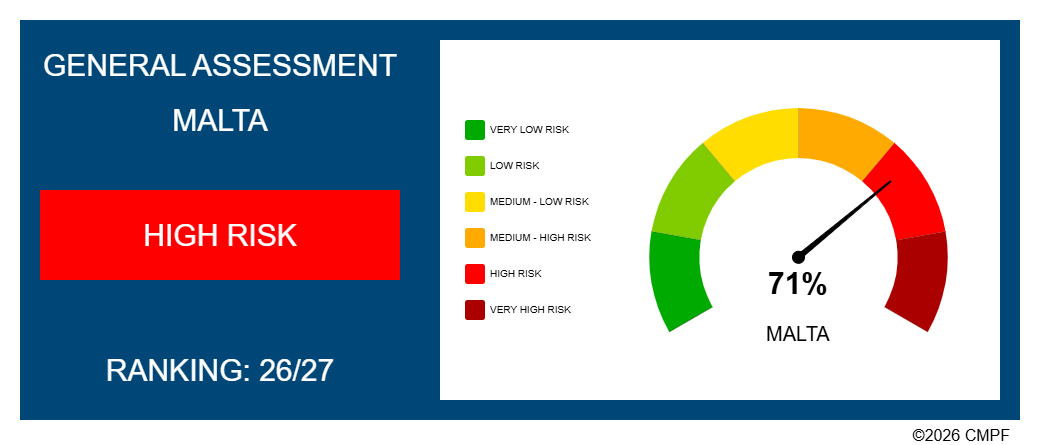
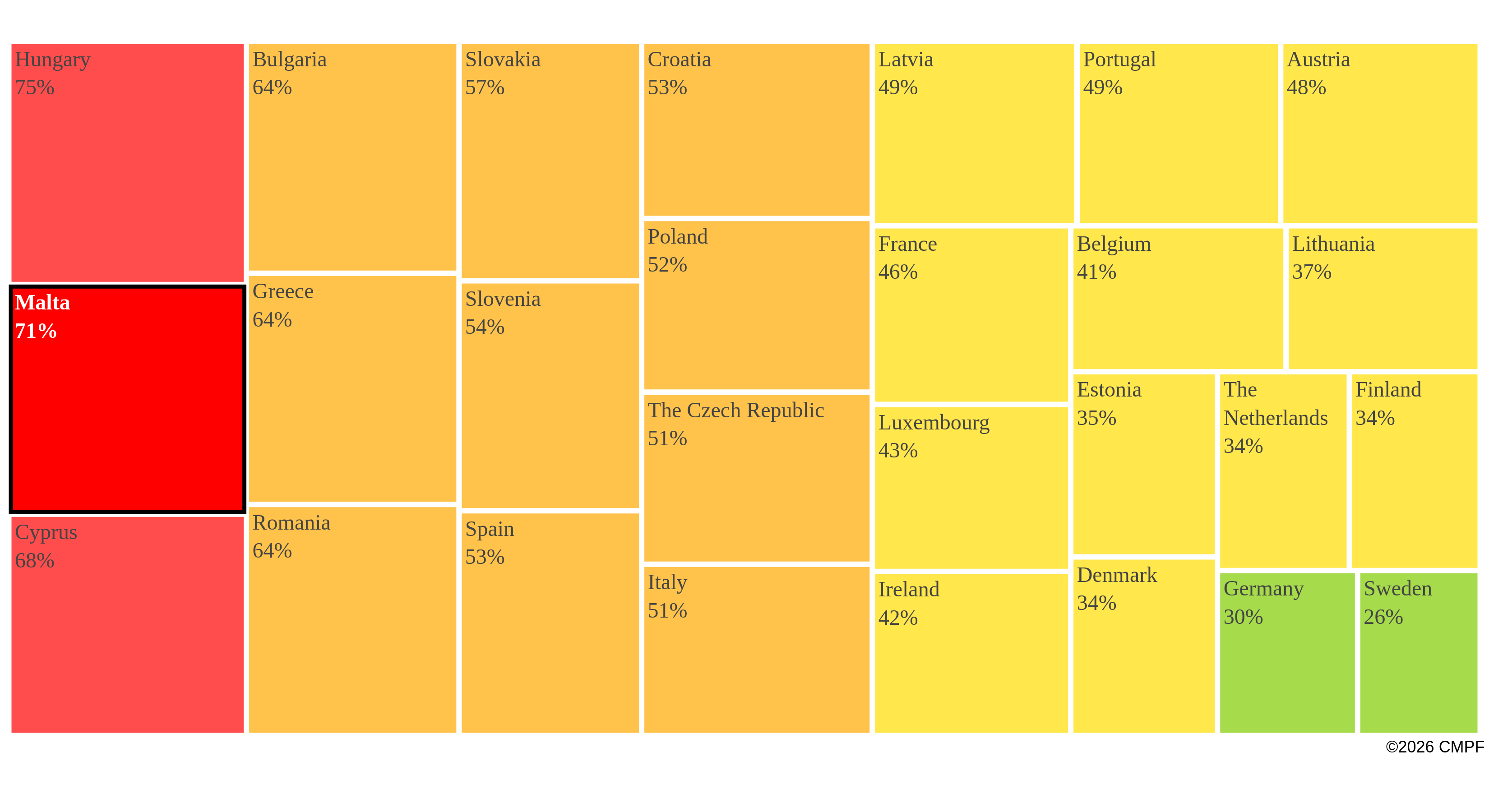
Risk score: 71%
| Fundamental Protection | 59% |
| Market Plurality | 84% |
| Political Independence | 79% |
| Social Inclusiveness | 61% |
In-depth analysis:
Read the full MPM2026 Country report
Country overview
Malta is situated at the southernmost point of Europe and is the smallest European Union member state, measuring around 316km2, with a population of around 574,000 (National Statistics Office, 2025). The country’s political landscape is dominated by the Labour Party (in government since 2013) and the Nationalist Party, despite the existence of a handful of smaller parties. This two-party system impacts Maltese culture and, indeed, the country’s media landscape. Strong partisanship has nurtured an environment in which reporting on corruption is discredited by politicians and their supporters as a “personal vendetta” or “fake news”. Journalists continue to face online and offline threats and harassment, and there are little to no repercussions for the perpetrators, particularly those in high positions of power. Public servants continue to target journalists on social media, and authorities continue to breach the right to freedom of information by failing to handle FOI requests properly. The Maltese government has still not fully implemented the recommendations of the public inquiry into the circumstances surrounding Daphne Caruana Galizia’s 2017 assassination (Balzan, 2025b).
The country’s media environment is marked by the strong presence of institutions; political parties, the church and trade unions own media outlets. Political influence is both direct and indirect. On the one hand, the two dominant political parties own their own media houses, and the public service media is widely considered government-controlled. On the other, the extensive presence of political patronage often permeates into commercial media through sponsored content and, in some cases, curated coverage. This being said, independent media is still strong, despite the unfavourable conditions.
The assassination of investigative journalist Daphne Caruana Galizia continues to leave a dark stain on Malta. Caruana Galizia was murdered on 16th October 2017 for her investigations into high-level corruption. The conclusions of the public inquiry into the circumstances of her assassination were published in July 2021 and included a set of recommendations aimed at the protection of journalists and democracy. However, despite this, and despite continued pressure from international institutions, press freedom and human rights organisations and networks, and civil society, the Maltese government continues to drag its feet on the full implementation of these recommendations. Furthermore, while the government published Legal Notice 175 of 2025 – European Media Freedom Act (Measures for Implementation) Order in August 2025, nothing changed in practice.
Fundamental Protection
Fundamental Protection scored within the medium-high risk band. Key points include the following:
- In 2025, journalists, activists and members of civil society continued to be labelled as partisan or “traitors” of Malta for holding the government to account. Simultaneously, actions that amounted to assaults on activists’ freedom of expression were defended by the Maltese government as “an exercise of freedom of expression” – the key case being when an individual on the public payroll demolished the Valletta protest site calling for justice for Caruana Galizia (including tributes left by a number of foreign dignitaries); in a statement on the matter, the Office of the Prime Minister said that “freedom of expression applies to all” (Meilak, 2025b).
- The 2025 report SLAPPS in Europe: Democracy in the Dock, prepared by the Daphne Caruana Galizia Foundation on behalf of the Coalition Against SLAPPs in Europe (CASE), once again highlighted a major limitation of the Maltese government’s 2024 anti-SLAPP legislation: the law does not cover domestic SLAPP cases. Furthermore, Malta remains the country with the highest number of SLAPPs per capita in Europe (Coalition Against SLAPPs in Europe, 2026).
- The government continues to block information. In March 2025, the prime minister rejected a freedom of information (FOI) request for the publication of ministers’ asset declarations, which Times of Malta filed after the prime minister refused to publish copies of the cabinet’s annual asset declarations, including his own, in parliament (J. Borg, 2025). In retrospect, the prime minister’s refusal to cooperate with the FOI request/s anticipated the government’s push, in March 2026, to formally abolish the submission of ministers’ asset declarations as well as remove obligations for MPs to declare properties solely owned by their spouses (J. Borg, 2026).
- Malta had the Presidency of the Committee of Ministers of the Council of Europe in 2025, and in this capacity it hosted a high-level conference on the subject of building democratic resilience to disinformation. Despite this, the country lacks a national strategy to tackle disinformation and indeed has a major disinformation problem as a result of its highly polarised political environment. Most disinformation centres on the political issues of the day, and on stories that Caruana Galizia was investigating as well as their fallout, and much of it is propagated by the government itself.
- Fighting disinformation remains a grassroots effort, with initiatives being led by news outlets, as well as academic institutions and NGOs. New in 2025 was the Daphne Caruana Galizia Foundation’s investigative platform Amphora Media, which publishes in-depth investigations and a fact-checking series called “Fatti” (“Facts”).
- In 2025, the Institute of Maltese Journalists (IĠM) became a trade union, aiming to regulate the relationship between journalists and their employers in addition to advocating for press freedom, robust self-regulation and professional standards in journalism (The Malta Independent, 2025a).
- The Mapping Media Freedom Project led by ECPMF recorded 13 media freedom violations in Malta in 2025. In most cases, the actors were public officials.
- In June 2025, the men who supplied the bomb used to murder Caruana Galizia were sentenced to life in prison (OCCRP, 2025). These sentences were confirmed in January 2026 when the men lost their appeal (B. Borg, 2026). In February 2025, the man accused of masterminding Caruana Galizia’s assassination was released on bail. The Times of Malta news report read that he “will remain on bail, pending the trail by jury, for which there is no set date” (N. Borg, 2025a).
Market Plurality
Market Plurality scored within the very high risk band. Key issues include the following:
- The law only obliges the media sector to provide ownership details to the Broadcasting Authority, not to the public. Furthermore, this only applies to TV and radio, while print and digital outlets are excluded from this obligation.
- There remains a lack of market data, although surveys conducted and reports published by the Broadcasting Authority provide a general overview of audience concentration. The Authority’s survey has been subject to criticism for its conceptual approach and methodology, particularly for not making a distinction between social media platforms and media outlets (Pace, 2025).
- Many media outlets struggle financially, partly due to increasing competition with Very Large Online Platforms and Search Engines (VLOPSEs). In 2025, Times of Malta introduced a soft paywall on their website (Times of Malta, 2025a).
- Commercial influence remains a problem. Local news media – even leading news organisations – sometimes carry sponsored content promoting figures and organisations that are or have been subject to scrutiny.
Political Independence
Political Independence scored within the high risk range. Key points include the following:
- Political-party-owned media remain a dominant feature of the landscape.
- Although public service media channels and services in Malta have a legal duty of impartiality, they continue to face significant and persistent challenges regarding political independence and fair representation.
- Appointments to the Public Broadcasting Services board, which are the direct responsibility of the Minister in charge, are not transparent. It remains to be seen whether the introduction of the European Media Freedom Act will change this.
- There is no self-regulation structure for news outlets. Meanwhile, broadcast channels are regulated by the Broadcasting Authority, which tends to focus primarily on public service media platforms rather than on political-party-owned outlets.
- The blurred lines between politics and business permeate into the media: some outlets sometimes carry content that some have argued is an exercise of reputation laundering for past or present public servants.
- The allocation of state advertising is not regulated and its distribution is opaque.
Social Inclusiveness
Social Inclusiveness is associated with a medium-high risk score. Key points include the following:
- Accessibility features in audiovisual media are very limited: sign language interpretation is only offered on a few programmes on the public broadcaster, and subtitling is practically inexistent, as is an audio description facility.
- Trolling on social media remains prevalent and the authorities are very slow to act on reports of hate speech. Anonymous Facebook profiles/pages known for spreading hateful content face no apparent action, with cases only being prosecuted when individuals take it upon themselves to seek legal recourse by initiating formal action.
- Little is publicly known about the government-appointed Media Literacy Development Board, set up in 2021. To date, no policy or working paper has been published. Media literacy education in Malta remains a grassroots effort and an optional subject offered at secondary school level, with individual teachers, NGOs and others taking on the onus to improve the country’s poor media literacy and information literacy. The government’s ostensible “effort” to help people understand and appreciate the media through a national media literacy strategy announced in 2026 stands very much at odds with the fact that it fails to do so itself.