

Romania 2026
Media Pluralism Monitor 2026 results
Risk score: 64%
| Fundamental Protection | 45% |
| Market Plurality | 89% |
| Political Independence | 58% |
| Social Inclusiveness | 63% |
In-depth analysis:
Read the full MPM2026 Country report
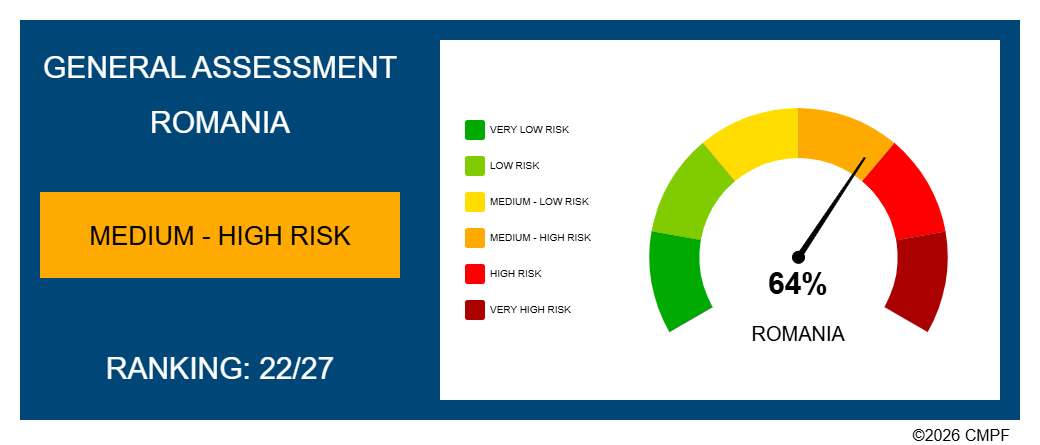
Country overview
After a year of four nationwide elections – European, local, parliamentary and presidential – 2025 was dominated by the rerun of the annulled 2024 presidential elections on 4 and 18 May 2025 and the subsequent reorganization of the government and its legislative coalition. The far-right opposition substantially increased its vote share in both the presidential and the 1 December 2024 parliamentary elections, at the expense of the left-right grand coalition providing the government since 2020 but failed to get a foothold in the dual executive of the semi-presidential system. The most spectacular change in the country’s politics was the emergence of unprecedentedly contentious circumstances regarding the presidential election.
The 24 November first round of the election had been annulled by the Constitutional Court, which found that the electorate’s decision-making had been vitiated by a corrupted online information environment (Całus, 2024). This decision prevented a runoff between Călin Georgescu, a mysterious nationalist far-right and Russia-friendly (Rainsford, 2024) frontrunner, and Elena Lasconi, the broadly liberal leader of the anti-corruption centre-right party USR (Union Save Romania) who unexpectedly defeated multiple major party candidates including the incumbent PM in the race for the second place.
The charges appearing in the court’s ruling were serious and the weakness of the supporting evidence (Iancu, 2025) initially seemed probably explicable by circumstances (though nearly three years later the evidence is still leaving much to be desired for). Yet many felt that political considerations shaped the ruling more than legal substance given the Court’s previous indifference to the National Election Commission inconsistently allowing or denying appearance on the ballot by candidates (Iancu, 2025 and Ilie, 2024), to the NEC’s prior inaction in the face of campaign rule violations by Georgescu, and sudden shifts in the court’s stance on various challenges to the validity of the first round within a short period of time (Całus, 2024). The public perceptions of the elite’s commitment to democracy and the rule of law were further impaired by the long delay in the governing coalition setting the date for the rerun election and unpopular incumbent president Klaus Iohannis’ reluctance to step down and make way to an interim head of state until presented with threats of impeachment for overstaying his welcome.
When the new election was at last called for May 2026, the Electoral Bureau rejected the candidature of Calin Georgescu essentially as someone who, in light of the December 2024 Constitutional Court ruling, did not live up to the normative expectations set in the constitution regarding presidential candidates (Biroul Electoral Central, 2025). George Simion, the leader of the parliamentary party AUR, ran instead as the main flag-bearer of the far-right and had Georgescu’s endorsement. The ruling coalition made up of the Liberal Party (PNL), Social Democrats (PSD) and Hungarian minority party (UDMR), threw their support behind Crin Antonescu, a semi-retired former PNL-leader and 2009 presidential candidate. After the start of the election campaign, the centre-right opposition, i.e. the USR (Union Save Romania Party), withdrew support from Elena Lasconi, and backed instead their previous and more conservative leader, former civic activist, then-mayor of Bucharest, Nicusor Dan, who run as an independent. Dan eventually won the presidential race ahead of Simion and was sworn in on 26 May.
Prior to the 2025 presidential elections, some tweaks to the regulation of political campaigning online were introduced prior to the 2025 presidential elections, requiring that all forms of sponsored political content be labelled. During the election campaign, there were continued efforts to influence public opinion online through unmarked sponsored content and coordinated inauthentic behaviour on social media, and on television – the main source of news and public affairs information for most Romanians – the coverage of many channels had various political biases (depending on the channel’s leaning) and a scarcity of substance. There were still problems related to information accuracy including full and clear signalling of candidate paid content especially on social media platforms but also on television and in online media. Otherwise, however, the election by and large complied with basic contemporary democratic standards and even included televised debates where all main candidates participated (OSCE 2025).
Following the presidential elections, a broader “pro-European” coalition government was formed. It was backed by all parliamentary parties except the nationalist populist AUR, SOS and POT parties. Ilie Bolojan, the PNL leader who served as acting President until the May presidential election, was voted in as the first Prime Minister, with a PSD (Social Democratic) PM planned to succeed in 2027, similar to the rotation in the previous PSD-PNL grand coalition (2021 – 2025).
The Bolojan government programme includes a reference to reforming public service media funding in the context of broader cultural policy institutional reviews and the planned reduction of “pressure on the state budget.” However, no legislative changes were made or started regarding PSM independence. Neither any legislation on nationwide media literacy plans, included in the National Security Strategy, nor the expected legislation to prevent Strategic Litigation Against Public Participation were adopted in 2025.
In August 2025, the audiovisual regulator (National Audiovisual Council – CNA) adopted a new Audiovisual Code, which includes much awaited provisions including some definitions – disinformation, harmful content, content creator – that could, in the long run, have significant impact.
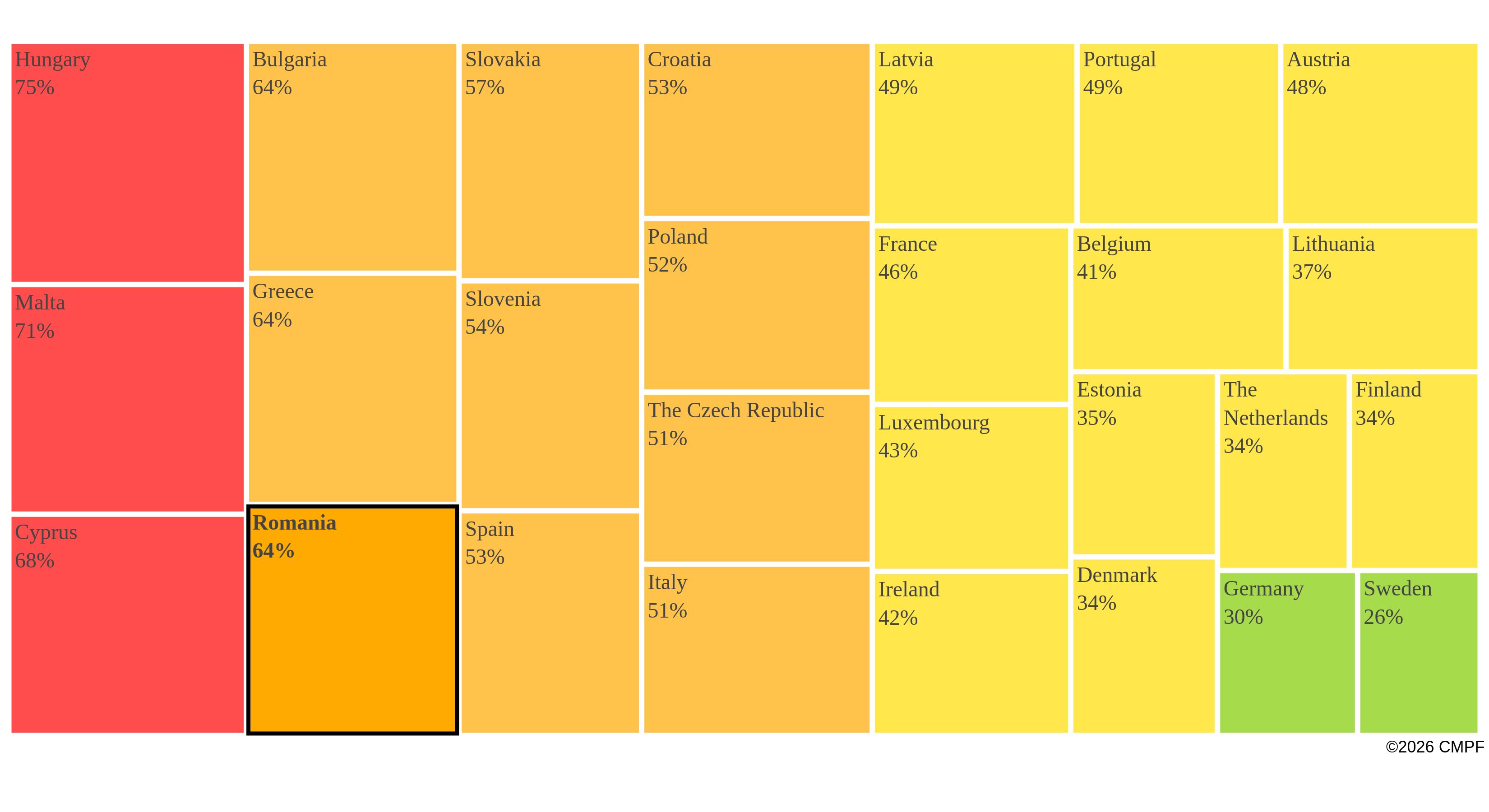
Fundamental Protection
The Fundamental Protection area registered a medium-low risk score in 2025. Key points:
- The state’s approach to risk reduction in the online information environment is marked by a trend towards securitization, which in turn increases the risks of excessive restrictions of freedom of information and expression.
- When violations of freedom of expression occur, accessing legal remedies may require significant resources, as evidenced by lengthy court proceedings and the fact that Romania lags behind other countries in enforcing European Court of Human Rights (ECHR) decisions.
- Continued risk factors include the lack of regulation and self regulation in some areas. The European Union directive regarding Strategic Lawsuits against Public Participation (SLAPP) has not yet been transposed in Romania.
- There are also insufficient labor protections for those exercising the journalistic profession.
Market Plurality
The Market Plurality area registered a very high risk score in 2025. Key points:
- Only audiovisual media companies are bound by more extensive and media-specific disclosure obligations regarding ownership transparency.
- There is no media-specific regulation regarding concentration in the digital or print field or across different sectors of the media market.
- There are significant gaps in the data available on key aspects of the media market (e.g. revenues), in particular the digital media market.
- There are no regulations to protect journalists and newsrooms from arbitrary dismissals or demotions, in cases of changes in media company ownership or editorial direction.
Political Independence
The Political independence area risk score qualified as medium-high in 2025. Key points:
- There is a lack of regulations preventing political control and conflicts of interest in media ownership.
- With regard to the repeat election in 2025, while independent observers saw commercial media coverage as rather biased, public television coverage was seen as impartial but was also less likely to be watched, due to the low appeal of the channel. Online, monitoring organizations reported continued problems with coordinated inauthentic behavior and unmarked political advertising.
- There has been no further progress towards rethinking the governance and oversight of the public broadcaster and radio, and the 2025 dismissals and appointments of the leaders of these PSM played out in the traditional fashion, with the decision-making process playing out behind the scenes prior to the nominations and with little-to-no discussion of nominee strategies, qualifications or objectives for the next few years and no retrospective look at the out-going leadership.
Social Inclusiveness
The Social Inclusiveness area registered a medium-high risk score in 2025. Key points:
- The new Audiovisual Code adopted by the audiovisual regulator CNA includes new accessibility standards for broadcasters to meet, standards that progressively get higher each year starting 2026.
- At the public broadcaster and public radio, there is no specific, dedicated diversity policy in the sense of a programmatic document or a code of practice dedicated to diversity alone. Most commercial broadcasters we examined do not have a diversity policy – and if they do, it refers to recruitment and internal organization.
- The spotty evidence available points towards a small amount of locally-relevant public interest information being provided by a small number of sources.
- There is increasing attention given to media literacy in strategy documents and speeches from representatives of central government institutions, but the policies have not changed in the past year.