

The Czech Republic 2026
Media Pluralism Monitor 2026 results
Risk score: 51%
| Fundamental Protection | 36% |
| Market Plurality | 74% |
| Political Independence | 35% |
| Social Inclusiveness | 61% |
In-depth analysis:
Read the full MPM2026 Country report
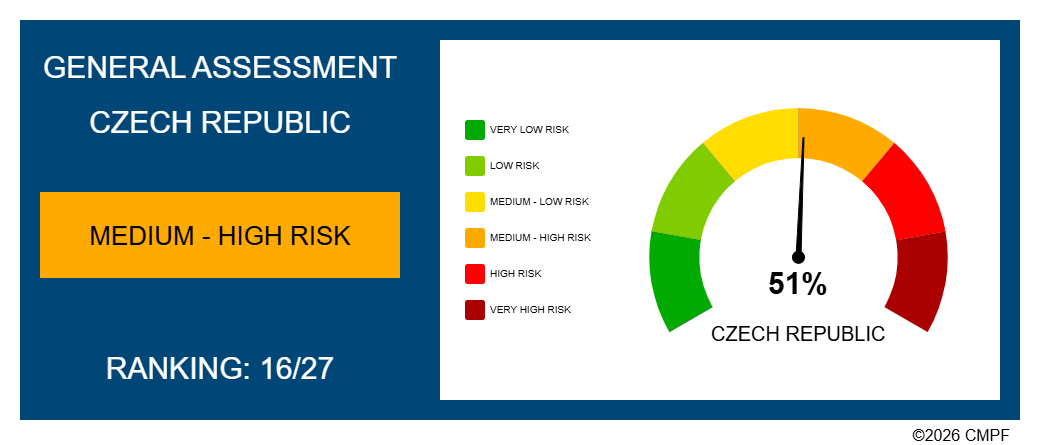
Country overview
The political landscape in 2025 was shaped by the parliamentary elections held in October, with the campaign influencing both the political and media environment for much of the year. The elections resulted in a change of government, as the populist ANO 2011 movement, led by billionaire and former media owner Andrej Babiš, returned to power. This time, it formed a governing coalition with two other populist parties, SPD (Freedom and Direct Democracy) and Motorists for Themselves, both of which regularly promote far-right rhetoric and take highly critical stance towards the EU, Ukraine, and public service media, particularly Czech Television.
In 2025, the Czech economy grew by 2.6%, narrowly surpassing inflation (2.5%) and ranking among the EU’s more dynamic economies. However, these relatively favourable macroeconomic conditions were not reflected evenly across the media sector. While the online advertising market maintained strong momentum – reaching an estimated CZK 70.7 billion in 2025, representing a year-on-year increase of approximately 10.6% (SPIR, 2026) – print media continued to struggle with structural challenges, including declining circulation (–9.6% year-on-year) and subscription revenues (–8.3%) (MediaGugu.cz, 2026). One of the most notable developments in the media market was the transfer of a 50% stake in one of the leading media houses, Mafra (previously owned by PM Andrej Babiš), from the Kaprain Group to Pavel Tykač, an energy tycoon and one of the country’s wealthiest individuals.
The adoption of legislation implementing key European media frameworks – namely the Digital Services Act (DSA) and the European Media Freedom Act (EMFA) – has been further delayed. Although the respective implementing laws were approved by the previous government, their passage through Parliament is facing opposition from the current governing parties, rendering the timeline for their adoption uncertain. The key legislative development was therefore the adoption of Act No. 234/2025 Coll. (Act on Election Campaigns), in October 2025, to implement Regulation (EU) 2024/900 on political advertising transparency and targeting, introducing clearer rules on disclosure, targeting, and data protection for political actors and advertising providers.
The end of the year brought heightened concern over the future of Czech public service media, following the new government’s announcement that it intends to abolish the license fee – which were only increased in May 2025 after a two-decade freeze. The plan to eliminate the fee and replace it with direct state funding, which Prime Minister Babiš indicated could be implemented as early as 2027, has been widely interpreted as an attempt to undermine the financial sustainability and political independence of public service media, and has drawn criticism from both domestic and international media organizations (EBU, 2026).
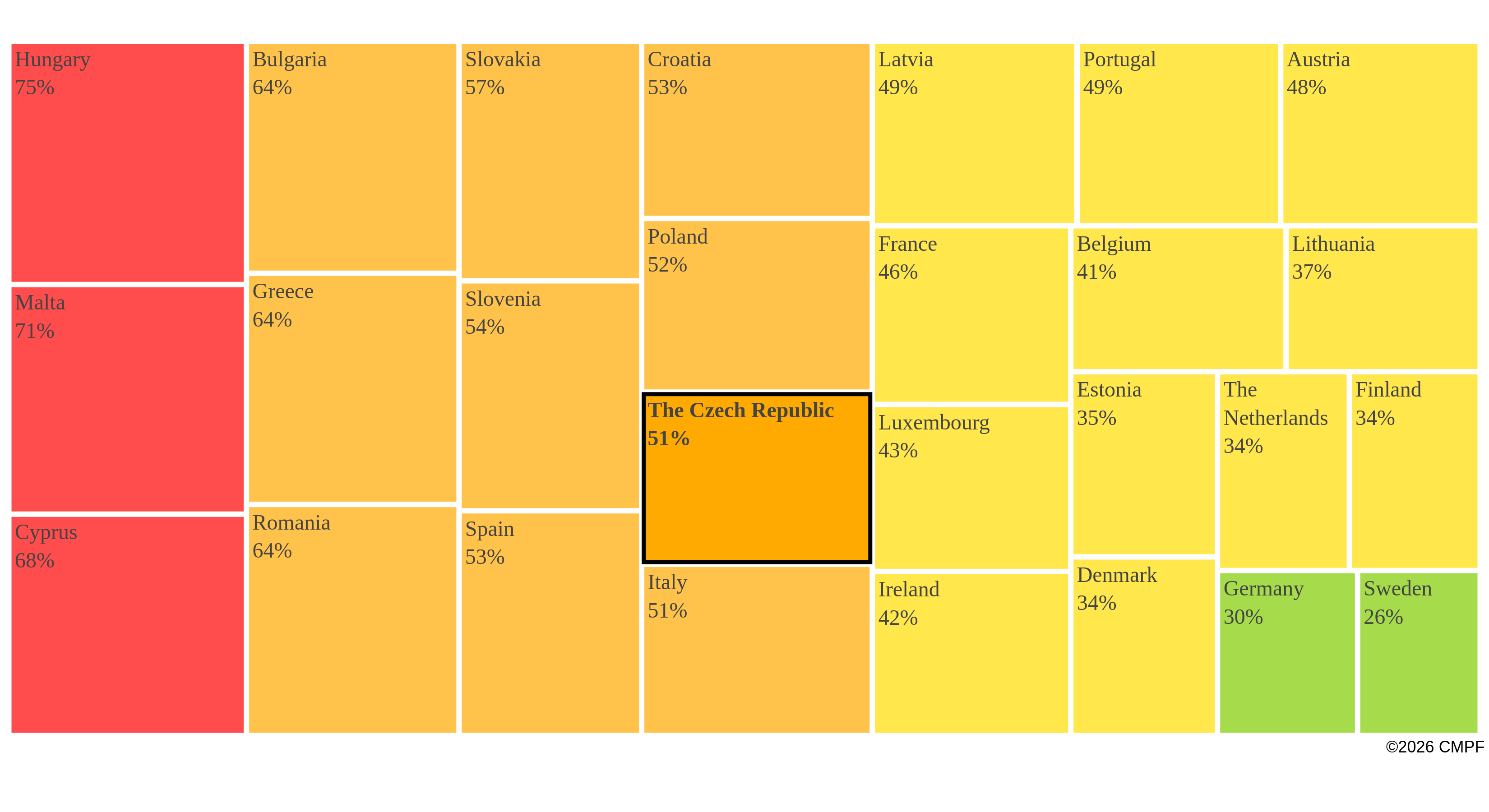
Fundamental Protection
The Fundamental Protection area displays a medium-low level of risk. Key points include:
- The digital environment continues to pose significant risks, including online attacks against journalists, culminating in coordinated campaigns targeting high-profile female journalists – some of which have been amplified by politicians in public discourse.
- A further key concern is the lack of transparency in content moderation, combined with the unchecked spread of disinformation on major online platforms. Reports of fake TikTok accounts interfering in the campaign ahead of the October 2025 Parliamentary Elections prompted a response from the authorities.
- Verbal attacks by politicians and public officials against media outlets and journalists have intensified, renewing concerns that media plurality in the country may face a new wave of political pressure following the October elections, in which parties advocating restrictions on public service media financing secured a majority.
- Czechia has yet to transpose the Digital Services Act into national legislation.
Market Plurality
The Market Plurality area shows high level of risk. Key points include:
- Deterioration in transparency of media ownership, linked to restricted public access to beneficial ownership data and the absence of media-specific transparency provisions.
- Persistently high concentration of media ownership across offline and online markets, combined with limited effectiveness of the regulatory framework in addressing consolidation.
- High concentration in digital markets, driven by the dominance of global platforms such as Google and Meta, as well as the strong position of major media groups in the online news segment.
- Continued risks to editorial independence stemming from conflicts of interest related to concentrated media ownership and the broader economic activities of media proprietors.
- Economic viability of the media sector remains under pressure, particularly affecting local and regional media.
Political Independence
The Political Independence area displays medium-low level of risk. Key points include:
- Political control over local and regional media remains a concern, with continued blurring of the line between journalism and political PR in some outlets.
- While editorial autonomy shows some improvement due to recent self-regulatory initiatives, it continues to be undermined by the absence of a widely recognised and effective independent self-regulatory framework.
- A lack of transparency of state advertising. The fragmented disclosure practices and the absence of a coherent legal and methodological framework, limit effective oversight of public spending on media services.
- The absence of a comprehensive framework for state support to the media sector, despite repeated calls for structured and transparent mechanisms from experts and industry stakeholders.
- Increasing risks to the independence of public service media, linked to political pressure on governance structures and uncertainty surrounding the future funding model.
Social Inclusiveness
The Social Inclusiveness area fell within a medium-high risk band. Key points include:
- Public service media content still lacks guaranteed prominence across platforms, as the transposition of Article 7a of the Audiovisual Media Services Directive (2018/1808/EU) remains incomplete and continues to face resistance from commercial broadcasters concerned about protecting their audience share and advertising revenue.
- Independent local and regional journalism is weakening, with many areas effectively becoming local “news deserts,” and municipalities relying on dependent, municipally funded outlets rather than editorially independent media.
- Minority representation in public service media remains uneven: while some groups benefit from dedicated formats, larger communities, such as the Vietnamese minority, still lack comparable tailored programming.
- Online hate speech remains widespread; despite a strengthened legal framework, enforcement is inconsistent, underreporting persists, and the current mix of reporting channels remains fragmented and underused.
- Women remain significantly underrepresented in management positions, within media regulatory bodies, and among expert guests in major news and political discussion programmes.