

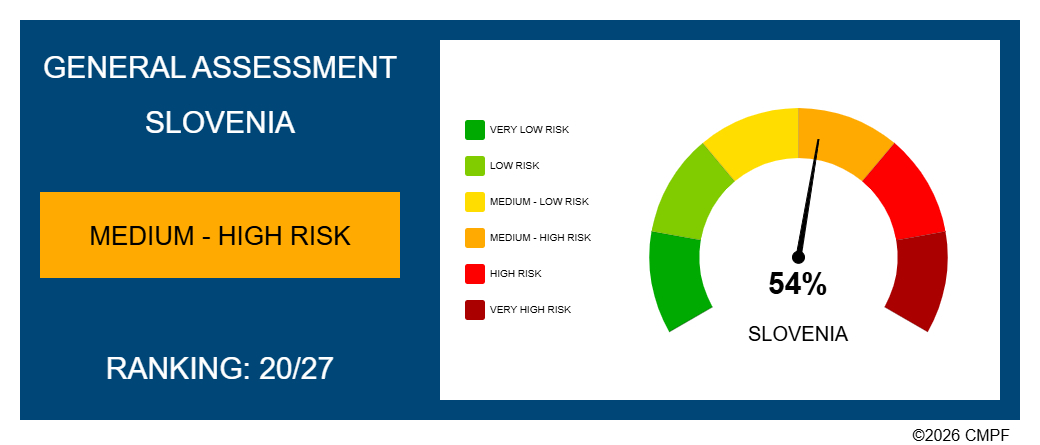
Slovenia 2026
Media Pluralism Monitor 2026 results
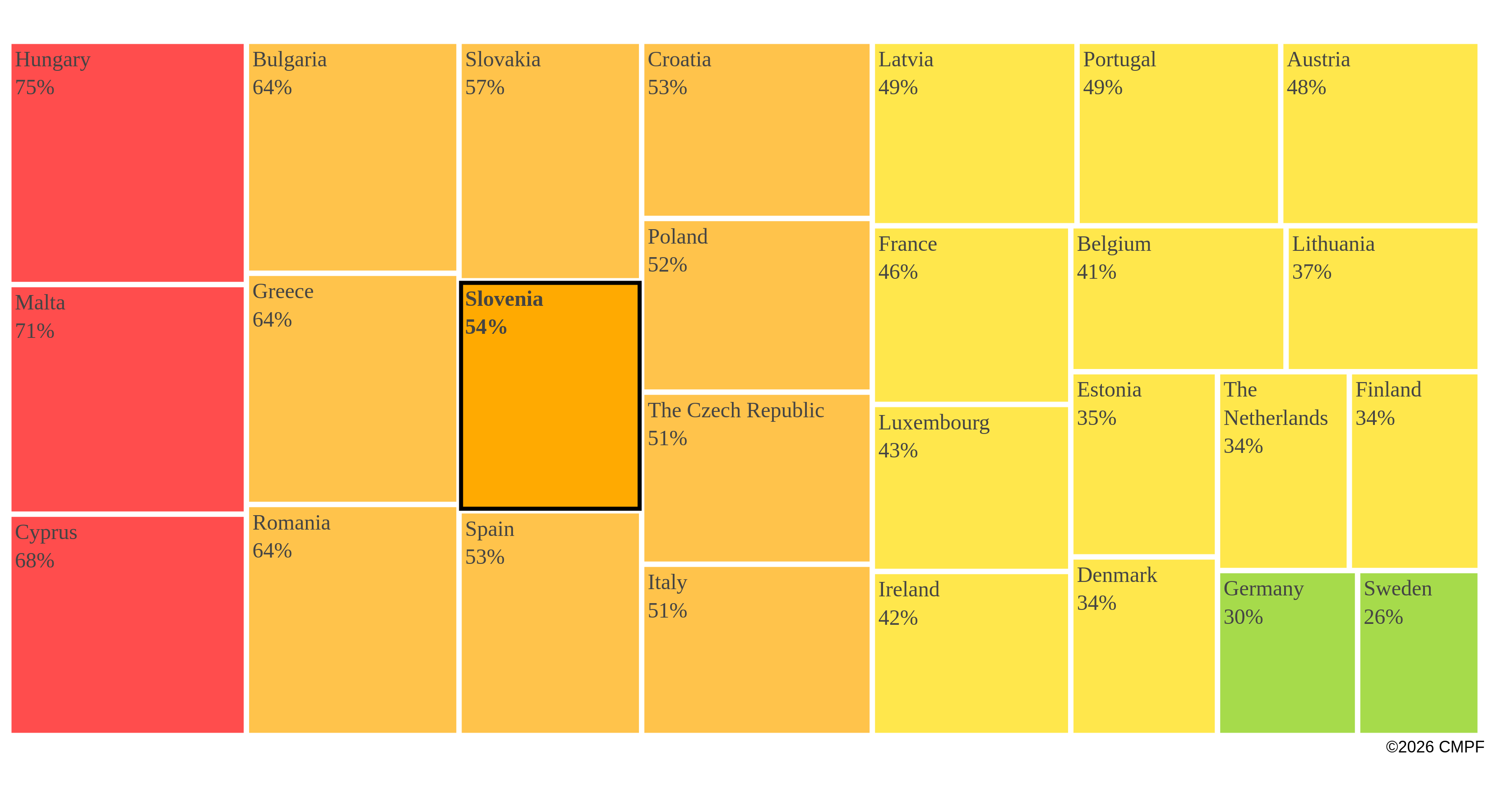
Risk score: 54%
| Fundamental Protection | 42% |
| Market Plurality | 75% |
| Political Independence | 51% |
| Social Inclusiveness | 50% |
In-depth analysis:
Read the full MPM2026 Country report
Country overview
In 2025, the Slovenian media landscape was marked by changes to several media-related laws, some of which were adopted with limited public consultation, prompting criticism from certain stakeholders. The main development was the adoption of the new Mass Media Act (ZMed-1) in September. The law, implementing aspects of the European Media Freedom Act (EMFA), introduced changes in areas including ownership and financing transparency, state advertising, procedures for assessing media concentration, funding schemes, media content partly or fully generated with generative AI systems, and protection of journalists (Ministrstvo za kulturo, 2025b).
Its full implications, however, remain to be seen, and the law has been criticised for lacking safeguards against potential abuse by governments (Reporters Without Borders, 2025). The law also extends certain obligations to public-facing communication, including influencer activity, covering conflicts of interest, harmful incitement, child protection, and rules on advertising, sponsorship, and product placement.
In October, the National Assembly adopted the Act on the Implementation of the Regulation (EU) laying down harmonised rules on artificial intelligence (ZIUDHPUI), establishing the legal basis for the implementation of the EU’s harmonised rules on artificial intelligence. In December, the Act on Radiotelevizija Slovenija (ZRTVS-1) was amended to provide state-budget funding for minority programmes and music production. The change also aimed at strengthening RTV Slovenia’s financial planning, although it did not index the licence fee to inflation, which was criticised as a “missed opportunity for stable financing of public media” (G. C., M. Z., A. K. K., 2025).
The Government also approved anti-SLAPP legislation, based on the EU Anti-SLAPP Directive, and a new law on the Slovenian Press Agency (STA) aimed at reinforcing STA’s financial and institutional independence. Both proposals were subsequently adopted by the National Assembly in 2026 as the Act on Protective Measures against Strategic Lawsuits against Public Participation (ZZUSTOJU) and the Act on the Slovenian Press Agency (ZSTAgen-1).
Concerns regarding media pluralism nevertheless persisted. While the country improved its position in the World Press Freedom Index, journalists and journalistic associations warned that the media landscape remains problematic (STA, 2025). The media market continues to show signs of economic strain, particularly in the print sector, which was illustrated in 2025 by further layoffs at newspapers Večer and Delo and the closure of Delo’s correspondent office in Koper.
The country also records particularly low levels of trust in news media: only 26.3% of the population trusts the news media, well below the OECD average of 38.9% (OECD, 2026). Further concerns relate to the continued prevalence of SLAPPs and online harassment, restrictions and pressures affecting access to information and reporting, persistent concentration risks in both the media and digital markets, media ownership transparency, stable financing, effectiveness of regulatory authorities, and political independence of media outlets.
Fundamental Protection
The Fundamental Protection area scored within the medium-low risk band. Key points include:
- SLAPP cases against journalists and media outlets remained frequent. The Government approved a proposal to transpose the EU Anti-SLAPP Directive, with the proposal later being adopted by the National Assembly in 2026.
- Concerns persist about the independence of AKOS’ main bodies, given the Government’s role in appointing its leadership (Civil Liberties Union for Europe, the Peace Institute, 2025).
- Although no killings, arrests or physical attacks on journalists were recorded in 2025, the overall climate remained hostile, especially online (Hanitzsch et al., 2025).
- Journalists continued to face lengthy access-to-information procedures, selective refusals to answer questions, and pressures linked to data-protection rules (M. Z., 2025; Council of Europe, 2025).
Market Plurality
The area of Market Plurality scored within the high risk band. Key points include:
- The Mass Media Act (ZMed-1) introduced stronger transparency obligations regarding ownership, financing, and public funding, but their effects remain to be seen.
- Media viability remained under pressure, reflected also in indications of financial strain in the print sector (A. S., G. K., 2025).
- In the digital sphere, Slovenia lacks national measures to rebalance bargaining power between publishers and platforms, and there is no publicly available information on systematic agreements with digital intermediaries or generative AI providers.
- Editorial independence remains insufficiently protected against commercial and owner influence, with hidden advertising, blurred boundaries between editorial and commercial content, and broader cross-sector ownership raising concerns (AKOS, 2025b; Društvo novinarjev Slovenije, 2025d).
Political Independence
The area of Political Independence scored within the medium-high risk band. Key points include:
- Risks related to political influence, conflicts of interest, and politically affiliated media networks remain (Civil Liberties Union for Europe, the Peace Institute, 2025) and were further reinforced by the findings of the parliamentary inquiry on alleged misuse of public funds to support politically connected media outlets (Al. Ma., 2025b).
- While the Mass Media Act (ZMed-1) introduced new rules on state advertising and media support, its practical implications remain to be seen.
- The Mass Media Act (ZMed-1) also defines political advertising, however, the national implementing act for Regulation (EU) 2024/900 on the transparency and targeting of political advertising had not been adopted by the end of 2025.
- Concerns persist over the absence of licence-fee indexation in the amendments to the Act on Radiotelevizija Slovenija (ZRTVS-1) (G. C., M. Z., A. K. K., 2025).
Social Inclusiveness
The area of Social Inclusiveness scored within the medium-low risk band. Key points include:
- The continued prevalence of hate speech in public and online discourse remains a significant issue (Ženski lobi Slovenije, 2025).
- Media literacy is still only weakly embedded in the compulsory curriculum, and significant needs remain in the population’s information and data literacy skills (European Commission, 2025; Eurostat, 2026).
- Local, regional and community media continue to rely mainly on project-based public support, while legal recognition of community media remains limited (Hanžič, 2025; Zaniuk, 2025).
- Women continue to be underrepresented in media content and among expert sources (JK, STA, 2025; ONA VE, 2025), and they hold a minority of top editorial positions in a sample of the largest outlets across media sectors.