

Serbia 2026
Media Pluralism Monitor 2026 results
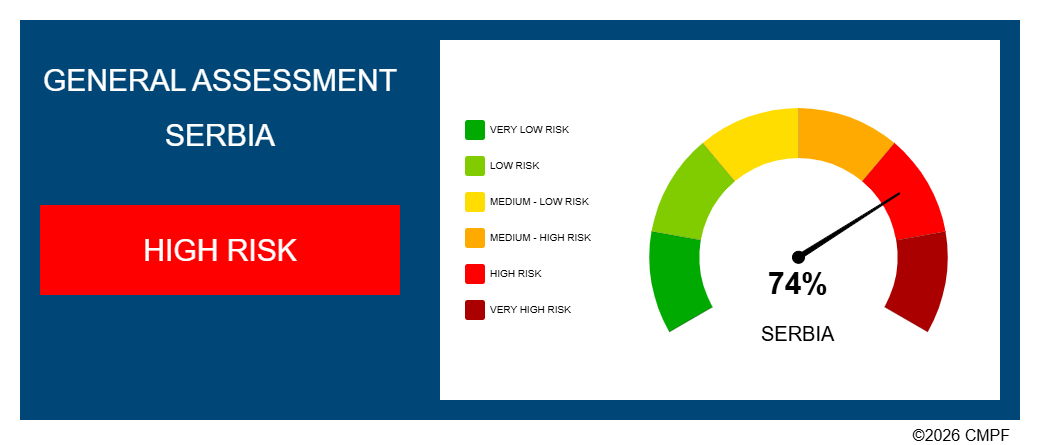
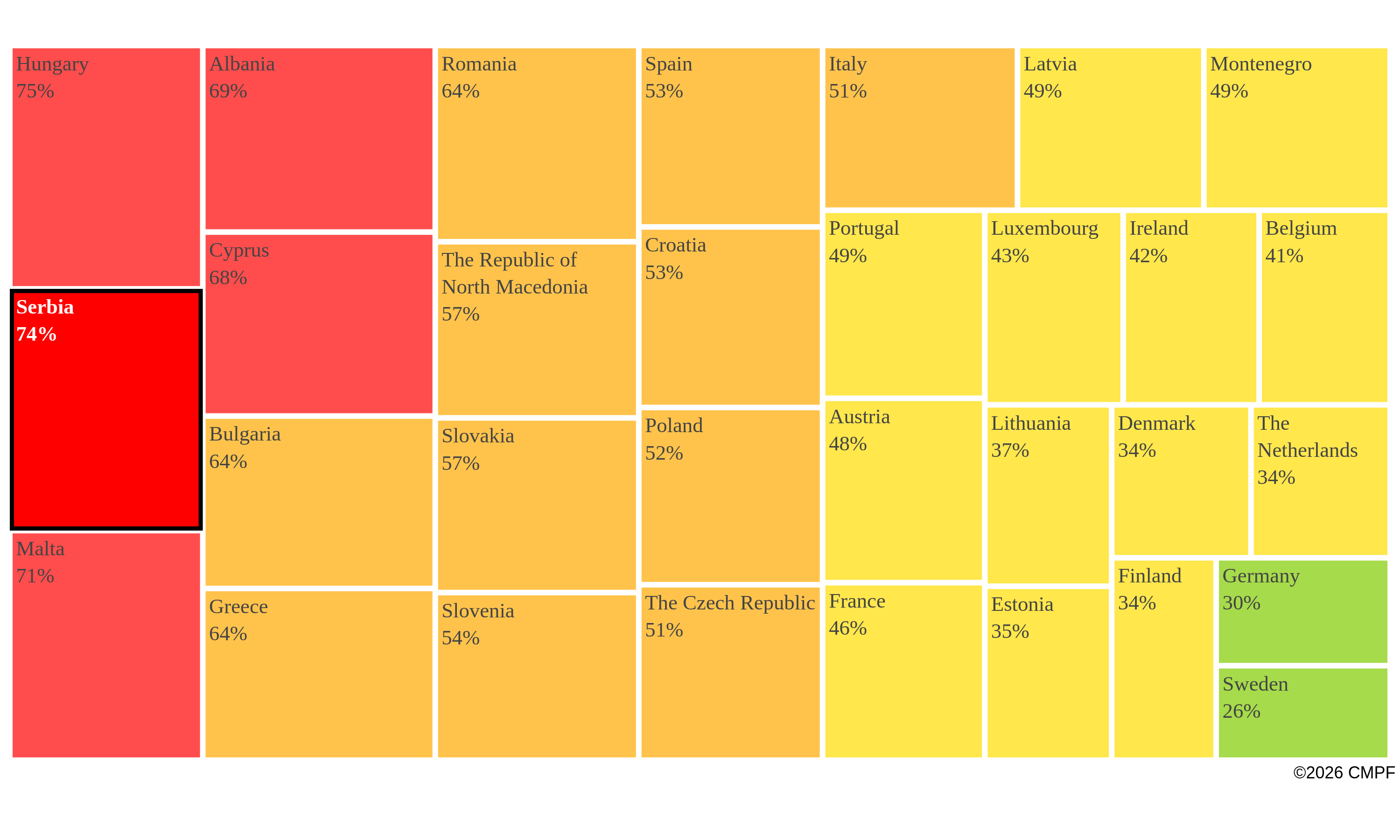
Risk score: 74%
| Fundamental Protection | 69% |
| Market Plurality | 74% |
| Political Independence | 81% |
| Social Inclusiveness | 74% |
In-depth analysis:
Read the full MPM2026 Country report
Country overview
The escalation of physical assaults on journalists, coupled with intensifying institutional repression and unlawful digital surveillance, signalled a sharp deterioration in Serbia’s media environment in 2025.
The amendments to the media-related laws (the Law on Public Information and Media – LPIM and the Law on Electronic Media – LEM) were rushed without prior public debate, amidst severe anti-government protests in June 2025. The amendments to the Law on Public Service Media (LPSM) failed to resolve the fundamental issue of the PSMs’ political and financial independence in practice (Babić, 2026: 5-7; Stojković, 2026).
Then, in November, the competent Ministry initiated the formation of working groups tasked with carrying out the media laws “reform”, under the alleged aim of harmonizing national regulations with the European Media Freedom Act (EMFA). However, this non-inclusive and non-transparent process has suffered from absence of democratic foundations and exclusion of public debate. An attempt to appoint members of the REM Council (the media authority) failed again at the end of 2025, mostly due to a violation of the law by the ruling Parliamentary majority, leaving the media sector without a main regulatory authority for more than a year.
Social media as free platforms for spreading uncensored news, proved to be particularly important during the 2025 political crisis, while mainstream media were subjected to increased political control. The government’s efforts to eliminate the remaining critical media from the United Media Group have come to light, thanks to a leaked recording of the phone conversation (MFRR, 2025). International observers warned that this escalation posed a direct challenge to the commitments of Serbia under European Union accession frameworks.
Fundamental Protection
The Fundamental Protection area scores a high risks for the first time since the MPM has been implemented in Serbia. Key points include:
- Violence against journalists has escalated sharply, especially against reporters who covered civic protests and blockades. Journalists were frequently obstructed in their work by law enforcement officers, and a climate of the impunity of perpetrators was fostered at the highest state level (RsF, 2025).
- Freedom of expression dramatically eroded because journalists, activists and academics who voiced support for anti-corruption protests were targeted, threatened, harassed, and accused by government and loyal media of orchestrating demonstrations as part of a foreign-backed agenda.
- The risks of a non-regulated mass-surveillance have raised. The misuse of personal data of students, journalists, and activists who participated in the anti-government protests intensified, while the illegal surveillance of phones and the use of spyware had no legal outcome.
- Although strategic lawsuits against public participation (SLAPPs) pose an increasingly serious barrier to investigative journalism, Serbia’s legal framework still lacks dedicated anti-SLAPP provisions aligned with international freedom of expression standards.
- Online platform moderation has been highly questionable, ranging from a lack of clear regulation to a wide range of issues arising from the absence of intervention.
- Although the state did not impose direct restrictions on the Internet through content filtering or removal, a marked surge in disinformation flows across both traditional media and digital platforms is noted (FakeNews Tracker, 2025).
- The exercise of the right of access to information has continued to deteriorate with an institutional obstruction, but the Law on Free Access to Information of Public Importance has still not been amended according to the GRECO recommendations.
- The legal framework on whistle-blower protection remains misaligned with the EU acquis, and the whistle-blowers who choose to report publicly are frequently confronted with extensive administrative obstacles.
- Serbia remains without a functional Council of the REM (Regulatory Authority for Electronic Media), following the resignations of its members who pointed to legal irregularities and manipulation by the ruling majority in the 2025 election process.
Market Plurality
The Market Plurality area is associated with a steadily high risk. Key points include:
- Current regulations do not stop hidden ownership or undisclosed links between media owners and political actors. Public registries still fail to ensure full ownership transparency, as beneficial owners often remain concealed behind subsidiary companies.
- The lack of comprehensive financial information on specific horizontal markets such as television, internet, print and radio serious obstacle to achieving transparency in media ownership.
- National legislation lacks mechanisms to guarantee that media service providers make their ownership details readily available to the public. As a result, many providers fail to present current ownership information in a clear and easily accessible way to their audiences.
- While the cable operators’ market landscape further concentrated, the 2025 amendments to the media laws have not addressed the shortcomings in terms of the regarding competitive safeguards.
- The national legislation does not establish rules based on transparent, objective, proportionate and non-discriminatory criteria, to assess the impact of media market concentrations on media pluralism and editorial independence.
- There are still no legal initiatives addressing the financial ties between publishers and online platforms or technology companies. Likewise, no copyright-related financial agreements exist between digital intermediaries and media providers, nor are there established rules or practices concerning the use of AI models.
- Serbia continues to lack objective and reliable systems regarding audience measurement and monitoring.
- Leading media owners in Serbia maintain significant investments outside the media sector, which creates persistent challenges for newsroom independence. Editorial autonomy is undermined by pressures to protect these external business interests, often through accommodating political actors and clients whose support is vital for sustaining non-media ventures.
Political Independence
The Political Independence area is the most endangered among the four assessed areas, with a high-risk score. Key points include:
- The gravest threats to the public interest in media stem from entrenched clientelist networks linking media company owners with political authorities. These ties extend also beyond the national level, including international actors.
- The ruling elite’s political influence has shaped appointments and dismissals of management and editors-in-chief in several media outlets. The cases of Euronews Serbia and United Media in 2025 highlight the fragility of editorial autonomy, showing how ownership changes and outside actors can dictate editorial practice.
- Contrary to the recommendations of the ODIHR, a persistent bias of both the public broadcasters and commercial media in favour of the authorities was observed during the 2025 local electoral campaigns.
- A significant regulatory gap persists in ensuring transparency and accountability in the electoral process, particularly regarding expenditures in political campaigns conducted through social media platforms.
- State support to the media has failed to fail to produce positive and proportionate effects for their sustainability. Pro-government and tabloid outlets remain the primary beneficiaries of public funds, while funds were denied to the media that regularly reported on the 2025 protests.
- State advertising continues to operate in a grey zone, where public money is distributed without transparency, fairness, or accountability, becoming one of the most entrenched mechanisms of media control.
- Despite recent amendments to the Law on Public Service Media, the structural deficiencies undermining the autonomy of Serbia’s public broadcasters remain unresolved. Pressures from the ruling party intensified throughout 2025, while reporting continued to display a bias favouring the governing majority. On the other hand, protests and blockades were relativized or condemned, while the voices of participants were conspicuously absent.
Social Inclusiveness
The Social Inclusiveness area is situated within a high-risk band. Key points include:
- While public broadcasters provide somewhat better-disposed coverage of minority communities compared to private outlets, their interests remain insufficiently addressed.
- Access to information remains inadequate for persons with disabilities, while the national regulatory authority (REM) does not enforce its monitoring obligations in this regard.
- The funding of minority media outlets, particularly those overseen by national councils, remains subject to political influence. This undermines their independence and contributes to an unequal distribution of resources.
- Although Serbia’s legal framework on hate speech is well established, sanctions remain rare across both online and traditional media. The 2025 political crisis triggered a sharp escalation of hateful discourse, targeting political opponents as well as ethnic and gender groups.
- Serbia still lacks appropriate regulation defining the role of online intermediaries in limiting hate speech. Social media platforms rarely remove hateful content, even when it is reported.
- Ahead of the 2026 local elections, supporters and members of the ruling SNS party acquired financially troubled local media outlets in several municipalities. Following these purchases, editorial policies were adjusted to align with political interests, undermining independence and pluralism.
- The problem of news deserts in Serbia is worsening, marked by declining quality, relevance, and diversity of local information. Most local outlets remain under direct or indirect control of local authorities, producing content with tightly managed topics that restrict pluralism and independent reporting.
- Women remain underrepresented in news and current affairs broadcasting across pro-government and independent outlets, in both public service and commercial media, as well as traditional and cable broadcasters.
- Media literacy in Serbia remains underdeveloped compared to EU standards and practices. It is treated largely as an optional subject rather than a mandatory component across all levels of formal education.