

Lithuania 2026
Media Pluralism Monitor 2026 results
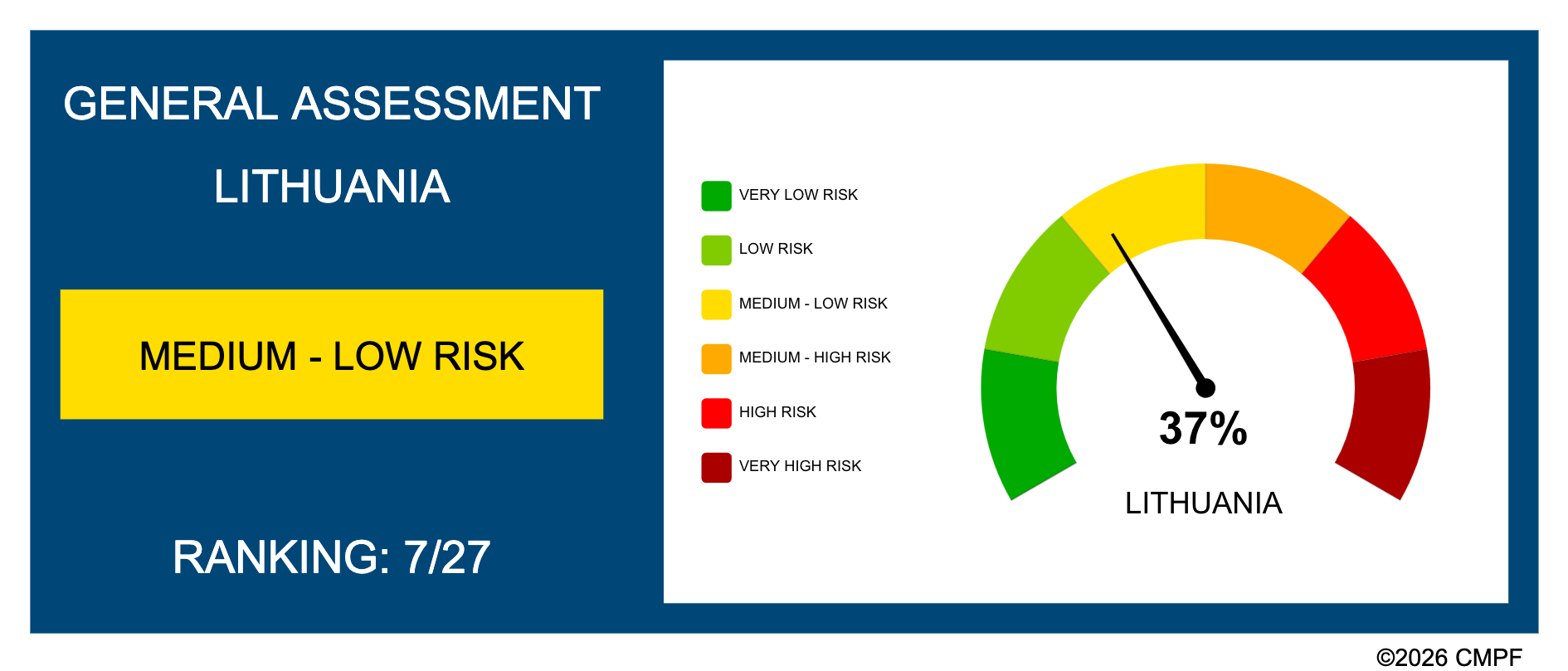
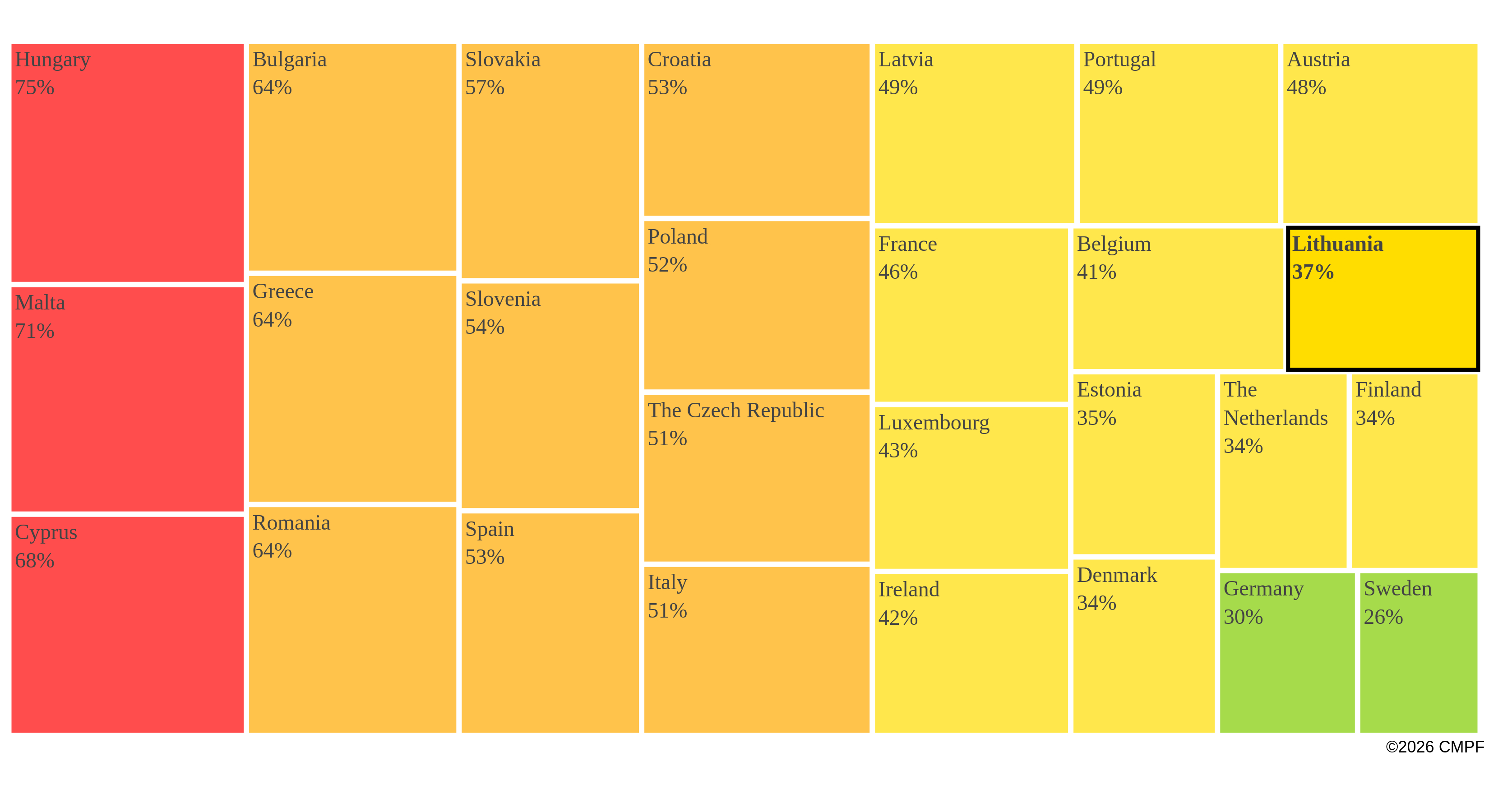
Risk score: 37%
| Fundamental Protection | 23% |
| Market Plurality | 56% |
| Political Independence | 29% |
| Social Inclusiveness | 39% |
In-depth analysis:
Read the full MPM2026 Country report
Country overview
In August 2025, the ruling coalition in the Parliament was reformed. It was composed of the Lithuanian Social Democratic Party, Nemunas Dawn, and the Lithuanian Farmers and Greens Union. In September 2025, a new Lithuanian Government was approved, replacing the previous one, which had been in office for less than a year. In 2025, Lithuania approved tax and pension fund reforms and adopted a record-breaking 2026 defense budget, amounting to 5.38% of the gross domestic product (Infolex, 2025).
At the end of 2025, the Lithuanian Parliament froze the 2026-2028 allocation to the Lithuanian national radio and television (LRT) from the state budget at the 2025 level. The adopted amendment to the law also established that, starting from 2029, the level of funding (using the formula applied from 2015 to 2025) will be relatively reduced (BNS, Balčiūnienė, 2025). In this way, the financial model that had existed for a decade, which guaranteed LRT’s financial independence and tied LRT’s income to the state of the economy, was violated.
In late 2025, the ruling coalition of political parties proposed an amendment to the Law of Lithuanian National Radio and Television (2025) that would make it easier to dismiss the LRT Director General from office. The draft law was considered urgently in parliament. This sparked strong disagreement among opposition parties in parliament and prompted massive public protests (BNS, 2025). The urgent consideration of the draft law was suspended and postponed to 2026. In January 2026, the European Parliament adopted a resolution on the attempted takeover of Lithuania’s public broadcaster and the threat to democracy in Lithuania (2026), stating that the freezing of LRT funding, as well as proposals to simplify the dismissal of the general director, may constitute political pressure for the public service media and violate EU law, in particular the European Media Freedom Act. In March 2026, the European Commission for Democracy through Law of the Council of Europe (2026) (Venice Commission) provided a critical opinion regarding this draft law and the freezing of LRT funding from the state budget.
At the end of 2025, the media group Ekspress Grupp sold 100% of the shares of UAB Lrytas (the Lrytas website) to the company Admisa (Balčiūnienė, 2025). This complied with the Competition Council’s (2025) decision, which recognized that Ekspress Grupp, the owner of the leading Lithuanian website Delfi.lt, had illegally acquired Lrytas in 2022 and was obliged to sell it in 2025. This provides the potential to reduce the concentration of the Lithuanian news website market.
In 2025, the Media Support Fund’s support (from the state budget) for the media increased to 10.5 million euros, with 4 million euros allocated to a special educational program to compensate for lost revenue from restrictions on gambling advertising (Media Support Fund (3), 2025).
Fundamental Protection
The Fundamental Protection area scores within the low-risk band. Key points include:
- Defamation remains a criminal offense that can carry a fine, public works, or a prison sentence of up to 1 year. However, liability for defamation can be imposed only if it is proven that the defamatory information was intentionally spread. There has been no ongoing debate about decriminalizing defamation in recent years.
- Almost a fifth of journalists in state or municipal institutions sometimes encounter situations where information is not provided or is delayed, often due to personal data protection and thus misuse procedure (Jastramskis, 2024).
- The 2025 Whistleblowers’ Forum (Pranešėjų forumas, 2025) stated that internal channels in many institutions already contribute to creating a more transparent environment, but it is necessary to further strengthen their reliability and accessibility for employees.
- There are no special legal provisions that prevent the illegal surveillance of journalists, media service providers, and any persons with regular or professional ties to them, including the deployment of various forms of intrusive surveillance technology.
- Lithuanian media authorities’ requirements to remove identified disinformation and incitement of war propaganda are not always respected by the very large online platforms (Report of the Inspector of Journalists’ Ethics, 2025).
Market Plurality
The Market Plurality is associated with a medium-high risk as the most sensitive area among the four assessed. Key points include:
- Media Support Fund subsidies increased by more than 50 percent in 2025, but almost the majority of the additional support went to mainstream national commercial media, which lost some of their revenue due to restrictions on gambling advertising.
- Disclosures of media ownership to the public are provided partially. If the media organization is owned by a legal entity whose owners are natural persons and are residents of Lithuania, in most cases, information about the final beneficiaries is disclosed. If a foreign legal entity owns the media organization, most information is available about the first-generation media owners, but the next generation of legal entities and/or ultimate beneficiaries is not disclosed.
- Weak concentration regulation (absence of media-specific anti-concentration framework) leads to high horizontal and diagonal concentration in the media markets.
- There are no financial agreements (and negotiations) between digital intermediaries and news media producers to remunerate the publishers for using copyright-protected content.
- National digital news companies report a steady increase in digital subscription numbers. However, local media digital subscription initiatives are relatively limited, and the old paper newspaper business model still dominates, meanwhile, as newspaper advertising revenue declines.
Political Independence
The Political independence remains in the low-risk area. Key points include:
- At the end of 2025, amendments to the National Radio and Television Law, which were urgently considered in the Lithuanian Parliament to ease the procedure of dismissal of the general director of the LRT and was frozen funding of the LRT, created risks to the LRT’s political independence.
- The Law on the Provision of Information to the Public (2025) does not restrict politicians and state or municipal figures from owning the media. This leaves room for direct political control of the media, especially at the local level.
- Legislative does not provide rules for advertising state institutions in the media. When organizing tenders for the purchase of advertising in the media, state institutions determine the requirements for advertising in their separate decisions. The distribution of state advertising to media organizations is not always fair and transparent.
- The State Data Protection Inspectorate has prepared recommendations on the processing of personal data during elections. However, the use of personal data by political parties for electoral campaigning is not monitored.
Social Inclusiveness
The Social Inclusiveness area is at medium-low risk near the low-risk threshold. Key points include:
- Public service media have been increasing the scope of content adapted for people with disabilities in recent years. Also, the Media Support Fund finances some private commercial media and non-profit media projects aimed at people with disabilities.
- In national media organizations, leadership positions (board members, general directors) are more often held by men, but more women work as editors-in-chief.
- The offer of local news in Lithuanian municipalities is very different. There are local communities well served by diverse news offerings. However, other municipalities, where the discourse of ruling politicians is more dominant, can be attributed to the so-called news deserts.
- Very large online platforms are not active in Lithuania’s media literacy field.