

Spain 2026
Media Pluralism Monitor 2026 results
Risk score: 53%
| Fundamental Protection | 51% |
| Market Plurality | 61% |
| Political Independence | 49% |
| Social Inclusiveness | 52% |
In-depth analysis:
Read the full MPM2026 Country report
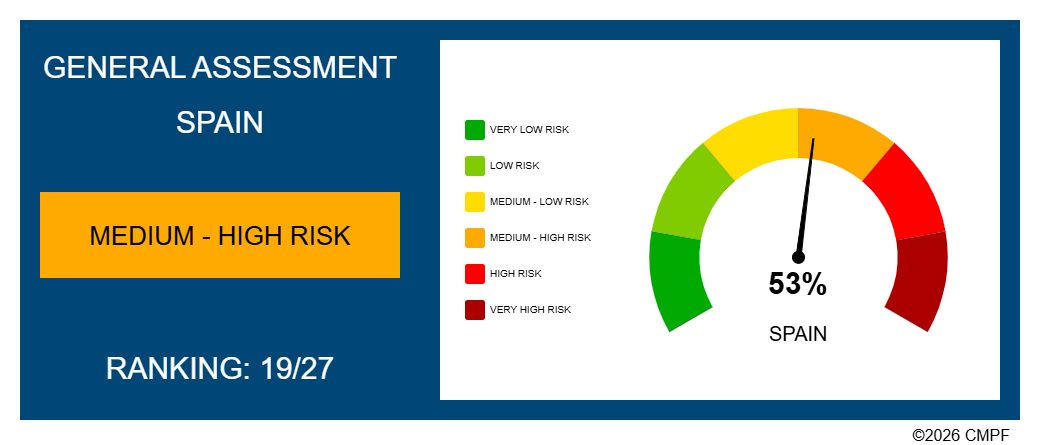
Country overview
In 2025, Spain remained marked by a highly polarised political climate under the coalition government led by Prime Minister Pedro Sánchez and the Spanish Socialist Workers’ Party, whose parliamentary stability continued to depend on agreements with regional parties, particularly Junts per Catalunya. The political effects of the 2024 amnesty law related to the 2017 Catalan independence referendum continued to shape public debate, although territorial conflict became less central than broader disputes concerning institutional legitimacy, judicial independence, and corruption allegations affecting actors close to the government. Political confrontation remained intense throughout the year, contributing to a climate of sustained public distrust and reinforcing tensions between government institutions, opposition parties, and media actors.
Spain’s media landscape in 2025 reflected a growing gap between regulatory adaptation to European standards and the practical effectiveness of implementation. Particular attention is focused on national preparedness for the full application of the European Media Freedom Act, especially regarding transparency obligations and guarantees of editorial independence. Although the government presented legislative proposals aimed at creating a broader media registry under the supervision of the National Commission on Markets and Competition, the new framework had not yet entered into force by the end of the year, as parliamentary approval remained pending. Consequently, the existing State Register of Audiovisual Communication Services remained the operative mechanism, continuing to cover audiovisual providers and registered social media influencers under the regulatory framework introduced in 2024.
Its limited scope, however, meant that newspapers, digital-native media, and other non-audiovisual actors remained outside full transparency obligations, while concerns persisted regarding the future capacity of the proposed registry to ensure effective disclosure of ultimate beneficial ownership.
The reform of the governance system of RTVE (Corporación de Radio y Televisión Española – Spanish Radio and Television Corporation) remained one of the most debated issues affecting political independence in the media sector. The modification introduced through Royal Decree-Law in late 2024, which retained a qualified parliamentary majority in initial rounds but allowed subsequent appointments by simple majority, continued to generate criticism from professional organisations and media freedom observers. Throughout 2025, concerns intensified regarding whether this appointment mechanism sufficiently guarantees independence in line with European standards governing public service media. No substantial new measures were adopted to reduce indirect political influence over private media through institutional advertising allocation, and long-standing concerns persisted regarding the discretionary distribution of public advertising funds at different administrative levels.
Fundamental protection indicators showed limited improvement. Spain had not yet fully completed national transposition of the EU anti-SLAPP framework, leaving journalists and media organisations exposed to strategic litigation risks, particularly in cases involving investigative reporting and public-interest scrutiny. Criminal defamation provisions remained unchanged, and concerns persisted regarding their potential chilling effect on freedom of expression. At the same time, online harassment against journalists became increasingly visible, particularly in the form of coordinated intimidation campaigns through digital platforms targeting reporters and commentators involved in politically sensitive coverage.
In market terms, structural concentration remained a defining feature of the Spanish media system, while economic pressures linked to digital platform dependency continued to affect media pluralism. Large legacy media groups maintained strong market positions across audiovisual and press sectors, whereas smaller digital-native outlets remained economically fragile and highly dependent on platform-mediated visibility. Gender equality obligations introduced under Organic Law 2/2024 remained formally in force, but implementation across media organisations continued to be uneven, particularly regarding leadership positions and internal equality plans.
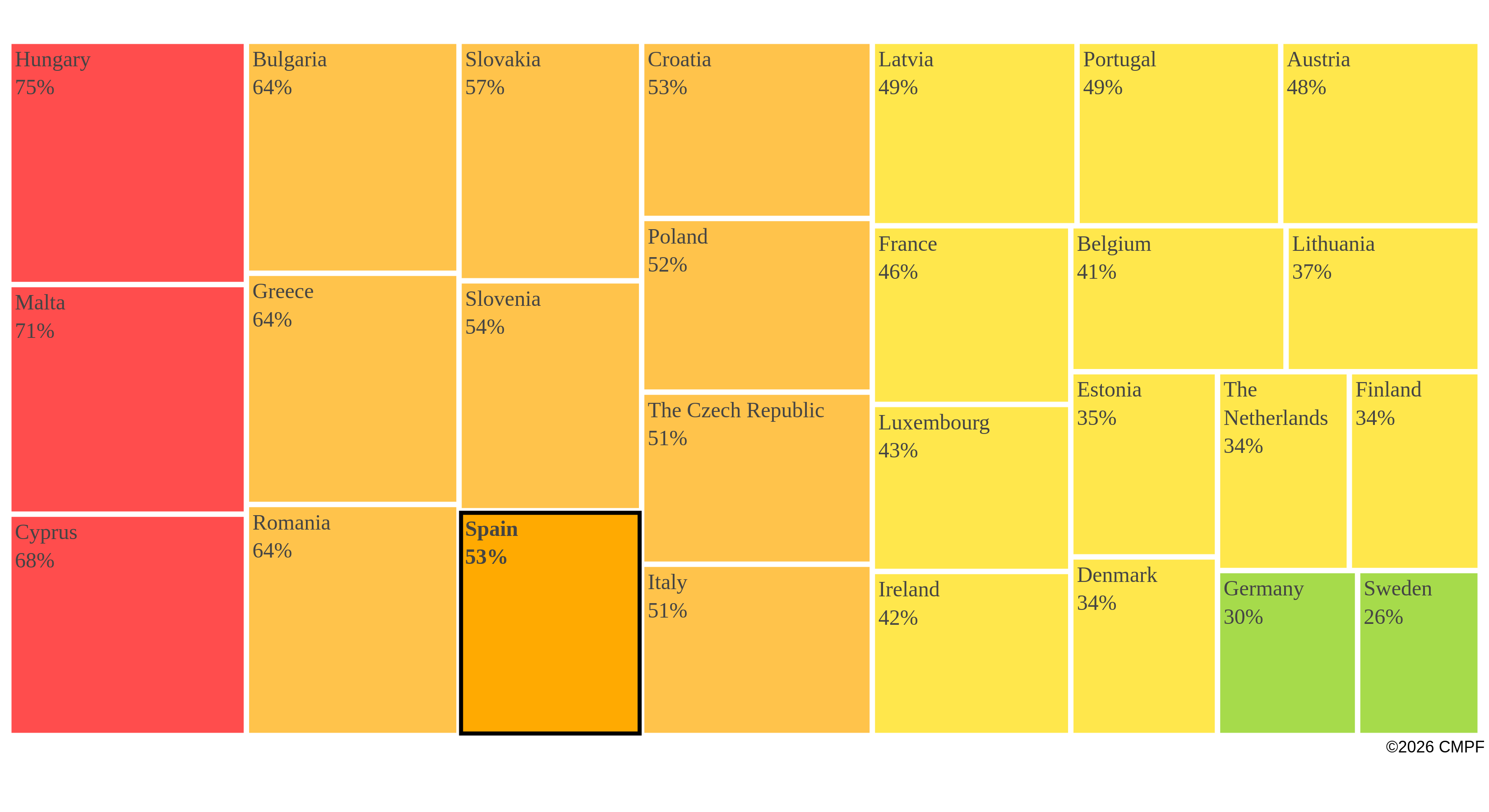
Fundamental Protection
The Fundamental Protection area fell within the medium-high risk band. Key points include:
- Defamation and insults: Under Articles 205 (calumny) and 208 (slander) of the Spanish Penal Code, defamation remains a criminal offense carrying up to two years’ imprisonment. These provisions remain in force despite international calls for decriminalization. Separate from general defamation, specific articles provide heightened protection for the state. These include Articles 490–491 (Insults to the Crown) and Articles 496, 504, and 543 (Insults to Parliament, Government, and State Symbols). These also remain fully in force.
- Stagnation of the anti-SLAPP framework: Spain lacks specific legislation to curb abusive lawsuits.
- The government intends to transpose the EU Anti-SLAPP Directive through the 2025 Plan de Acción por la Democracia (Democracy Action Plan), but critics argue it remains too narrow to stop domestic cases.
- Data Protection gaps: The Organic Law 3/2018 (LOPDGDD) has not been updated to include the “journalistic exceptions” mandated by Article 85 of the GDPR, leading to increased legal risks for investigative reporters.
- The Preliminary Draft Bill for the Improvement of Democratic Governance proposes granting the CNMC (media regulator) authority to issue content-removal orders. There are however concerns related to due process: legal experts argue this bill bypasses judicial safeguards established by the 2022 Supreme Court Ruling (Sentencia 1.231/2022), which maintains that only courts should authorize content removal.
- State secrets: the right to access to information is still governed by the Franco-era 1968 Law on Official Secrets. The 2025 Bill on Classified Information has been criticized for maintaining broad executive discretion and a punitive fine regime.
- Transparency obstacles: Under Law 19/2013 on Transparency, “administrative silence” remains a systemic issue, with the Council of Transparency and Good Governance (CTGG) reporting that 42% of appeals stem from a total lack of government response.
- Public safety- restrictions: the Organic Law 4/2015 (Citizen Security Law)—still not repealed—continues to be used to restrict journalists from recording security forces during public protests.
Professional secrecy: While a 2025 Draft Law on Professional Secrecy aims to align with the European Media Freedom Act (EMFA), current ambiguity led to the 2025 criminal investigations of journalists for “revealing secrets.” - Surveillance risks: Under Organic Law 2/2002 (CNI Law), the state maintains broad powers to request surveillance of those holding “classified” info, with no specific exemptions or safeguards for journalists yet established.
Market Plurality
The Market Plurality area is classified in the medium-high risk band. Key points include:
- Media ownership transparency issues persisted in 2025 despite EMFA officially coming into force on August 8. Two weeks earlier, the government had presented its draft “Law for the Improvement of Democratic Governance in Digital Services and Media Regulation,” which proposes adapting existing legislation to ensure the effective implementation of the EMFA. The main innovation of the government’s proposal is that control procedures will apply to all media, not just audiovisual media as is currently the case (Law 13/2022). However, the draft law is still pending approval.
- The state body responsible for overseeing the implementation of EMFA will be the National Commission for Markets and Competition (CNMC). This will require a reform of the CNMC to provide it with a new structure and more resources, as the CNMC itself has already requested.
Lack of transparency surrounding the financial results of Spanish media outlets persists and even worsens, due to the absence of a legal requirement for media outlets to provide data on their financial situation and ownership structure. - Based on the available information, the downward trend in revenue for most media outlets is confirmed, with the exception of radio sector. This decline is primarily due to the drop in traditional advertising revenue, and income from alternative sources (such as subscriptions) has not yet been sufficient to offset this decrease.
- The major media groups concentrate audience shares exceeding 75% in all sectors, except for digital media, for which we lack sufficient data. However, various audience measurement systems coexist, without clear standards unanimously accepted by all sectors involved.
- Media concentration in Spain is primarily horizontal, as the major media groups have a significant presence in one or two media sectors, while some of the main players specialize in a single sector, as is the case in television (Atresmedia, Mediaset), radio (COPE), and print media (Vocento).
- In 2025, legislative pressure increased to improve the transparency of digital platforms, particularly regarding their business and advertising practices. In December 2025, Law 10/2025 was passed, requiring platforms to disclose the parameters they use to personalize ads. However, the main instrument for improving the transparency of platform algorithms is the draft “Law for the Improvement of Democratic Governance in Digital Services and Media Regulation,” which is still pending implementation.
- Media associations achieved two significant victories in 2025 in their fight against digital platforms. Firstly, Meta was fined €542 million by the courts for the fraudulent use of data to personalize its advertisements. On the other hand, Google committed to the competition regulator, the CNMC, to review its agreements with media outlets for the use of news content, after the CNMC opened an investigation into Google for abuse of its dominant market position when signing these agreements.
- Lack of independence of journalists, along with precarious working conditions, remain among the main concerns of journalism professionals, both salaried and freelance. Faced with this situation, the only existing measure is self-regulation through codes of ethics, which have thus far proven largely ineffective in addressing the problem. This situation led to a conflict erupting in 2025 at the main regional radio and television networks, whose journalists denounced the political control their respective governments were exerting over the information provided by these channels.
Political Independence
The Political Independence area is classified in the medium-low risk band. Key points include:
- While major national media outlets remain free from direct political ownership, certain gaps persist in the areas of transparency, conflicts of interest and governance, particularly in publicly linked media.
- Political influence tends to operate through indirect channels, including institutional relationships, editorial alignment and funding dependencies, with more pronounced effects at regional and local levels.
- Recent European developments, notably the European Media Freedom Act (EMFA), introduce strengthened standards, while their effective translation into the national framework remains ongoing.
- Regulatory mechanisms largely depend on journalists’ goodwill and ethical commitment, and the lack of mandatory professional registration weakens the ability of professional associations to enforce standards.
- There is widespread pressure on journalists: according to the Madrid Press Association (APM, 2025), 79% of employed journalists and 72% of freelance journalists have experienced some form of pressure, mainly from media executives in the former case and from economic and political actors in the latter.
- There are recurring concerns that public funding and institutional advertising may be distributed in a politically biased way, despite Law 29/2005 requiring objective criteria, and there are calls to update the framework to comply with the European Media Freedom Act (EMFA).
The radio regulatory framework needs updating to reflect the current market structure, support the rollout of digital radio (DAB), and address illegal transmissions using unauthorized frequencies. - Spain is advancing reforms to improve media governance through a national media registry overseen by the CNMC, but the regulator warns that it lacks sufficient resources and calls for clearer rules and full alignment with the EMFA.
- Persistent concerns remain about political influence and lack of effective enforcement of impartiality rules in Spanish public service media, with journalists’ councils and unions reporting interference, non-transparent appointments, and decisions taken without required consultation.
Public broadcasters such as RTVE face governance weaknesses due to the absence of an updated Framework Mandate and Programme Contracts, which has left strategic and funding structures outdated for over 15 years, partly because their renewal requires a parliamentary qualified majority of two-thirds. - Spain’s electoral media framework ensures a high degree of formal regulation and equal access, particularly in public service media, although certain constraints on editorial flexibility remain.
The media environment reflects a degree of political parallelism and structural asymmetry between public, private and online media, which may affect the visibility of smaller political actors. - The regulation of political communication, especially in the digital sphere, is in a phase of gradual adaptation, with some aspects—such as transparency and targeting—still requiring further development in line with EU standards.
Social Inclusiveness
The Social Inclusiveness area fell within the medium-high risk band. Key points include:
- Although there is a solid and extensive legal framework that establishes the accessibility obligations of media service providers, its implementation has not been complete, and reports by the NRA show a significant gap between the measures applied by public and private audiovisual services.
- The Spanish government does not officially recognize the existence of minorities within its territory. Consequently, there is no regulatory framework that ensures the representation of and access for minorities in either public or private media.
- Although the Spanish government has launched multiple initiatives to develop a coordinated strategy among public institutions, civil society, and other actors to combat online hate speech, their effectiveness has proven limited, varying significantly depending on the reporting channel.
- Structural weaknesses in the detection, reporting, and removal system for online hate content were exposed following the events in Torre Pacheco. Following the violent attack on a local resident, online hate speech against North Africans spiked, accompanied by the rapid spread of misinformation, which directly influenced physical unrest.
- Community media remain structurally weak despite legal recognition. Although Spain recognises community media as a distinct non-profit sector, implementation remains incomplete. They still lack fully reserved spectrum, stable dedicated funding and full regulatory certainty, which keeps many outlets in a fragile position.
- Territorial inequalities in access to local news remain. Despite a relatively stable legal framework for regional and local broadcasting, local information remains unevenly distributed. Rural and depopulating areas continue to face weaker and less stable coverage, and some parts of the country remain underserved, forming “news deserts”.
- Gender equality in the media remains a serious concern. Spain has a relatively strong formal framework, and some public-service broadcasters have updated equality plans and internal guidance. However, implementation remains uneven and insufficiently transparent across the sector, while women continue to be underrepresented both in media leadership and in news and current affairs content, especially in roles associated with authority and expertise.
- Media literacy is increasingly visible, but remains fragmented. It is present in curricula, public policy and non-formal initiatives, and recent developments suggest greater institutional attention. Still, implementation remains dispersed, evaluation is still limited, teacher training is uneven, and many initiatives continue to rely on project-based support rather than on a coherent long-term national framework.