

Hungary 2026
Media Pluralism Monitor 2026 results
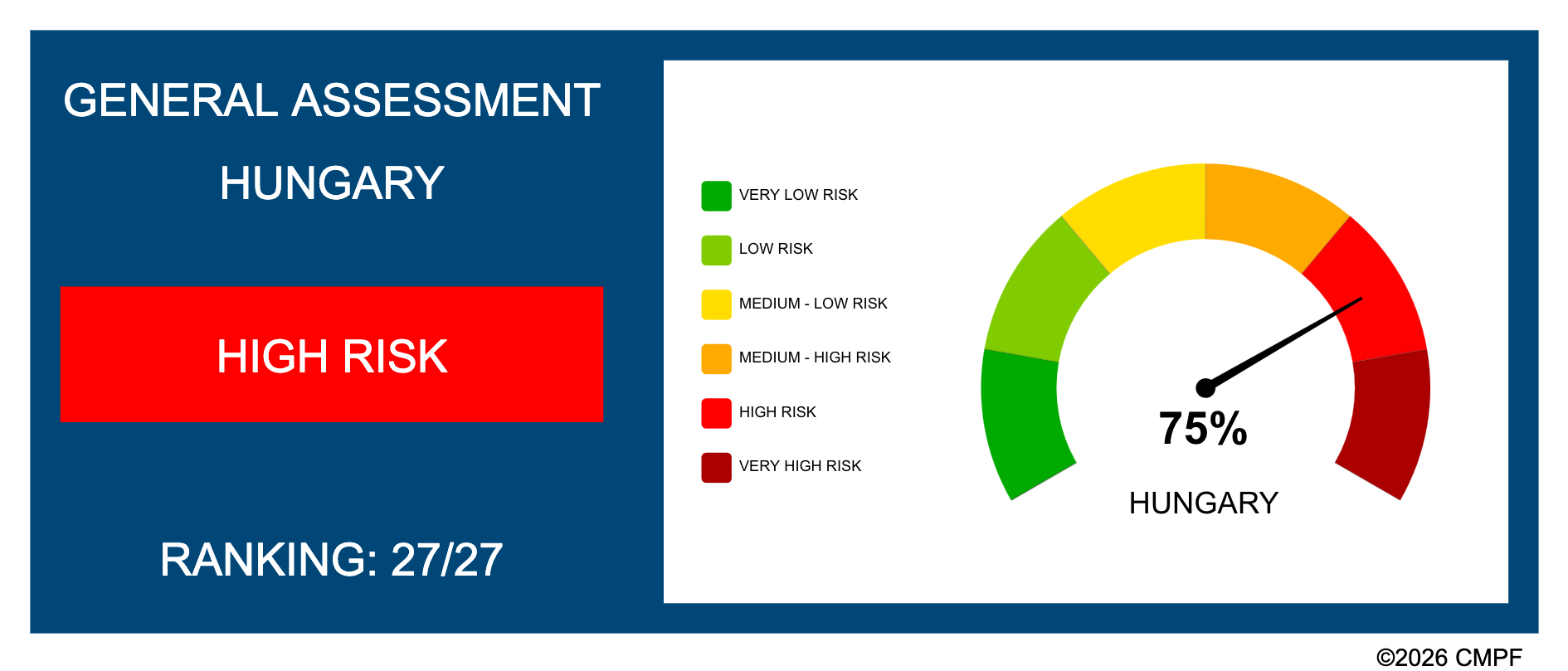
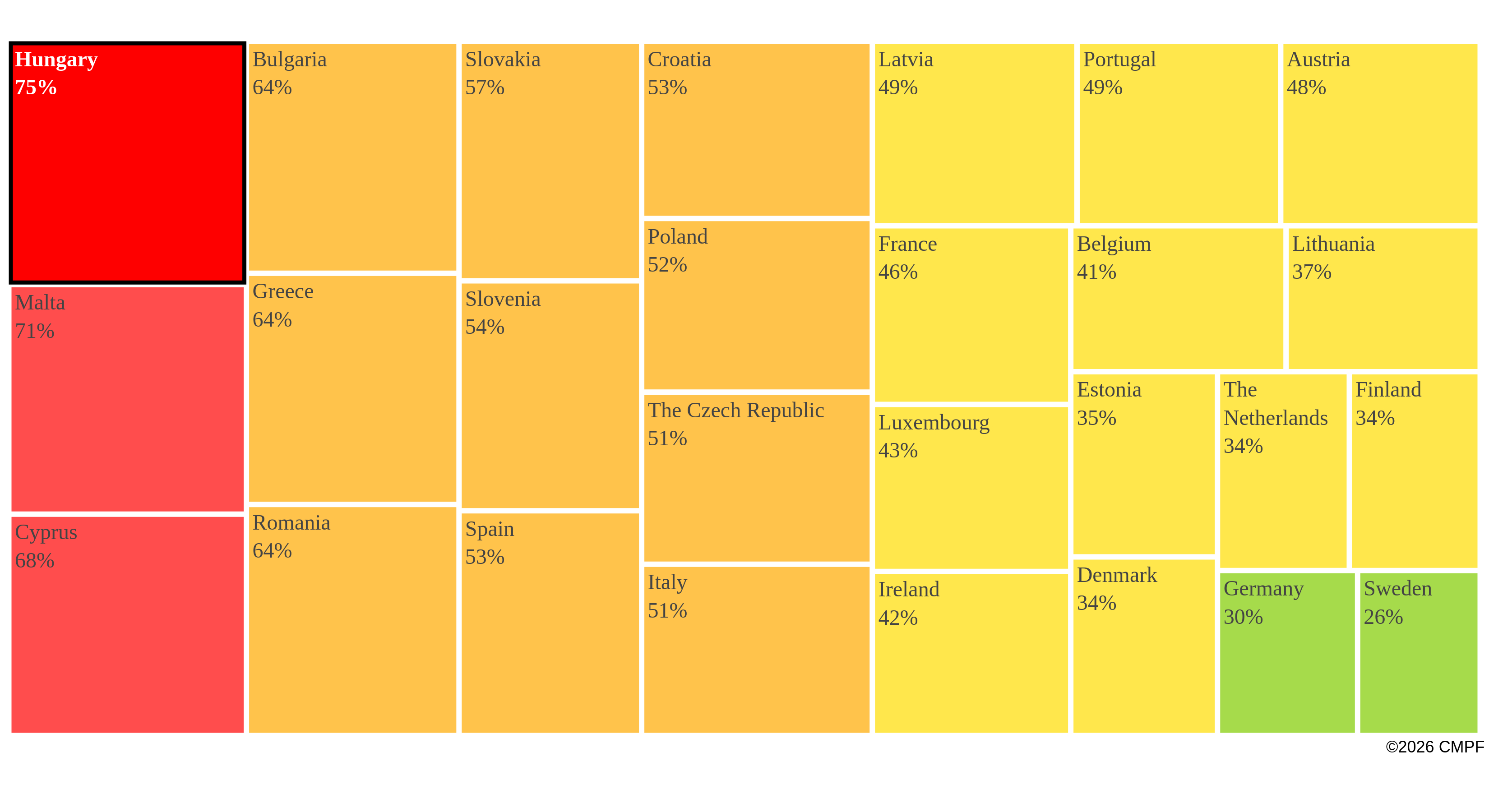
Risk score: 75%
| Fundamental Protection | 69% |
| Market Plurality | 85% |
| Political Independence | 80% |
| Social Inclusiveness | 66% |
In-depth analysis:
Read the full MPM2026 Country report
Country overview
Until early 2026, media pluralism and media freedom were under immense pressure in Hungary. Although the country was and is formally a parliamentary democracy, analysts and researchers have cautioned for the past decade about a trend of democratic backsliding. This has led some experts and political actors to label Hungary a hybrid regime or a competitive authoritarian system, rather than a full-fledged democracy (this was reiterated by the European Parliament decision T9-0324/2022). Since 2010, the right-wing/populist Fidesz- KDNP (originally the Alliance of Young Democrats, now the Hungarian Civic Alliance – Christian Democratic People’s Party) party alliance has been in power, winning four national elections consecutively in 2010, 2014, 2018, and 2022. In all four cases, the government gained a two-thirds majority in parliament. Viktor Orbán has been the prime minister since 2010. His government has changed election laws and significantly interfered with the provision of information, thereby hampering the emergence of successful competitors for many years.
Although there were no major elections in 2025, there was a reorientation of the political sphere with the emergence of Tisza, a conservative political party led by Péter Magyar. Magyar is a former ally of Orbán who has repositioned himself as an anti-corruption leader. On April 12, 2026, the Tisza party won the national elections, gaining more than two-thirds of the seats in parliament. This gives the party the chance to introduce significant reforms and rebuild the necessary checks and balances to safeguard the rule of law, particularly media freedom and pluralism. Although we use the present tense throughout the report, significant changes to the media environment may have occurred by the time the report is published.
The Hungarian media market consists of a mix of public and private media. Since the early 1990s, the market has been characterized by a high level of political parallelism and “party colonization” (Bajomi-Lázár, 2013 & 2017). As the political right has gained significant power in recent years, most market actors, even those that are privately owned and formally independent, are largely controlled by the governing party. Due to this dichotomy, the report differentiates between pro-government and independent media, considering that many forms of dependency can exist. In this context, “independence” refers to freedom from government control. Even among outlets formally independent from the government, we find media outlets that have or have had financial connections to political actors through state advertising, sponsorships, or ownership. According to the Digital News Report (2025), trust in news media and journalism is among the lowest in Europe. Only 22% of respondents trust “most news most of the time,” which is the lowest among the countries assessed. Audiences are polarized, meaning a significant portion of them consume media according to their political preferences (Polyák, Urbán, & Szávai, 2022).
The Hungarian media sphere extends beyond the borders of Hungary. Public service media (PSM) considers reporting on Hungarian communities abroad to be one of its tasks. This can be seen in the PSM Public Service Codex’s emphasis on covering the Carpathian Basin, which refers to historical Hungarian territories that still have significant Hungarian-speaking populations (Közszolgálati Kódex, 2016). The largest Hungarian-speaking population is in Romania, followed by Slovakia. These countries have a significant number of Hungarian-language publications. For more information, see the Global Media Finances Map (2024) for Romania.
Some independent outlets have editions focusing on the Hungarian community in Romania (Transylvania), such as Transtelex and Átlátszó Erdély. In Slovakia, important media outlets like Deník N and PSM have Hungarian-language editions. According to news reports and investigations, the Hungarian government has acquired much of the Hungarian-language media in the Carpathian Basin, including outlets in Romania, Serbia, and Slovenia (see Keller-Alánt, 2020a, b, c, and Sipos, 2022). In 2024, it was revealed that the Hungarian government has a financial stake in the pan-European Euronews channel (Pethő et al., 2024, Braun & Lund Nielsen, 2026). However, there are no clear signs of Hungarian government influence over Euronews’ content (Szalay, 2026a).
The Hungarian media’s main regulatory body is the Media Council, which is formally autonomous within the convergent regulatory body, the National Media and Infocommunications Authority (NMHH). The Media Council is considered to be controlled by the government (IPI, 2024).
The greatest concerns related to media freedom were related to the Sovereignty Protection Act (Act LXXXVIII of 2023 on the Protection of National Sovereignty), which created the Office for the Protection of Sovereignty. This office investigates, among other things, foreign funding provided to the media and is seen as instigating public stigmatization and coordinated action by other state agencies, including intelligence services. The office has extensively targeted the investigative news outlet Atlatszo.hu and the independent news outlet 444.
In May 2025, members of the governing party submitted a new bill on the “Transparency of Public Life” which could have further restricted the ability of independent news media and non-governmental organisations to receive funding (Uitz, 2025). However, with the change in government, we might see a significant change in the situation in 2026.
Fundamental Protection
The Fundamental Protection area is considered high risk. Key points include:
- Political control of key institutions goes on. Although citizens have legal remedies, they are not always effective due to shortcomings in the independence of the Public Prosecutor’s Office and the Constitutional Court.
- There are systematic violations of the freedom of expression of activists, academics, and human rights defenders. By 2025, most universities had lost their autonomy after being transferred to public trusts led by members of the governing party. NGOs were also targeted with smear campaigns and “foreign agent”-style legislation.
- Hungary is listed as one of the countries that have not yet initiated the transposition of the anti-SLAPP directive by December 2025, and there is no anti-SLAPP legislation in Hungary.
- Content moderation has been problematic in Hungary for the past decade, with journalistic content being removed without proper justification.
- There is no national public strategy to counter disinformation or foreign information manipulation and interference (FIMI). The Orbán government itself is seen as a significant source of disinformation.
- Access to data for journalists is problematic. Those requesting data must pay for it. Requests for data cannot be made anonymously. Data can be kept secret indefinitely if it is deemed relevant to government decision-making.
- Surveillance continues to be a problem. During the 2026 election campaign, the pro-government media outlet Mandíner published parts of a wiretapped conversation between investigative journalist Szabolcs Panyi and one of his sources.
- The Media Council is composed exclusively of members nominated by the governing Fidesz party, including former municipal councilors, political advisors, and Fidesz communications directors.
Market Plurality
The Market Plurality area scores a high risk. Media ownership in Hungary is highly concentrated, which distorts the market and threatens the sustainability of news media. Key points include:
- Media ownership transparency is significantly limited because owners identified from company data are not necessarily the final beneficiaries. The Orbán government has shown no interest in improving ownership transparency. The EMFA has not been implemented.
- Based on available revenue and audience data, Hungary’s media market is highly concentrated, particularly in print, television, and radio.
- Platform power remains unaddressed. There are no initiatives addressing the concentration of online platforms. There are also no known financial agreements between tech companies and the media.
- There is no transparent public support program for the news media sector.
- Media markets are uncertain.
- Commercial influence often overlaps with political influence because government advertising is a significant source of revenue. Furthermore, the government can exert pressure on market players through tax breaks, strategic agreements, strict regulatory controls, and unfavourable changes to the legal environment in which businesses operate.
- Some major media outlets have interests, links, or activities in non-media businesses. Conflicts of interest are not disclosed.
Political Independence
The Political Independence area scores high risk, because political influence remains a significant issue in Hungary. Key points include:
- Government control over private media and the capture of public service media are still common.
- The most significant market development in 2025 was the sale of most of Swiss company Ringier’s Hungarian portfolio to Indamédia, a government-affiliated company.
- In 2025, two major independent news portals faced significant political pressure. In November, the Office for the Protection of Sovereignty, which is politically controlled, announced an investigation into Telex due to potential foreign financing. Criminal proceedings have also been initiated against Zoltán Varga, the owner and CEO of Central Media, the publisher of 24.hu.
- The main self-regulatory instruments are ineffective at preventing political influence.
- Disguised political advertising is prevalent in government-controlled media, including the PSM. There are no rules regarding social media advertising.
- The unfair distribution of state advertising, including that from state-owned companies, still prevails. Government spending on social media is also not transparent.
- There are no independent appointment mechanisms for public service media. Former employees have testified that they were ordered by their supervisors to disregard journalistic standards and discredit the opposition and government critics.
Social Inclusiveness
Hungary shows several deficiencies in the area of Social Inclusiveness, scoring a medium-high risk. Key points include:
- People with disabilities still have insufficient access. For example, subtitles for the hearing impaired exist but are not always accurate and are usually unavailable for reruns of shows.
- Minority coverage is often stereotypical.
- Independent local coverage is almost non-existent because the majority of private and public media outlets are controlled by political interests.
- Women are significantly underrepresented and depicted in a stereotypical manner.
- Media literacy still shows significant limitations. Funding is not sustainable; there is no coordinated strategy, and vulnerable groups are not adequately covered.