

Austria 2026
Media Pluralism Monitor 2026 results
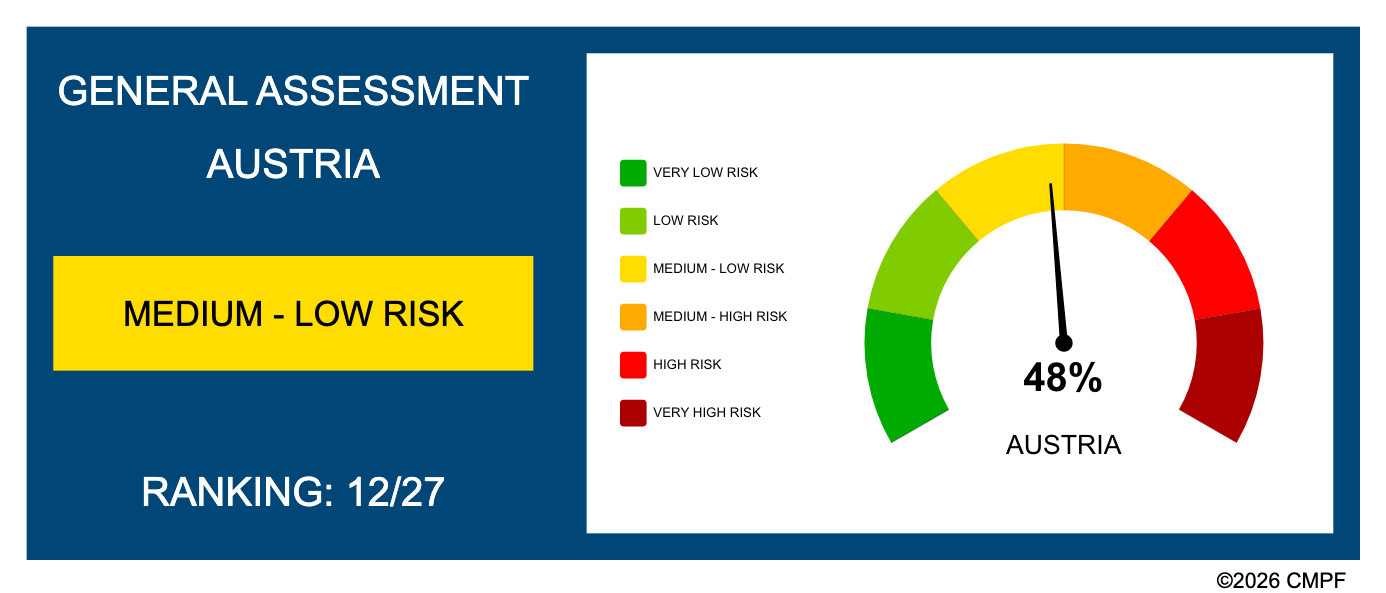
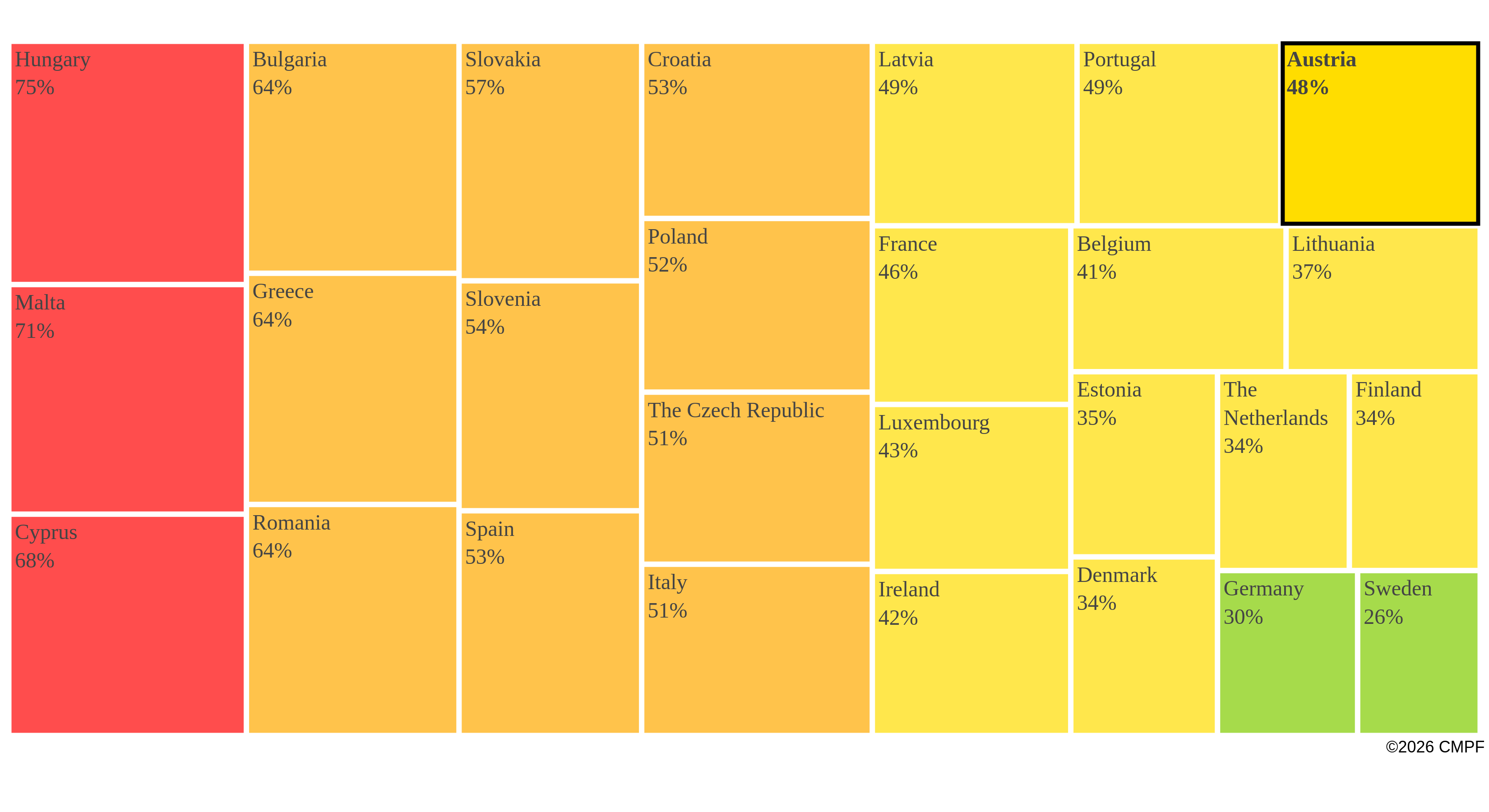
Risk score: 48%
| Fundamental Protection | 39% |
| Market Plurality | 65% |
| Political Independence | 36% |
| Social Inclusiveness | 51% |
In-depth analysis:
Read the full MPM2026 Country report
Country Overview
2025 saw the longest government formation process in the history of the Second Republic, which ended 155 days after the National Council election on 3 March with the swearing-in of the first three-party coalition comprising the conservative People’s Party (ÖVP), the Social Democrats (SPÖ) and the Liberals (NEOS), the latter being part of a federal government for the first time. Negotiations between the right-wing Freedom Party (FPÖ), which had emerged as the largest party in the September 2024 election with 28.85% of the vote, and the ÖVP had previously broken down. An unexpectedly large budget shortfall has marked the new government’s first year in office. Just a few weeks after taking office, it emerged that the 2024 deficit, at 4.7% of GDP, was significantly higher than expected. The government was consequently forced to put together a comprehensive austerity package, and the EU has launched an excessive deficit procedure against Austria. Nevertheless, after two years of decline, the domestic economy recorded slight growth. According to preliminary results from Statistics Austria, GDP rose by 0.6% in 2025 (Statistik Austria, 2026).
According to the 2025 Digital News Report (Gadringer et al., 2025), 85.2% of the Austrian population is extremely, very or reasonably interested in news. Despite losses, television remains the most significant source of information, followed by radio and social media. As in 2024, newspapers and their websites again suffered losses. General trust in the news has increased significantly to 40.6%, and 54.3% of respondents have confidence in the media they use. The public service broadcaster, which has maintained a relatively high market share of about one-third of the audiovisual market, is the most trusted news source (63.2%), followed by the quality newspapers ‘Der Standard’ (60.0%) and ‘Die Presse’ (59.4%).
In April 2025, the National Council passed an amendment to the Federal Act on the Austrian Broadcasting Corporation (ORF Act) by a coalition majority, introducing new rules for the appointment of the two main PSM bodies through a significantly shortened legislative process without public review. It came into force on April 19. The urgency was necessary because the Constitutional Court (VfGH) had already annulled several provisions governing the composition and appointment of the two PSM bodies in 2023, ruling them unconstitutional, and the unconstitutional provisions expired at the end of March. The amendment can be considered a first, long-overdue step that should be followed by others, if only because the Constitutional Court’s decision aimed to strengthen only PSM’s independence from the federal government, while the influence of the governing parties was not subject to the court ruling.
In June, the government agreed to the monitoring of messaging apps, triggered by an Islamist terrorist attack in Carinthia on 15 February 2025, when a 14-year-old boy was killed, and five others were injured. The draft legislation was then passed in the National Council in July, despite opposition votes; two NEOS MPs also voted against the bill. Although the provisions seek a legal solution acceptable to the Constitutional Court, which declared the previous regulation unconstitutional in 2019 (VfGH, December 11, 2019, G 72-74/2019, G181-182/2019), they are not without critics. The new provisions (§ 11 (1) item 8 f. Staatsschutz- und Nachrichtendienst-Gesetz – SNG [State Security and Intelligence Service Act]) allow both unencrypted and encrypted messages on messaging services such as WhatsApp or Signal to be accessed in two cases: either a threat to the constitution- the commission of which is punishable by a prison sentence of at least ten years, or a secret intelligence service to the detriment of the Republic of Austria is established, operated, or supported, whereby the penalty for the latter is significantly lower, at five years’ imprisonment. It should be noted that issues of media freedom or source protection (within the meaning of Article 10 of the European Convention on Human Rights, respectively Article 11 of the Charter of Fundamental Rights of the European Union) are not expressly taken into account in this law.
On September 1, the long-contested Freedom of Information Act, adopted in January 2024, came into force. While this law abolishes official secrecy in Austria, it has been met with much criticism because § 6 provides far-reaching exemptions from the publication obligation, § 4 exempts municipalities with fewer than 5,000 inhabitants from any proactive publication obligation, and failure to disclose information that should have been published proactively is not subject to any sanctions.
More than six months after the EU Media Freedom Act (EMFA) came into force in August 2025, the national implementation bill was passed by Parliament only on March 25, 2026, with the votes of the governing parties (EMFG-Begleitgesetz [EMFA Accompanying Act]). The government draft bill was submitted to the National Council in September 2025.
Fundamental Protection
Fundamental Protection is largely guaranteed in Austria, but the area is assessed at medium–low risk due to weaknesses in practice and emerging threats. Key points include:
- Freedom of expression has been enshrined in the Austrian constitution since 1867. Strong constitutional and international legal guarantees apply both online and offline, but the criminalisation of defamation (including higher penalties when published via mass media) and high litigation costs may create a chilling effect on journalists.
- SLAPPs are on the rise, often initiated by politicians, companies, or state-related actors; existing legal provisions to deter abusive suits are ineffective in practice.
- A July 2024 amendment to the Data Protection Act introduces differentiated exemptions for media services (particularly regarding requests for information, deletion, and correction), treating staff journalists and freelancers unequally and thereby creating legal uncertainty for freelancers.
- The DSA Accompanying Act, which took effect on February 17, 2024, was a key reform that improved platform moderation and related laws, but the regulatory authority’s complaint handling is constrained by difficulties in contacting some platforms and by resource limits.
- A national strategy to tackle disinformation is still missing. Some fact-checking initiatives exist, and criminal law penalizes the dissemination of false news during elections, but public concern about distinguishing facts from false reports remains high.
- The Freedom of Information Act took effect on September 1, 2025; it abolished official secrecy, but exempts small municipalities and state legislatures from its provisions and does not impose penalties for failure to proactively disclose information.
- The Whistleblower Protection Act (2023) transposed the respective EU directive but contains shortcomings (anonymous reports, size/content restrictions, penalties) that may deter reporting.
- The law effectively protects the confidentiality of journalists’ sources. Journalists have the right to refuse to answer questions that relate to the author or source of information.
- Journalists are facing physical and psychological attacks, harassment (especially online), and worsening working conditions (job cuts, precarious freelance pay, rising unemployment among journalists)
- Since 2010, the Austrian Communications Authority (KommAustria) has worked fully independently and has effective sanctioning powers. However, the appointment process (government-dominated nominations combined with a lack of objective selection criteria) poses structural risks of political influence, and the budget and human resources appear insufficient given the new EU responsibilities.
- KommAustria conducts public consultations on the budget, regulations, market definition, and market analysis – a best practice worth highlighting.
Market Plurality
As in the previous year, Market Plurality is at medium-high risk. This is again mainly related to a high degree of concentration in legacy and digital media markets, a lack of transparency of media ownership and endangered market viability. Key points include:
- To date, the Austrian media market has faced various transparency issues: vague definition of ownership; no requirement to disclose affiliates’ non‑media holdings; limited coverage of foreign/state‑edited media; high reporting threshold for share transfers (49%). Moreover, complex ownership networks (foundations, banks) make it difficult to identify beneficial owners. EMFA-aligned amendments were adopted only in April 2026.
- Concentration in the audiovisual, radio and newspaper sectors is extremely high: the four largest players hold between 70 and 92% of the respective markets in terms of revenue and audience. Media and antitrust laws, as well as state subsidies, have failed to prevent concentration for decades.
- Leading traditional media companies are also leaders in the online news sector; there are only a few opportunities for digital native media to apply for state funding.
- Existing legal thresholds apply only to terrestrial radio/TV; cartel and media laws have been ineffective at preventing consolidation.
- Article 22 EMFA plurality test lacks an enforceable national framework.
- While digital ads account for 61% of total advertising, global platforms capture 86% of Austria’s online ad market, i.e., 2.74 billion euros. This means that the outflow of ad revenue to global platforms leaves little for domestic publishers.
- Despite insufficient audience data, it seems that while global platforms generate the vast majority of advertising revenue, they are less successful at acquiring traffic relative to their share of the market, whereas domestic players such as Mediaprint and ORF can keep up.
- No broad agreements yet exist between publishers and generative AI providers on rights and compensation. Recently founded collecting societies are pursuing solutions.
- Austria lacks audience measurement systems that comply with the “principles of transparency, impartiality, inclusiveness, proportionality, non-discrimination, comparability and verifiability” set out by the EMFA.
- Advertising revenue for traditional media declined in 2025 (print: −5.6%, television: −3.5%); online advertising saw a slight increase (+3.6%), but it is nowhere near keeping pace with the platforms’ revenue growth.
- Job cuts and redundancies among editorial staff are increasing, and the number of unemployed journalists is rising, particularly in the print sector.
- Multiple subsidy schemes, amounting to 82.5 million euros annually, exist but have not prevented concentration and often favour large legacy players; criteria and effectiveness are widely criticized.
- Advertising and journalistic contributions must be clearly separated and labelled, but enforcement and labelling remain problematic.
- There are no comprehensive legal rules governing the separation of editorial and commercial activities in the print and online sectors, nor is there an obligation to disclose conflicts of interest arising from news organisations’ editorial and commercial activities.
Political Independence
The area of Political Independence is characterized by a medium-low risk, with the risks for the individual indicators varying considerably, with Editorial autonomy and Political independence of the media in general and PSM in particular being at medium risk. Key points include:
- Regulatory rules bar direct state ownership in broadcast, and most major media operate largely independently at the ownership level, but recent market moves (notably the takeover of ProSiebenSat.1 by MediaForEurope, which is controlled by the Berlusconi family) and the growth of right-wing online media warrant scrutiny.
- Investigations by the Public Prosecutor’s Office for White-Collar Crime and Corruption (WKStA) revealed indications of political interference in the media, which in some cases was linked to signs of partisan-favourable reporting.
- Editorial autonomy is threatened by insufficient self-regulatory measures. Only large TV and radio stations must have editorial statutes, and even the existing ones do not always include co-determination rights in the appointment and dismissal procedures for editors-in-chief.
- The Austrian Press Council lacks sanctioning power and stable funding; its membership rules exclude some media types, and enforcement of judgments is often blocked by member vetoes.
- Integrity of political information during elections is largely ensured.
- Legal changes tightened reporting and labelling requirements (including amendments to the 2023 Transparency Law and the 2026 Act on Political Advertising), but online political ad spending remains reportable only as a lump sum, thereby limiting transparency.
- State advertising is exceptionally high and concentrated, raising concerns about political influence over media; publicly reported state advertising reached 384 million euros in 2025.
- ORF has statutory editorial safeguards, and Constitutional Court rulings and subsequent amendments to the ORF Act (2025–2026) reformed appointment procedures for oversight bodies to reduce the risk of government influence. The consequences remain uncertain due to the persistent influence of the political parties that form the government.
- The introduction of a household fee replaces the PSB fee and ensures the ORF’s financing, while the ORF must also implement cost-cutting measures and restrictions on its internet presence.
Social Inclusiveness
Social Inclusiveness has reached a medium-high risk because risk levels are increasing regarding universal access to media, cultural and linguistic diversity, media literacy, and, in particular, gender equality, which poses a high risk.
- High internet coverage and net neutrality are juxtaposed with uneven broadband speeds across regions and restrictions in PSM online news.
- The ORF Act and Audiovisual Media Services Act mandate gradual improvements to media accessibility for persons with disabilities. Nevertheless, only in PSM programmes, particularly for people with hearing impairments, are the services offered satisfactorily.
- Hate speech has increased, despite Austria’s ‘Online-Hate-Speech-Package’ aimed at improving civil law enforcement and penalties for digital services. The NGO ZARA offers an online reporting tool and legal support for victims, but all too often, the platforms (VLOPs/VSPs) fail to reliably remove the content. Moreover, ZARA faces an uncertain future regarding government subsidies.
- Austria has a well-established system of local media. However, commercial media face challenges due to declining revenues and limited financing opportunities, while non-profit community media in Vienna are struggling to survive due to the city government’s unexpected suspension of subsidies. Community media are not legally recognised as a ‘third pillar’ alongside public and commercial media, and the Telecommunications Act does not provide sufficient detail on licensing procedures and criteria for reserving television or radio frequencies.
- Efforts to achieve gender equality in media management and journalism have stalled at a very low level. The proportion of women in executive ranks and management positions needs to improve, the gender pay gap persists, and the representation of women in media content remains unbalanced and biased.
- Media literacy activities in Austria, particularly in the formal education sector, are steadily improving; they need to be better coordinated (including in the non-formal sector) in line with a comprehensive policy strategy. Efforts to improve media literacy for vulnerable groups have significant room for improvement.