

Albania 2026
Media Pluralism Monitor 2026 results
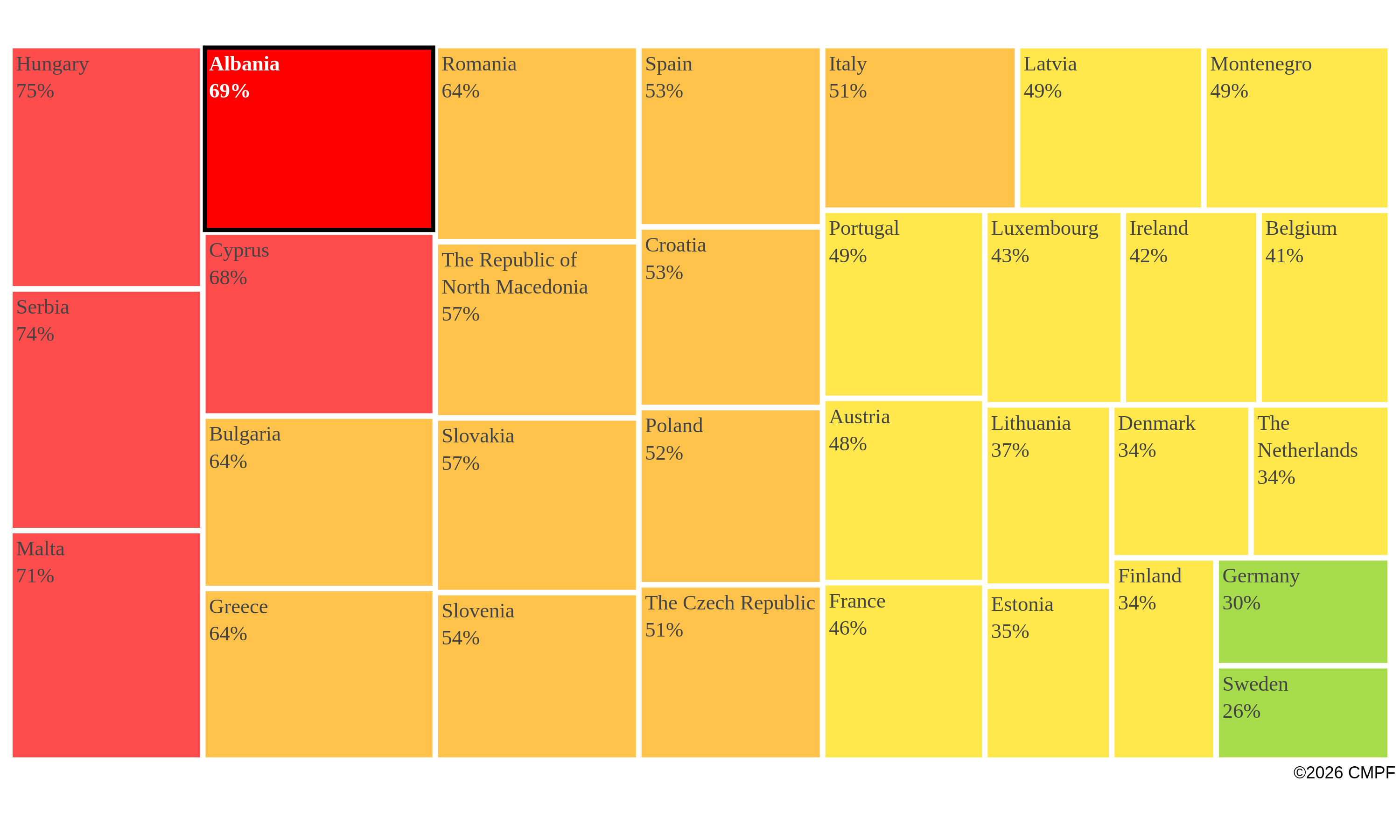
Risk score: 69%
| Fundamental Protection | 53% |
| Market Plurality | 83% |
| Political Independence | 72% |
| Social Inclusiveness | 69% |
In-depth analysis:
Read the full MPM2026 Country report
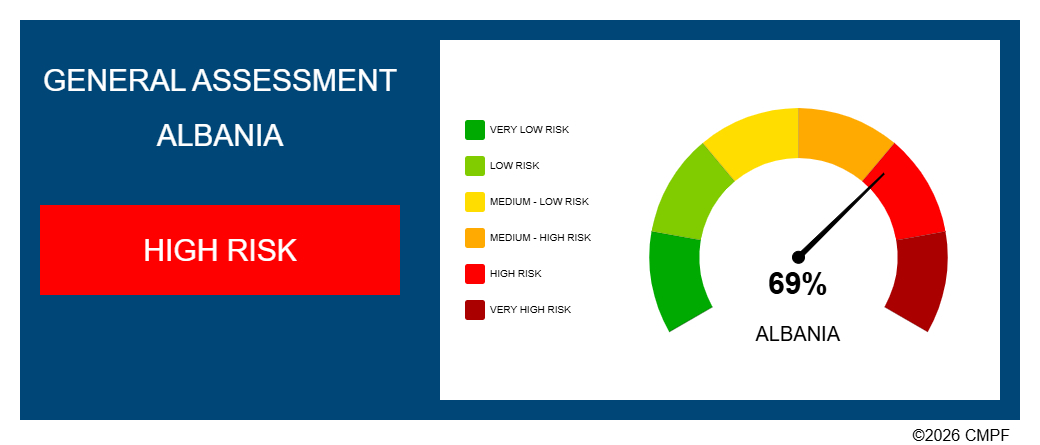
Country Overview
The Albanian media market is dominated by a small number of media groups with cross-ownership across television, radio and digital media. Despite the large number of outlets, revenues and audiences remain highly concentrated, with the market largely controlled by a few family-owned conglomerates. The largest groups include Klan, owned by the Frangaj family; Top Media, owned by the Hoxha family; and Media Vizion, owned by the Dulaku brothers. These media groups also hold investments in non-media businesses operating in heavily regulated sectors, making them potentially susceptible to government pressure.
In 2025, a multi-stakeholder dialogue facilitated by the Council of Europe produced a number of recommendations for Albania’s parliament on media reform. However, despite the consultation process, the ruling majority did not reflect the recommendations in the drafted legislation (BIRN Albania and SCiDEV, 2025). The legal environment in which the media operates in Albania registered further conformity with EU directives in 2025; however, some changes introduced by the government were contested by civil society as half-measures and even as having a chilling effect on media freedom.
In March 2025, the Albanian government blocked access toward TikTok for a year due to its alleged harmful effects on children (Council of Ministers Decision No.151, 2025). Two media organisations appealed the decision to the Constitutional Court. In May 2025, the State Police adopted guidelines on journalist safety, appointed contact points, and incorporated training modules into professional development (Directory of the State Police, 2025). In July 2025, Albania’s parliament approved the National Strategy against Foreign Interference and Disinformation 2025-2030 (Law No. 47, 2025).
In August 2025, a new Draft Criminal Code was published for consultation by the Ministry of Justice, provoking widespread concern for freedom of speech, because it reintroduced criminal penalties for defamation, insult, and broadly defined “desecration” or “disparagement” of public institutions, while removing key safeguards formerly considered necessary under European standards (SCiDEV, 2025). However, that draft was withdrawn, and in December 2025, the parliamentary media commission presented a number of amendments to the existing Criminal Code aimed at decriminalising defamation and aligning Albanian legislation with EU and Council of Europe recommendations. At the end of December 2025, parliament passed a new law on whistle-blowers to permit public disclosures through media, social media, and public gatherings, aligning Albania’s legislation with the EU Whistleblower Protection Directive (Law No. 96, 2025).
Fundamental Protection
The Fundamental Protection area scores within the medium-high risk band. Key points include:
- Freedom of expression is guaranteed by the constitution and the legal framework; however, in practice, violations persisted in 2025, and the media’s independence was undermined by the confluence of media owners’ political and economic interests and pressure from politics and organized crime, which pushes many journalists toward self-censorship.
- Albania has ratified the European Convention on Human Rights (ECHR), and case law from the European Court of Human Rights is frequently cited in Albanian court judgments, especially in defamation cases.
- Albania’s parliament proposed legislation to remove the criminal liability of defamation for registered journalists. Media freedom organizations complained that the definition was vague and called for a full decriminalization of defamation.
- Although preparatory work on transposing the EU Anti-SLAPP directive has begun, vexatious lawsuits against journalists and civil society activists are having a chilling effect on media freedom and freedom of expression.
- Albania has not aligned its legislation with the Digital Services Act; as a result, large online platforms do not moderate content in a diligent, objective, and proportionate manner, while national oversight remains weak and fragmented.
- The right to information is guaranteed in the constitution and the national law; however, appeal mechanisms are slow, and implementation continues to be inconsistent.
- Albania passed a new law on the protection of whistleblowers, which allows and protects public disclosures and is aligned with the EU directive.
- Although journalists’ associations and media rights watchdogs are active in advocating for press freedom, threats and attacks against journalists persisted in 2025, while working conditions remained precarious, with informal employment and delayed wages. A large number of physical attacks and online harassment cases target women journalists, often in sexist or defamatory forms.
- Impunity for past attacks against journalists remains the norm, while online harassment is a growing phenomenon.
- The media regulatory body (AMA) has yet to establish itself as a genuinely independent authority for the audiovisual media sector, due to the political affiliation of its board (BIRN Albania & SCiDEV, 2025).
- The Parliament adopted in February 2025 the National Strategy against Foreign Interference and Disinformation, which combines efforts to build resilience in the information space with formal commitments to protect media freedom.
Market Plurality
The Market Plurality area scores within the high-risk band. Key points include:
- Amendments to the Audiovisual Media Law partially align Albania’s national legislation with the EMFA regarding transparency of ownership and the disclosure of the distribution of state-sponsored advertising for broadcast media.
- The national law imposes certain limitations on broadcast media concentration, including caps on cross-ownership in national outlets and on advertising volume. However, despite these limitations, concentration in the broadcast and print market remains high, posing a threat to media pluralism.
- Cross-media ownership is also high, with a small group of family-owned media conglomerates and the public broadcaster holding a large combined share across TV, radio, and online brands.
- Albania has yet to adopt EMFA-style procedural safeguards to ensure that media market concentration assessments in merger and acquisition cases are transparent, objective, proportionate, and non-discriminatory.
- Editorial independence remains vulnerable to commercial and owners’ influence, with insufficient legal or self-regulatory safeguards against arbitrary interventions on the editorial line, exacerbated by political pressures.
- Although work with industry has begun to establish an audience-measurement tool for television, Albania still lacks an official and transparent mechanism.
- Albania lacks data on broadcast audiences, its advertising market, and radio and online media revenues.
- Albania has not transposed the relevant EU copyright directive and has no system in place to ensure that local publishers are paid by digital platforms for the reuse of content. No AI-content licensing agreements were reported in 2025. The country does not impose a digital services tax.
- Broadcast and radio revenues were flat in 2025, while print media revenues fell 20%, and employment in the media sector appears to be shrinking.
Political Independence
The Political Independence area scores within the high-risk band. Key points include:
- Although politicians are not explicitly barred from owning or controlling media outlets in Albania, the indirect political control of several major TV, print, radio, and digital outlets undermines public trust on the independence of the sector from political interference.
- The lack of strong regulatory and enforcement mechanisms and weak self-regulatory safeguards, expose Albanian journalists to political and commercial pressures, undermining their professionalism, failing to uphold the media’s commitment to serving the public interest, and ultimately compromising the quality of journalistic content.
- The Albanian Journalists’ Code of Ethics has been adopted by 35 members of the Alliance for Ethical Media, but the members are mostly online outlets and exclude the largest broadcasters, limiting its impact on political influence.
- A regulatory framework exists for the fair representation of different political actors and viewpoints in audiovisual media, both in private broadcasters and the PSM; however, different actors are represented in a biased and non-proportional way (BIRN Albania, 2025).
- In Albania, there is no state support for the media sector; however, television and print companies enjoy a privileged tax regime compared to online media.
- Most mainstream media lack internal ethical codes, ombudspersons, editorial boards, or other mechanisms to protect editorial independence from owners or political pressure.
- Appointments in the PSM board and management remain vulnerable to political interference. Although legal procedures exist for appointing the PSM leadership, in practice, the ruling majority exerts strong influence over the board and the choice of director-general (Sinoruka F, 2025).
- Although coverage in the PSM is required to be impartial, data from its flagship channel show that it allocates twice as much airtime to the ruling party as to the main opposition rival.
- Albania has no fair or transparent rules for distributing state advertising, and no authority monitors where public advertising funds are spent.
- Although media coverage during elections is regulated by the Electoral Code, data from the 2025 parliamentary elections shows that the two big political parties control the lion’s share of airtime during the campaign.
- In the 2025 parliamentary elections campaign, 80.2% of the overall airtime allocated only to the two leaders of the major political parties, Edi Rama and Sali Berisha (BIRN Albania, 2025).
- In Albania there are no regulatory mechanism that ensure the transparency of online political advertising during political campaigns, in particular for ads run by third-party entities (BIRN Albania, International IDEA and Rule of Law Centre, 2025).
- Leaked material and reporting suggest that some outlets were used by indicted political actors to attack justice officials and shape the coverage of their trials (Karaj V, 2025).
Social Inclusiveness
The Social Inclusiveness area scores within the high-risk band. Key points include:
- Although Albania’s legal framework recognizes 9 national minorities, their access to media in their own languages remains limited.
- Access to media services for people with hearing or visual impairments remains very limited, despite regulatory provisions.
- Although Albania has a legal framework to combat hate speech, oversight and appeals mechanisms are fragmented across several public bodies, and the number of formal complaints remains low.
- Monitoring from civil society shows that hate speech remains widespread online, especially targeting LGBTIQ people and women candidates during the 2025 electoral campaign.
- There are a limited number of audiovisual media outlets that operate outside the capital, Tirana and have a local focus. Local media outlets face serious sustainability and viability issues.
- Community media are recognized only as audio broadcasters, cannot broadcast advertising, and do not receive state subsidies, which limits their reach.
- Although the PSM has four local branches, its coverage of local issues in its flagship national broadcast channel remains limited.
- Women remain underrepresented in the PSM and private media leadership roles, especially at board and editor-in-chief levels.
- Women remain systematically underrepresented in news and current affairs broadcasting. During the 2025 parliamentary elections, women made up 38.7% of candidates but received only 9.9% of airtime in news editions.
- Media and information literacy is not fully integrated into the compulsory education curriculum.