

Luxembourg 2026
Media Pluralism Monitor 2026 results
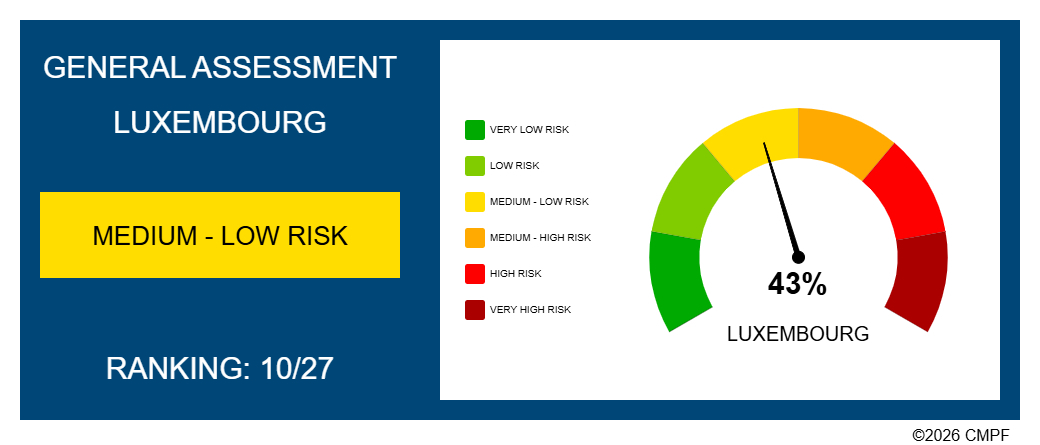
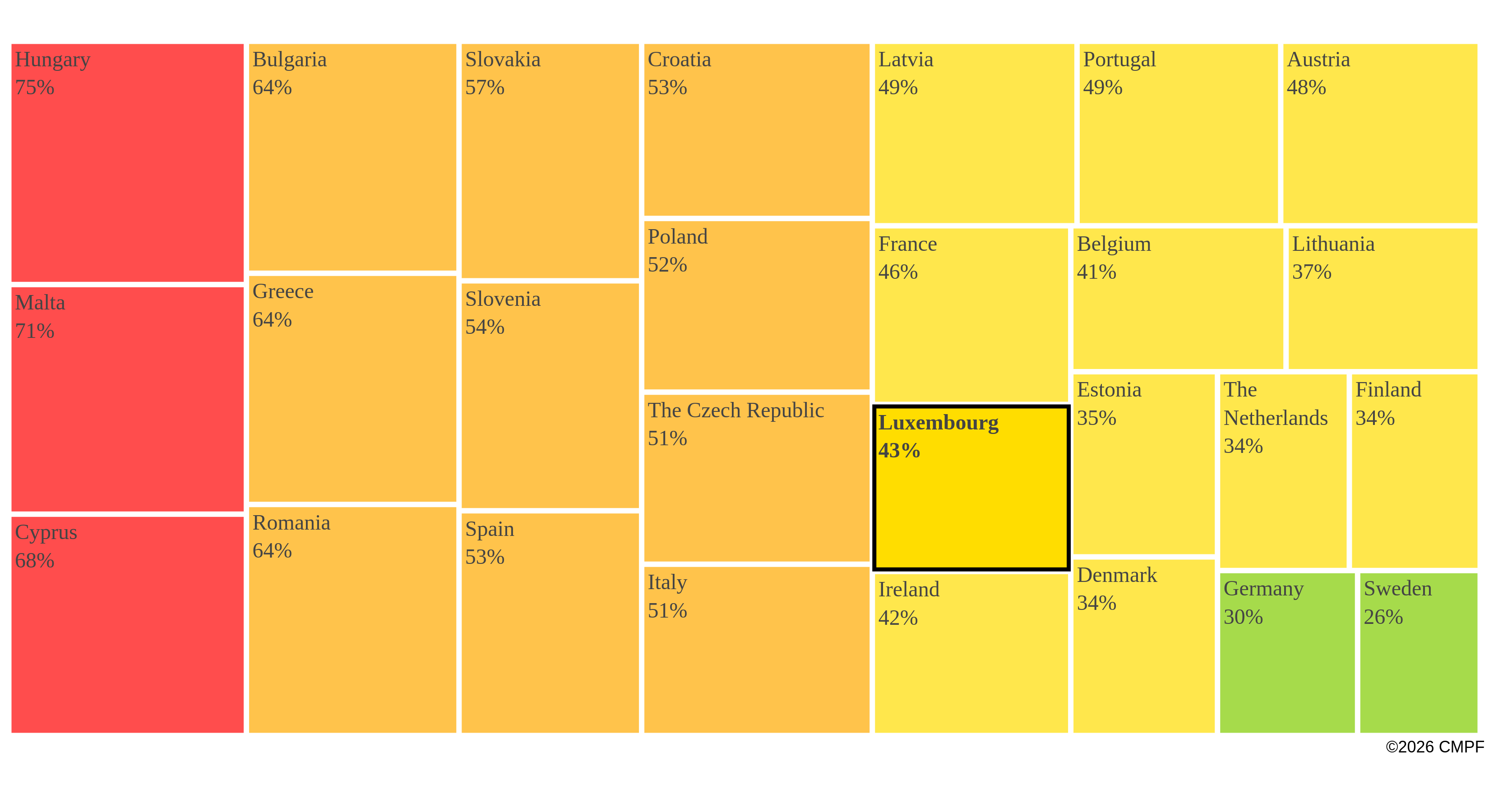
Risk score: 43%
| Fundamental Protection | 27% |
| Market Plurality | 68% |
| Political Independence | 33% |
| Social Inclusiveness | 44% |
In-depth analysis:
Read the full MPM2026 Country report
Country overview
Luxembourg is a prosperous parliamentary constitutional monarchy known for its political stability. Since 3 October 2025, Luxembourg has had a new Grand Duke, Guillaume, who succeeded his father Henri, and a new Grand Duchess, Stéphanie, who succeeded her mother-in-law Maria Teresa. The Christian Social People’s Party (CSV) has been Luxembourg’s leading party at national level since 1945 and has led all governing coalitions since the Second World War, with the exception of the periods from 1974 to 1979 and from 2013 to 2023 (two terms with the electoral coalition comprising the Liberal Party (DP), the Socialist Party (LSAP) and the Green Party (Déi Gréng)). The CSV is currently in power in a coalition with the Liberal Party (DP). With regard to media pluralism, the Grand Duchy has a rich media landscape given the country’s small size and population.
The year 2025 was marked in Luxembourg by the EMFA (European Media Freedom Act, Regulation (EU) 2024/1083) entered into application on 8 August 2025, and the main provisions of the TTPA (Transparency and Targeting of Political Advertising, Regulation (EU) 2024/900) applied from 10 October 2025. They should be implemented in Luxembourg through the provisions of the Draft Bill No. 8625 on the media and the organization of the Luxembourg Independent Media Authority. The latter which is currently under consideration, is expected to bring about a number of changes to the media landscape in Luxembourg. Among the main changes, unified licensing framework should facilitate market access for diverse media services. ALIA (Luxembourg’s Independent Audiovisual Authority) is set to be renamed ALIM (Luxembourg’s Independent Media Authority) and become a broader regulatory body with extended powers, strengthened sanctioning powers, a new decision-making structure and the authority to grant licences beyond local radio (for example, for national or online services).
The DSA (Digital Services Act, Regulation (EU) 2022/2065) is also fully in application EU-wide since February 17, 2024, and Luxembourg implemented it nationally via Law of April 4, 2025 (Loi du 4 avril 2025 portant mise en œuvre du règlement (UE) 2022/2065 du Parlement européen et du Conseil du 19 octobre 2022 relatif à un marché unique des services numériques et modifiant la directive 2000/31/CE (règlement sur les services numériques).
Besides, draft bill 8421 (Projet de loi sur la promotion du journalisme professionnel et du débat démocratique) should aim to promote professional journalism and democratic debate in Luxembourg by amending three laws: the 2004 law on media freedom of expression, the 2018 law on transparent administration, and the 2021 law on journalism aid. Deposited on July 30, 2024, it remains in parliamentary commission as of April 2026. The Press Council, for its part, is also set to have its powers strengthened. It is to be granted the power to launch investigations on its own initiative and will cooperate formally with ALIM (the Independent Media Authority of Luxembourg) in the event of breaches of the journalists’ code of ethics. Support for journalism should also be strengthened by broadening eligibility criteria (for example, to include radio and the print media) in accordance with the EU’s ‘de minimis’ rules (€300,000 over three years), with the aim of supporting the continued production of news content. Bill No. 8421 also provides for an update to the definition of ‘professional journalist’ and a strengthening of administrative access rights under the Tromsø Convention (Draft bill No. 8421).
Fundamental Protection
The Fundamental Protection area currently falls within the low-risk band.
- Freedom of expression relies on established constitutional safeguards (Articles 23–24) and the 2004 Freedom of Expression Act, though concerns persist regarding the proportionality of defamation penalties—which include up to one year of imprisonment and €2,000 in fines—as well as existing hate speech provisions.
- The right to information is supported by the 2024 draft bill 8421 on Access to Information, which aligns journalist access standards with the Tromsø Convention. Critiques from the Press Council in 2025 emphasize ongoing challenges such as delayed official responses, the non-binding nature of the Access Commission’s powers, and insufficient legal cost reimbursement for appeal procedures.
- Throughout 2025, journalists faced no instances of killings, arrests, or imprisonment, yet they continued to encounter threats including physical and verbal assaults, as well as online harassment. These safety issues, particularly acute for women, resulted in the launch of the National Action Plan for Journalists’ Safety (2025–2028).
- Strategic lawsuits against journalists remain a focus of concern due to the ongoing absence of anti-SLAPP legislation, and “right-to-be-forgotten” requests continue to carry risks of preventive censorship.
- The independence and effectiveness of the ALIA/ALIM are reinforced by the 2025 draft bill 8625 on Media Regulation, which enhances board transparency through public calls and a required two-thirds parliamentary vote for majority appointments. While the draft bill expands the authority’s sanctioning power to include fines up to €250,000, the agency remains strained by resource shortages, with only 15 staff members currently overseeing over 400 channels while managing new mandates such as disinformation and FIMI.
- The Competition Authority operates as an independent coordinator for the Digital Services Act; however, enforcement data for 2025 is currently unavailable. To ensure regulatory consistency, ALIA has proposed that it be entrusted with the specific task of monitoring video-sharing platforms.
Market Plurality
The Market Plurality area currently falls within the high-risk band.
- Transparency of media ownership is limited to print media (for shareholders exceeding 25%) under the 2004 Freedom of Expression Act without associated sanctions, while audiovisual media have no such mandates. The 2025 Draft Bill 8625 on Media Regulation, which implements the European Media Freedom Act (EMFA), aims to extend these requirements to all providers—including audiovisual media services, the press, and online outlets—with enforcement by the ALIM. However, the framework still lacks clear penalties and access to the Register of Beneficial Owners (RBE), placing additional strain on the already under-resourced ALIM.
- Plurality of media providers and digital markets are marked by extreme concentration, as CLT-UFA (RTL) dominates the television and radio sectors while EditPress and Mediahuis maintain control over the print press. There are currently no concentration limits or cross-media ownership rules in place. While the 2025 Draft Bill 8625 on Media Regulation envisions the use of assessment tools under Article 22 of the EMFA, it has yet to detail clear criteria or standards. Furthermore, there is a lack of data regarding digital intermediaries and aggregators, and no significant publisher-platform deals have been established, despite the existing law on neighboring rights.
- Media viability and editorial independence are supported by state aid. Given the small, multilingual nature of the market, this level of subsidy remains essential. The number of professional journalists decreased to 347 in 2025, partly due to stricter requirements for press cards, and the 2024 Draft Bill 8421 on Access to Information will further limit these cards to journalists covering general or political news.
- Commercial and owner influence over editorial content persists through advertising, despite the Press Council’s code of conduct regarding the separation of advertising and editorial content and existing regulatory oversight. The 2025 Draft Bill 8625 on Media Regulation is expected to grant the Press Council the power of self-referral to better address ethical concerns.
- The absence of public audience data—which remains limited to private studies — hampers the transparency of the market.
Political Independence
The Political Independence area currently falls within the low-risk band.
- The independence of public service media (radio 100.7) is secured by the 2022 Law on Public Service Media and the 2023–2030 convention.
- The Press Council code remains the primary mechanism for rejecting political pressure, complemented by internal safeguards such as the RTL Ethics Committee and the radio 100.7 statute. The 2025 Draft Bill 8625 on Media Regulation is expected to further strengthen this by granting the Press Council the power of self-referral for ethics investigations. No major breaches of editorial independence were reported in 2025.
- Public trust remains in the political independence of media is mixed, with 33.5% of the population perceiving journalists as politically independent according to the 2023 Medialux report. ALIA continues to supervise public service media during election periods, with no complaints filed in 2024. Furthermore, the 2025 Draft Bill 8625 on Media Regulation, implementing the Transparency of Targeted Political Advertising (TTPA) and the EMFA, mandates the clear labeling of political advertisements.
- Regarding state resources, while subsidies remain transparent under the 2021 Law on Press Aid, data concerning state-funded advertising remains opaque. The implementation of the EMFA via the 2025 Draft Bill 8625 on Media Regulation will task ALIM with monitoring these practices.
- Concerns persist regarding municipal media channels, which currently lack comprehensive regulation and carry a potential risk for political propaganda. Additionally, the RTL monitoring commission remains characterized by a lack of transparency, and the composition of the RTL board still involves partial political appointment processes.
Social Inclusiveness
The Social Inclusiveness area currently falls within the medium-low risk band.
- Community medium Radio ARA signed new state convention, receiving €450,000 annually for the 2026–2030 period, representing an 80% increase in funding. The 2024 Draft Bill 8421 on Access to Information introduces de minimis aid of €300,000 over three years extending support to non wirtten media (ex: local radios or influencers) promoting pluralism, though this measure does not guarantee continued financial support beyond that timeframe.
- Digital accessibility remains high, with 99% household internet penetration reported in the 2024 Digital Economy and Society Index (DESI). The 2023 Law on Accessibility mandates that audiovisual media services and video-on-demand platforms ensure content is accessible to disabled and elderly populations, under the supervision of the Monitoring Office on the Accessibility of Products and Services (OSAPS).
- While a multilingual media offer exists, particularly through Portuguese and French radio stations, the core public service media—Radio 100.7 and RTL—remain predominantly Luxembourgish-speaking. There is an ongoing concern regarding the underrepresentation of minorities and vulnerable groups in media coverage, as no formal diversity quotas or comprehensive inclusion policies have been established.
- Regarding gender representation, women hold 33% of editor-in-chief positions across 24 outlets. The 2025 Global Media Monitoring Project (GMMP) indicates that women represent 30% of news subjects, typically appearing in segments focused on soft topics, while the proportion of female reporters has declined from 39% to 33%. While state aid schemes require gender-focused reporting, there are no binding quotas, and while boards like that of Radio 100.7 approach parity, others such as the RTL board remain imbalanced.
- Media literacy efforts are currently integrated into secondary education with a primary focus on digital skills. While higher education currently lacks dedicated journalism or media programs that provide comprehensive media literacy, several national initiatives are actively addressing this gap. These include ALIA’s promotional efforts—which are expected to be coordinated under the 2025 Draft Bill 8625 on Media Regulation—as well as the BEE SECURE and EDMO initiatives and the Young Journalists’ Competition.