

Montenegro 2026
Media Pluralism Monitor 2026 results
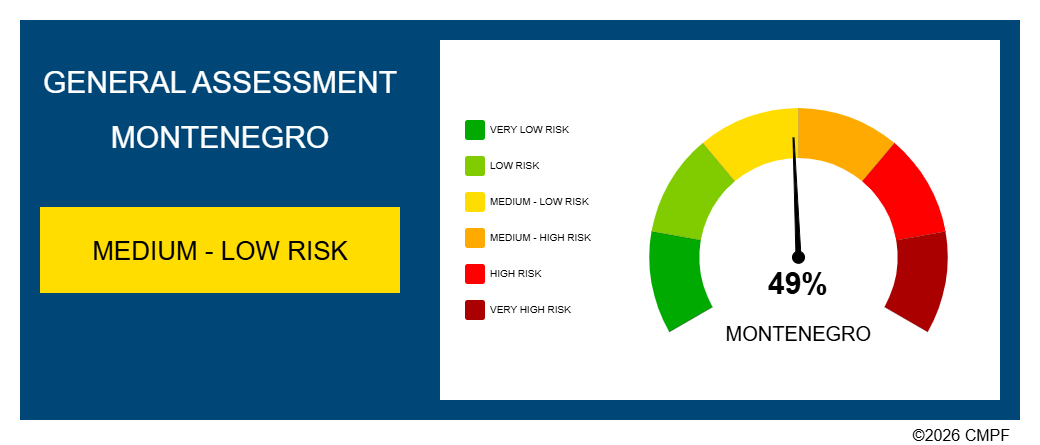
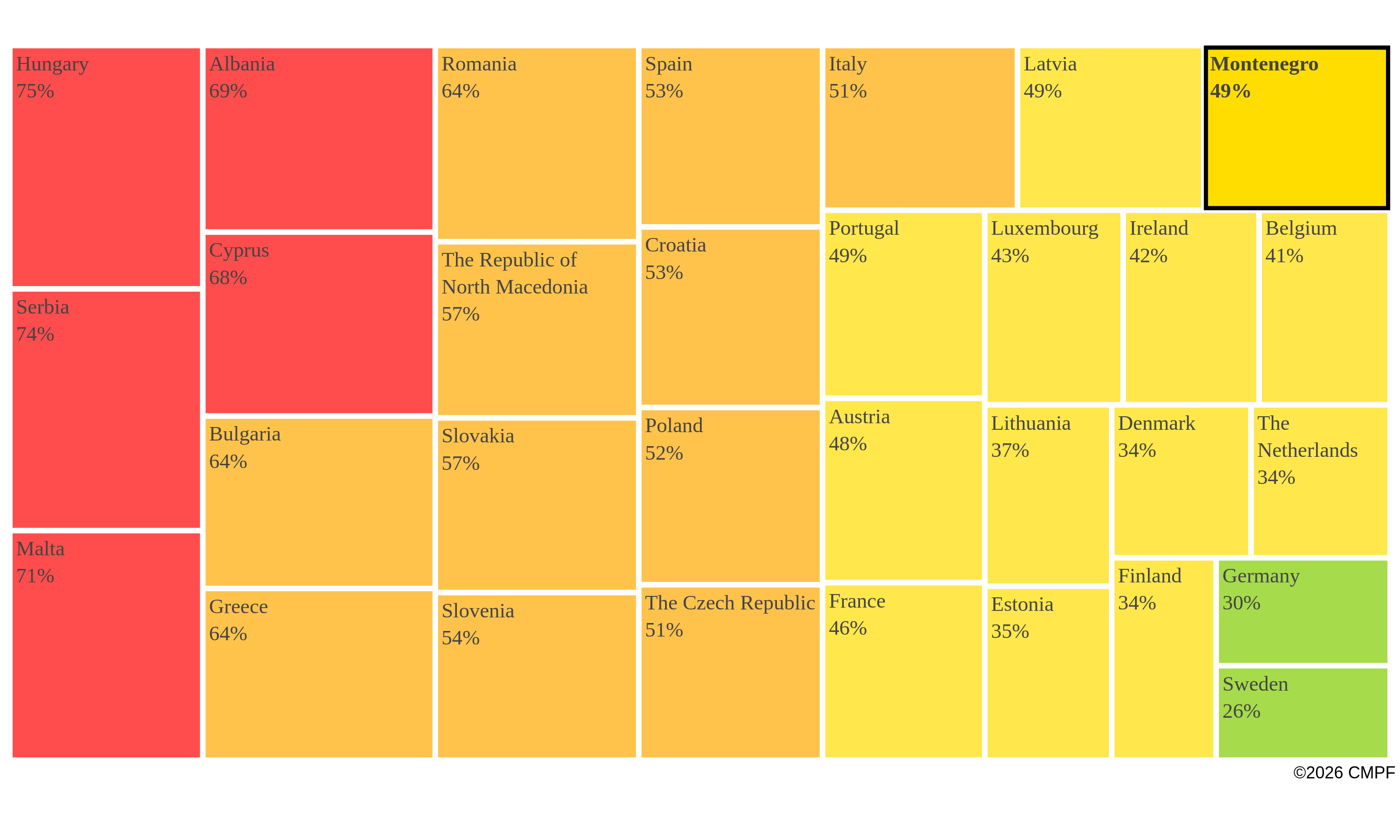
Risk score: 49%
| Fundamental Protection | 39% |
| Market Plurality | 54% |
| Political Independence | 45% |
| Social Inclusiveness | 58% |
In-depth analysis:
Read the full MPM2026 Country report
Country overview
The government formed in October 2023 was reshuffled for a second time in April 2025. The coalition, composed of pro-European, pro-Serb, Albanian, and Bosniak minority parties, expanded by two members to 34 ministers, making it one of the largest governments in Europe relative to the country’s population of 630,000. The broad coalition was a compromise to counter political fragmentation and preserve momentum on the EU accession agenda, which aims to close membership negotiations by the end of 2026 and secure full membership by 2028. In 2025, Montenegro closed five additional negotiation chapters (bringing the total to 12 of 33), though progress slowed in key Chapters 23 (Judiciary and Fundamental Rights) and 24 (Justice, Freedom and Security) compared with the previous year.
In terms of media pluralism, the media legislative package adopted in June 2024 – comprising the Media Law (54/24), the Law on Audiovisual Media Services (54/24), and the Law on Public Broadcaster RTCG (60/24) – came fully into force in 2025. The Media Law substantially increased state funding for public-interest content across broadcast, print, and online media, raising the Media Pluralism and Diversity Fund from 0.09% to 0.2% of the current national budget. It also introduced sanctions for unregistered online outlets and added safeguards for editorial independence.
The Law on Audiovisual Media Services expanded the Agency for Audiovisual Media Services’ (AMU) competencies and empowered it to impose fines. Independence of local public broadcasters was reinforced through guaranteed funding and more diverse management structures. Also in 2025, a revised Law on Free Access to Information (160/25)—aligned with EU standards after prolonged consultations—was adopted. The law broadened the scope of proactively published information, sped up procedures by allowing electronic submissions, and introduced the new institute of controllers. However, last-minute amendments by the ruling PES party introduced a cost-sharing mechanism for court disputes arising from administrative silence, prompting strong NGO protests that the change would deter public participation and incentivise unlawful withholding of information.
Parliament appointed three new members to the public service media RTCG Council in July 2025, restoring the body to full capacity. In September 2025, the president and three former RTCG Council members were convicted at first instance for abuse of office over the 2023 reappointment of Boris Raonić as RTCG director. Prior to this episode, Raonić’s appointment had been challenged in court twice, but this did not lead to his dismissal.
Two new members of the national regulatory authority AMU Council were finally appointed in December 2025 after an 18-month delay. Dragoljub Vuković’s candidacy—endorsed by NGOs—was confirmed as valid by the Administrative Committee, but an irregular consultative hearing on 24 July and a subsequent parliamentary abstention on 30 July stalled the process. Following sustained NGO pressure and warnings from EU institutions, Parliament ultimately confirmed the NGO candidate.
The most pressing reform ahead remains regulation of the online media sphere, primarily through implementation of the European Media Freedom Act (EMFA) and the Digital Services Act (DSA).
Fundamental Protection
The Fundamental Protection area scores within the medium-low risk band. Key points include:
- Montenegro lacks specific legislation addressing strategic lawsuits against public participation (SLAPP), leaving journalists exposed to legal pressures. A notable case in 2025 involved the brother of Serbian President Aleksandar Vučić filing a lawsuit against the daily Vijesti.
- Montenegro still hasn’t aligned its legislation with the EU General Data Protection Regulation (GDPR) to protect the personal data of citizens and enable them to exercise their rights to privacy.
- In the absence of relevant legislation, there is no national contact point for Very Large Online Platforms (VLOPs), and data on their content moderation practices in Montenegro remain largely unavailable.
- The amended Law on free access to information (160/25) tackles the very large number of appeals against decisions of public sector institutions, procedural backlog and consequential administrative disputes, but also raises concern over the potential harmful effects of the cost-sharing scheme in such disputes.
- Foreign information manipulation and disinformation continue to affect the media landscape, while the Government has not fully implemented the measures outlined in the Media Strategy 2023–2027 to address these challenges.
- The authorities efficiently processed attacks on journalists, but incidents persist without a noticeable decrease in frequency.
- Salaries of media workers remain below the national average, and the sector still lacks a collective agreement.
- The audiovisual regulator operates independently and efficiently, but instances of political pressure continue to occur.
Market Plurality
The Market Plurality area falls within the medium-high risk band. Key points include:
- Transparency of media ownership has continued to improve, placing this indicator in the very low-risk category. Relevant data are generally accessible both on media websites and in the online registers maintained by the audiovisual (AV) regulator and the competent Ministry. The AV regulator has also launched the first public digital register of media ownership.
The media market remains highly concentrated in terms of both revenue and audience share. - Montenegro’s regulatory framework does not provide for a comprehensive assessment of the impact of media market concentration on pluralism and editorial independence. The open market for foreign ownership has resulted in four out of five national private TV channels being majority-owned by Serbian capital, two of which belong to the same media conglomerate.
Montenegro still lacks a systematic and generally accepted audience measurement system. - The absence of reliable data and regulatory oversight concerning online audiences and advertising revenues makes it difficult to assess pluralism in this segment.
- The media market has shown overall viability in recent years, with revenues increasing across most sectors; however, financial data for the online segment remains largely unavailable.
State support for the media is increasing, with 0.2% of the national current budget allocated to the Fund for Encouraging Media Pluralism and Diversity. However, broadcast media have not fully utilised the available funds.
Political Independence
The Political Independence area improved the score to the medium-low risk band. Key points include:
- Concerns over indirect political influence remain present in TV, press and digital native media.
- The number of media participating in the self-regulatory council increased following the introduction of self-regulation as a legal requirement for accessing state support. However, this mechanism still needs to gain prominence and public presence to be an effective safeguard of editorial independence.
- Public service media show less bias in electoral reporting, whereas commercial outlets continue to exhibit clear political alignment in their coverage.
- While the legal framework ensures fair conditions for political advertising in traditional media—closely monitored by the audiovisual (AV) regulator—the online sphere remains largely unregulated, lacking adequate oversight and transparency mechanisms.
- Legal requirements regarding the transparency of state advertising are not consistently implemented, limiting access to information on both the volume of spending and the fairness of its distribution.
- The contested re-election of the Director General of the national broadcaster RTCG continues to raise concerns over the legality of the process and potential political influence.
Social Inclusiveness
The Social Inclusiveness area improved the score to the medium-high risk band. Key points include:
- The national public broadcaster RTCG remains the only media providing regular programming in sign language, limited to a short evening news segment.
- Leading commercial TV stations do not offer dedicated content for minorities.
- Hate speech remains a serious challenge, with efforts to combat it remaining fragmented and largely ineffective.
- Local PBS outlets have gained greater financial stability and protection from partisan influence following amendments to the Law on audiovisual media services (54/24). However, the offer of local content still falls below the legally required minimum.
- The concept of community media is still unknown to Montenegrin legislation.
- Women remain underrepresented in management structures of both public and commercial media, as well as in informative programmes.
- Efforts to promote media literacy have intensified, but no concrete steps have been taken to introduce media literacy as a compulsory subject in schools.