

Denmark 2026
Media Pluralism Monitor 2026 results
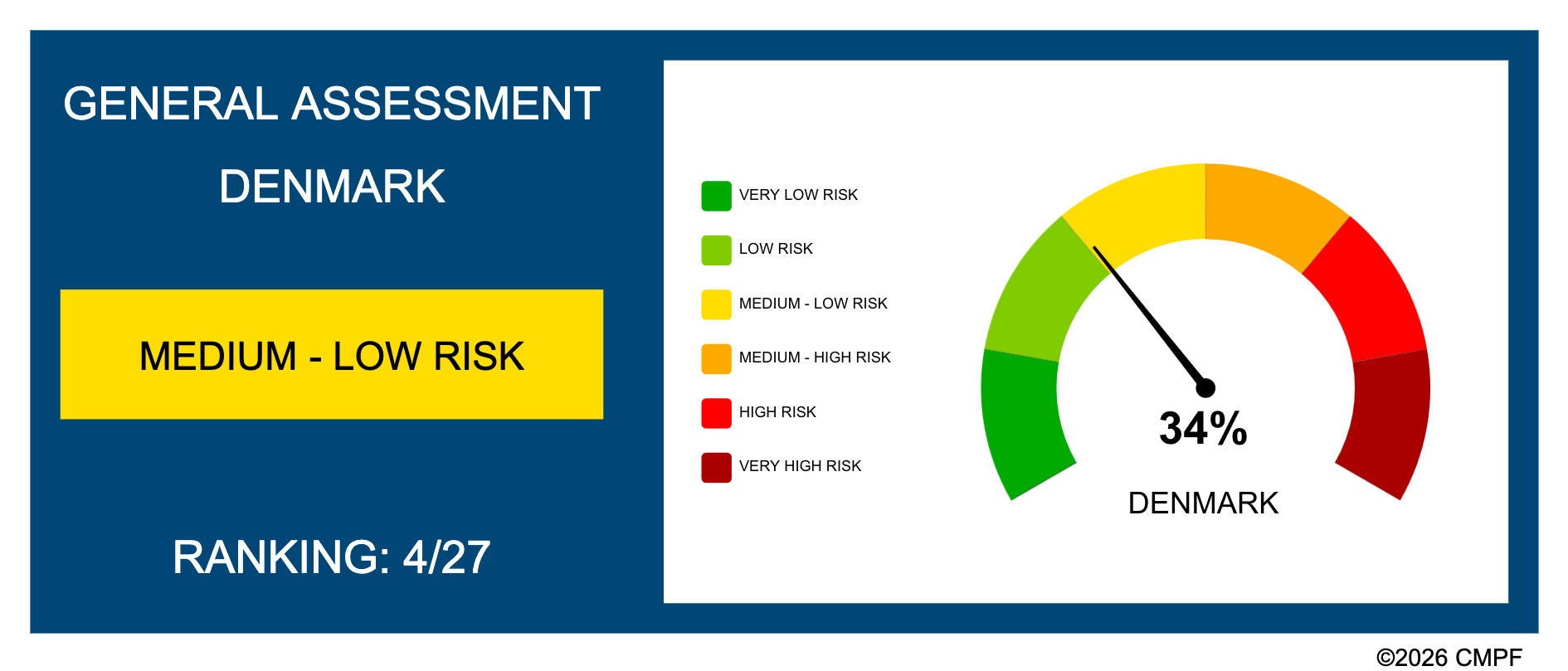
Risk score: 34%
| Fundamental Protection | 17% |
| Market Plurality | 62% |
| Political Independence | 24% |
| Social Inclusiveness | 33% |
In-depth analysis:
Read the full MPM2026 Country report
Country overview
In March 2026, Denmark held a general election, resulting in a fragmented outcome and ongoing coalition negotiations. At the time of writing, no new government has been formed. The election reflects a continued pattern of political fragmentation within an otherwise stable parliamentary system, where minority and coalition governments are common. While Denmark maintains a strong tradition of institutional stability and cross-party cooperation, the current uncertainty may delay or reshape ongoing policy initiatives, including those affecting the media sector.
In recent years, the Danish media landscape has increasingly been shaped by both national policy developments and broader European regulatory frameworks. Efforts to reform the media support system have continued, with a particular focus on ensuring the sustainability of journalism in a rapidly changing digital environment. At the same time, the implementation of EU-level regulation, including the European Media Freedom Act (EMFA), is expected to further influence national media governance, particularly in areas such as regulatory independence, media ownership transparency, and the relationship between media and digital platforms.
A key legislative development in 2025 is the adoption of Bill L 162 (Forslag til lov om ændring af lov om radio- og fjernsynsvirksomhed m.v. og lov om mediestøtte), adopted in June 2025 and entering into force on 1 July 2025. The law contributes to the national implementation of elements of the European Media Freedom Act (EMFA) and related EU frameworks. In particular, it establishes a legal basis empowering the Minister of Culture to adopt rules on media ownership transparency (Art. 6 EMFA), the assessment of media mergers, including the potential introduction of a media plurality test (Art. 22 EMFA), and transparency requirements related to political advertising under the EU framework on the transparency and targeting of political advertising (TTPA). It also designates the Radio and Television Board as the national supervisory authority for these areas. However, the concrete implementation of these provisions depends on subsequent regulatory measures and is therefore still at an early stage.
The Danish media system continues to be characterised by a strong public service sector alongside privately owned news media, often structured under foundation ownership. Public service broadcasters, notably DR and TV 2, maintain a central role in providing news and current affairs content across platforms. State support mechanisms for both public and private media remain extensive and are generally distributed according to transparent criteria. This dual structure contributes to a diverse and accessible media environment, while also reinforcing the dominant position of established actors.
At the same time, structural challenges persist and have become more pronounced in recent years. Ownership concentration in the national news sector remains relatively high, and local and regional media continue to face financial pressures. The growing influence of global digital platforms such as Google and Meta has further intensified competition for advertising revenues and audience attention, affecting the economic sustainability of domestic media providers. While digital-native outlets and new business models, including subscription-based journalism, continue to emerge, they have not fully offset the decline in traditional revenue streams.
Journalistic working conditions in Denmark remain comparatively strong, supported by collective agreements and professional organisations. However, there are increasing concerns related to online harassment and threats against journalists, particularly in digital environments. While Denmark does not experience severe violations such as imprisonment or physical attacks against journalists, the lack of comprehensive data on online threats limits the ability to fully assess the scale and impact of these developments.
In parallel, ongoing debates around freedom of expression, including recent legislative initiatives targeting harmful content, have raised questions about potential implications for self-censorship. Overall, Denmark continues to maintain a strong media pluralism framework characterised by institutional stability, a well-functioning public service sector, and supportive regulatory structures. However, challenges related to market concentration, the economic viability of local and regional media, the growing influence of digital platforms, and the need to adapt regulatory frameworks to evolving European standards continue to shape the risk landscape, with market plurality emerging as the most significant area of concern.
Fundamental Protection
The Fundamental Protection area falls within the low risk band. Key points include:
- Debates on freedom of expression (2024–2025): Court cases leading to convictions for publishing racist jokes online have intensified discussions about the limits of free speech and the potential for self-censorship, reflecting a continued tension between regulation of harmful content and freedom of expression.
- Implementation of the Digital Services Act (DSA): Since 17 February 2024, when DSA was implemented, Denmark has designated the Danish Agency for Digital Government as the competent authority, strengthening oversight of online platforms. New complaint-handling and dispute resolution mechanisms, including cross-border initiatives, are now in place.Denmark has designated the Danish Agency for Digital Government as the competent authority, strengthening oversight of online platforms. New complaint-handling and dispute resolution mechanisms, including cross-border initiatives, are now in place.
- Strong legal protections and institutional framework: Denmark continues to maintain robust protections for journalistic sources, access to information, and regulatory independence.
- Ongoing transparency reforms: Discussions on revising the Public Information Act have continued, aiming at improve transparency in political decision-making, although no major legislative changes have yet been finalised.
Market Plurality
The Market Plurality area falls within the medium-high risk band. Key points include:
- High and persistent market concentration: Ownership concentration remains significant across sectors, particularly in audiovisual media and national news markets, with a small number of actors dominating audience share.
- Digital platform dominance: Global platforms such as Google and Meta continue to capture a substantial share of advertising revenues and audience attention, reinforcing structural imbalances in the media market.
- Economic pressures on traditional media: While overall advertising spending has increased, traditional media – especially print – continue to face declining revenues and financial uncertainty, particularly at the local and regional level.
- Ongoing policy and industry responses: Efforts to address these challenges include continued discussions on reforming the media support system and initiatives by the Danish Press Publications Collective Management Organisation to secure fair compensation from digital platforms.
- Emerging collective licensing strategies: Collective licensing is gaining importance as a potential new revenue stream. In 2025, Denmark’s press-publisher CMO (DPCMO) intensified efforts to secure compensation for the use of journalistic content in AI systems, moving from mediation to legal action. While it remains uncertain whether this will result in stable licensing revenues, it signals a strategic attempt to capture value from platform and AI reuse of news content (DPCMO, 2025).
- Proposed reform of media support system: In October 2025, a government-appointed committee chaired by Rasmus Kleis Nielsen published the report Media Support for Citizens (Danish Ministry of Culture, 2025c), recommending a comprehensive reform of the media subsidy system. The proposal is based on three core principles: democratisation (broadening access to support for smaller media), future-proofing (ensuring platform- and technology-neutral support), and simplification (replacing multiple schemes with a single, transparent model) (
Political Independence
The Political Independence area falls within the low risk band. Key points include:
- Stable and well-functioning institutional framework: Denmark continues to benefit from high levels of trust, transparent governance, and limited direct political interference in media operations.
- Implementation of EU rules on political advertising and media governance: In June 2025, Denmark adopted Bill L 162 (entering into force on 1 July 2025), which introduces a national legal framework to support the implementation of the EU Regulation on transparency and targeting of political advertising (TTPA) and aspects of the European Media Freedom Act (EMFA), including provisions on regulatory oversight and transparency.
- Debates on perceived bias in public service media: Public discussions regarding the impartiality of DR highlight the importance of maintaining both actual and perceived independence, particularly in a polarised media environment.
- Resilience with underlying sensitivities: While the system remains robust, its reliance on trust-based norms may present vulnerabilities in periods of political change, such as the post-election phase in 2026.
Social Inclusiveness
The Social Inclusiveness area falls within the low risk band. Key points include:
- Strong access and media literacy framework: Denmark continues to ensure universal access to media and has expanded media literacy initiatives, particularly targeting children and young people through recent policy agreements.
- Implementation of EU accessibility requirements: New EU rules are expected to further improve access to media services for persons with disabilities.
- Challenges in representation and diversity: Risk levels remain higher in areas such as cultural diversity and gender equality, indicating ongoing disparities in media representation.
- Pressures on local and regional media: Despite targeted support measures, financial challenges persist, contributing to concerns about emerging news deserts and reduced local news coverage.