

Sweden 2026
Media Pluralism Monitor 2026 results
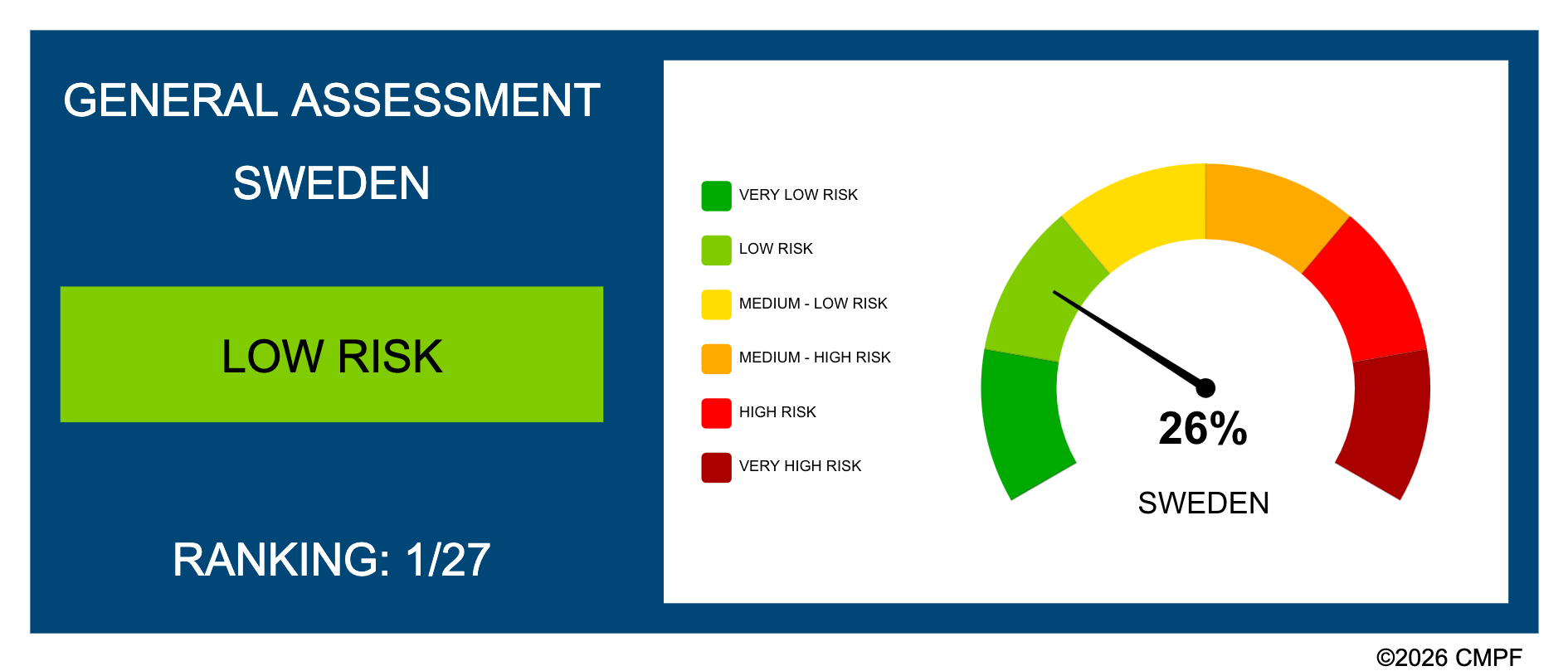
Risk score: 26%
| Fundamental Protection | 12% |
| Market Plurality | 55% |
| Political Independence | 22% |
| Social Inclusiveness | 16% |
In-depth analysis:
Read the full MPM2026 Country report
Country overview
Political situation: In 2025, Sweden is continuing to navigate the consequences of its historic accession to NATO, with integration into the alliance’s structures remaining a central pillar of national security policy. The government led by Prime Minister Ulf Kristersson, supported by the Tidö Agreement parties including the Sweden Democrats, maintains a strong focus on law and order, implementing stricter measures to combat organized crime and gang violence. These policies continue to fuel debate regarding privacy, civil liberties, and the long-term societal impact of expanded state powers.
As Sweden moves through 2025, attention is gradually shifting toward the upcoming 2026 general election, with political parties beginning to position themselves on key voter concerns such as crime, the economy, energy policy, and immigration. While full-scale campaigning has not yet begun, early signs of increased political polarization are evident, and the election is expected to serve as an important test of public support for the government’s reform agenda and its cooperation with the Sweden Democrats. Economically, Sweden is entering a gradual recovery phase after the slowdown of previous years, with growth picking up modestly during the year. Inflation is moving closer to the central bank’s target, while employment is showing clearer signs of improvement, although structural challenges remain. At the same time, political discussions around climate transition, energy policy, and industrial competitiveness are intensifying, particularly in light of broader European green transition goals. Overall, Sweden in 2025 is characterized by continued security integration, early electoral positioning, and a cautiously improving economic outlook.
Media market: The Swedish media market is continuing to undergo significant structural transformation, driven by shifting consumer behaviour and the sustained dominance of global digital platforms. Traditional media, particularly print and linear TV, remains under financial pressure as advertising revenue continues to migrate toward digital ecosystems largely controlled by international tech companies. At the same time, streaming services are firmly established as a central part of everyday media consumption, further accelerating the transition toward on-demand and personalized content.
Public service media continues to play a key role in the national media landscape. With the previous broadcasting licences having expired, political discussions are now focusing on the implementation and long-term direction of the new regulatory framework, including questions related to funding, independence, and the scope of public service in an increasingly competitive and digitalized environment. Overall, the Swedish media market in 2025 is characterized by ongoing digital disruption, intensified competition for audience attention, and continued debate over the role of public service media in a rapidly evolving media ecosystem.
Regulatory environment: In 2025, Sweden continues to implement and adapt legal and regulatory changes affecting press freedom, freedom of expression, the principle of public access to information, and the broader media landscape. Measures introduced in previous years to strengthen the protection of journalists, including harsher penalties for crimes targeting them due to their professional activities, remain in force and are now part of the established legal framework aimed at safeguarding independent reporting and reducing risks of self-censorship.
Government support for vulnerable and persecuted journalists also continues through initiatives such as Reporters Shield, providing legal assistance to media professionals operating in restrictive environments. At the same time, the implications of the Foreign Espionage Act remain under discussion, particularly regarding its potential impact on investigative journalism and the protection of journalistic sources. Concerns persist among media stakeholders about how the legislation may affect the balance between national security interests and the free flow of information. In parallel, the ongoing inquiry into the constitutional protection of search services that publish personal data continues to develop, with proposed limitations aimed at strengthening individual privacy while potentially influencing journalistic practices related to the dissemination of personal information.
During 2025, legislative work related to the EU’s media regulation framework intensifies. Following the referral of the memorandum ”Kompletterande bestämmelser till EU:s mediefrihetsförordning” (Ds 2024:28), the government proceeds with proposals to align Swedish legislation with the European Media Freedom Act (EMFA). These proposals are intended to introduce requirements for greater transparency in media ownership, including notification obligations for media service providers regarding the publication and updating of ownership information, as well as provisions on the supervision of media market concentrations and governance structures within public service companies.
As the main provisions of EMFA begin to apply from August 2025, Sweden enters a transitional phase of regulatory adjustment. National implementing legislation is adopted during 2025, with several provisions entering into force in late 2025 and early 2026, meaning that much of the practical impact will materialise after the assessment year. Authorities and media actors therefore focus on compliance and implementation, while discussions continue around the long-term implications for media pluralism, market competition, and editorial independence. Overall, the regulatory environment in Sweden during 2025 is characterized by ongoing efforts to balance national security, individual privacy, and the protection of free and independent media within an evolving European legal framework.
Fundamental Protection
The Fundamental Protection area scores within the very low risk band. Key points include:
- The Swedish Agency for the Media, established in 2024 through the merger of the former Swedish Media Council and the Swedish Press and Broadcasting Authority, is now fully operational, with its mandate and supervisory role becoming more clearly defined during 2025.
- Online platforms’ reporting on content moderation shows some gradual improvement, partly influenced by EU regulation, but transparency and meaningful accountability remain limited.
- A national strategy to counter disinformation remains in place; however, its effectiveness continues to be debated, particularly in light of evolving digital threats and the approaching 2026 general election.
- Working conditions for Swedish journalists remain relatively strong, with secure employment frameworks and stable compensation levels, though the pathway to permanent positions is still often prolonged, especially for early-career journalists.
- Systemic threats to journalism in Sweden are still largely linked to activities outside the strictly criminal sphere, such as online harassment, intimidation, and smear campaigns, which, due to their scale and persistence, continue to have a significant negative impact on journalistic practice.
Market Plurality
The Market Plurality area scores within the medium-high risk band. Key points include:
- There are still no comprehensive legal provisions requiring disclosure of media ownership, though new transparency requirements are being introduced in line with the European Media Freedom Act (EMFA).
- The regulatory framework still lacks fully developed rules to assess the impact of media market concentration on media pluralism, although this is increasingly addressed at the EU level.
- There are still no clear objective criteria to prevent high levels of horizontal and cross-media ownership concentration.
- Revenues across most media sectors remain under pressure, with continued decline or only limited recovery.
- Media owners and other commercial actors continue to occasionally attempt to influence editorial content.
Political Independence
The Political Independence area scores within the low risk band. Key points include:
- Self-regulatory mechanisms are only partially developed effective in preventing political or commercial influence over editorial independence.
- There are still no formal safeguards ensuring that appointments and dismissals of editors-in-chief are protected from external influence.
- Rules requiring political parties, candidates, and electoral lists to transparently report online campaign spending remain limited or fragmented. Transparency regarding spending and targeting techniques used in social media political campaigns remains insufficient.
- Regulation addressing State advertising does not enable full transparency
Social Inclusiveness
The Social Inclusiveness area scores within the very low risk band. Key points include:
- Representation of legally recognized minorities in public service media (PSM) news remains generally safeguarded and broadly proportionate, with no major structural changes.
- Regional and local media continue to have access to distribution platforms and public subsidy schemes, which remain in place and are generally considered functional and transparent.
- Very large online platforms (VLOPs) and video-sharing platforms (VSPs) continue to report on systemic risks related to hate speech, but transparency and consistency remain uneven across platforms.
- Despite no formal requirement for local or regional correspondents, Swedish PSM maintain a strong national presence across the country.
- Efforts to improve gender representation in media continue, but women are not yet consistently represented in a fully proportionate or stereotype-free manner.
- AVMS-regulated actors and VSPs remain only partially active in structured media literacy initiatives, with no major expansion of coordinated effort s during 2025.