

Portugal 2026
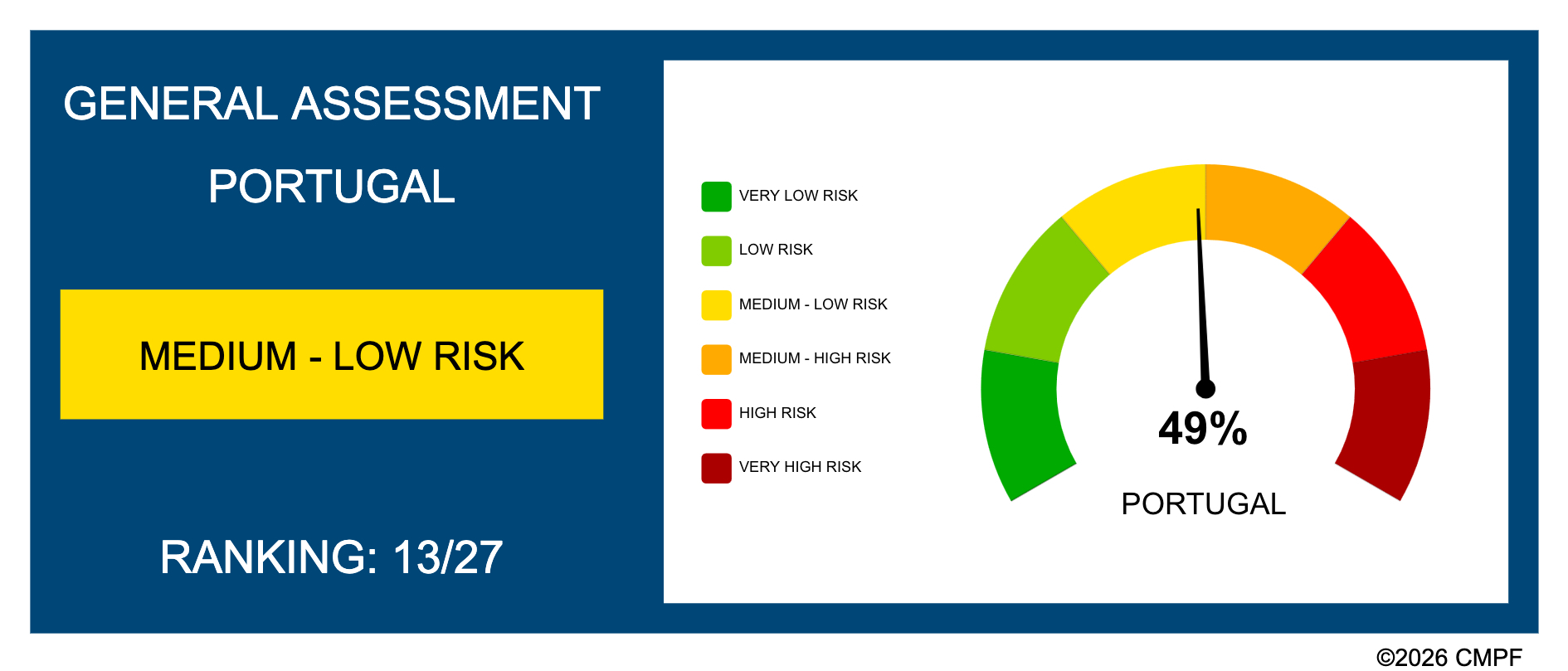
Media Pluralism Monitor 2026 results
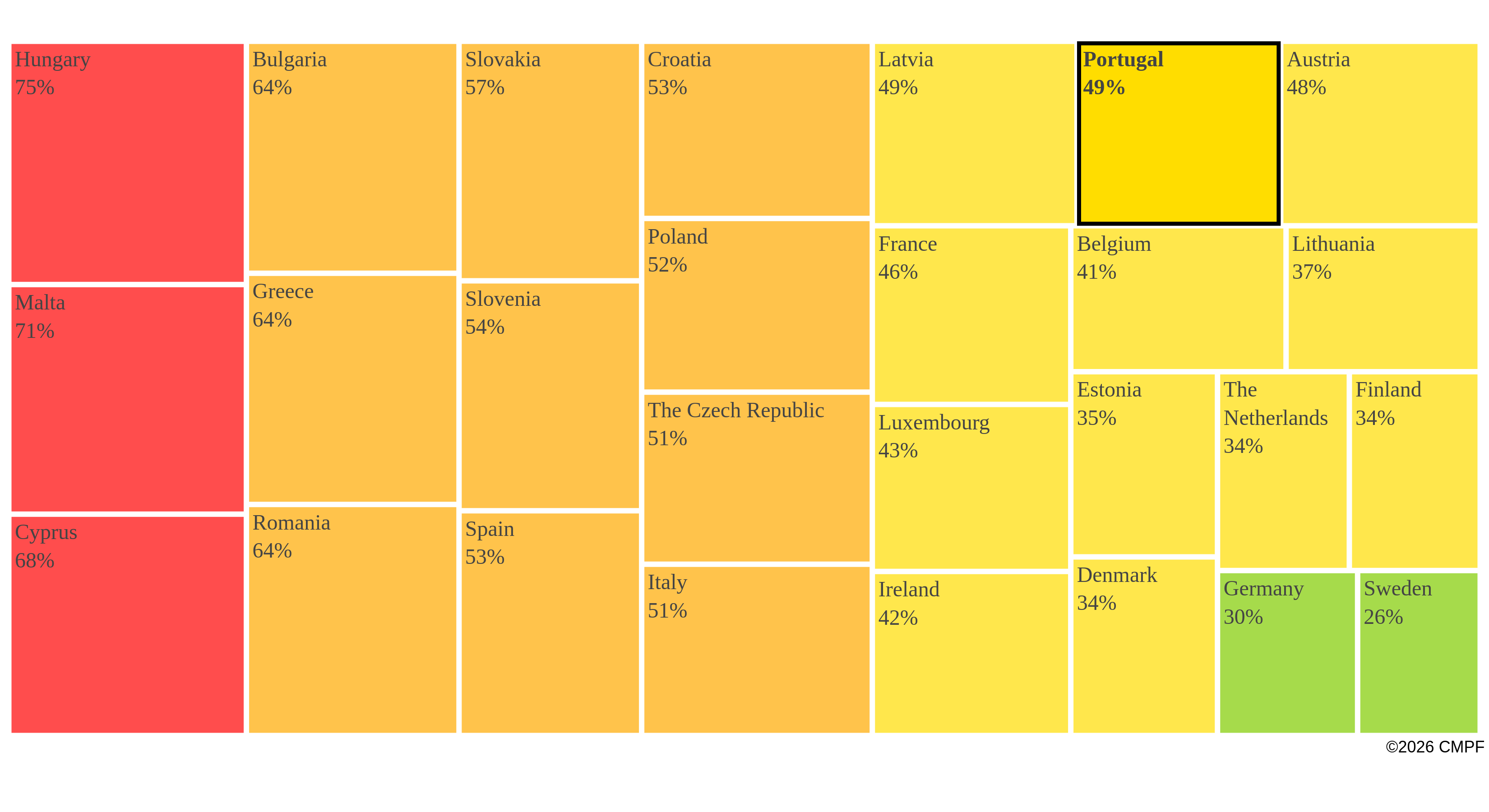
Risk score: 49%
| Fundamental Protection | 41% |
| Market Plurality | 58% |
| Political Independence | 30% |
| Social Inclusiveness | 66% |
In-depth analysis:
Read the full MPM2026 Country report
Country Overview
Following the Government’s fall on 11 March 2025, after the rejection of a confidence motion presented by Prime Minister Luís Montenegro, Portugal held legislative elections again on 18 May 2025. As a result, the AD coalition (composed of Social Democrats and Christian Democrats), which had been in Government, strengthened its vote share (31.21%), though it still fell short of an absolute majority. The main loser was the Socialist Party (PS), which dropped to 22.83% and lost 20 seats. Despite a similar percentage, the far-right party Chega (22.76%) surpassed the Socialists in the number of MPs, calling itself the “new leader of the opposition”.
In the 2025 Corruption Perceptions Index (TIP, 2026), Portugal scored 56 points. It fell to 46th place among 182 countries — its worst result ever — remaining below the European Union average and among the weakest performers in Western Europe. The decline reflects a negative trend that began in 2022 and stems mainly from less favourable assessments across several index sources, highlighting persistent weaknesses in public integrity, the effectiveness of prevention and oversight mechanisms, and the inaction of the current National Anti-Corruption Strategy (ENAC). Despite some legislative progress, policy implementation and institutional follow-up remain insufficiently consolidated. In response to these results, the Government argued that the drop in the ranking does not reflect ongoing reforms and that the Anti-Corruption Agenda launched in the previous legislative term constitutes a strategic plan based on the ENAC 2020–2024 evaluation. According to the Ministry of Justice, most of the 42 measures are underway, with several already completed, and an implementation report will be presented soon. Transparency International Portugal, however, links the worsening perception of corruption to the rise of populist discourse that undermines trust in institutions and calls for strengthening bodies such as the National Anti-Corruption Mechanism, as well as for a long-term strategy rather than isolated measures. Overall, the results suggest that structural challenges persist and require greater coordination, institutional capacity, and political commitment to improve public integrity in the coming years.
According to the Bank of Portugal (2025, p. 7), “economic activity in Portugal is expected to grow by 1.9% in 2025 (…), and inflation is expected to stabilise at around 2% over the projection. The Portuguese economy has been facing a succession of external shocks, including trade and geopolitical tensions, and armed conflicts. The relatively favourable performance within the euro area is expected to continue over the projection horizon, relying on the strength of the labour market, firms’ adaptability and innovation, and the orientation of activity towards services. Monetary and fiscal policies also support growth in domestic demand. However, there are significant risks surrounding the projections.” Meanwhile, at the end of 2025, The Economist named Portugal the “Economy of the Year 2025,” placing it at the top of a ranking of the world’s 36 richest economies. Highlighting strong GDP growth, low inflation, robust employment, and a thriving stock market—driven by tourism, foreign investment, technology, and a resilient service sector—the magazine emphasised Portugal’s solid macroeconomic fundamentals. In the article titled “Which economy did best?” (2025), Portugal is portrayed as having evolved from a mere lifestyle destination into a strategically positioned, well-balanced EU economy capable of attracting talent and capital despite global challenges.
Regarding market developments in the media sector, Portugal experienced two major events in 2025. First, the Impresa group was forced to seek foreign investment and restructure its shareholder base. In this context, the Italian company MFE – MediaForEurope is expected to invest €30 million in Impresa. The group originally founded by Silvio Berlusconi and controlled by the Berlusconi family will hold a 32,934% stake in Impresa. The Balsemão family will retain control with 33,738% of the shares, and the remaining shareholders will hold 33,328%. Francisco Pedro Balsemão will remain the company’s CEO.
Another development involved the Trust in News group, which the courts declared insolvent. Visão launched a crowdfunding campaign to keep the title in the hands of the 12 journalists who, since 1 August 2025, have been producing the magazine entirely remotely, despite delayed salaries, ensuring that each weekly edition continues to reach newsstands every Thursday. There was also the aftermath of the 2024 split from the Global Media Group, which has not yet led to a clear economic recovery for its main outlets: the century-old daily newspapers DN and JN and the radio station TSF. In fact, 2025 began with DN’s director announcing that the weekend print edition would be discontinued. In the case of public media, the withdrawal of private shareholders from the news agency Lusa — largely due to concerns about financial sustainability — left a significant ownership gap, which the State has now filled. As a result, the State effectively controls 100% of Lusa’s capital, raising critical questions about the extent of governmental influence over the Portuguese news agency.
Regarding legislative developments in the media sector, Portugal introduced new policy measures to strengthen press freedom and protect journalists. The most significant was the PNSJ – National Plan for the Safety of Journalists and Other Media Professionals (Plano Nacional para a Segurança dos Jornalistas e Outros Profissionais da Comunicação Social), approved by the Council of Ministers, which establishes a coordinated national strategy to address physical, digital, and professional risks faced by media workers. At the European level, the entry into force of the European Media Freedom Act further reshaped the regulatory landscape by imposing binding rules on editorial independence, ownership transparency, and limits on political interference. Portugal’s legal framework already provides strong safeguards for media independence, journalistic activity, and funding transparency. Because it is closely aligned with the EMFA’s core requirements, the Regulation is expected to be implemented smoothly in Portugal, without major difficulties.
A reference must also be made to the Media Action Plan (Plano de Ação para a Comunicação Social – PACS), which was launched in 2024 by the previous government and, in a sense, was overlooked in 2025. As highlighted in this year’s MPM report, the Portuguese media system’s difficult sustainability — across multiple dimensions (financial viability, working conditions, press distribution, innovation, etc.) — has led industry actors and unions to call for a more assertive implementation of the PACS repeatedly, warning of the gap between the measures announced by the Government and their actual execution on the ground (Simões, 2026). António Leitão Amaro, Minister of the Presidency, stated during a parliamentary hearing that the government is “fully committed” to implementing the Media Action Plan, including support for journalists in strengthening self-regulation, “without creating dependencies” (Governo de Portugal, 2024). The sector is still awaiting the creation of the Social Communication Code, intended to unify the legal framework and provide an integrated, simplified regulatory structure for the media sector.
Fundamental Protection
The Fundamental Protection area fell within the medium-low risk band. Key points include:
- Over recent years, defamation has been a major concern. Portugal still punishes defamation with imprisonment or fines under Penal Code Law 48/95, Article 180, which criminalises insults and the imputation of facts. Recent cases have often led to sanctions by the ECtHR for violations of freedom of expression.
- Portugal lacks anti-SLAPP laws that protect against abusive lawsuits. The government has designated the CCPJ as its focal point, and the CCPJ has issued a brief statement urging reporters to report SLAPP cases (CCPJ, 2025). No draft legislation or discussions are underway to transpose the EU anti-SLAPP directive, which is due by May 2026.
- Online content moderation respects constitutional rights and EU regulations, but transparency issues persist. Reports on moderation are limited and unclear, especially regarding ‘visibility moderation’ (the new form of censorship) and mistaken content removals. The DSA Coordinator (ANACOM) has received complaints but has not yet issued orders under the DSA. Public authorities also lack transparency in content moderation requests, with outdated information on their websites.
- Legislation addressing disinformation is scarce despite the rise in false narratives, though efforts such as Law No. 15/2022 aim to align with EU strategies. Coordination among entities is weak, with no comprehensive national strategy or regular monitoring in place.
- Legal protection of the right to information may be undermined by administrative practices that deny access without explanation. The 2024 report from CADA (Commission for Access to Administrative Documents) notes that nearly 14% of access requests were denied without full reasons, though some were later granted on review (CADA, 2025).
- Portugal’s whistle-blower law is limited, protecting only those reporting offences encountered in the course of professional duties, with minimal guarantees and poor enforcement. Awareness campaigns are lacking, and protections exclude victims of governance issues or environmental crimes. High-profile cases, ranging from corruption to cybercrime, highlight the need for stronger legal safeguards. Despite adopting a whistle-blower statute, Portugal did not fully implement EU recommendations, thereby restricting workers’ direct reporting rights and excluding many workers, underscoring the need for reform.
- Regarding journalists’ concerns and the sustainability of the media sector, the situation remains fragile, with ongoing payment issues and financial struggles. Precarious work undermines journalistic independence and ethics amid insecurity and exploitation. Job insecurity remains a key vulnerability in the sector.
- Regarding journalists’ physical safety, the situation in Portugal has become more complex amid heightened political polarisation. The Journalists’ Union has established a channel for reporting pressure and threats, including social media threats, calls, emails, and in-person insinuations, aimed at restricting journalists’ freedom.
- Portugal has robust protections for journalists but lacks specific measures to address illegal surveillance or the use of intrusive technologies, such as spyware. To prevent illegal surveillance, Portugal approved the PNSJ in 2025 to protect media professionals from online threats by providing training in online safety, data security, cyber resilience, and threat management.
- The Portuguese media regulator (ERC) operates within an independent framework that has certain flaws, blending formal protections with informal political influence, particularly in the appointment of board members. The regulator’s independence is also compromised by staffing and organisational limitations, as well as by persistent reliance on unpredictable state budget allocations. These factors create a gap between its de jure independence and its de facto vulnerability.
Market Plurality
The Market Plurality area fell within the medium-high risk band. Key points include:
- A few major private media players have large shares in several media sub-sectors. This creates an oligopolistic structure and major market power.
- Powerful platforms and conglomerates coexist with many small media firms. Small firms often face competitive challenges in this landscape.
- The Portuguese media laws do not consider the complexities of the current media ecosystems and the accelerated trends that promote ownership concentration.
- Portugal’s audience measurement framework remains inadequate for the demands of a hybrid media landscape.
- Media operators continue to rely mainly on traditional sources of revenue. A few examples of business diversification strategies within the sector can be identified. But the results are still modest.
- The journalist profession is under major pressure due to economic problems in many media operators. The specific situation of freelance journalists has considerably deteriorated over the past few years.
- CCPJ (Comissão da Carteira Profissional de Jornalista) has been stating that it is aware of the pressure to which some journalists holding professional press credentials are being subjected to produce sponsored content in the form of news articles, reports, interviews, and other journalistic genres.
Political Independence
The Political Independence area fell within the low-risk band. Key points include:
- The Transparency Law (Law nº 78/2015) requires media operators to disclose information, yet persistent shortcomings remain in preventing conflicts of interest. The ERC can suspend voting rights and property rights only when there are reports of default and, in corporate structures with foreign investors, it has not been able to identify the ultimate beneficiary.
- The government announced that ANACOM will be the supervisory authority for the AI Act and digital services, adopting a centralised governance model. This decision could mean downgrading the role AI plays in the spread of disinformation and political influence in the media.
- Due to structural precarity, media have adopted monetisation strategies that compromise their independence through paid content and sponsored events. The situation is alarming in the local press, where de-professionalisation and continuous revenue declines make journalism vulnerable to political control.
- There are no proven claims of political patronage in recruitment. However, hiring and firing directors and editors-in-chief is becoming more top-down. Decisions are made before consultation. In July 2025, RTP’s news director and his team were dismissed and replaced without consulting the ERC.
- Current media legislation does not effectively regulate the digital environment. The Media Code, announced in 2024 to update and unify legislation, has yet to be implemented. Meanwhile, political disinformation practices—closely tied to online platforms and driven by IA—continue to grow.
- In March 2025, the Government and RTP revised the public service concession agreement, which had been in force since 2015. RTP’s management has repeatedly argued that the CAV should be increased to modernise the company, but the government has so far rejected this. However, in November 2025, the government agreed to a €2.3 million capital increase to implement the second phase of the voluntary redundancy plan. This phase is expected to cover around 135 people and is projected to save €7.9 million annually in payroll costs.
- The acquisition process of the news agency Lusa was completed in November 2024, and the company became wholly owned by the State. In January 2026, new statutes were approved, introducing a governance model with three executives on the board of directors and an expanded advisory board of 13 members, including representatives from society and stakeholders. The agency will be subject to parliamentary scrutiny and supervised by a single auditor. Lusa’s journalists have protested, fearing loss of independence.
- Election interference via social media is a growing concern. In the May 2025 legislative elections, academic monitoring found evidence of coordinated behaviour and amplification strategies. The patterns point to a hybrid dynamic in which real and anonymous accounts operate within networks to promote politically aligned content, mostly far-right.
- The obligations imposed by the Regulation on Transparency and Targeted Political Advertising (EU 2024/900) are divided between the Entity for Political Accounts and Financing (ECFP), which oversees the financing and accounts of election campaigns, the National Elections Commission (CNE), and the ERC. A protocol was signed with the MediaLab Research Laboratory (ISCTE) to monitor disinformation on social networks during election campaigns. An exclusive WhatsApp line was also created so that citizens can report potentially misleading publications or paid advertising on social networks during the election period. These measures reinforce transparency and align with the objectives of the TTPA, although many shortcomings remain in effective internet regulation. Political parties continue to present very brief budgets detailing their spending on advertising and publicity during election campaigns, without specifying expenses for political communication disseminated through digital platforms.
- The CCPJ had no president for a year due to voting impasses. This weakened journalists’ self-regulation, limiting the CCPJ’s authority to issue and renew professional press credentials.
Social Inclusiveness
The area of Social Inclusiveness continues to carry the highest risk score among all four areas, placing it within the medium-high risk zone for 2025. Key points include:
- Women remain unrepresented in media content and in leadership positions. Gender inequality has worsened in 2025, and there are no signs of systematic efforts to address what seems to be a setback in this indicator.
- More than half of municipalities are news deserts, semi-deserts or are on the brink of becoming so. Economic challenges affecting local media companies’ sustainability continue to contribute to the decline of local and regional journalism. The possible shutdown of daily newspaper distribution in eight districts is raising public concern about limited access to news in rural and inland municipalities.
- Media literacy remains excluded from the compulsory education curriculum. The approval of the National Media Literacy Plan (2025-2029) in March 2025 is a very positive step, but its implementation and impact remain unknown. Media literacy initiatives targeting vulnerable groups remain scarce. In Portugal, 76% of the population has above basic information and data literacy skills.
- Cultural and linguistic communities continue to be underrepresented in media coverage. PSM and private media companies both lack a comprehensive diversity policy.
- Online hate speech is rising in Portugal. Still, persistent gaps in the legal framework, delays in the processing of discrimination complaints and the absence of monitoring and enforcement mechanisms challenge the proper addressing of this issue.
- Regarding media accessibility for people with disabilities, the minimum standards for audio description remain very low.