

Latvia 2026
Media Pluralism Monitor 2026 results
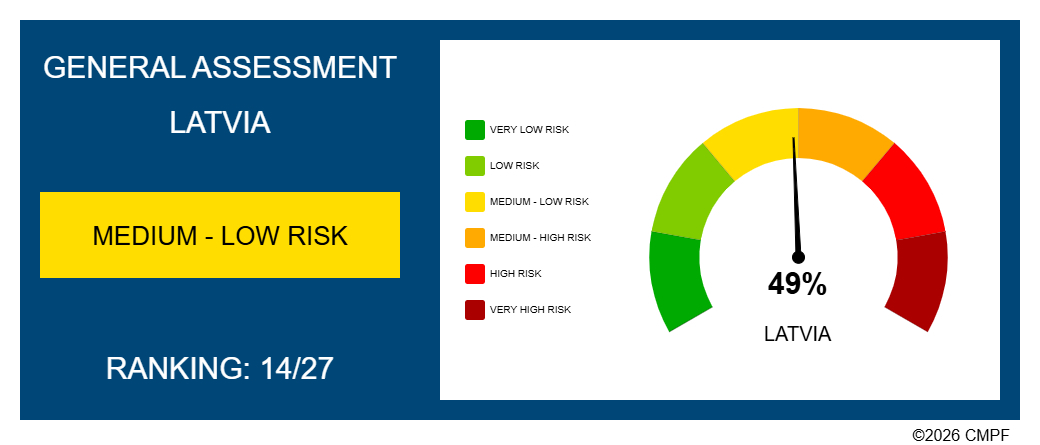
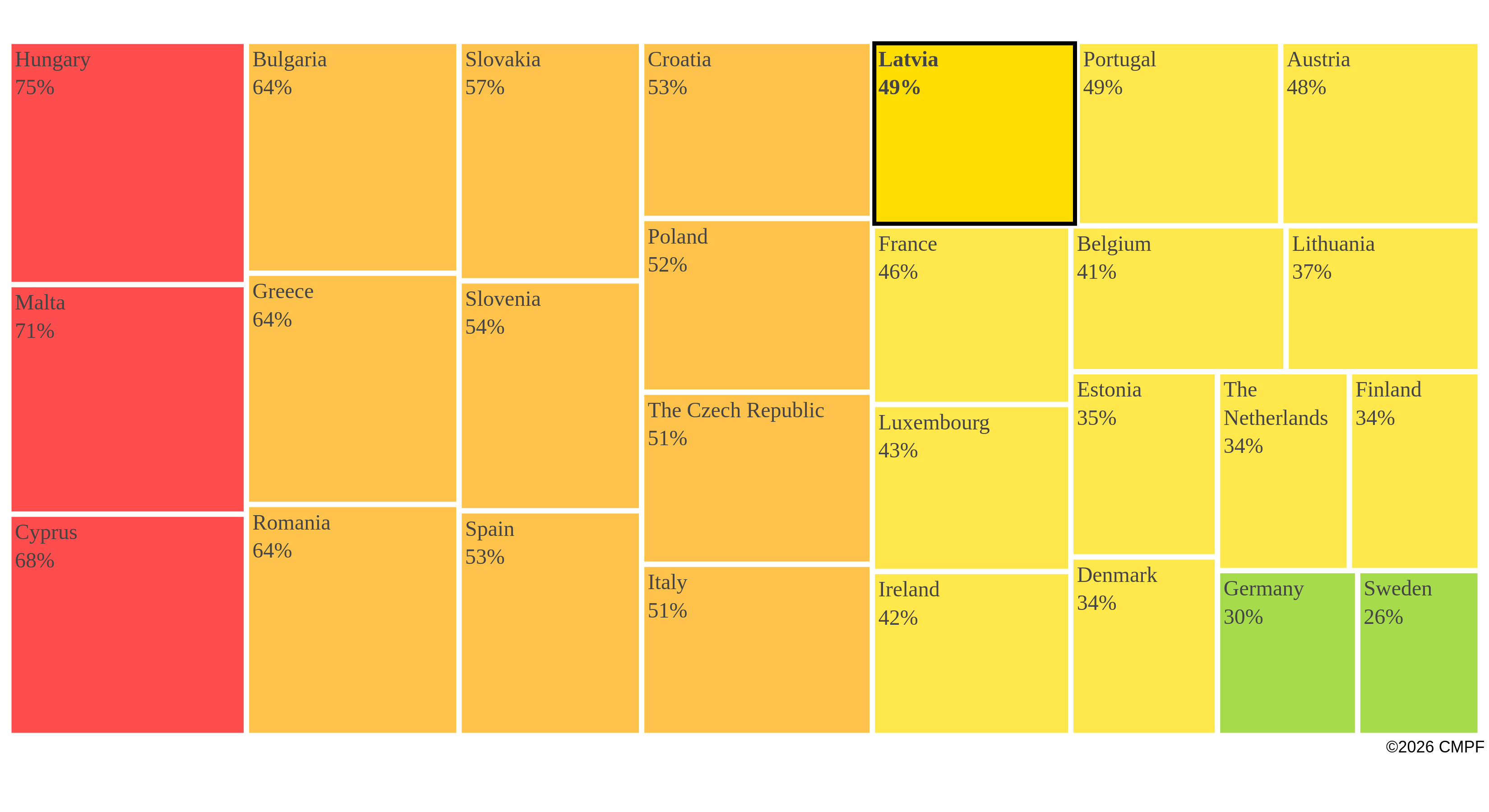
Risk score: 49%
| Fundamental Protection | 32% |
| Market Plurality | 72% |
| Political Independence | 34% |
| Social Inclusiveness | 58% |
In-depth analysis:
Read the full MPM2026 Country report
Country overview
In 2025, media regulation in Latvia mainly focused on adjustments to existing legislation and the implementation of the European Media Freedom Act (EMFA). The Ministry of Culture of Latvia prepared amendments to several regulatory acts to facilitate EMFA implementation. First, amendments to the Law on Public Electronic Mass Media and Administration (Latvijas Vēstnesis, 232, 01.01.2020) completed the first stage of the reform of Latvian public media. Since January 2025, a unified public media organisation has operated (Ministry of Culture, January 2, 2025), merging the previously separate entities Latvian Radio and Latvian Television (LV portāls, December, 30, 2025).
Second, changes to the Law on the Press and Other Mass Media (Latvijas Republikas augstākās Padomes un Valdības ziņotājs, 6/6, 14.02.1991) intends to prepare updated definitions of media and media service providers, to designate competent authorities responsible for implementing EMFA provisions, and to establish additional obligations for media service providers and public institutions (Cabinet of Ministers, January 20, 2026). Besides, amendments developed for the Law on the Press and Other Mass Media now requires the Enterprise Register of Latvia to publish self-declared information from media service providers on the total annual amount of public funding received for state advertising in the Mass Media Register. The reforms further envisage revising the Mass Media Register (MIL), shifting it from a register of individual media outlets to a register of media service providers, and gradually creating a dataset on public entities’ funding for state advertising on the Latvian Open Data Portal.
The NEPLP has also been designated as the authority responsible for assessing media market concentration and for monitoring and reporting annually on state advertising allocated to media outlets by public institutions. Finally, amendments to the Electronic Mass Media Law (Latvijas Vēstnesis, 118, 28.07.2010) replace the European Regulators Group for Audiovisual Media Services (ERGA) with the European Board for Media Services and expand the competences of the National Electronic Mass Media Council (NEMMC). Finally, at the beginning of 2026, the Ministry of Culture of Latvia announced plans to develop a new comprehensive media framework law till 2027 (Kultūras ministrija, March 4, 2026).
In parallel, the Ministry of Justice of Latvia prepared draft amendments to the Civil Procedure Law to transpose Directive (EU) 2024/1069 (EUR-Lex, 2023) on the protection against strategic lawsuits against public participation (SLAPP), strengthening legal protection for individuals engaged in public participation (LV portāls, October 27, 2025), which was endorsed by Parliament on April 16, 2026. The new Law on the Protection of Persons Involved in the Public Interest (Latvijas Vēstnesis, 84, 05.05.2026.) was approved by Parliament at May 5, 2026 and came into force at May 7, 2026.
To strengthen the goal of improving the safety of journalists included in the Latvian Media Policy Guidelines (2024 – 2027) (Latvijas Vēstnesis, 194, 04.10.2024), the Safety Plan for Journalists and Other Media Professionals for 2025–2027 was developed and approved in 2025 (Ministru Kabinets, November 11, 2025).
The main political developments affecting the media environment were the municipal elections (CVK, June 7, 2025) held in June 2025 and public protests (Satori, November 3, 2025) in November 2025 related to the denunciation of the Istanbul Convention (LR Saeima, October 30, 2025). The mentioned law adopted by the Parliament was returned for reconsideration by the President of Latvia (Office of the President, November 3, 2025), who decided that the issue should be addressed by the next parliament to be elected in October 2026.
Fundamental Protection
A low risk is observed in the Fundamental Protection area. Key points include:
- Latvian legislation guarantees the protection of freedom of expression. The country has ratified key international instruments, and constitutional provisions allow restrictions only under clearly defined conditions. In practice, however, occasional violations of freedom of expression occur.
- Journalists, experts, and specialists are among the most frequent targets of online attacks performed by politically engaged actors. Participants in fact-checking projects experience various forms of attacks on a regular basis.
- Attempts to restrict freedom of expression often originate from political actors, including representatives of political parties, members of parliament, and political communication professionals. Through public campaigns, they attempt to discredit journalists, media outlets, public media, and experts commenting on socially and politically sensitive issues such as ethnic minorities, migration, or language policy.
- In 2025, Latvia completed a major stage of public media reform: the previously separate organisations Latvian Radio and Latvian Television were merged into a unified public service media organisation.
- Media regulation developments in 2025 mainly concerned the implementation of the European Media Freedom Act (EMFA) and preparations for transposing the anti-SLAPP directive (amendments to the Civil Procedure Law prepared by the Ministry of Justice).
- SLAPP cases are not systematically monitored in Latvia, although individual cases with characteristics of SLAPP are occasionally discussed by media representatives and journalists.
Market Plurality
The Market Plurality domain continues to present a high level of risk. This is primarily driven by persistent concentration across media sectors and stagnating or declining advertising revenues. Among the five indicators in this domain, two are assessed as very high risk, one as high risk, one as medium–high risk, and one as medium–low risk. Key points include:
- Information on media ownership is publicly available through the Enterprise Register of Latvia, in line with the Law on the Prevention of Money Laundering and Terrorism and Proliferation Financing (Latvijas Vēstnesis, 116, 30.07.2008) and general commercial transparency requirements. These ensure disclosure of company ownership and beneficial owners. However, no media-specific regulatory framework exists that would require targeted transparency of ownership and ultimate beneficiaries in the media sector, including in the digital environment.
- The absence of sector-specific ownership transparency rules remains a key risk factor. General commercial regulation (Latvijas Vēstnesis, 158/160, 04.05.2000) applies to media companies, but does not fully address the specificities of the media market. Amendments related to the European Media Freedom Act foresee the creation of a dedicated media register; however, implementation is still ongoing. In practice, most media outlets have not yet made ownership and beneficiary information publicly available on their websites.
- The Latvian media market remained economically stagnant in 2025 as the amount of advertising increased by 1.6%. Advertising revenues declined in the newspaper, audiovisual and online sectors and increased in the radio sector (LRA, 2026), while investment in global platforms continued to exceed that of domestic media. This trend represents a structural constraint on media sustainability.
- As a result, relatively high levels of direct state support for quality journalism are insufficient to ensure the long-term viability of the media sector. Economic pressures continue to shape market dynamics and limit pluralism.
- High levels of market concentration, combined with the weakening of traditional media, increase the risk of commercial influence on editorial independence. This creates structural vulnerabilities affecting the autonomy of media organisations.
- Key policy responses to these challenges remain limited. In particular, measures aimed at addressing the growing market power of global platforms—such as the introduction of a digital tax—have not been implemented at the national level. Potential developments in this area may be linked to Latvia’s participation in the OECD/G20 Inclusive Framework on Base Erosion and Profit Shifting (Statement of 8 October 2021), which addresses taxation challenges arising from the digitalisation of the economy..
Political Independence
The Political Independence area remains within the medium–low risk range. Key points include:
- Main developments in media governance are based on strengthened transparency of ownership (Rožukalne, 2025), restrictions on municipal ownership under the Local Government Law (Latvijas Vēstnesis, 2022), and the consolidation and strategic development of public service media (PSM) in 2025 (LV portāls, 2025).
- Significant regulatory gaps persist, particularly the absence of legal provisions addressing conflicts of interest and limiting direct or indirect media ownership by political actors. Media ownership remains regulated primarily through general legislation such as the Commercial Law (Latvijas Vēstnesis, 2000) and the Law on Press and Other Mass Media (1991), which do not provide specific safeguards against political influence.
- Although no direct political interference in media content was identified in 2025, the lack of targeted regulation and the reliance on self-regulatory mechanisms—such as the Latvian Media Ethics Council and professional codes of conduct—mean that resistance to political pressure largely depends on editorial practices and journalistic culture rather than institutional guarantees.
- The integrity of political information during elections remains strong, supported by detailed regulation in the Pre-election Campaign Law (Latvijas Vēstnesis, 2012) and oversight by the National Electronic Mass Media Council (NEMMC, 2025) and the Corruption Prevention and Combating Bureau (CPCB, 2025). However, emerging risks relate to limited monitoring capacity, insufficient transparency of political advertising in digital environments, and the lack of comprehensive data protection oversight in online campaigning.
- State support to the media sector is generally provided through transparent and competitive mechanisms, particularly via the Media Support Fund administered by the Social Integration Fund, and through indirect measures such as subsidised press delivery (Cabinet of Ministers, 2025). Nevertheless, frequent adjustments to funding conditions and the absence of a clear regulatory framework for state advertising—despite policy discussions in 2025—indicate partial misalignment with the requirements of the European Media Freedom Act (Regulation (EU) 2024/1083).
- The independence of public service media (PSM) remains at a very low risk level, supported by legal safeguards under the Law on Public Electronic Mass Media and Their Management (Latvijas Vēstnesis, 2020), transparent governance structures, and stable public funding. However, recent public opinion data indicate a slight decline in perceived impartiality (Saulītis, 2025), alongside challenges related to the representation of diverse societal groups and potential future pressures linked to broader fiscal constraints.
Social Inclusiveness
The Social Inclusiveness area is within the medium–high risk band. Key points include:
- Sustainability challenges—limited audiences, revenues, and staffing—continue to affect local and regional media. Despite existing support mechanisms, quality and performance remain uneven. Public service media (PSM) are developing their regional presence, which was further strengthened in early 2026 with the establishment of the first local editorial office in Daugavpils; however, community media remain undefined in law, and their role within the media system is unclear.
- While accessibility has improved, gaps remain, particularly regarding the extent of subtitling, sign-language provision, technologically innovative solutions, and services for visually impaired audiences.
- Minority rights are formally protected, but policies lack practical effectiveness. The shift towards Latvian-language integration contrasts with previous practices of multilingual content provision, including in Russian. Planned reductions in Russian-language content in public service media raise concerns.
- The legal and policy framework addressing hate speech remains insufficiently implemented, with weak monitoring and ineffective cooperation with platforms (VSPs/VLOPs).
- Gender equality is supported by general policy commitments but lacks comprehensive implementation and monitoring. Women remain underrepresented in expert roles, and research data are limited.
- Media and information literacy (MIL) development is hindered by fragmented, project-based initiatives lacking sustainability, coordination, and data. Activities targeting vulnerable groups remain limited, and engagement by audiovisual media services and platforms is weak. While MIL is integrated into education policy, gaps persist in teacher training, coverage, and consistency.