

Bulgaria 2026
Media Pluralism Monitor 2026 results
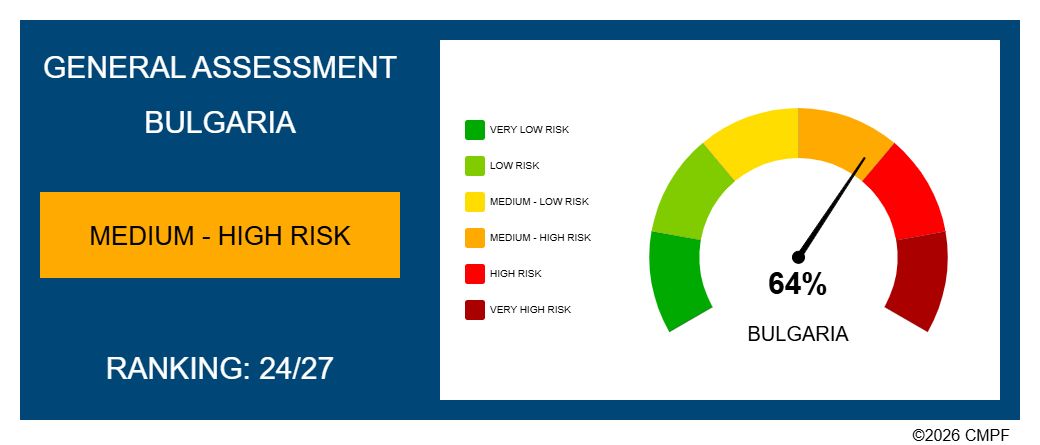
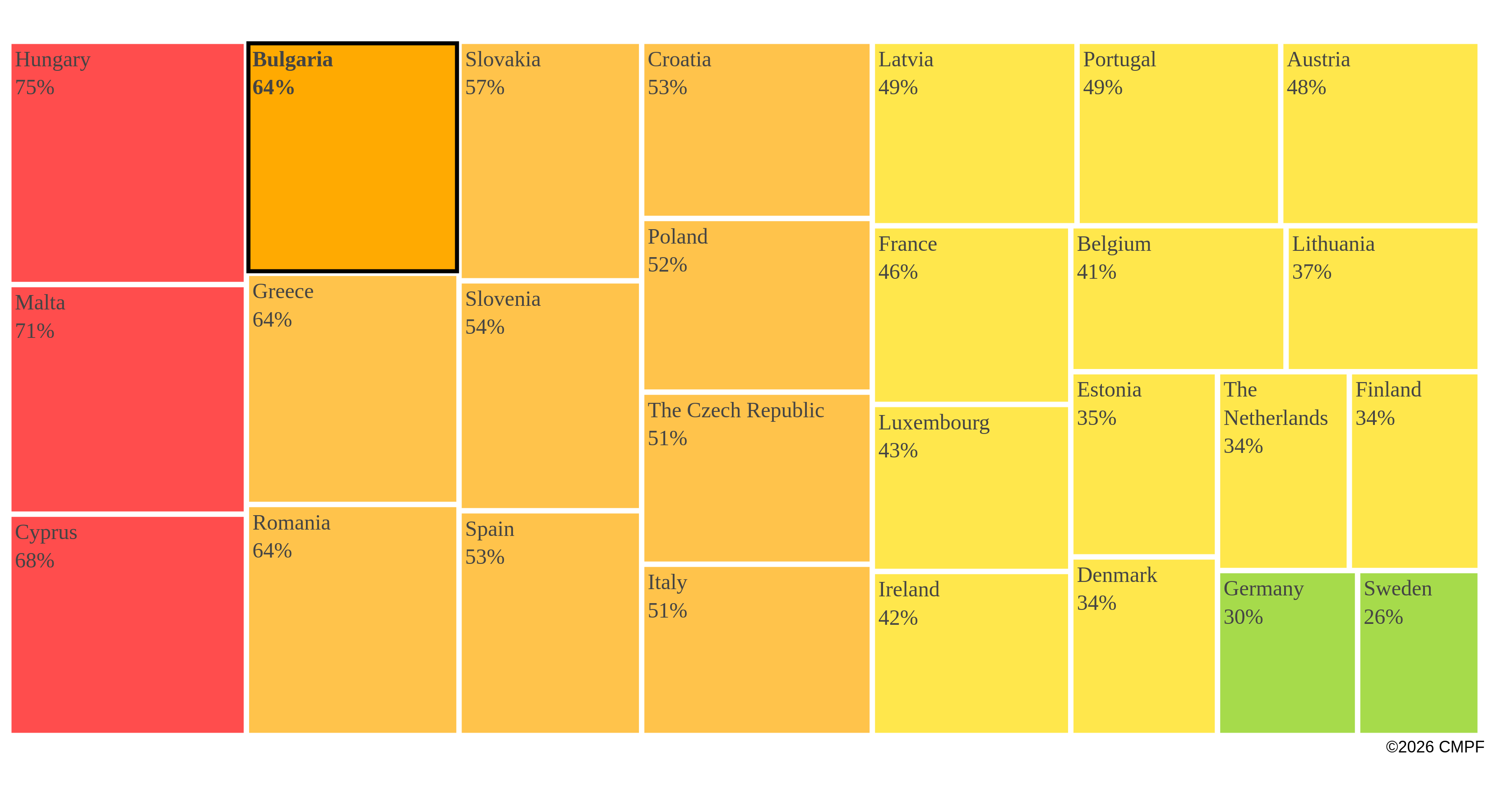
Risk score: 64%
| Fundamental Protection | 54% |
| Market Plurality | 79% |
| Political Independence | 54% |
| Social Inclusiveness | 69% |
In-depth analysis:
Read the full MPM2026 Country report
Country overview
In 2025, political instability in Bulgaria continued. The GERB-led coalition government, which was formed in January 2025, did not last a year. On 11 December, the government resigned after a series of massive protests expressing public discontent with political corruption and a controversial 2026 draft budget. After the National Assembly could not form a new government, new early parliamentary elections, the eighth parliamentary elections since 2021, were scheduled for 19 April 2026. The elections were won by Progressive Bulgaria (PB), a newly established coalition led by Rumen Radev, who stepped down as president in January 2026 after nine years in office. Radev’s PB secured a majority in the National Assembly with 44.6% of votes, followed by the GERB–SDS coalition with 13.4%, the We Continue the Change – Democratic Bulgaria coalition (PP–DB) with 12.6%, the Movement for Rights and Freedoms (DPS) with 7.1%, and the Vazrazhdane party with 4.3%. Despite political instability in recent years, Bulgaria managed to achieve a successful eurozone entry. In July 2025, the Council of the European Union confirmed Bulgaria’s readiness to introduce the euro on 1 January 2026, making the country the 21st member of the euro area. The transition to the euro was accompanied by social uncertainty, disinformation, and demonstrations against the adoption of the euro.
Against this background, the state of media pluralism did not improve. Although some necessary legal amendments were adopted, there were no substantial legislative changes for the implementation of the European Media Freedom Act (EMFA). In May 2025, the National Assembly adopted amendments to the Act on Protection of Persons, Reporting Information, or Publicly Disclosing Information about Breaches (Whistleblower Protection Act). The amendments were coordinated with the European Commission.
In July 2025, the minimum fines for insult and defamation were reduced in line with Bulgaria’s commitments to the European Convention on Human Rights. It was not until November 2025 that Bulgaria incorporated into its national legislation the Digital Services Act and empowered the Communications Regulation Commission (CRC) as the Digital Services Coordinator (DSC). Also in November 2025, amendments to the Protection of Competition Act were adopted to provide for the mandatory conduct of an in-depth investigation of concentration when an assessment is required from a specialised state authority that is legally mandated to regulate activities in the relevant sector.
However, no relevant amendments to the Radio and Television Act were made to empower the Council for Electronic Media (CEM) to carry out a media pluralism test in media concentration cases. In addition, Article 30, section 4 of the EU Audiovisual Media Services Directive 2018/1808 regarding the adequate financial and human resources provided to the national regulatory authorities has not yet been transposed. There has still been no progress regarding the alignment of Bulgarian legislation with the Commission Communication on the application of State aid rules to public service broadcasting. The lack of anti-SLAPP legislation continues to be a pressing issue amid the ongoing practice of SLAPPs against critical media outlets, journalists, and civil society activists.
Fundamental Protection
The Fundamental Protection area scores within the medium-high risk band. Key points include:
- In 2025, the minimum fines for insult and defamation in the Criminal Code were reduced in line with Bulgaria’s commitments to the European Convention on Human Rights.
- The case law of the European Court of Human Rights in 2025 confirmed that the Bulgarian state had failed to adequately protect freedom of expression and access to information (ECtHR, 2025a, 2025b).
- Freedom of expression of activists and civil society organisations (CSOs) is under increasing pressure, with practices of stigmatisation, political attacks and legal intimidation.
- In the absence of legislation against SLAPP lawsuits, SLAPPs continue to be a pressing problem in Bulgaria, negatively impacting freedom of speech of journalists, the media, and civil society activists.
- In 2025, the balance between the protection of information integrity and freedom of expression online remained unguaranteed in practice. Bulgaria incorporated into its national legislation the Digital Services Act and eventually empowered the Communications Regulation Commission as the Digital Services Coordinator as late as November 2025.
- Bulgaria lacks a comprehensive national strategy to address disinformation and foreign information manipulations and interference (FIMI). In practice, activities to monitor, analyse, and counter disinformation are largely undertaken by CSOs, academic institutions, and media initiatives; however, their overall impact remains limited, and disinformation continues to persist. It was not until March 2026 that the caretaker government established a temporary coordination mechanism within the Ministry of Foreign Affairs to counter disinformation and FIMI ahead of the early parliamentary elections on 19 April.
- Several developments have raised concerns regarding access to information, including legislative changes that may delay court cases concerning access to information, and regulatory amendments restricting public access to notarial deeds in the Property Register, a key resource for investigative and anti-corruption journalism.
- Journalists continue to face obstacles in exercising their profession, including limited transparency from state institutions, hostility by political actors, online harassment, and unfavourable working conditions.
- There remains a need to refine national legislation in order to strengthen the effectiveness of the media regulatory authority. In this context, and amid legal disputes and institutional tensions, the Council for Electronic Media was once again unable in 2025 to exercise one of its key powers – electing a director general of the Bulgarian National Television. A new director general was eventually elected in February 2026.
Market Plurality
The Market Plurality area continues to be the most problematic among all four areas for Bulgaria, remaining within the high-risk band. Key points include:
- Bulgaria does not meet the EMFA standards in several market-related areas, including the absence of a designated authority responsible for the national media ownership database (Art. 6), and the lack of implementation of transparent and reliable audience measurement systems for both traditional and digital media (Art. 24).
- Despite existing legal provisions for transparency of media ownership and ownership registers, information is still not effectively provided to the public. Lack of transparency is most pronounced in the online sector.
- Bulgaria has not yet introduced into national law substantive and procedural rules for the assessment of media market concentrations. In November 2025, amendments to the Protection of Competition Act introduced a requirement to consider assessments from sectoral regulators, meaning that the Council for Electronic Media’s opinion might be taken into account in media concentration cases. However, the Radio and Television Act has not been amended accordingly, and the media regulator is not yet empowered to conduct a media pluralism test.
- Against the backdrop of insufficient data for the reliable assessment of media market concentrations, data on advertising revenues indicate a high concentration in the audiovisual sector.
- In 2025, there was no progress regarding financial agreements between digital intermediaries or Generative AI providers and news publishers to remunerate the rightsholders for the use of copyright-protected content.
- Despite the increase of advertising revenues in the audiovisual, radio and online sectors, media viability remains fragile. The state does not provide support schemes for the news media sector. The media are expanding their search for alternative sources of revenue, but such models remain fragmented.
- Although there are regulatory and self-regulatory provisions for editorial independence from commercial interests, in practice they are often ineffective. The non-media business activities of media owners continue to influence editorial content.
- There are still no mechanisms granting protection to journalists in accordance with the Commission Recommendation (EU) 2022/1634 of 16 September 2022 on internal safeguards for editorial independence and ownership transparency in the media sector – in cases of arbitrary interferences by owners, changes of ownership or editorial line.
Political Independence
The Political Independence area falls within the medium-high risk band. Key points include:
- Concerns about covert political control over commercial media service providers persist. In 2025, the highest risk was observed in the audiovisual and online sectors, which are effectively the most influential news sectors in Bulgaria.
- Cases in the audiovisual sector in 2025 revealed that media managers apply self-regulatory standards and legal safeguards of editorial independence in questionable ways.
- There are no regulatory safeguards ensuring that decisions regarding appointments and dismissals of editors-in-chief are not dependent on political influences, and this has negative effects on the news sector in practice.
- Concerns persist regarding interference by sponsors from third countries and coordinated inauthentic behaviour on social media in the context of political campaigning.
- There are no national measures regulating the activity of political advertising by influencers in electoral periods.
- Bulgaria continues to lack safeguards for fair and transparent distribution of state advertising, and in 2025 no progress was made in this regard amid ongoing criticism. Article 25 of the EMFA is not implemented.
- Concerns about the independence of the Bulgarian National Television and its management were reiterated in 2025, amid criticism over the representation of political viewpoints and controversial developments surrounding the mandate of the director general.
- For yet another year, no progress has been made in the legislative sphere regarding the provision of better safeguards for the independence of public service media in relation to funding mechanisms.
Social Inclusiveness
The Social Inclusiveness area again scores within the high-risk band. Key points include:
- Although in recent years there has been progress in media accessibility for people with disabilities, further improvements are needed, particularly regarding services provided by multiplex operators, the availability of subtitles on demand, and the introduction of audio descriptions.
- Except for some fragmented anti-discriminatory principles, the media sector lacks comprehensive media policies for the promotion of diversity standards.
- Online hate speech remains widespread, while reporting mechanisms continue to be largely ineffective, and a comprehensive, coordinated, and sustainable approach between governmental and non-governmental actors to address the issue is still lacking. Lengthy legal proceedings, limited enforcement, and persistent use of aggressive rhetoric by political actors further impede protection against hate speech.
- Local and regional media continue to operate in an unstable market environment, access to local news sources varies across regions, while independent journalism at the local level is at risk.
- Against the backdrop of the feminisation of the journalism profession in Bulgaria, the representation of men and women in news and political content is unbalanced, particularly with regard to the underrepresentation of female experts.
- The lack of governmental measures to advance a national media literacy policy has prompted concerns among experts and organisations. Although civil society organisations continue to promote media literacy, their efforts have a fragmented impact.