

Slovakia 2026
Media Pluralism Monitor 2026 results
Risk score: 57%
| Fundamental Protection | 49% |
| Market Plurality | 69% |
| Political Independence | 52% |
| Social Inclusiveness | 57% |
In-depth analysis:
Read the full MPM2026 Country report
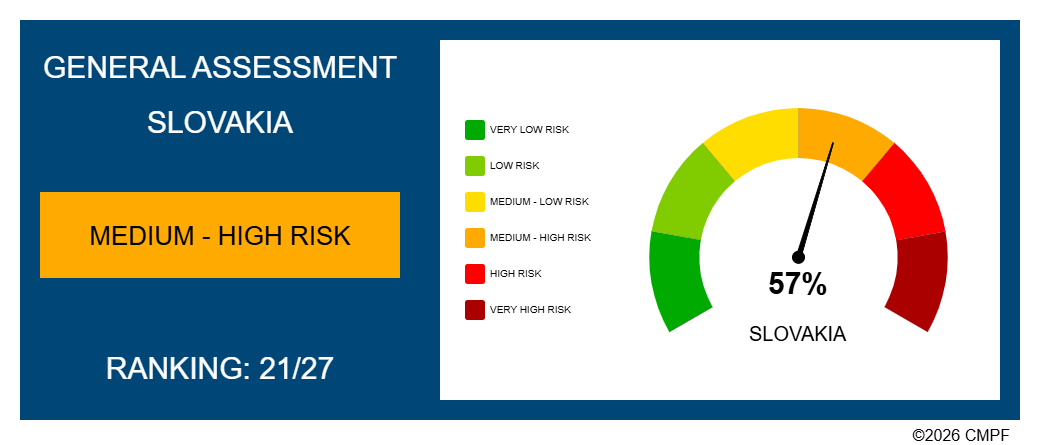
Country Overview
In 2025, politics in Slovakia continued to be dominated by the government of Prime Minister Robert Fico and his coalition of Direction-Social Democracy (Smer-SD), Voice-Social Democracy (Hlas-SD), and the Slovak National Party (Slovenská národná strana, SNS). Although the coalition briefly lost its parliamentary majority early in the year due to internal disputes and defections, Fico managed to stabilize the government through negotiations with independent and dissident lawmakers and by reshuffling the cabinet.
At the same time, the government pursued a more confrontational foreign policy stance, opposing further sanctions against Russia and criticizing Ukraine, especially during a dispute over the halt of Russian gas transit through Ukraine that had significant economic implications for Slovakia. These positions contributed to tensions with EU partners and domestic protests by opposition supporters concerned about the country’s geopolitical direction.
Domestically, 2025 was marked by several controversial institutional and constitutional reforms. The parliament approved a constitutional amendment recognizing only two sexes, which critics argued could undermine minority rights and Slovakia’s international obligations (Associated Press, 2026). Other measures included proposals affecting NGOs and the dismantling of the Office for the Protection of Whistleblowers, an independent oversight institution, raising concerns about the rule of law and democratic standards.
However, the Constitutional Court of the Slovak Republic promptly suspended the effectiveness of the law abolishing the Office. After the European Commission froze a payment from Slovakia’s Recovery and Resilience Plan in late January 2026 over concerns about the reform, the government subsequently decided to repeal the law (The Slovak Spectator, 2026).
Media governance became a particularly contentious issue in Slovakia in 2025, with developments pointing to a regressive trajectory rather than progress. Following the 2024 replacement of the public broadcaster Radio and Television of Slovakia (Slovenský rozhlas a televízia, RTVS) with Slovak Television and Radio (Slovenská televízia a rozhlas, STVR), which resulted in the termination of the mandates of the RTVS Director General and the RTVS Council, the newly established STVR Council was composed largely of individuals with direct political or institutional ties to the governing coalition (Hanák, 2025).
In 2025, the STVR Council appointed a new Director General during a closed-door session, despite legal provisions requiring public deliberation, and without disclosing either the list of candidates or the reasoning behind the decision (European Centre for Press and Media Freedom, 2025a).
Concerns about regulatory independence also extended to the Council for Media Services (Rada pre mediálne služby), the country’s media regulator. At the beginning of 2026, the sudden dismissal of the head of its office intensified debate about possible political pressure on media oversight bodies and the broader stability of the institutional framework governing the Slovak media environment (Denník N, 2026).
According to a draft amendment submitted to parliament by one of the coalition parties and discussed in second reading in February 2026, the Council for Media Services would be transformed into a National Media Authority (Národný mediálny úrad), in which the entire media environment would be overseen by a single chair elected by the governing majority (TASR, 2026). While the council would formally remain in place, the proposal transfers all key decision-making powers to the regulator’s chair. This would represent a fundamental shift from a collective governance model to single-person decision-making, entailing a high concentration of regulatory power.
At the same time, attacks on journalists continued to increase in 2025 (Investigative Center of Ján Kuciak, 2026), with many incidents fuelled by politicians who publicly target journalists from positions of power. Taken together, these developments raise serious concerns about the independence of media institutions and the overall trajectory of media freedom in Slovakia.
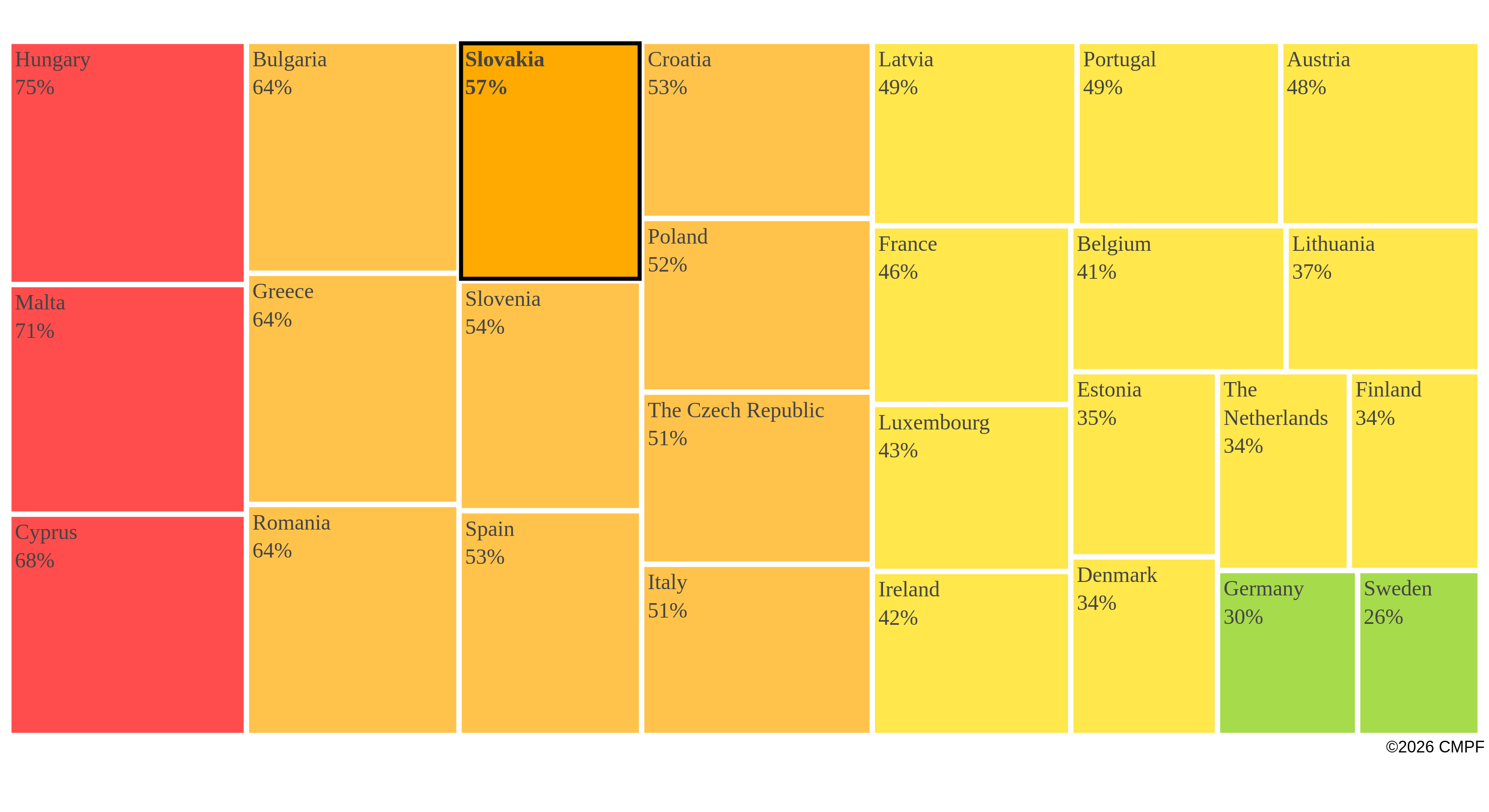
Fundamental Protection
The Fundamental Protection area fell within the medium-low risk band, although the risk score is approaching the border with medium-high level. Key points include:
- Concerns about the independence of the Council for Media Services (Rada pre mediálne služby), Slovakia’s media regulator, increased in 2025. Although there is no evidence that the authority’s decisions fell outside legitimate regulatory practice, in 2025, the parliamentary majority appointed six new members to the nine-member Council, several with direct political or institutional ties to governing parties (Hanák, 2025). At the same time, the ruling Slovak National Party proposed legislation to transform the regulator into a National Media Authority and concentrate decision-making powers in a chair elected by Parliament (TASR, 2026). Further debate followed the sudden dismissal of the head of the regulator’s office in early 2026 (Denník N, 2026).
- Attacks on journalists have increased again (Investigative Center of Ján Kuciak, 2026). Female journalists are disproportionately targeted, while legal action against perpetrators remains rare. Analysis by the Investigative Center of Ján Kuciak (2026) further indicates that the actual number of attacks—particularly in the online environment—is significantly higher. Politicians also contribute to this trend by publicly targeting journalists from positions of power.
- The ruling coalition attempted to dismantle the Office for the Protection of Whistleblowers, the independent oversight body responsible for whistleblower protection, raising concerns about the rule of law and democratic standards. The Constitutional Court of the Slovak Republic subsequently suspended the effectiveness of the law abolishing the office. After the European Commission froze a payment from Slovakia’s Recovery and Resilience Plan in late January 2026 due to concerns about the reform, the government decided to repeal the law (The Slovak Spectator, 2026).
- Slovakia has not yet implemented a comprehensive legal framework to address strategic lawsuits against public participation (SLAPPs). In 2025, however, the Ministry of Justice presented an amendment to the Civil Procedure Code intended to transpose the EU Anti-SLAPP Directive. The proposed amendment goes beyond the directive’s minimum scope, as it does not limit its application solely to court proceedings with a cross-border element. Until such legislation is adopted and implemented, the absence of a dedicated anti-SLAPP framework continues to leave journalists vulnerable to abusive litigation. Several suspected SLAPP cases were recorded in 2025 (Investigative Center of Ján Kuciak, 2026), contributing to a chilling effect on freedom of expression, despite the absence of direct state violations.
- Defamation remains a criminal offense punishable by up to eight years’ imprisonment under Act No. 300/2005 Coll. (Criminal Code), making Slovakia’s defamation regime among the strictest in Europe (Griffen, 2017), although convictions in practice remain extremely rare.
- In November 2025, the Constitutional Court ruled that charging fees for the provision of information under Act No. 211/2000 Coll. on Free Access to Information is incompatible with the Constitution. The Court had already suspended the effectiveness of these provisions in March 2025. The amendment extended response deadlines for information requests and introduced the possibility of charging fees, raising concerns about potential restrictions on access to public information. In addition, although appeal mechanisms for denials of access to information exist, judicial proceedings tend to be slow and there is no specialised independent body providing a faster review process (Centre for Law and Democracy & Access Info Europe, 2025).
- The lack of transparency in online content moderation limits platform accountability, with major digital platforms failing to provide sufficient data on content removals.
- Slovakia lacks a dedicated strategy to combat disinformation, and weak measures against foreign information manipulation leave the country vulnerable to influence operations. Political reshuffling after the 2023 elections disrupted strategic communication efforts (Prague Security Studies Institute, 2023), further weakening the government’s response to disinformation threats.
Market Plurality
The area of Market Plurality continues to carry the highest risk score among all four areas, placing it within the high risk zone for 2026. Key points include:
- Slovakia faces high levels of media ownership concentration, with the top four owners controlling over 60% of the audience in the newspaper, TV, and radio sectors, according to the available data. However, the limited size of the Slovak media market must be considered when interpreting these results. The country also lacks sufficient data on market share based on revenue, making it difficult to assess the full impact of this concentration.
- While regulations ensuring media ownership transparency are in place, measures to prevent excessive media ownership concentration remain limited. Although the safeguards introduced in 2022 (Act No. 264/2022 Coll. and Act No. 265/2022 Coll.) formally apply across all media sectors (TV, radio, press, news websites, and news agencies), in practice, the Council for Media Services—the national media regulator—has the competence to prevent high ownership concentration only in relation to audiovisual media services. Moreover, the applicable thresholds are based on shares of the advertising market. It remains unclear, however, whether and how the regulator collects the relevant data, as this information is not disclosed in its annual reports.
- The Publications Act (Act No. 265/2022) requires the Ministry of Culture to establish a unified media register within 30 months of the Act’s entry into force in August 2022. However, the register is still not operational. Information on media owners and ultimate beneficial owners is nevertheless available online through the Register of Public Sector Partners, although this is not a dedicated national media ownership database. Also, national legislation does not establish specific financial reporting obligations for media companies.
- Efforts to balance economic resources between media outlets and online platforms remain insufficient, as the 2022 amendment to Act No. 185/2015 Coll. (the Copyright Act) did not lead to significant changes. Furthermore, there is no indication of financial agreements between Generative AI providers and media outlets to remunerate rights holders for the use of copyright-protected content.
- Revenue trends in the media sector remain mixed. After accounting for inflation and GDP growth, revenues in the television and digital-native media sectors appear to be increasing, while the radio sector remains broadly stable and the newspaper sector appears to be in decline. However, limited and outdated data prevent a comprehensive assessment of these sectoral developments.
- There is no support scheme for the news media sector, aside from a VAT reduction for printed press (Act No. 222/2004 Coll. on Value Added Tax).
- Slovakia lacks safeguarding mechanisms for content integrity, as there are no comprehensive regulatory or self-regulatory measures to protect journalists from ownership changes or shifts in editorial policy, nor to guarantee the independence of editorial decisions from commercial interests.
- Major Slovak media outlets are owned by Slovak and Czech business figures with investments across multiple industries (Godársky & Mračka, 2023), which increases the risk that editorial content may be influenced by commercial interests. Several suspicious cases reported in previous years—such as suspected hidden native advertising (Denník N, 2024a) and the alleged promotion of owners’ other business interests (Denník N, 2023a)—have raised doubts about editorial independence. Although no new anecdotal evidence was recorded in 2025, the underlying structural conditions remain unchanged and there are no indications that the situation has improved.
Political Independence
The Political Independence area fell within the medium-high risk band. Key points include:
- In 2025, concerns about the independence of Slovak Television and Radio (STVR), which replaced the former public broadcaster RTVS under Act No. 157/2024 Coll., intensified. The reform abolished RTVS, a step that the Minister of Culture openly acknowledged was intended to replace the broadcaster’s leadership (Pluska.sk, 2024; Pravda, 2024; TA3, 2024). It also resulted in the termination of the mandates of the Director-General and the Council, raising concerns about political interference in the governance of public service media. The newly established STVR Council consists solely of members elected by Parliament and the Ministry of Culture through a process dominated by the governing coalition, with several members having direct political or institutional ties to ruling parties (Hanák, 2025).
- In May 2025, the STVR Council appointed a new Director General—whose family and professional background are closely connected to actors linked to the ruling SMER party—in a closed-door session without a public hearing or disclosure of candidates (European Centre for Press and Media Freedom, 2025a), further intensifying concerns about the politicisation of STVR’s leadership.
- In 2025, STVR announced plans to dismiss approximately 5% of its employees as part of cost-cutting measures. In March 2026, however, media outlets began reporting on an alleged list of employees intended for dismissal; according to the management, the selection was based on the findings of an external audit, although the audit report has not been made public (SME, 2026). News reports indicate that those targeted are predominantly creative staff, including several outspoken critics of recent changes at STVR and all publicly active members of the strike committee, raising suspicions that the dismissals may serve to remove employees critical of the current management (SME, 2026).
- Concerns about the impartiality and balance of STVR’s news content increased in 2025. Empirical analyses by NGOs, although limited in scope, indicate increasing politicisation of evening news coverage, including greater prominence of government actors, limited space for opposition voices, and the uncritical reproduction of official narratives (MEMO 98, 2025; Transparency International Slovensko, 2025a, 2025b). Additional incidents—such as the cancellation of critical programmes and the dismissal of a journalist after criticising management—have further reinforced concerns about growing political influence over editorial decisions (European Centre for Press and Media Freedom, 2025b, 2025c; Hanák, 2025).
- In February 2026, the Constitutional Court of the Slovak Republic referred preliminary questions to the Court of Justice of the European Union regarding whether the Slovak law establishing Slovak Television and Radio complies with the European Media Freedom Act. The questions concern, among other issues, the procedures for appointing and dismissing the Director-General and Council members, safeguards for the independence of the STVR Council from the executive, and protections for editorial independence (Constitutional Court, 2026). The case stems from a 2024 constitutional complaint by opposition members of the National Council of the Slovak Republic challenging both the substance of the law and the legislative process by which it was adopted.
- Concerns about indirect political pressure on selected commercial media outlets persisted in 2025. Developments at TV Markíza—Slovakia’s largest commercial broadcaster—continued to raise questions about editorial independence following earlier management changes and shifts in newsroom practices. In 2025, several prominent journalists and presenters left the broadcaster, citing political pressure, censorship, or the silencing of critical voices (European Centre for Press and Media Freedom, 2025d, 2025e, 2025f).
- Issues regarding editorial independence were also identified in the local and regional press: many municipal newspapers operate under conditions that do not sufficiently guarantee independence from local authorities, increasing the risk of their misuse for electoral campaigning (Transparency International Slovensko, 2025c).
- Slovakia lacks effective regulatory safeguards to prevent conflicts of interest and politicians can still own media outlets.
- Editorial independence, including the appointment of editors-in-chief, is not fully guaranteed due to the lack of comprehensive internal (within media organisations) and external (industry-wide) safeguards. Additionally, existing self-regulatory measures seem ineffective in preventing political or owner influence in practice.
- Act No. 181/2014 Coll. on Electoral Campaigns, which mandates campaign spending reports, has major transparency gaps, making expenditures opaque and creating opportunities to circumvent spending limits (Transparency International Slovensko, 2025d).
- Since 2025, the transparency of state advertising has been regulated in the amended Media Services Act (Act No. 264/2022 Coll., as amended in connection with the European Media Freedom Act). As the regulation is new, its practical implementation remains unclear. Recent analyses suggest that state advertising in Slovakia has been distributed unevenly and often without transparent criteria, with spending concentrated among a small number of state-linked entities and selected media outlets (Hanák, 2025; Transparency International Slovakia, 2026).
Social Inclusiveness
The Social Inclusiveness area fell within the medium-high risk band. Key points include:
- Up to a third of Slovakia’s population lives in media deserts, meaning areas with little to no local or regional media coverage (Transparency International Slovensko, 2024a). Economic challenges and the lack of dedicated state funding contribute to the decline of independent local and regional journalism.
- Regarding media literacy, no major improvement was recorded in 2025. Despite the ongoing efforts of multiple NGOs and the Council for Media Services, which coordinates activities in the field (Council for Media Services, 2025a), progress is significantly hindered by the absence of an up-to-date, comprehensive policy framework. Due to long-term neglect, the share of the population with above-basic information and data literacy skills remains below the EU average (Eurostat, 2025a).
- Despite its inclusion in school curricula, media literacy education lacks consistent implementation (Bielčiková, 2021; Polievková et al., 2022). Also, vulnerable groups receive little targeted support.
- Online hate speech remains widespread, while enforcement mechanisms appear insufficient to address the challenge. Monitoring by DIGIQ found persistent illegal hate speech across major platforms in Slovakia and very low removal rates when content was reported by ordinary users (DIGIQ, 2025). Investigative reporting also documented coordinated hateful political advertising targeting journalists and civil society on Meta platforms (European Centre for Press and Media Freedom, 2025g).
- Slovakia has a relatively strong legal framework for media accessibility (incl. Act No. 264/2022 Coll. on Media Services). Full compliance with accessibility requirements is expected by 2027.
- There is no comprehensive data on the media representation of legally recognised minorities, making assessment difficult. Both commercial and public service media lack comprehensive diversity policies to promote cultural and linguistic diversity in media content and production.
- Women remain underrepresented in media leadership positions. Similarly, women are significantly underrepresented as guests on TV talk shows. The underrepresentation of women in media content is rarely considered problematic, and systematic efforts to address it are lacking. STVR, the public service medium, lacks a comprehensive gender equality policy.
- Internet access and broadband mobile subscriptions in Slovakia remain below the EU average (Eurostat, 2025b; Eurostat, 2024), limiting digital inclusion.