

France 2026
Media Pluralism Monitor 2026 results
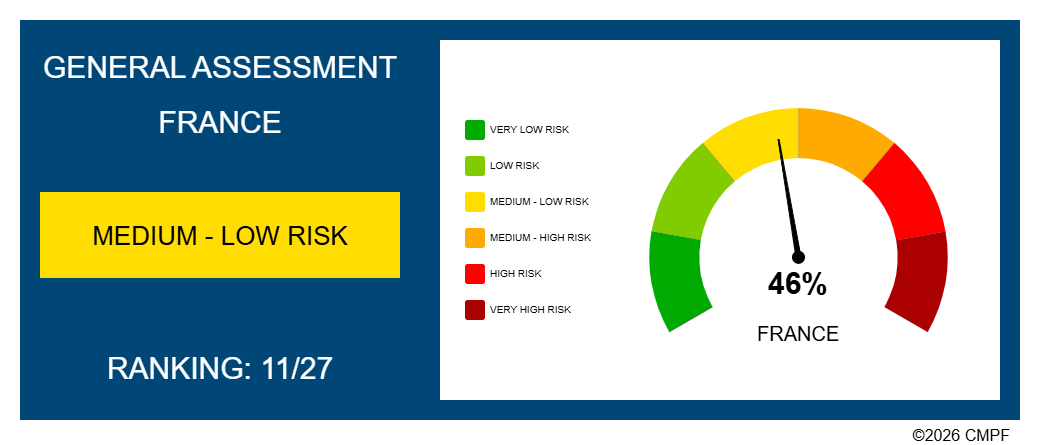
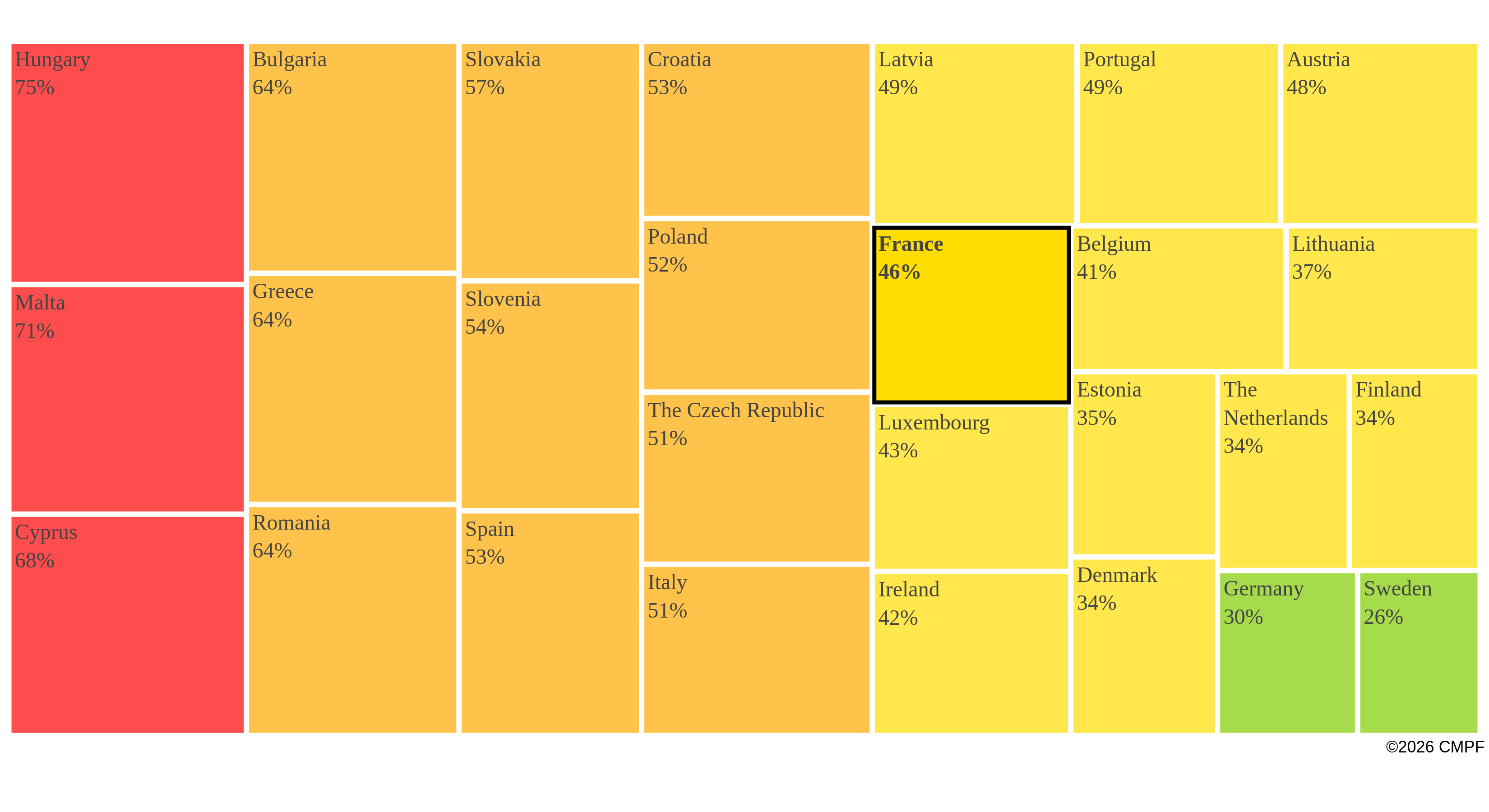
Risk score: 46%
| Fundamental Protection | 40% |
| Market Plurality | 71% |
| Political Independence | 39% |
| Social Inclusiveness | 34% |
In-depth analysis:
Read the full MPM2026 Country report
Country overview
Following a tumultuous 2024 — marked by snap legislative elections triggered by President Macron’s dissolution of the National Assembly and a lasting political crisis, during which three right-wing prime ministers succeeded one another (including the Barnier government being censored) despite the left-wing coalition having won a relative majority — 2025 can be characterized as a year of transition, with the media landscape remaining largely in continuity with the previous year. France’s overall risk score holds steady at Medium-Low risk, pointing to a situation that remains concerning.
As in 2024, various threats to freedom of expression are to be noted, ranging from overt physical intimidation to more insidious forms of speech limitation, such as the appointment of potentially biased trusted flaggers by ARCOM for online content reporting — trusted flaggers being NGOs tasked with reporting illicit content to platforms, whose reports are granted priority processing over those submitted by ordinary users. Several cases of interference with journalistic independence have also been recorded, whether in the form of heavy-handed management and editorial directives — as in the case of weekly magazine Marianne — or contentious appointments within public service media (PSM). On the subject of PSM, Delphine Ernotte was reappointed as head of France Télévisions for a third term.
Media concentration remains very high, and the implementation of EMFA is still pending, with ARCOM tasked with formulating proposals to transpose it into national law, notably regarding the creation of a database to monitor media ownership. AI regulation is slowly taking shape, with several agreements signed between media outlets and AI service providers, now extending beyond OpenAI. However, no comprehensive policy has yet been enacted to regulate AI’s impact on media markets.
Another defining development of 2025 — still ongoing — has been the creation of a Parliamentary commission of inquiry into PSM, following the filming of two prominent journalists in conversation with center-left MPs, perceived as an attempt to undermine Minister of Culture Rachida Dati’s bid for Mayor of Paris. While the circumstances warranted scrutiny, the commission itself has been criticized for its overtly right-wing bias and has taken on the character of a crusade against PSM. With the DSA now one year into implementation, its provisions appear insufficient to curb online hate speech and content moderation failures, as illustrated by the tragic death of streamer Jean Pormanove. Overall, further public intervention seems necessary to protect journalism as a democratic force providing an essential service to citizens.
Fundamental Protection
France’s Fundamental Protection risk remains Medium-Low. Key points include:
- There are still attempts at limiting freedom of speech, for instance the Yadan law which aims to stifle criticisms of Israel’s conduct in Gaza (i24News, 2025) or the dissolution of grassroots solidarity association advocating the boycott of Israeli product (Le Monde, 2025b). This has to be understood in a larger context of weaking of association freedom in France (Delfini & Talpin, 2025).
- Journalists encounter several threats to freely practice their profession, whether it is SLAPP cases (Blast, 2024; L’Humanité, 2025f; Rue89, 2024), physical threats emanating from protesters (Syndicat National des Journalistes, 2025c) or far-right activists (L’Humanité, 2025d). A concern to press safety stemmed from the national plan against urban violence unveiled in September 2025, which restricts journalists’ presence during clashes between protesters and police, potentially exposing those who report on such events to a loss of legal protections (RSF, 2025b).
- In May 2026, France transposed Directive (EU) 2024/1069 through Decree No. 2026-337, introducing measures for the early dismissal of SLAPPs. It was nevertheless criticized the reform as too limited, since it applies only to civil proceedings and excludes criminal cases such as defamation, the main route for SLAPPs in France. It also denounced the lack of broad consultation with civil society actors (Transparency International, 2026).
- State-backed content moderation initiatives (ARCOM, 2025j) have faced criticism for potential political or ideological biases, raising questions about the impartiality of the actors entrusted with these roles. The designation of certain organizations as privileged moderators has sparked concerns about unequal influence over what content gets flagged or removed.
- While sector-specific initiatives exist across different ministries, the absence of a coherent national strategy raises questions about overall effectiveness, especially given the inherently global nature of disinformation, which has prompted calls for stronger international coordination (OCDE, 2024). There is also a need to broaden moderation to second tier platforms, as exemplified with the death of streamer Jean Pormanove in August 2025 (Franceinfo, 2025c).
- Whistle-blower protection remains inadequate in practice, as competent authorities are often slow to process reports and procedures tend to be lengthy. Moreover, existing legal frameworks such as the Waserman law fall short of preventing sanctions disguised as exclusionary measures against whistle-blowers (La Gazette des Communes, 2025).
Market Plurality
This area is the most concerning of all, with its risk rising from Medium-High last year to High this year. Key points include:
- The media concentration remains very high in terms of market and audience share, but data is still lacking to assess comprehensively the state of media concentration in France.
- Implementation of EMFA art 6(2) which prompts the national authority to create a database on media ownership is underway (ARCOM, 2025b), but very few details have been made public so far.
- While France is one of the few countries that has adopted digital services taxation, its implementation remains difficult in the context of the US-EU trade war (Franceinfo, 2026). While this tax policy could be more ambitious, a positive development has been the validation of the GAFAM tax by the Constitutional council (Le Monde, 2025d).
- Several AI-media agreements have been signed (Le Monde, 2025c; Libération, 2025c), as it seems that outlets are turning to new actors in AI in order to: 1/ compensate for use of their content by AI services provider and 2/ balance the dominance of OpenAI. This is an ongoing issue that is heavily discussed and therefore not yet stabilized, underlining the need for public authorities to balance a configuration skewed in favor of big tech actors since they can impose their terms to media (Papaevangelou et al., 2024).
- Journalists’ use of AI is also increasingly discussed in public debate, and early reports show awareness of the shortcomings of this technology a willingness to experiment internally before implementing AI into everyday practices (Franceinfo, 2025a). Several guidelines have been issued but they are still heterogeneous so far (La Revue des Médias, 2025b).
- Given the well-documented nature of the interventions associated with Vincent Bolloré, several cases of overt managerial interference with journalistic independence have also been reported beyond his media holdings, notably involving Rodolphe Saadé (Ouest-France, 2025a), and Daniel Kretinsky in the case of weekly magazine Marianne where management imposed a specific editorial line despite a formal motion of defiance from the publication’s journalists (Le Monde, 2025f).
Political Independence
France’s Political Independence score remains at a Medium-Low risk. Key points include:
- In 2025, multiple accusations of media bias have been featured heavily in French public discourse. Two prominent PSM journalists, Thomas Legrand and Patrick Cohen, were filmed in a private exchange suggesting a potential use of their airtime to oppose Paris mayoral candidate and Minister of Culture Rachida Dati (Le Monde, 2025h). More broadly, critiques have also emerged regarding the composition of commentators and the framing of political events, as illustrated by coverage of the conviction of former President Nicolas Sarkozy (L’Humanité, 2025c; Marianne, 2025a).
- Attacks on PSM by the far-right are still ongoing. Following the Cohen–Legrand controversy, the public service broadcasters Radio France and France Télévisions initiated legal proceedings against outlets controlled by Vincent Bolloré, including Europe 1, on grounds of denigration (Libération, 2025d). In parallel, a parliamentary inquiry led by right-wing MPs into the diversity and neutrality of public service media has been launched, attracting critical commentary regarding its scope and framing (Le Monde, 2026).
- The influence of Vincent Bolloré over Europe 1 and Cnews is still concerning. Analyses indicate that while formal airtime distribution across political actors may appear balanced, editorial practices—such as scheduling—can result in uneven visibility, with right- and far-right perspectives receiving more prominent exposure (RSF, 2025d).
- Several management changes in PSM in 2025 have been controversial and marred by suspicions of political involvement such as the reappointment of Delphine Ernotte for a third term as the head of France Télévisions (La Lettre, 2025) or the nomination of Nathalie Saint-Cricq (L’Humanité, 2025e) or the hiring of the former’s son Benjamin Duhamel by France Inter as his star interviewer (Le Parisien, 2026). Additional criticisms have targeted editorial orientations within public service media, including allegations directed at Radio France direction regarding shifts in programming tone and content (L’Humanité, 2025b).
- Agence France-Presse (AFP) is facing economic and reputational challenges, including the loss of clients such as Europe 1 (Telerama, 2025) as well as budget cuts, underlining structural difficulties (Le Monde, 2025i; The Media Leader, 2026).
- Measures aiming at monitoring political activity during elections have been put into law, including Regulation (EU) 2024/900 prompting major platforms such as Meta, Google and Microsoft to introduce a ban on political advertising on their platforms operating in the EU (Euractiv, 2025a).
Social Inclusiveness
This year, France’s Social Inclusiveness risk remains rated Medium-Low. Key points include:
- While not as serious as it can be elsewhere, the situation for local news services is degrading to the point that the expression “media deserts” is now getting traction, as a 2025 landmark study showed that strong disparities exist between regions regarding the number of outlets per 1,000 habitants (Fondation Jean-Jaurès, 2025). This is a negative inflexion from the 2024 CMPF report that stated that there is no media desert in France (while still expressing concerns) (Bousquet, 2024).
- The situation for disabled people is improving but progress is still to be made, especially regarding digital service providers which do not systematically include categories for programs with closed captions (for deaf and hard-of-hearing audiences) or audio description. There are also insufficient sign language coverage and significant disparities in the implementation of audio description across networks (ARCOM, 2025f).
- While several programs are broadcast in regional languages, there is currently no comprehensive assessment of the languages spoken on regional television.
Initial fears of budget cuts impacting community radio stations have been partially alleviated when budget cuts were canceled in the 2026 budget, even increasing their subsidies (Public Sénat, 2025). On the other hand, broader reductions affecting the non-profit sector continue to weaken the ecosystem in which associative media operate, endangering jobs and support structures nationwide (Syndicat National des Radios Libres, 2025). - Efforts directed at combating hate speech appear to be ineffective. Regarding audiovisual media, ARCOM has intervened in only 0.5% of reports filed (ARCOM, 2024b), which seems exceedingly low in light of well-documented instances of hate speech on CNews. Regarding hate speech online, the Government has reminded platforms that the DSA requires them to implement measures aimed at limiting such content (Le Figaro, 2025).
- While print, audiovisual and online media have adopted and consolidated their gender-equality policies, there are concerns of a growing backlash fueled by far-right figures alongside the persistence of sexist stereotypes in media representations (Haut Conseil à l’Égalité entre les femmes et les hommes, 2025). At the same time, the Mazan trial marked a significant turning point by bringing the issue of rape culture into public debate and shedding light on the systemic nature of gender-based violence.
- Regarding media literacy, the main points of scrutiny are the limited actions aimed at vulnerable groups (inmates, senior citizens…), and the limited engagement from foreign VSPs such as YouTube or Meta, which do not present major programs aiming at enhancing media literacy.