

Greece 2026
Media Pluralism Monitor 2026 results
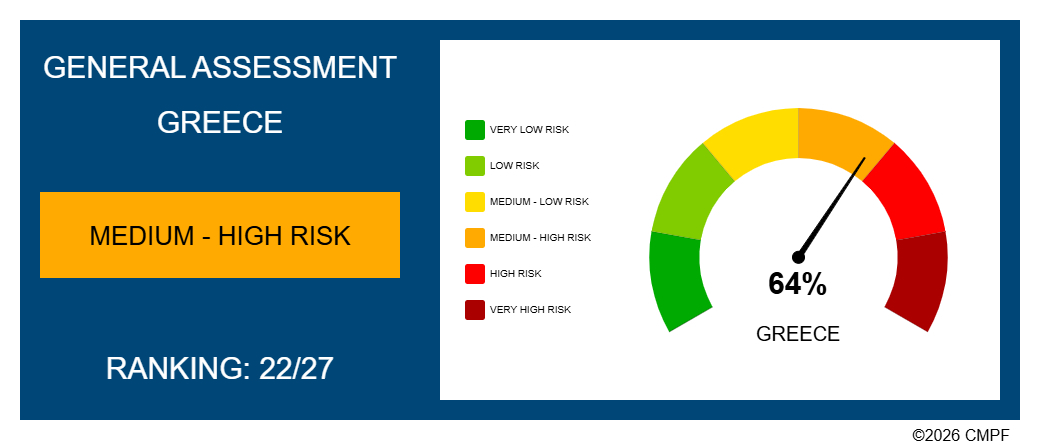
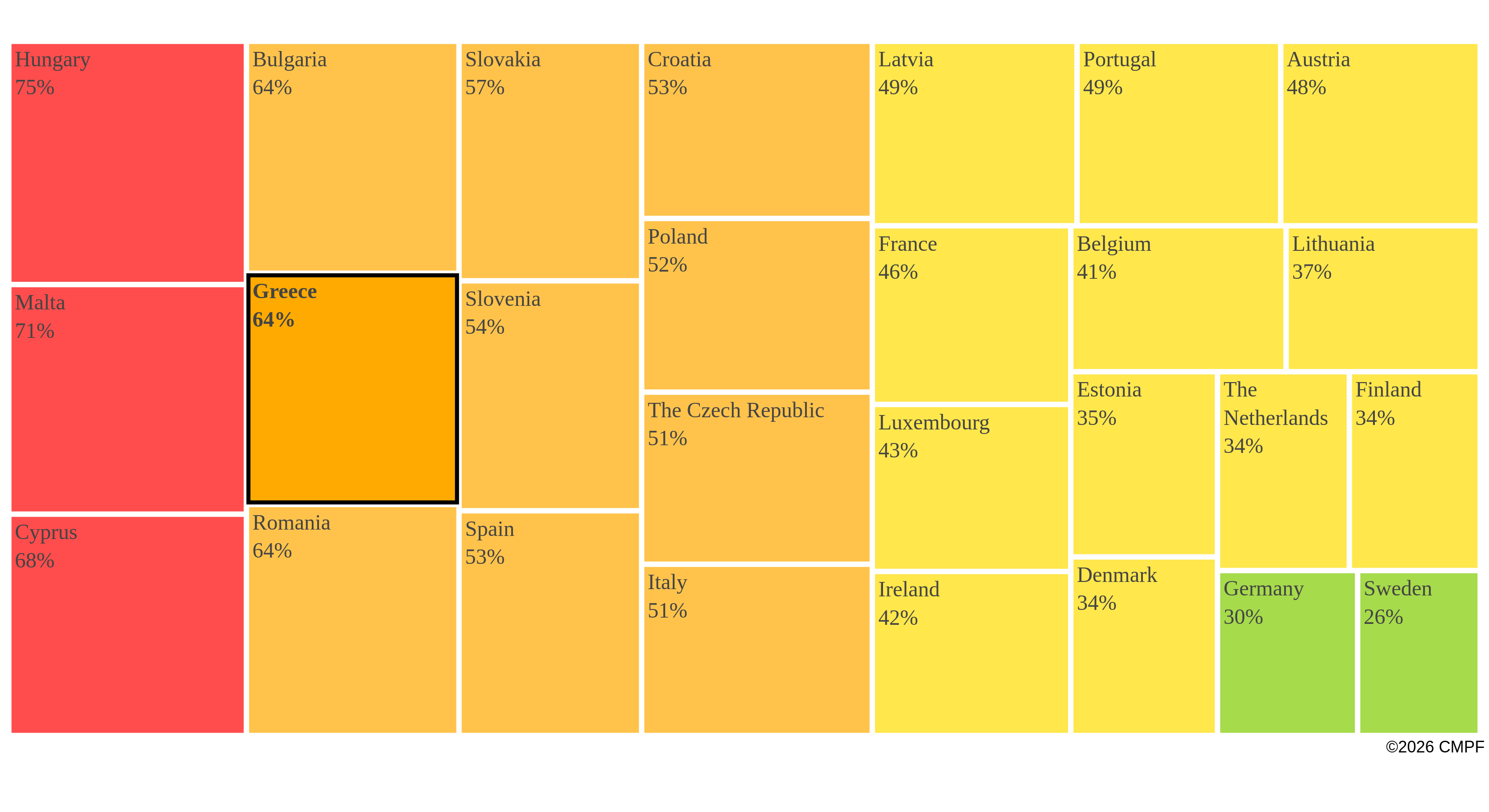
Risk score: 64%
| Fundamental Protection | 58% |
| Market Plurality | 67% |
| Political Independence | 62% |
| Social Inclusiveness | 68% |
In-depth analysis:
Read the full MPM2026 Country report
Country overview
In Greece, 2025 was marked by heightened social mobilization and institutional tensions. In February 2025, mass demonstrations occurred for the second anniversary of the Tempi train disaster that killed 57 people in February 2023 and became a national symbol of state failure. These demonstration were among the largest since the restoration of democracy in 1974 (Vouliwatch, 2025). They reflected the discontentment of the Greek population whose trust in the institutions is declining. Protesters requested more institutional accountability and condemned delays in justice as no one has been convinced for the accident so far.
Regarding the political landscape, Konstantinos Tasoulas, a senior conservative politician from the governing New Democracy party, was elected as President of the Republic in February 2025, a choice interpreted as reinforcing institutional continuity while highlighting limits to cross-party consensus. However, political tensions intensified mid-year with the OPEKEPE (Organization for the Payment and Control of Community Agricultural Aid) subsidy scandal, which triggered high-level resignations, ongoing parliamentary investigations, and broader debates over transparency, clientelism, and administrative oversight. Economic pressures, particularly rising inflation during the summer, further fuelled public dissatisfaction and social unrest (ToVima, 2025b).
At the same time, opposition dynamics remained fluid, with former prime minister Alexis Tsipras of the left-wing SYRIZA party re-entering public debate through high-profile interventions, while the election of Kyriakos Pierrakakis of New Democracy as Eurogroup president in December signalled strengthened Greek institutional presence at the European level. The year closed amid continued social tensions, including sustained farmer mobilizations, underscoring persistent pressures on governance, accountability, and social cohesion.
The media landscape in 2025 remained highly fragmented and structurally concentrated, with persistently low public trust and growing reliance on digital platforms for news. According to the Reuters Institute Digital News Report (Newman et al, 2025) , Greece again recorded the lowest trust in news among the 48 surveyed markets (22%), reflecting sustained political polarization, concerns about undue influence from political and economic elites, and criticism of media coverage during major public events such as the Tempi anniversary demonstrations.
Trust declined across all major outlets, including public service broadcaster ERT and commercial channels such as SKAI, underscoring broader credibility challenges. News consumption continued to shift toward social media, with 64% of online users accessing news via platforms, particularly YouTube, Instagram, and TikTok, where younger audiences are increasingly active and alternative news actors have gained visibility. At the same time, podcasts expanded as a news format, with major publishers launching current affairs productions, though entertainment content still dominates.
Structural market challenges persist, including the absence of a standardized system for measuring digital audiences, which weakens publishers’ position in advertising markets dominated by global platforms. The year also saw concrete ownership changes and continued financial pressures in the press sector. Alter Ego Media acquired the Newsit–Tlife news websites group in July 2025, while center-left newspaper Efimerida ton Syntakton entered a new ownership phase with the sale of 51% to Dimitris Melissanidis in September 2025. At the same time, financial pressures intensified particularly in the newspaper sector (advertising revenues declined by 1.9% in 2025 despite GDP growth of 2.1%), alongside gradual and cautious newsroom experimentation with AI. Despite isolated innovation, the sector continues to face deep challenges related to trust, sustainability, and pluralism.
Overall, the developments observed in 2025 are characterised by fragmented and limited responses, which fall short of addressing the structural challenges affecting media pluralism and press freedom, and contribute to a further deterioration of the media environment in Greece. On the legal level, no significant new framework was introduced to address long-standing structural concerns, particularly regarding the protection of journalists, anti-SLAPP measures, or media independence.
However, certain targeted legislative developments were noted. Notably, Law 5143/2024 introduced amendments related to access to information, although these did not substantially alter existing challenges in implementation. In addition, Law 5253/2025, which partially implements the EMFA in Greece, established a revised framework for state support and transparency in media funding, including provisions related to advertising allocation, though its practical impact remains uncertain.
From a regulatory perspective, incremental changes were observed in the competences of the National Council for Radio and Television (NCRTV/ESR), with some expansion of its role. However, concerns persist regarding its effectiveness, resources, and independence, particularly in light of previous appointment procedures and continued structural limitations.
With regards to EMFA, some fragmented legislative adjustments can be observed, however, key requirements—such as safeguards for editorial independence, transparency of media ownership, and protection against political interference in public service media—have not yet been systematically translated into domestic law or practice. As a result, its impact in 2025 remains limited and largely prospective, pending future implementation.
Fundamental Protection
The Fundamental Protection area scores within the medium-high risk band. Key points include:
- Freedom of expression is constitutionally guaranteed; however, its practical protection remains uneven, with activists, academics, and human rights defenders facing stigmatization and systematic discrediting, contributing to a chilling effect on public debate.
- Strategic Lawsuits Against Public Participation (SLAPPs) remain a significant concern, as journalists and media outlets are increasingly targeted by legal actions from political and business actors, while no dedicated anti-SLAPP legal framework has yet been adopted.
- Policies addressing information integrity are limited, with no comprehensive national strategy on disinformation; existing frameworks focus primarily on cybersecurity and fail to ensure coordinated, multi-stakeholder responses.
- Content moderation practices by online platforms lack transparency and consistency, with concerns over over-reliance on automated systems, insufficient disclosure of removal decisions, and disproportionate impacts on smaller or independent media actors.
- The right to information is legally protected, but challenges persist in balancing transparency with privacy and security considerations, particularly in the digital environment.
- The whistle-blower protection framework remains ineffective in practice due to weak enforcement, judicial delays, limited public awareness, and persistent risks of retaliation.
- The journalistic profession operates under increasingly precarious conditions, including low wages, lack of collective labour agreements, and growing political pressure, undermining professional autonomy.
- Journalists face ongoing threats to their physical and digital safety, including attacks during demonstrations and online harassment, while impunity persists in high-profile cases such as the 2021 murder of Giorgos Karaivaz.
- The independence and effectiveness of the National Council for Radio and Television (NCRTV/ESR) are undermined by politically contested appointment procedures, structural underfunding, limited resources, and constraints on its regulatory capacity.
Market Plurality
Market Plurality area remains at high risk in 2026. Key points include:
- Media ownership remains highly concentrated across sectors, with continued dominance of major actors in audiovisual, newspapers, and digital markets. Cross-media ownership concentration remains at the highest risk, while regulatory safeguards remain insufficient and consolidation trends persist.
- Digital markets continue to show structural imbalances. Weak redistribution mechanisms, limited bargaining power for publishers, lack of transparency in platform agreements, and the absence of standardized audience measurement systems continue to undermine pluralism.
- Editorial independence remains the highest-risk dimension, as entrenched ownership structures, weak institutional safeguards, and persistent commercial pressures continue to constrain newsroom autonomy.
- Transparency of media ownership shows formal progress but limited practical impact, with fragmented registries, uneven enforcement, and restricted access to beneficial ownership and public funding data.
- Media viability continues to deteriorate, driven by declining revenues in audiovisual and print sectors, precarious employment conditions, and limited structural transformation across the industry.
Political Independence
The Political Independence area scores within the medium-high risk band. Key points include:
- Political independence of the media remains fragile, with widespread perceptions of indirect political influence over major outlets, reinforced by close ties between media owners and political actors.
- High levels of media concentration and ownership by powerful business figures with political connections create structural conflicts of interest, undermining editorial independence and pluralism.
- The Athens–Macedonian News Agency (ANA-MPA) holds a dominant position in the news market and remains vulnerable to political influence, particularly through government-linked appointments and oversight by the Prime Minister’s office.
- Editorial autonomy represents the highest risk, as media organisations lack formal internal safeguards, relying instead on informal practices, with no comprehensive self-regulatory framework in place.
- There are no effective legal or institutional guarantees protecting editorial independence in appointments and dismissals, allowing owners and politically connected actors to influence newsroom leadership.
- The integrity of political information during elections is compromised by unequal media representation of political actors, favouring major parties and limiting pluralism.
- Oversight of political advertising remains insufficient, with no dedicated authority responsible for ensuring transparency and fairness in political advertising, particularly in the online environment.
- Greece lacks specific regulations to ensure transparency and equal opportunities in online political advertising, while existing campaign finance rules are not adapted to digital campaigning practices.
- State regulation of media resources presents a lower risk overall; however, serious concerns persist regarding the lack of transparency and objective criteria in the allocation of state advertising, raising risks of political favouritism.
- Public Service Media (ERT) faces very high risks to independence, with longstanding political influence over its editorial line and governance structures, including politically driven appointments and dismissals of senior management.
Social Inclusiveness
The Social Inclusiveness area moves into the high-risk band in 2026. Key points include:
- In 2025, the vulnerability of local and regional media became more visible through the exclusion of regional journalists from key political information processes, while financial fragility, uneven coverage, weak public support, and limited local PSM television coverage remained unresolved. Community media also remained unrecognized in law.
- Media literacy showed some progress, including a National Strategy on Media Literacy, a dedicated EKKOMED budget, and continued activity in non-formal education. However, governance remained fragmented, funding project-based, integration into formal education limited, and inequalities in media literacy skills persisted.
- No progress was made on the online prominence of public service media content, while net neutrality safeguards remained only partly implemented and accessibility gaps for people with disabilities persisted despite some improvements by ERT.
- Minority representation remained reactive and uneven, with no new binding obligations for proportional representation, no national news in minority languages, and continued weaknesses in anti-hate speech enforcement across audiovisual and online environments.
- Gender inequalities remained entrenched: women were absent from top executive positions in both public and major private audiovisual media, underrepresented among editors-in-chief in leading national media, and less visible in political and hard news coverage.