

Ireland 2026
Media Pluralism Monitor 2026 results
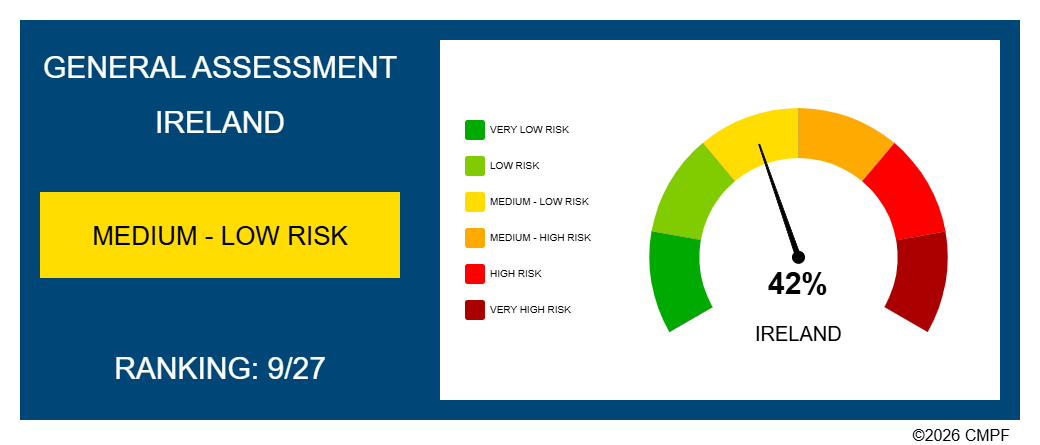
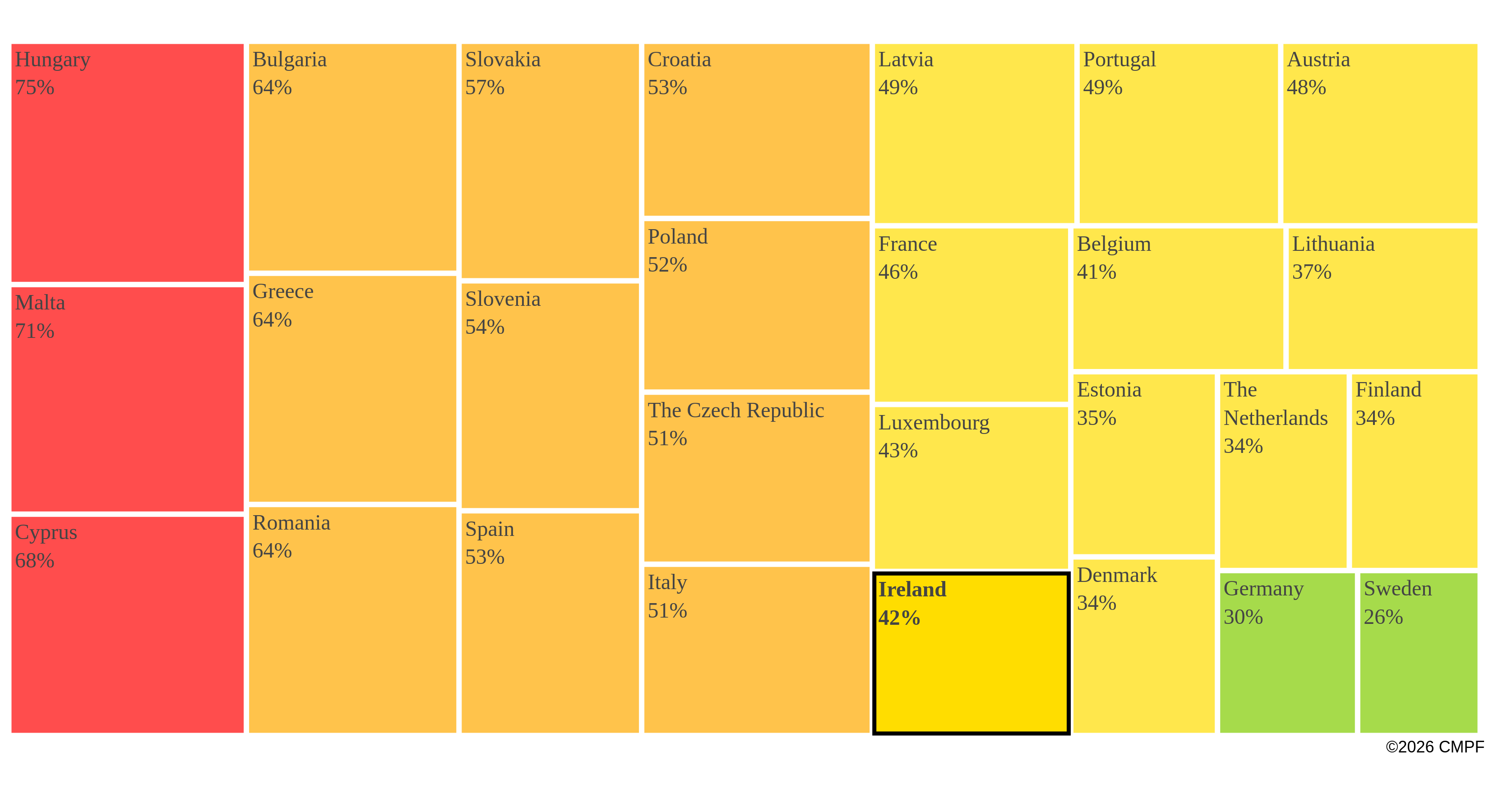
Risk score: 42%
| Fundamental Protection | 28% |
| Market Plurality | 71% |
| Political Independence | 28% |
| Social Inclusiveness | 42% |
In-depth analysis:
Read the full MPM2026 Country report
Country overview
Irish politics in 2025 was dominated by government formation, leadership shifts, and a volatile party landscape. Following the 2024 general election, a new coalition government of Fianna Fáil and Fine Gael, supported by independents, was formed in January 2025, with Micheál Martin as Taoiseach and a planned leadership rotation with Simon Harris. The year was marked by early instability, including disputes over parliamentary speaking rights involving independents and tensions within the coalition. The major political event was the presidential election, won decisively by independent candidate Catherine Connolly, backed by left-wing parties including Sinn Féin, signalling public dissatisfaction with establishment parties. There were also resignations and internal party strains, particularly within Fianna Fáil, alongside continuing pressure on government over housing, immigration, and cost-of-living issues. Overall, 2025 combined coalition continuity with growing electoral volatility, as opposition forces – especially Sinn Féin and smaller left parties – sought to capitalise on public discontent.
Irish media legislation and regulation in 2025 was shaped by a combination of EU-driven reform, domestic legislative change, and the growing role of the new regulator, Coimisiún na Meán. The entry into force of the European Media Freedom Act (EMFA) in August 2025 significantly reshaped the regulatory framework, particularly around media ownership transparency, editorial independence, and merger control. In parallel, the Irish Government approved the General Scheme of a Media Regulation Bill (July 2025) to implement EMFA domestically. This proposed major changes, including:
- Transferring responsibility for media merger assessments from the Minister to Coimisiún na Meán;
- Expanding the definition of “media business” to include online platforms;
- Introducing stronger tests focused on media plurality and editorial independence.
The Bill also made legislative provision for the existing mediaownership.ie and Media Ownership Monitor Ireland databases, enhancing transparency in line with EU requirements. Regulatory activity intensified under the Digital Services Act (DSA). In 2025, Coimisiún na Meán launched investigations into major platforms (e.g. TikTok, LinkedIn, and X) over compliance with online safety and user complaint mechanisms, signalling a more assertive enforcement approach toward tech companies. Domestically, further reforms were advanced through a Broadcasting (Amendment) Bill, restructuring oversight of public service media. This amended the existing system reviewing RTÉ and TG4 funding and performance, and intensified the extent of external scrutiny of the finances of both PSM.
Finally, broader media law reform continued with the passage of a new Defamation Act, updating defamation legislation, which promises to reduce legal risk for publishers and improve the balance between reputation and freedom of expression. Overall, 2025 marked a transition to a more centralised, regulator-led system, aligned with EU law, with greater emphasis on platform accountability, media plurality, and transparency.
Fundamental Protection
The Fundamental Protection area for Ireland was assessed within the low risk band for 2025.
- The passing of the Defamation (Amendment) Act 2025 promises to curb excessive litigation and enhance legal certainty for media organisations who have long cited Irish defamation law as imposing a chilling effect on media content. By abolishing juries in High Court defamation cases and allowing judges to determine the level of defamation settlements, the new act should increase predictability and reduce costs. Damages guidance is clarified to improve consistency. The new “serious harm” threshold also requires plaintiffs to show real reputational damage, discouraging trivial claims. The Act also strengthens and clarifies the honest opinion and fair and reasonable publication defences, giving greater protection to public-interest journalism. It also introduces early resolution mechanisms and anti-SLAPP measures allowing courts to dismiss weak cases sooner and reducing legal expense. The legislation is still new and, as yet, there is almost no case law testing is application. Nonetheless it marks progressive step for media freedom.
- There remain issues with the operation of Ireland Freedom of Information (FOI) mechanism. In their most recent (published in 2025 but referring to 2024) annual report, the Office of the Information Commissioner highlighted growing pressure on the FOI system. The Commissioner pointed to under-resourcing of the FOI function in some public bodies, which is contributing to delays, poorer decision-making, and increased appeals to his office. The report also expressed concern that some public bodies are increasingly relying on technical or legalistic exemptions under the FOI Act to refuse requests, rather than applying a spirit of openness. This includes broad or defensive use of refusal provisions, which can undermine transparency and shift disputes into formal review processes.
- With regard to online content moderation, the manner in which VLOPs present their transparency reports makes it more or less impossible to assess the extent to which their moderation practices respect freedom of expression. In theory, the EU’s DSA Transparency Database permits a national breakdown of statements of reasons for content moderation but the Database is, of its nature, largely descriptive and does not offer a basis on which to arrive at an objective, meaningful assessment of content moderation practices.
- There are also some concerns relating to dispute resolution mechanisms relating to platform moderation. The first report from Appeals Centre Europe (a Dublin-based independent dispute-resolution body created under the EU’s Digital Services Act) is critical of major online platforms’ content moderation practices and engagement with oversight. It finds that platforms frequently get decisions wrong, with over 75% of reviewed cases overturned in favour of users. Errors include unjustified content removals, wrongful account suspensions, and failures to remove harmful material. The report also highlights poor cooperation, with some platforms failing to provide necessary information or respond to cases, leading to “default decisions” against them. Overall, it argues that current platform systems are inconsistent, opaque, and insufficiently accountable, underscoring the need for independent review mechanisms under the EU Digital Services Act.
- April 2025 finally saw the publication of the Irish National Counter Disinformation Strategy. The strategy came in for criticism from groups like the Irish Council for Civil Liberties even before it was published because of its focus on increasing the resilience of individuals to disinformation while failing to address social-media algorithms and platform power. Recommender systems used by platforms determine what users see in their feeds and therefore shape public discourse: arguably a disinformation strategy focused on media literacy and coordination without addressing algorithmic amplification misses the structural causes of disinformation.
- Online hostility toward women journalists is widespread and often distinctly gendered. Female journalists are often targeted with abuse that focuses on their appearance, sexuality, age, and perceived competence to an extent that leads to the normalization of abuse within newsroom culture. Social media platforms are simultaneously essential tools for professional visibility and vectors for abuse. News organizations benefit from journalists’ online engagement but may lack clear training, policies or robust support mechanisms to address harassment. Overall, the research concludes that online abuse of women journalists in Ireland is systemic rather than incidental.
- The Garda Síochána (Powers) Bill (2025) promised to introduce a requirement for the issue of journalistic privilege (that is the protection of journalistic sources) to be brought to the attention of the court. However, the current (as of the end of 2025) draft of the Bill makes no specific reference to journalistic privilege (or journalism in any guise). Furthermore newspaper representative groups have complained that the current draft of the bill only permits the assertion of a claim of journalistic privilege in the High Court after an electronic device has been seized on foot of a District Court order and potentially accessed. In effect then, even under the new legislation, journalistic’s claims to privileging of source protection would not be regarded or treated as distinct from any other form of privilege.
Market Plurality
Market Plurality fell squarely within the high risk coding.
- Irish competition law has never specified quantitative thresholds automatically limiting increases in concentration of media ownership. Instead, the 2014 Competition and Consumer Protection Act has used somewhat imprecise language referring to the “undesirability of allowing any one undertaking to hold significant interests within a sector or across different sectors of media business in the State”. “Significant interest” in this regard is not defined in reference to any universal or objective criteria. Given this it is disappointing that that the General Scheme of a Media Regulation Bill approved by the Government on 2 July 2025, incorporating elements of the European Media Freedom Act, into existing domestic legislation on media mergers does not specify any new ownership thresholds or offer any novel descriptions of limitations that relate to the prevention of media ownership concentration.
- Similarly, it is disappointing that the Media Regulation Bill makes no reference to the kind of pro-competition measures aimed at balancing market power between publishers and online platforms (or indeed Generative AI providers) found elsewhere although, on a more positive note, the Bill does broaden the concept of a ‘media business’ to include both a media service provider and online platforms providing access to media content.
- The paucity of data on the financial value of Irish media markets and the absence of reliable figures on the respective market shares of key players by revenues remains a concern in 2025, given that objective assessments of plurality rely on such data.
- The previous point notwithstanding, those estimates of Irish media market values appear to suggest that 2025 saw the long trend of declining legacy media market revenues in real terms continued unabated. At best, figures suggest that some sectors (possibly broadcast radio) may have seen their revenues plateau in real terms.
- On a more positive note, the available evidence suggests that in 2025, the number of journalists may have increased despite the fact that major employers like RTE, Mediahuis and REACH plc have sought a significant number of redundancies since 2023. The net increase in employment follows the first round of funding of Coimisiún na Meán’s Local Democracy and Courts
- Reporting Schemes in February 2025 which created “over 100 new or enhanced journalist roles” in 2025. These included 71 newly funded roles for journalists, and more than 30 roles where freelance or part-time journalists saw enhanced employment terms.
- We also note the continuing situation whereby many Irish media outlets maintain financial interests in non-media outlets. The Irish Times Designated Activity Company and Mediahuis Ireland both operate online advertising portals as subsidiaries whilst Virgin Media Television Ireland is a subsidiary of Liberty Global, the global cable giant which enjoys a near-monopoly of the Irish cable distribution market and, via a deal with mobile phone operator Three, operates as a mobile virtual network operator in the Irish mobile communications market. How potential conflicts of interest between such cross-ownership and editorial content are managed remains opaque, not least because there is no legal requirement for Irish media outlets to declare such potential conflicts in their reporting.
Political Independence
Political Independence is also considered a low risk in Ireland in 2025.
- Commission Recommendation C/2022/6536 and article 34 of EMFA encourage media service providers to establish internal independent bodies to receive complaints on possible violations of any charters, codes or other editorial guidelines and policy documents adopted within the media service provider. It appears that most of the major news outlets in Ireland maintain such guidelines for journalistic (although not all of these are public). However, to the extent that we can establish, bodies functioning as professional representation groups of the editorial staff in the media were still not a common feature of the Irish media scene in 2025. The only significant exception to this appears to be the Irish Times which, in 2025, made their first appointment to a “Head of Standards” position, a role which also encompasses some elements relating to compliance with editorial integrity rules. The Irish Times also has an Editorial Committee, elected by journalists, mandated to carry out functions relating to editorial independence.
- The OSCE Office for Democratic Institutions and Human Rights (ODIHR) produces Needs Assessment Reports relating to the conduct of elections. As of early 2026 the assessments conducted by in the run up to the November 2024 Irish general election and the October 2025 Presidential election have been made public. However, the last ODIHR report that is available (relating to the 2020 general election) suggested that the Irish Electoral Commission which commenced operations in February 2023 could official guidance on the conduct of TV debates during elections. In practice, however, to date the Commission’s “Post Electoral Event Review” documents appear to be entirely silent on the manner in which media coverage of the election occurred. It is unclear as to whether this should be interpreted as meaning that the Commission has no concerns about the fair representation of the different groups of political actors during elections or – more concerningly – whether this question is simply not being addressed by the Commission.
- There remains scope for tightening the regulatory framework regarding the clear identification of political advertising in the media. As of 2025, there is no single, explicit Irish law that requires all political advertising in newspapers or online media to be labelled as such in the way broadcast advertising is regulated. A combination of electoral law, consumer protection rules, and regulatory guidance does creates indirect but meaningful labelling/identification obligations. If political message is paid for it should not be presented as independent editorial content and in practice newspapers and websites generally label such content as advertising. However this falls short of requiring that such messages be labelled as political advertising. Thus although the TTPA will require clear labelling of political ads identifying then sponsor, funding and targeting of such advertising, there has not yet been any direct legislative move to implement this in Ireland.
- In a similar vein, although there is no clear, documented case showing that political advertising services were provided to sponsors from third countries during the three months preceding the November 2024 Irish general election or October 2025 Irish presidential election, it is concerning that the Electoral Reform Act 2022 which provides powers for the Electoral Commission to require transparency notices on online political advertisements and regulate online political advertising during election periods has not yet been commenced due to European Commission concerns about the compatibility of some provisions of the domestic legislation with EU law. Therefore during the 2025 Presidential Election campaign, the Electoral Commission did not have full statutory investigative powers over online political advertising activity. (In passing because the EU Regulation on the Transparency and Targeting of Political Advertising only came into force only in October 2025 it did not apply to political advertising used in the 2025 Irish presidential election, because an initial implementation grace period meant the election campaign fell outside the scope of the rules.)
- It is disappointing that the five parties with the largest representation in the current parliament do not publish clear descriptions of their electoral social media spend/techniques even after campaigns are completed. Information is limited to general references to digital campaigning or social-media engagement, job descriptions mentioning paid social campaigns, and isolated examples of illustrative ad costs. This lack of disclosure is consistent with long-standing criticism in Ireland that political parties rarely publish their online advertising spending or campaign techniques voluntarily. Some information about spending and techniques is available via analyses of data from Meta’s Ad Library and Google’s Ads Transparency Centre but this clearly falls short of active efforts towards transparency on the part of political parties themselves.
- The Irish EDMO Hub review of platform compliance with the EU Digital Services Act (DSA) during Ireland’s 2025 Presidential Election concluded that despite EU requirements for clear labelling, disclosure, and public repositories of political ads, major platforms failed to provide consistent transparency during the election period. EDMO found that, in some cases, ad libraries were removed or made inaccessible, while in others, records of paid political ads were incomplete or outdated. EDMO concluded that such gaps “prevent voters, researchers, and regulators from assessing who is funding political messages and how they are being targeted, undermining accountability in the digital campaign environment.”
- Some progress has begun with regard to the transposition of EMFA requirements relating to state advertising. On 2 July 2025, the Government approved the General Scheme of a Media Regulation Bill designed to implement elements of the European Media Freedom Act (EMFA) into Irish law. This includes enhanced rules on media mergers and transparency of state advertising. In February 2026, the General Scheme was republished as a full bill, envisaging the provision of (a) the legal names of the media service providers or the providers of online platforms from which services were purchased; (b) where applicable, the legal names of the business groups of which any media service providers or providers of online platforms as referred to in point (a) are part; and (c) the total annual amount spent and the annual amounts spent per media service provider or provider of an online platform. In sum, the Irish government is in the process of transposing Article 25 of EMFA but, strictly speaking in 2025 this legislation had not been passed.
- 2025 also some moves towards the implementation of Article 5(2) of EMFA relating to the requirement that PSM appointments be free of political and economic influence. On 08 April 2025, a revised General Scheme for a Broadcasting (Amendment) Bill was approved by Government and subsequently published. It was submitted to the Joint Oireachtas Committee on Arts, Media, Communications, Culture and Sport for pre-legislative scrutiny on May 14 2025 and remains under scrutiny as of January 2026. Under Head 15, Section 89B of the GS states that the director general of both PSM “ shall be appointed by the board of a corporation.” This ends the current situation whereby the Government of the day plays a key role consenting to the appointment of a Director General and can, in theory, veto an appointment. However the Broadcasting (Amendment) Bill does NOT change the current appointment process for the 12 Board members of the two PSM, RTÉ and TG4. Of these, six are directly appointed by the Minister for Communications, while the Joint Oireachtas Committee on Media nominates a further 4 candidates as directors. However, the Minister is not absolutely required to accept those latter candidates and may impose his or her own. In effect then the current situation whereby a single government minister has the authority to appoint 10 or the 12 board members on both PSM looks set to continue, despite EMFA.
- On 08 April 2025, a revised General Scheme of the Broadcasting (Amendment) Bill was approved by Government and subsequently published. It was submitted to the Joint Oireachtas Committee on Arts, Media, Communications, Culture and Sport for pre-legislative scrutiny on May 14 2025. The Bill envisages that Coimisiún na Meán will review of the adequacy of public funding of RTÉ and TG4 every 3 years (instead of every 5 as at present). On the basis of that review, the Bill envsiages that Coimisiún na Meán will make a recommendation to the Minister on the appropriate public funding level for RTÉ and TG4 for a 3-year period. The government has framed this as a new statutory framework to “support the provision of public service content”. However, it should be noted that since 2009, the media regulator consistently and repeatedly recommended increases in the level of funding to be provided to be both PSM.
- However, nothing in the 2009 Broadcasting Act (as Amended) imposed any kind of legal obligation on the state to accept this advice and, in practice successive governments have consistently and repeatedly decided against awarding increases in line with the regulator recommendations. Nothing in the proposed legislation changes this situation and the cost of the broadcasting licence looks set to remain at €160 per annum, as it has done since 2008.
- The retention of the licence fee system in 2025 is itself problematic, Since 2017 there have been a number of official investigations into the appropriateness of PSM funding mechanisms, all which have recommended replacing the licence with other public funding mechanisms. Most recently the 2021 Future of Media Commission concluded that the licence was no longer a reliable basis on which to fund the main PSM and strongly recommended to an entirely new direct exchequer-supported funding system. Of the 50 recommendations contained within the Future of Media Commission report this was the only one not accepted by the then government. Since then, the number of households paying for the licence has further declined from 948,000 in 2022 to 769,000 in 2025, leading to a decline of €29.4m in annual revenue. As a result of this shortfall, the state has begun to financially support RTÉ through direct exchequer funding. However, the basis on which the annual sums granted by the Exchequer to RTE at present are determined does not appear to be based on any publicly available formula and, as a result, the funding of both PSM is subject to state discretionary action.
Social Inclusiveness
The Social Inclusiveness area for Ireland was coded as a medium-low risk in 2025.
- EDI (Equality, Diversity and Inclusion) policies for Irish broadcasting can at best be described as “emergent” in 2025. The PSM RTÉ’s website link to s a diversity policy that was prepared in 2017 or 2018 and was designed to cover the period up to 2022. As of the close of 2025 the document has not been updated and even that document fell far short of constituting a comprehensive diversity policy to promote cultural and linguistic diversity. In practical terms the PSM’s commitment to linguistic diversity is limited to the Irish language (rather undermining the very concept of “diversity”). Even the 2018 diversity policy refers only to the development of initiatives that bring the “Irish language into the heart of everything we do (for example, integrate the Irish language naturally and seamlessly into all our channels and services; and create quality content and tell great stories through the Irish language).” A scan of RTE annual reports since 2022 does not reveal much impetus to explore wider conceptions of linguistic or cultural diversity despite the fact that the last census saw 23% of the population identity as something other than “White Irish”. Whilst RTE annual reports may refer to a “vision” of celebrating “our country’s rich [but ill-defined] diversity” when it refers to championing culture, it invariably refers to “Irish culture”.
- Matters are scarcely better in the commercial sector where EDI policy appears to be limited to that published by the regulator, Coimisiún na Meán in July 2024. The policy document states that the Commission expects the strategy to be implemented across the sector and notes that standards included in the policy will be included amongst the criteria used to determine the allocation of Coimisiún na Meán’s various funding schemes. The first key principle of the Commission document is the need to mainstream GEDI objectives across Irish media organisations. The document identifies the development and publication of such policies, plans and strategies by all audio visual media outlets in Ireland. As of close 2025, however, we have been unable to find overt statements of these policies on the websites of any of the leading commercial Irish media. (The one exception to this is Bauer Media Audio Ireland which links to a People Code of Conduct built around 7 principles, the fourth of which is to “champion diversity and inclusion at Bauer”. However, this applies to Bauer Media internationally and has not been specifically developed in response to Coimisiún na Meán’s policy.) In general it appears that Irish media outlets regard the existence of Coimisiún na Meán’s GEDI policy as sufficient regulation of this area and exempts them from having to develop and publish coherent policies.
- In October 2025, the European Commission against Racism and Intolerance (ECRI) published a report which concluded that hate speech was widespread across news media, online platforms and politics in Ireland motivated mainly by anti-migrant, anti-Black/African and anti-refugee/asylum-seeker sentiment. ECRI made 15 recommendations in relation to Ireland for addressing these concerns including essentially revisiting the provisions dropped from the 2024 legislation. Thus ECRI recommended that Irish authorities adopt legislative measures to specify and legally define expressions of hate speech subject to criminal liability, in particular incitement to hatred, violence or discrimination. The Report included the Irish government response to ECRI’s findings and recommendations. The response made no reference to the recommendations relating to the legal definition of hate speech.
- In May 2025, the European Commission sent a reasoned opinion to Ireland (INFR(2024)2205) for failing to comply with provisions of Council Framework Decision 200/913/JHA on combating racism and xenophobia by means of criminal law. While noting the passage of the 2024 Criminal Justice (Hate Offences) Act the Commission argued that Ireland had not transposed the Framework Decision provisions related to criminalising the public incitement to violence or hatred against a group or a member of such group based on certain characteristics. In May 2025 therefore, the Commission issued a reasoned opinions to Ireland in this regard giving two months to implement reform. To date, it is our understanding that no such measures have been introduced leaving open the possibility that the Commission will refer the cases to the Court of Justice of the European Union.
- In January 2026, Ciaran O’Connor of the Institute for Strategic Dialogue civil society organisation addressed the Joint Committee on Arts, Media, Communications, Culture and Sport on platform moderation practices. O’Connor noted that “ Platforms are inconsistent in enforcing their own rules (Terms of Service or Community Guidelines) in relation to hate speech, online gender-based violence, disinformation and extremism (even Terrorist and violent extremist content). Furthermore he argued that the platforms’ “own products and engagement-based algorithmic systems have been found to recommend disinformation and various forms of hateful content, further amplifying harmful or potentially illegal content to users, including children. In an address to the same committee the civil society group, the Hope and Courage Collective (HCC) cited a number of examples of poor moderation of hate speech. HCC research argued that that far-right agitators amplified the locations of homeless encampments, filmed and harassed individuals and used dehumanising narratives to incite hostility. Algorithms contributed to this by boosting videos showing harassment and threats, increasing visibility beyond the original audience; normalising harassment and amplifying extreme content; HCC conclude that algorithms do merely reflect user behaviour but actively shape it.
- With regard to community media, 2025 again saw no concrete moves towards addressing the 2021 recommendation of the Future of Media Commission to establish a specific support mechanism for community media. Responsibility for implementing such a scheme fell to Coimisiún na Meán. It was initially anticipated that a Community Media Fund would be up and running by the close of 2025 actually established by the end of 2024. In practice not only had this not occurred by the close of 2025 but there is currently no establishment date of any kind. In practice then, progress toward inaugurating a Community Media Fund has so far taken the form of incremental funding programmes and pilot schemes rather than a single dedicated fund.
- The 2025 Global Media Monitoring Project (GMMP) report for Ireland concludes that, although some progress has been made since the beginning of the 21st century, patterns of gender-biased portrayal “endure despite decades of change in women’s roles in the physical world”. GMMP also noted “a persistent journalistic bias toward defining women by domestic roles, despite women’s current unprecedented engagement in work outside the home.” Underrepresentation of women in occupations and in positions of power has remained consistent as has the tendency to describe women by their age and physical attributes has also persisted. On a more positive note, GMMP found that women’s visibility in political and economic news has increased significantly over the past three decades with the proportion of women providing expert testimony in news and current affairs markedly increasing. has grown remarkably over the decades, showing the highest increase ( 7 points) in digital news since 2015. The research also found that women now constitute the majority (64%) of the academic experts captured in the same (up from 42% in 2020). Furthermore, overall women accounted for 36% of the “expert or commentator” category captured in the 2025 survey (up from 20% in 2005).