

Poland 2026
Media Pluralism Monitor 2026 results
Risk score: 52%
| Fundamental Protection | 41% |
| Market Plurality | 63% |
| Political Independence | 53% |
| Social Inclusiveness | 51% |
In-depth analysis:
Read the full MPM2026 Country report
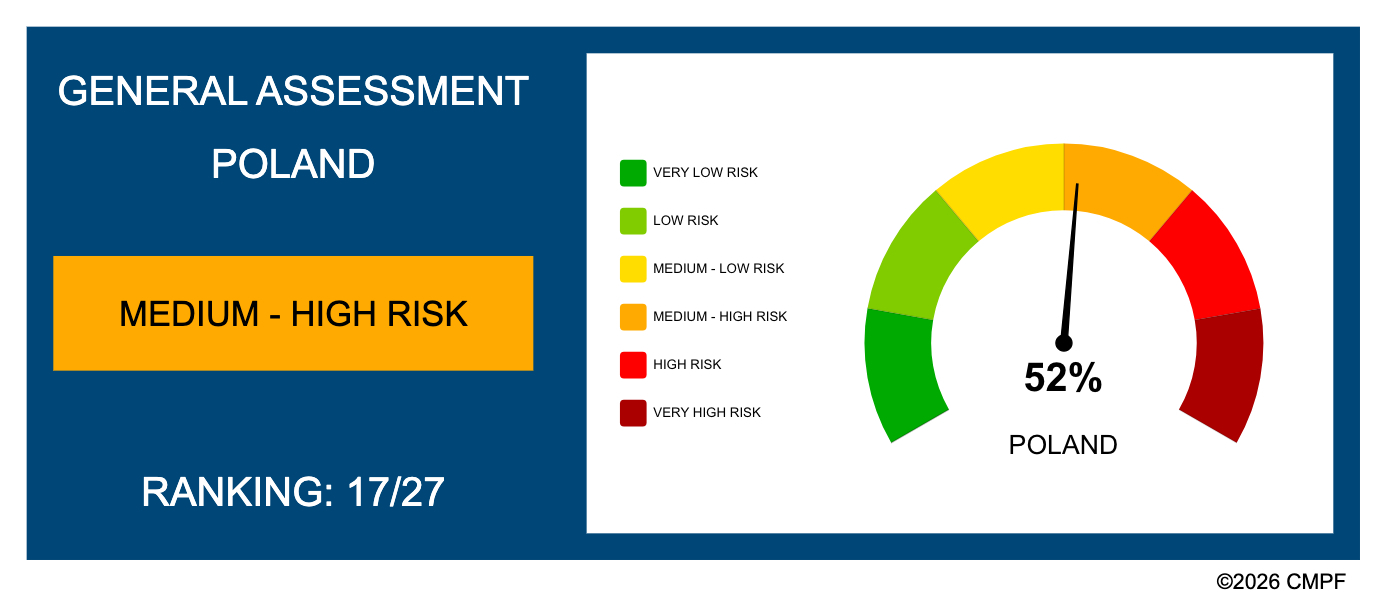
Country overview
In 2025, Polish news media have continued to maintain fragile viability and a relatively diverse offer in an increasingly challenging platform environment, where navigating between dependency on click-bite and attention-driven business models, AI challenge, and serving users with news provision, has become more difficult than ever. Also, by many media professionals, this structural setup has been viewed as a principal threat to media freedom and professional survival (MeDeMAP, 2025). In terms of a political situation, 2025 witnessed tensions between the pro-EU government led by Donald Tusk and the new President Karol Nawrocki, who has been backed by the former PiS ruling party. In a challenging cohabitation, the President has used repeatedly his veto power against some government legislation.
Major regulatory developments shaping Polish news media landscape included slowdowns and delays in some regulatory and legal initiatives (e.g. DSA and EMFA implementation), cautious dealing with long-term problems (e.g. criminalization of defamation, municipal ‘press’), and a regulatory ‘ping-pong’ between the government and the President. In December 2025, the Ministry of Culture and National Heritage completed the 2025 Draft Act amending the Broadcasting Act and certain other acts (hereafter the media bill, Ministry of Culture and National Heritage, 2025) aiming at a major revamping of media regulation, including changes in KRRiT (National Broadcasting Council) and PSM governance, abolition of license fees, closure of RMN (National Media Council), implementation of EMFA and AVMS Directive. The bill went through the first round of public consultations in between 8 December 2025 and 23 January 2026.
One of the major issues stood also for a President Karol Nawrocki’s veto in January 2026 of a government bill on the Provision of Electronic Services that would have implemented DSA (Ministry of Digital Affairs, 2025). In the President’s view the bill could have led to ‘administrative censorship’. At the same time, the document was widely supported by the NGO sector and some journalistic organisations (Ptak, 2026).
The media market’s structural and institutional polarization has continued to divide a professional community, making it difficult for journalists and managers to form a united front and reach collective agreements with platform operators. A year after an enforcement of copyright amendments and implementation of the EU Copyright Directive (EU) 2019/789, most Polish publishers are still negotiating with big tech companies in a fragmented rather than unified manner. The advertising revenues in 2025 increased by 6.9% year-on-year according to an analysis by Publicis Groupe Polska (pap.pl, 2026).
While the public has positively evaluated changes affecting PSM after the government swap in 2023 (Dąbrowska-Cydzik, 2025), the experts and international organisations continue to point out insufficient impartiality particularly with regard to political and electoral reporting (e.g. OSCE, 2025). Local media strived to sustain competition from the municipal ‘media’ funded by local governments, while being in urgent need of investment in new technologies and fixing more stable employment conditions (Jacak et al., 2025).
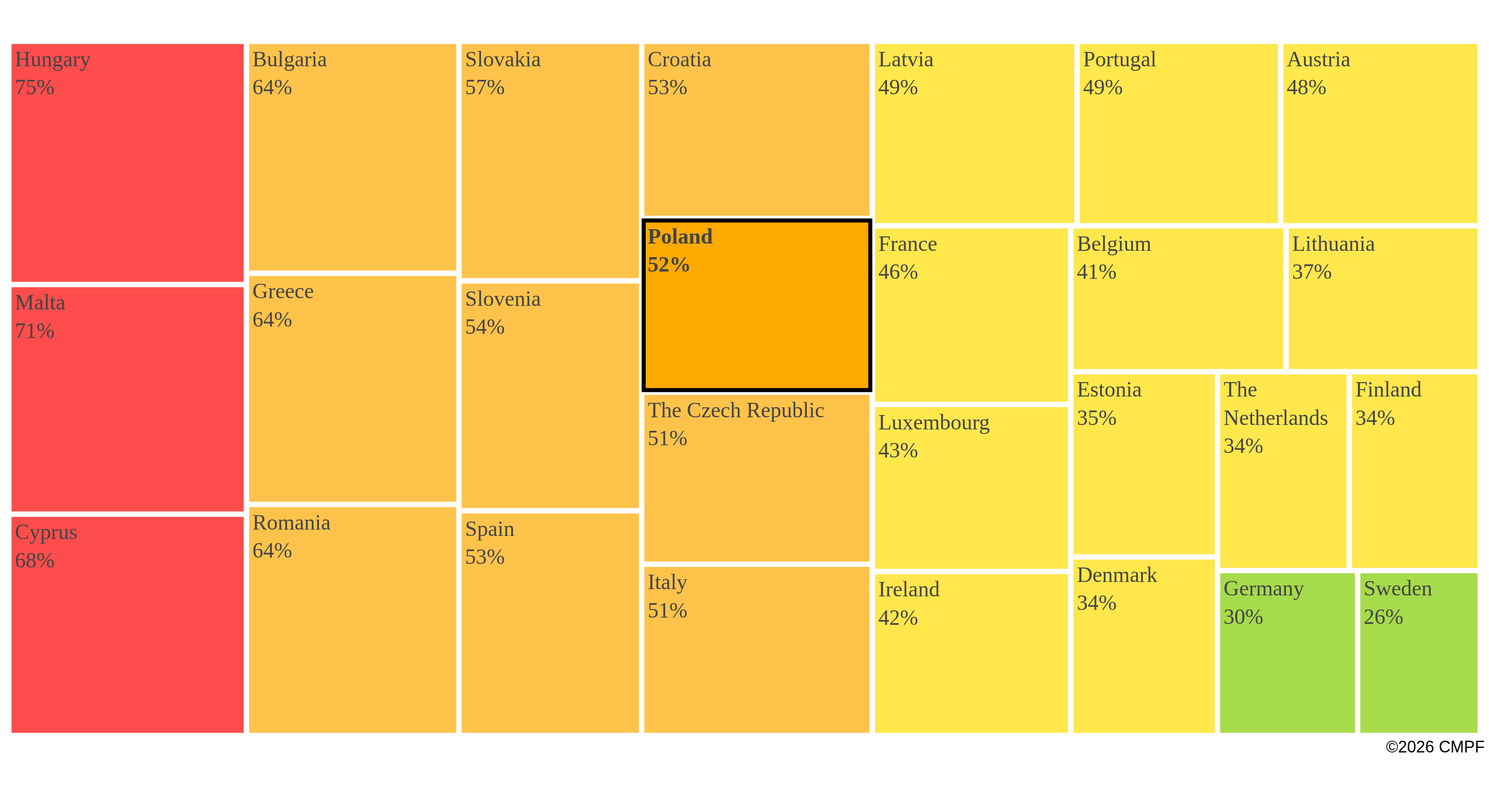
Fundamental Protection
The Fundamental Protection area scored within the medium-low risk band. Key points include:
- Poland has not implemented specific anti-SLAPP legislation. Although legislative works were pending and legal solutions proposed, these did not include so far amendments to criminal law (in particular Article 212 criminalising defamation).
- The draft amendment to the Act on the Provision of Electronic Services (Ministry of Digital Affairs, 2025; gov.pl, 2025), aiming at DSA implementation, was vetoed by the President Karol Nawrocki at the beginning of 2026. The impact of the veto is multifold, affecting policies counteracting disinformation, protection against hate speech, minors protection and many other fields.
- After a year of new legislation protecting whistle-blowers being in place, the relevant cases show that citizens are still learning about the new legal tool (brpo.gov.pl, 2025).
- A complex legal change that would prevent the illegal surveillance of journalists or media service providers, is still missing. The amendments to the regulations on operational control by three special services signed by the Prime Minister in 2024 have not brought expected changes. In 2025, the Commissioner for Human Rights (CHR) proposed several solutions as a remedy.
- In 2025, neither journalist nor net-citizens were killed in Poland (rsf.org, 2025; CoE, 2025).Yet, some attacks or threats, including digital, to the physical safety of journalists occasionally happen (Coe, 2025).
Market Plurality
The Market Plurality area scored within the medium-high risk band. Key points include:
- Media ownership transparency potentially faces a major change with a planned establishment of a national media ownership database under the new media bill (Ministry of Culture and National Heritage, 2025). Currently, KRRiT maintains a publicly available register of providers of on-demand audiovisual media services (VOD/VSP), yet without information about owners, shareholders, revenues and financial accountability (KRRiT, 2025a).
- Under the 2025 Draft Act amending the Broadcasting Act and certain other acts (Ministry of Culture and National Heritage, 2025), currently under revision and consultation, the regulatory assessment on concentration will have to include an impact of concentration on formation of the public opinion; diversity of media services; editorial independence and media viability (Ibidem, 2025).
- A year after the copyright amendment and implementation of the EU Copyright Directive (EU) 2019/789, collective agreements between news providers and platform as well as Generative AI providers remain limited.
- Poland has not introduced a specific form of general taxation for digital services, but on August, 2025, the Ministry of Digital Affairs started to test a ground for change with presenting the concept of a digital services tax and timeframe reaching 2027.
- Media viability continues to be mixed. Some news providers go toward multiple revenue streams and diversifying activities, others rely more on crowdfunding and building stable communities of loyal followers.
- Commercial influence on the editorial content has remained more subtle than political influence, while impacting newsrooms mainly through overpowering influence of Big Tech, occasional law suits and politicization of advertising.
Political Independence
The Political Independence area scored within the medium-high risk band. Key points include:
- Effective legal and self-regulatory safeguards guaranteeing editorial independence are missing in Poland. An institutional setup remains fragmented and it is uncertain which of the national organisations will play a unifying, by-partisan and EMFA-implementing role, respected by the whole professional community.
- Insufficient transparency of political advertising and electoral campaigns on online platforms remains an issue. In 2025, a major controversy erupted over identification by the state cybersecurity agency (NASK) of political ads on Facebook that were disseminated from anonymous accounts from abroad (Polskieradio.pl; 2025).
- In the area of state advertising, the rules of a new media bill (Ministry of Culture and National Heritage, 2025) awaiting further legal proceedings in 2026 offer greater transparency of both state advertisers and media providers.
- Supportive measures for the media have not changed and remained minimal, also in the new media bill.
- Although PSM’s performance has improved, the management structures remained politically-nominated. The new media bill offers minimal improvements (e.g. strengthening some competences of the PSM programme councils), at the same KRRiT’s oversight powers lacks a necessary counterweight (e.g. in forms of accountability or greater involvement of organisations representing civil society).
Social Inclusiveness
The Social Inclusiveness area scored within the medium-high risk band. Key points include:
- The available data show that proportion and reach of services for disabled persons are still below the EU average and year-to-year improvement has been minimal (KRRiT, 2025d).
- In September 2025, the Constitutional Court ruled that the amendments to the Penal Code submitted in 2024 by the Ministry of Justice and aimed at broadening the catalogue of punishable forms of discrimination expressed through hate speech, were unconstitutional (Trybunał Konstytucyjny, 2025).
- Systematic supportive means to local and regional media in Poland have been minimal. In 2026, Ministry of Culture and National Heritage has been working on a new support program for local media (pap.pl, 2025b) which has not, however, been part of the new media bill.
- In the field of media literacy, two new initiatives were announced by the governing coalition. Since September 2026, a media education module will be introduced in Polish schools and integrated in programmes of several school subjects. Secondly, under a new regulatory proposal inspired by solutions implemented in Australia, a ban on the use of social media by children under 15 is being designed (Kazmierczak, 2025).