

Belgium 2026
Media Pluralism Monitor 2026 results
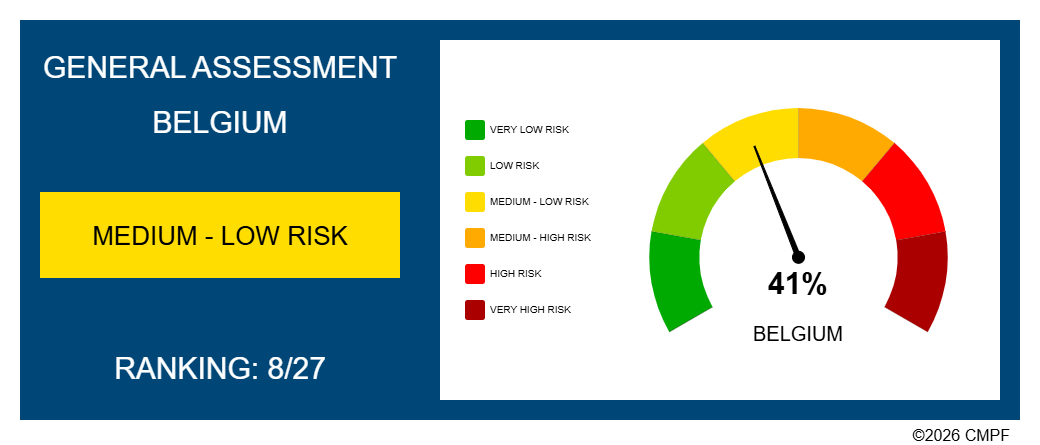
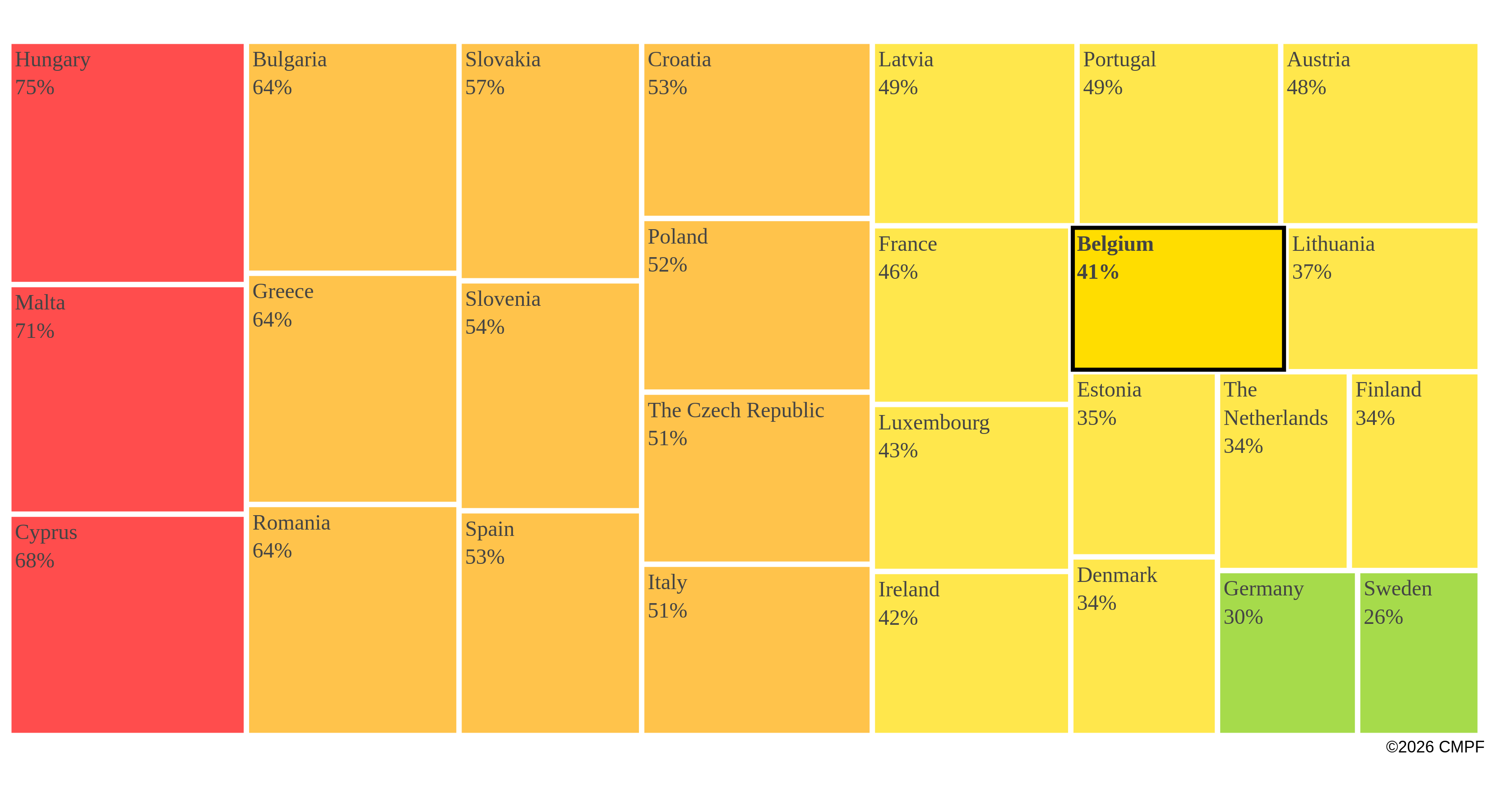
Risk score: 41%
| Fundamental Protection | 29% |
| Market Plurality | 68% |
| Political Independence | 22% |
| Social Inclusiveness | 44% |
In-depth analysis:
Read the full MPM2026 Country report
Country Overview
Belgium is a federal state and is structured along regional and linguistic lines, resulting in three linguistic Communities: Flemish, French and German-speaking. Since 1970, successive state reforms have given the Community governments more powers to regulate the audiovisual media markets. This has resulted in separate (audiovisual) media laws and separate media regulators, with sometimes varying tasks and competences. For example, the regulator of the French Community, the Conseil Supérieur de l’Audiovisuel (CSA), monitors concentration indices and can take regulatory action if it concludes that the media market in the French Community is becoming too concentrated, whereas the Vlaamse Regulator voor de Media (VRM) of the Flemish Community has the power to ‘map’ media concentration and publish annual reports about the state of media markets.
A consequence of the linguistic diversity is the economic reality of two separate media markets: the north of Belgium has a predominantly Flemish- speaking population, whereas the south of Belgium has a predominantly French-speaking population. This division results in small media markets compared to neighbouring countries like France, Germany, or the Netherlands. Both markets are highly concentrated, with only a handful of companies on each side. Recent years have witnessed a growing consolidation between media actors (within and across sectors). DPG Media is the only media company that operates in all media sectors: television, radio, print and online. Both Mediahuis and DPG’s activities are not confined to Belgium. The Belgian public also has access to a broad range of foreign media outlets, both print publications and audiovisual media which are available via cable, satellite and via the internet. Especially the French-speaking part of the country, TV channels from neighbouring countries are very popular, in particular the channels from the French public service broadcasting organisation and from the TF1 Group.
Media companies DPG Media and Mediahuis have plans to pay a part of their journalists’ wages in copyright royalties as of 2026. Although this at first sight might improve their income, the Flemish journalist association VVJ objects to this way of working, because of legal uncertainty surrounding copyright regulations and hollowing social protection.
In 2025, there were no significant developments in terms of new media legislation or policy. In both the Flemish and the French speaking Community, proposals to adjust the existing media legislation in order to comply with EMFA have been introduced, but they have not been approved yet. At the federal level, a law proposal for anti-SLAPP was introduced, but it has not been promulgated yet.
Fundamental Protection
The Fundamental Protection area scores within the low risk band. Key points include:
- Despite a strong recognition of freedom of expression, Belgium keeps struggling with the lack of a clear legal framework of a priori restrictions (‘preventieve censuur’) . In the past, Belgium has been condemned by the ECtHR because of this lacking framework. The Court was of the opinion that the legislative framework, together with the case-law of the Belgian courts, did not fulfil the condition of foreseeability required by the Convention. As the interference complained of could not be considered to be prescribed by law, there had thus been a violation of Article 10 of the Convention. Despite this conviction, there are still cases where courts do not follow this case law. For instance, a journalist intended to publish an article about a judicial investigation into a local politician for tax fraud. The Court of first instance ruled in favour of the politician, but in June 2025 the the Court of Appeal in Liège confirmed that a priori restrictions are not allowed.
- At the beginning of 2025, a federal law proposal with regards to SLAPPs was introduced but it has not yet passed into legislation.
- Initiatives to tackle disinformation are numerous but a national policy to tackle the issue is not available. This could be attributed to the federal structure of the country.
- As in the previous implementations rounds, the financial situation of freelancers remains unstable in comparison with journalists who are employed as employees.
- Violence against journalists, both online and offline, is still an issue in 2025. This includes physical attacks, verbal assaults, and online harassment, which indicates a persistent challenge to press freedom.
- The Federal Institute for Human Rights (FIRM) has published its first report on the whistle-blower protection law of 2022. The FIRM notes a strong progress but recommends for instance to simplify the rules as they are too complex and to harmonise existing legislation.
Market Plurality
The Market Plurality area scores within the high risk band. Key points include:
- Both on the Flemish an the French speaking side, the media market remains highly concentrated. In its yearly report, the Flemish media regulator again designates PSM VRT and commercial media companies DPG Media and Play media as the leaders in the Flemish television market. The same applies to the other media sectors: PSM VRT, DPG Media and Mediahuis for radio and DPG Media, Mediahuis and Roularta for the written press.
- On the French speaking side, there are commercial company RTL (owned by DPG Media and Rossel), PSM RTBF, and French commercial company TF1 for television. For the radio market, there are RTL Belgium, PSM RTBF, IPM et NRJ Group. Finally, the written press only has two main actors: Groupe Rossel and IPM. The latter have announced their merger in the summer of 2025. However, the merger is pending due to the investigation by the Belgian Competition Authority. If it would be approved, only one media company would own almost all the titles of the daily press in the French speaking part of the country.
- Rules concerning the disclosure of media owners remain restricted to licensed, audiovisual media. On the Flemish side, the yearly concentration report of the Flemish media regulator gives some insight in the ownership of media companies, but it is not fully transparent as prescribed by EMFA. Similar rules for the press or online media do not exist.
- Apart from some restrictions on the accumulation of radio or TV licenses, regional media laws do not contain specific thresholds or procedures for (cross-)media mergers, mainly caused by the division of powers in Belgium between the federal state and communities. General merger control rules also apply to the media sector. The Belgian Competition Authority occasionally attaches conditions to a merger with the goal of ensuring diversity of media content, but this has not prevented the current high level of concentration.
- There is a lack of social protection for journalists and editors accounting for the risks associated with the profession (i.e. failing to protect against undue commercial influences or conflict of interests with management or boards, other than through traditional ‘soft’ regulation such as self-regulatory statutes and deontology). On a positive note, regulation of advertising may be considered well-implemented and effective.
- Belgium transposed Directive (EU) 2019/790 of 17 April 2019 on copyright and related rights in the Digital Single Market but went further than what the EU prescribed. However, this act was challenged by Meta (Facebook), Google and others before the Constitutional Court, which referred 13 questions to the Court of Justice of the European Union (CJEU) for a preliminary ruling in an annulment action. The case is still pending.
Political Independence
The Political Independence area scores within the low risk band. Key points include:
- No regulation prevent politicians (either in government or not) to own shares in media. An explicit provision that the board of directors cannot have someone with a political mandate is foreseen only for the radio sector in Flanders. Respective community regulation FIRTA and FrAMSA provide some other safeguards in terms of independence from the government, parties, and other entities, however they only exist for the broadcasting sector (radio and television), in contrast to newspapers and media distribution (leaving aside the general constitutional protection of freedom of expression and press freedoms, and self-regulatory codes of ethics for journalists).
- There is a lack of transparency of (online) political advertising during campaigning as there is no specific regulation obliging parties or intermediaries to be transparent to authorities on whether these campaigns are run fairly and by use of which techniques.
- There is no specific legislation governing the distribution of state advertising to media outlets and online platforms, and no public body is responsible for monitoring or reporting annually on state advertising distribution.
- Some concern have emerged in terms of funding in the PSM sphere.
- Reduced support for newspapers delivery is reportedly having a negative impact, according to media sources.
- With regards to adapting media legislation in light of the transparency and targeting of political advertising, in both parts of the country, proposals have been drafted to change the existing media legislation (which designates the media regulators as supervising authorities). However, these proposals are still pending approval.
Social Inclusiveness
The Social Inclusiveness area scores within the medium-low risk band. Key points include:
- The different language communities have difficulty defining clear categories of minorities due to politically sensitive language legislation. French and Dutch speakers form a minority in some parts of the country but not in others, so that none can truly be considered a minority. As a result, any protection of access to media for minority groups, is mostly based on rather abstract, generic anti-discrimination regulation.
- With regards to access to media for people with disabilities, there are different institutions and regions in Belgium that have policies and regulations in place. In practice this creates a fragmented implementation of measures. PSM generally do a better job than private actors in implementing them, as they annually have to report their efforts in this regard.
The previous management contract of the Flemish PSM VRT contained quota on women and minorities. However, in the new management contract (2026-2030) these quota have been replaced by a commitment that is rather vaguely formulated. - With regards to local media, both the Flemish and French communities face issues. In its yearly concentration report, the Flemish media regulator VRM warns for financial pressure on Flemish media companies, leading to a negative influence on local diversity. In the French speaking Community, the governments has proposed reforms for local and regional media in terms of budget cuts.