

Italy 2026
Media Pluralism Monitor 2026 results
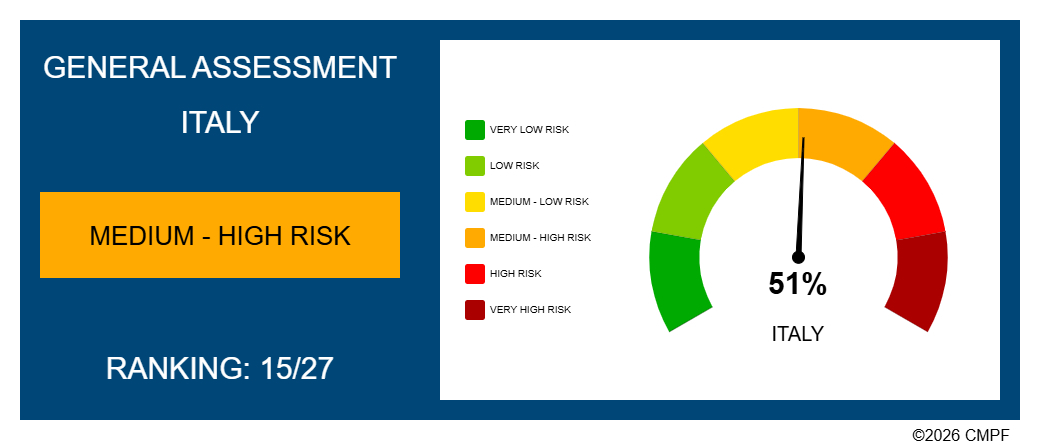
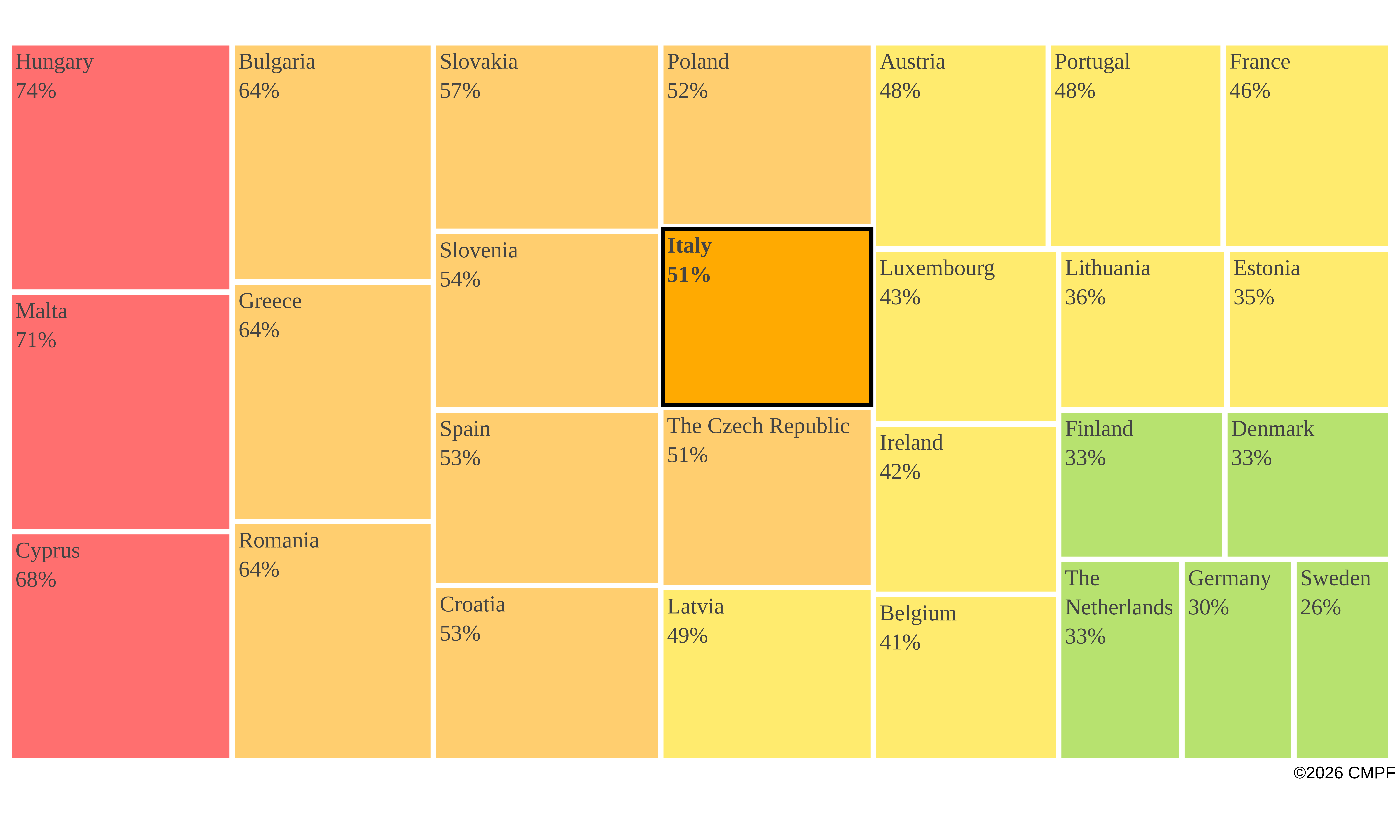
Risk score: 51%
| Fundamental Protection | 45% |
| Market Plurality | 69% |
| Political Independence | 48% |
| Social Inclusiveness | 43% |
In-depth analysis:
Read the full MPM2026 Country report
Country overview
During 2025, from a political perspective, Italy maintained substantial continuity with the previous year: a centre-right parliamentary majority (composed of Fratelli d’Italia, Lega, Forza Italia, and Noi Moderati) continued to support, for the third consecutive year, the government led by Giorgia Meloni. The majority remained stable, despite some non-negligible political divergences: governing parties occasionally expressed different positions on support for Ukraine and, more broadly, on relations with international partners and NATO; similarly, public finance decisions were adopted at the cost of some internal frictions. These tensions, which may be considered physiological in a system such as the Italian one (characterised by broad and composite governing coalitions), never called into question the stability of the government, which is in fact emerging as one of the longest-lasting executives in the history of the Italian Republic.
During the year, no national political elections were held, but regional elections took place in five major Italian regions: in two cases, centre-right coalitions prevailed (Lombardy and Veneto), and in three cases, centre-left coalitions (Campania, Puglia, and Tuscany). However, it should be emphasised that in all cases none of these regions experienced a change in political majority, confirming a certain stability of territorial political arrangements. In all these elections, the centre-left presented itself under the formula of the “campo largo”, in which traditional progressive parties (Partito Democratico and Alleanza Verdi-Sinistra) formed a coalition with the Movimento 5 Stelle; these regional elections appear to have confirmed the competitiveness of such an alignment also in view of a potential national contest. In June, five abrogative referendums were also held (four relating to labour issues and one concerning the acquisition of Italian citizenship), but none reached the required turnout quorum.
At the institutional level, on 30 October 2025 the parliamentary procedure for approving the constitutional reform on the separation of the careers of judges and public prosecutors was concluded. The reform, which originated from the government itself and was approved by Parliament without any amendments, sparked a broad and highly contentious debate. The reform was subsequently rejected in the constitutional referendum held in March 2026. The other major institutional reform proposed by the governing majority, concerning the direct election of the Prime Minister, appears to have been set aside; it was approved on first reading by the Senate in 2024, and no further parliamentary developments have followed.
A particularly significant event in 2025 was the case concerning the release and repatriation of Osama Almasri Njeem, ordered by the Court of Appeal of Rome. The case had a strong media impact, both due to its international implications and to the communication strategies adopted by the government. The initially limited transparency of institutional communication fuelled an intense public debate. The episode highlighted critical issues in government communication and in the relationship between institutions, media, and public opinion.
In the media sector, the main critical issues already identified in previous years are confirmed. In particular, the highly problematic relationship between politics and public service broadcasting continues to stand out: despite the entry into force of the European Media Freedom Act, Italy has not adopted any new legislation ensuring the effective independence of RAI, and indeed the situation has worsened compared to previous years. Since 2024, the appointment of the President of RAI has been blocked, and the parliamentary majority has also paralysed the work of the parliamentary oversight commission since then.
In the Italian context, attention has recently focused on the case involving Paragon Solutions, a company developing advanced spyware reportedly used by state security apparatuses. The affair has reignited concerns over the deployment of highly intrusive surveillance technologies, particularly regarding transparency, oversight, and the potential for misuse against individuals not necessarily involved in criminal activity. At the same time, the adoption of the Security Decree, later converted into Law 9 June 2025 No. 80, has updated Italy’s legal framework on public security by strengthening preventive and operational powers of law enforcement and intelligence agencies. Criticism from legal scholars and public debate has highlighted the tension between these developments. On one hand, the use of sophisticated surveillance tools raises proportionality and accountability concerns, especially in relation to privacy rights and freedom of expression. On the other hand, the expanded powers introduced by the 2025 legislation have been questioned for potentially broad or vague provisions, which may weaken oversight mechanisms and judicial safeguards. Overall, the intersection of technological capabilities and regulatory expansion has intensified the ongoing debate on the balance between national security and fundamental rights.
Significant concentrations and links with politics also persist in the private sector. The Fininvest group, which continues to be controlled by the heirs of Silvio Berlusconi, maintains a very significant role in the national media landscape. More generally, the risk of conflicts of interest remains high in the Italian media sector, also due to the presence of several political figures with direct or indirect interests in the media and communication industries.
At the same time, the traditional media market (in particular newspapers and periodicals) continues to display significant economic weaknesses due to the constant decline in readership and advertising revenues. During 2025, several highly significant ownership reorganisation processes were initiated, which were finalised between the end of the year (entry of LMDV Capital into “Il Giornale”) and the beginning of 2026 (including the transfer of the newspaper “La Stampa” to the SAE group and the sale of the GEDI group to the Greek group Antenna).
Overall, the state of media pluralism in Italy in 2025 remains problematic and does not show significant improvements compared to the previous year. Conditions of risk persist, linked to political influence over the media, ownership concentration, and the structural weakness of independent journalism. At the same time, the growing relevance of digital platforms and social media continues to transform the information ecosystem, intensifying challenges related to the quality of information, the spread of disinformation, and the economic sustainability of the journalistic sector.
Fundamental Protection
The Fundamental Protection area is assessed at a medium-low level of risk, as last year. Notwithstanding this positive assessment, a number of structural weaknesses persist, particularly as regards freedom of expression and the conditions of the journalistic profession.
- The journalistic profession remains the most critical area. While the legal and institutional framework continues to provide relevant safeguards, their effectiveness is increasingly undermined by structural factors. These include the persistent failure to renew the collective labour agreement, growing economic precarity, and the expansion of freelance work, all of which negatively affect professional independence and may contribute to self-censorship. At the same time, threats and intimidation against journalists are increasing, particularly in the online environment. The continued use of strategic lawsuits against public participation (SLAPPs) represents a significant source of economic and psychological pressure, especially for freelance journalists and smaller media outlets.
- The protection of freedom of expression remains overall robust at the formal level, supported by constitutional guarantees and well-established case law. However, several structural shortcomings persist. These include the absence of an independent national human rights institution, the excessive length of judicial proceedings, and ongoing concerns related to defamation law, notably the existence of custodial sanctions, despite their limited application in practice. The legal framework to address SLAPPs remains incomplete: the transposition of the relevant EU directive is ongoing but currently limited in scope and lacking effective mechanisms for the early dismissal of manifestly unfounded claims.
- A deterioration of civic space is observable in practice. Reports point to increasing pressure on journalists, activists, and human rights defenders, including instances of digital surveillance and restrictions in the context of peaceful demonstrations. Intimidatory litigation continues to be widely used, producing a chilling effect on public participation and investigative journalism. At the same time, legislative developments indicate a potential tightening of the regulatory environment affecting the exercise of fundamental freedoms, including the right to protest.
- The protection of information integrity and the right to information remains at a medium-low level of risk, reflecting a framework broadly aligned with EU standards but affected by implementation gaps. While no systematic restrictions by public authorities are observed, concerns persist regarding transparency and accountability, in particular in relation to online platform content moderation and the lack of comprehensive reporting on public authorities’ content removal requests. Disinformation continues to pose a structural challenge, in the absence of a unified national strategy and in light of increasingly sophisticated campaigns, including foreign interference.
- The right to information, although supported by a structured access regime (including FOIA and civic access mechanisms), remains limited in practice. The extensive use of exceptions, inconsistent administrative practices, and procedural delays constrain effective access to public information. Recent legislative changes concerning the publication of wiretaps, as well as broader uncertainties surrounding access to judicial information, raise additional concerns. The whistleblowing framework has been strengthened, but its practical effectiveness remains in a consolidation phase.
- The independence and effectiveness of national regulatory authorities continue to be assessed at a low-risk level. The Communications Authority (AGCOM) operates within a solid legal framework ensuring formal independence and has assumed an enhanced role under the Digital Services Act. Nevertheless, challenges remain, including the limited deterrent effect of sanctions, the increasing complexity of regulatory tasks, and exposure to indirect pressures in politically sensitive contexts.
Market Plurality
The Market Plurality area remains, also in 2025, the most problematic, with an overall high level of risk, showing a slight deterioration compared to the previous assessment. While the regulatory framework is formally developed and broadly aligned with EU standards, its effectiveness in addressing structural and market-driven challenges remains limited, particularly in the digital environment.
- The indicators on Plurality of media providers and Plurality in digital markets continues to present a high level of risk. Although Italy has established a sophisticated system to monitor and prevent excessive concentration—based on the Integrated Communications System (SIC) and enforced by AGCOM—important limitations persist. The framework remains primarily focused on economic indicators and does not fully integrate editorial independence as an autonomous assessment criterion. In addition, significant gaps remain in the coverage of digital actors, many of which fall outside the regulatory perimeter. Structural asymmetries in digital markets further exacerbate risks, as global platforms maintain strong market power over advertising, data, and content distribution, creating dependency and bargaining imbalances for media publishers.
- The Transparency of media ownership is assessed at medium-high risk, reflecting a system that ensures transparency vis-à-vis authorities but not effective public accessibility. Existing tools, such as the Register of Communication Operators (ROC) and the Register of Beneficial Owners, provide fragmented and only partially accessible information. Recent reforms have introduced a more restrictive access model based on “legitimate interest,” limiting proactive transparency and falling short of the requirements set by the European Media Freedom Act. In practice, ownership information is often difficult to access, incomplete, or presented in formats that are not easily understandable, particularly in the digital-native media sector.
- The economic sustainability of the media sector (Media viability) remains at medium-high risk, reflecting structural fragility despite some areas of resilience. While television and radio markets show relative stability, the print sector continues to experience a structural decline in circulation, advertising revenues, and overall profitability. The digital market is growing, but a large share of revenues is captured by global platforms rather than news publishers. Although media organisations are diversifying business models and public support mechanisms remain in place, these measures have not yet ensured long-term sustainability. Labour market conditions, particularly the growing reliance on low-paid freelance work, further weaken the sector’s resilience.
- Editorial independence from commercial and owners influence also remains at medium-high risk. Formal safeguards exist, including legal provisions, collective agreements, and ethical standards, but their effectiveness is significantly limited in practice. Structural factors—such as the economic fragility of the sector, the increasing reliance on alternative revenue streams, and the prevalence of “impure publishers” with broader business interests—create indirect but pervasive pressures on editorial choices. While direct interference is generally prohibited, commercial influence often operates in more subtle forms, including sponsored content and advertiser-driven editorial priorities. Enforcement of existing safeguards remains uneven, further weakening their practical impact.
- Overall, the Italian media market is characterised by a structural imbalance between formal regulatory strength and practical effectiveness. Persistent data gaps, limited enforcement capacity, and the rapid evolution of digital markets reduce the ability of existing rules to effectively safeguard media pluralism. As a result, risks related to concentration, economic sustainability, and independence remain significant and only partially mitigated.
Political Independence
The Political Independence area is assessed in 2025 at a medium-low risk level, in line with previous assessments. It should be noted that:
- The regulatory framework on conflicts of interest remains unchanged and inadequate. The current rules continue to fail to effectively prevent situations of overlap between politics and the media. The reform proposal approved by the Chamber of Deputies in 2024 has not been finally adopted.
- As regards political information during electoral processes, certain critical issues persist in news coverage, as well as difficulties in distinguishing between institutional communication and propaganda. The entry into force of Regulation (EU) 2024/900 (TTPA) on the transparency of political advertising has strengthened online transparency, but has also shifted part of the competition towards less traceable content, such as that produced by influencers.
- The governance system of RAI has not been modified and is therefore in contrast with the principles established by the European Media Freedom Act (EMFA), which entered into force in August 2025. Throughout 2025, the deadlock also persisted, due to the lack of agreement between governing and opposition parties, regarding the appointment of the President of RAI and the functioning of the Parliamentary Oversight Commission.
Social Inclusiveness
The Social Inclusiveness area remains at a medium-low risk level, with highly differentiated indicators. It should be noted that:
- Access to media reaches very high levels, with radio and television coverage close to the entire population (99.8%), alongside significant progress in digital transition and in accessibility for persons with disabilities.
- Cultural and linguistic diversity presents a heterogeneous picture: public service media ensure good protection of historical linguistic minorities, while in private media such content remains almost entirely absent.
- In 2025, AGCOM continued the enforcement activity initiated in 2024, imposing sanctions for violations of the criteria established by the Authority to prevent hate speech. AGCOM accredited the first “Trusted Flaggers”, namely experts tasked with reporting illegal online content and ensuring its rapid removal. From July 2025, content creators with more than 500,000 followers are required to comply with the principles of human dignity established by TUSMA.
- Gender equality in the media continues to represent a significant critical issue. Despite some formal initiatives, women remain strongly underrepresented in top positions and in editorial production, while imbalances also persist in media representation and in participation in public debate.
- Despite increased investments and new institutional initiatives, digital literacy initiatives remain fragmented and uneven, and not particularly effective; in this area, significant generational and territorial divides continue to emerge.