

The Netherlands 2026
Media Pluralism Monitor 2026 results
Risk score: 34%
| Fundamental Protection | 27% |
| Market Plurality | 62% |
| Political Independence | 19% |
| Social Inclusiveness | 28% |
In-depth analysis:
Read the full MPM2026 Country report
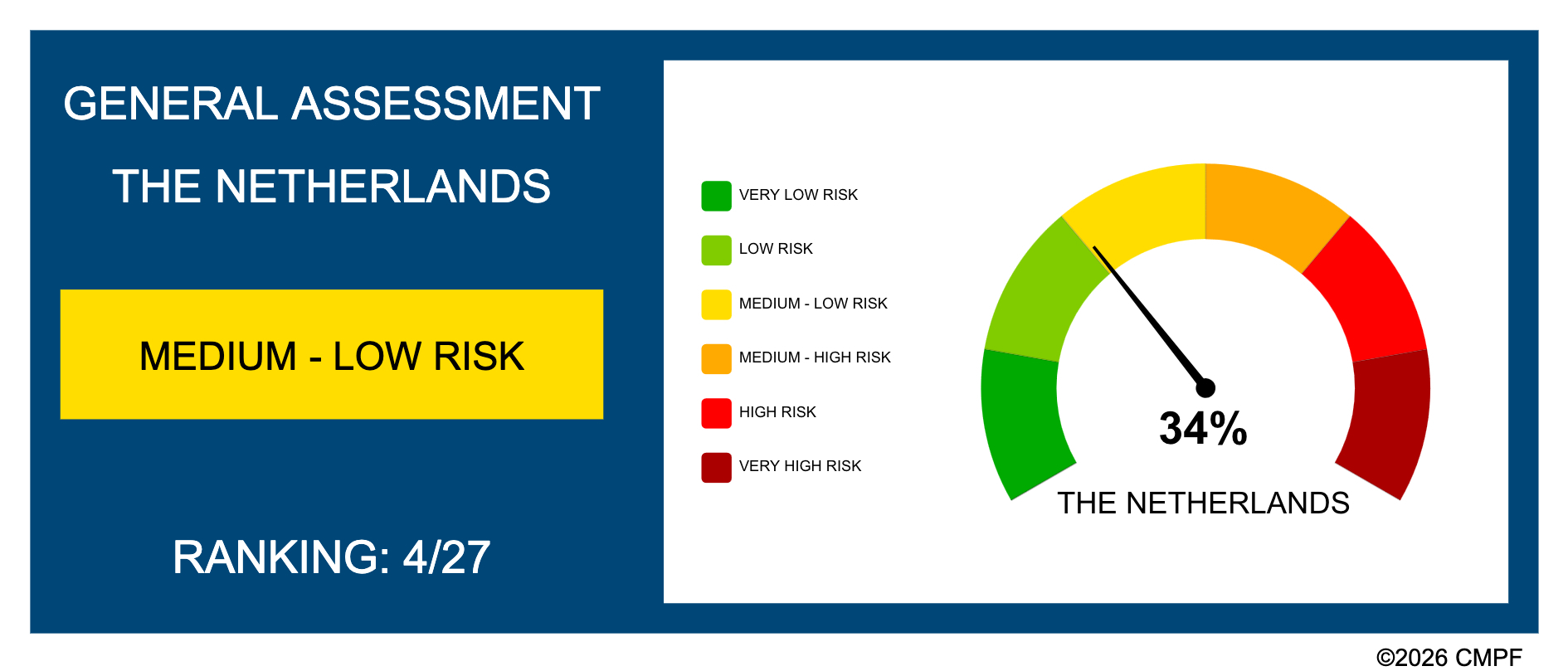
Country overview
In June 2025, the only recently installed government felt (the right-wing oriented cabinet Schoof started only in July 2024). New elections were held on 29 October 2025 and after coalition talks, a minority cabinet led by Rob Jetten was formed and installed on the 23rd of February 2026. The new government is composed by the parties D66, VVD and CDA, and will need to find parliamentary majorities for their policies, which means support by other parties.
From the coalition agreement, it seems that in terms of media policy, the new government will continue the pathway of the previous governments, also in terms of large reforms of local and regional public broadcasting and national public broadcasting, including the intended budget cuts. However, it seems like this will be smoothened a little bit by about 50 million EURO. This means that by 2027, the plan is still to have a reduced number of public broadcasters, with a focus on professionalization and more efficiency of the PSM.
The media market in the Netherlands remains quite concentrated, with only very few (mostly foreign) organisations dominating the media landscape when it comes to newspapers, television, radio and online news. An important 2025 development is the approval by the Dutch competition watchdog of the merger between RTL and DPG Media, which was only given if certain interesting conditions are followed, of which some are linked to editorial independence (and thus not purely economic elements). The pressure from very large online platforms (VLOPs) on media viability remains significant.
With regards to journalists’ safety, in 2025, again, PersVeilig reported increasing harassment incidents against journalists leading to continued concerns about journalist safety and press freedom.
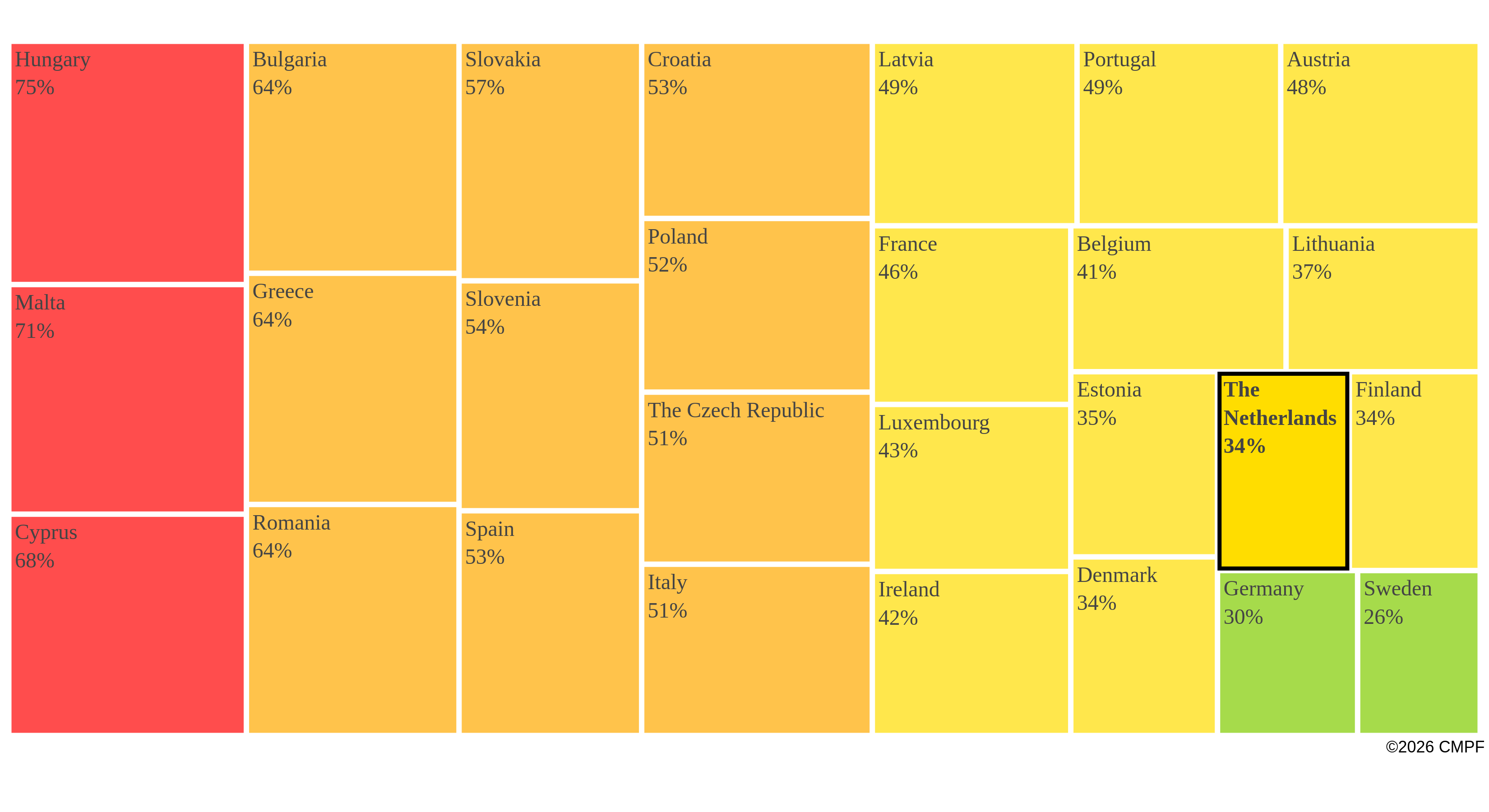
Fundamental Protection
In line with the last years, the risk level for Fundamental Protection in The Netherlands is low. Key points include:
- The Netherlands continues to rely on a strong legal and institutional framework for fundamental rights, particularly in the areas of freedom of expression, access to information, and regulatory independence, all of which remain aligned with European standards.
- Several pressures identified in previous years persist and remain visible in practice, including legal intimidation of journalists, gaps in protection against SLAPPs, and ongoing concerns related to surveillance and source protection.
- The safety of journalists remains a key concern, with incidents of threats and attacks increasing further in 2025, including both physical incidents during reporting and a continued high level of online harassment, particularly affecting women journalists.
- Online platforms play a central role in how people access news but their content moderation practices remain insufficiently transparent and accountable in practice, despite new rules under the Digital Services Act.
- The right to information and whistle-blower protection are well established in law but practical implementation remains inconsistent, with delays in access to information, moderate awareness of whistle-blower protections, and ongoing political debates about potential restrictions.
- Independent regulatory authorities operate effectively and with strong safeguards, including the expanded role of the ACM under the Digital Services Act, although certain structural features of the Dutch system remain points of attention.
Market Plurality
The domain Market Plurality is traditionally the domain with the highest risk score for The Netherlands, and that is also the case in 2025 with an (even increased) estimate of medium-high risk. Key points include:
- Plurality of media providers was found at an even higher level of risk than in previous years. A critical development for this has been the 2025 take-over of the commercial TV stations of RTL Nederland (including their well-watched news program) by the already largest publishing house active in the Netherlands.
- With this recent take-over, the media market consolidated even further; reducing the number of major media players in the Dutch market (newspaper, TV, radio, but also very prominent in the online news environment) from four to three: the public broadcaster NPO, DPG Media, and Talpa Network.
- In general, sufficient transparency of media ownership is found in the Dutch context. However, one should note that this is not the consequence of law that enforces media service providers to make ownership information easily accessible, but it instead relies on self-disclosure, which makes it a potential weakness for the future.
- Major publishers have agreed on a first license agreement could with a tech company: Google agreed to pay for the use of snippets of newspaper articles of Dutch media companies. No deals have been made regarding the use of news content for (Gen)AI purposes. However, Dutch publishers have been pro-active is sharing their news content free of charge to train a Dutch large-language model that is created in an ethical and transparent manner.
- Revenues trends in the media sector remained stable and slightly positive. An important development seems that revenues based on subscriptions are growing proportionally, whereas the income generated with advertising seems less secure.
- The public broadcaster is facing a large budget cut, which will likely have a strong impact on the plurality of the Dutch television landscape if implemented by reducing costs on the programming and content creation rather by reducing the costs of management and overhead.
- Self-regulatory mechanisms still play a key role in guaranteeing the editorial independence of journalists. For example, in the recent take-over of RTL Nederland by DPG Media, the competition regulator in the Netherlands (Authority for Consumers and Markets, ACM) attached great value to the editorial statutes that are functioning to formalise the separation between the newsroom (i.e., editorial decision-making) and commercial management of news media organizations.
Political Independence
For The Netherlands, the area of Political independence carries a low risk. Key points include:
- In The Netherlands, there is broad consensus that there is little to no political influence on media outlets or media content, but this currently favourable situation is not legally guaranteed because of a lack on formal legislation.
- The Dutch tradition of strong editorial statues to protect journalists and editors from political (and commercial) influences, remains in place and was even strengthened in 2025 following the merger between DPG Media and RTL and the conditions ACM set for that. For example, the editorial statutes of the online newspaper nu.nl have been renewed and strengthtened.
- Due to the large number of (often small) political parties in The Netherlands, it is hard to achieve fair representation of all parties in media content. Especially smaller parties suffer from a lack of attention. To keep this problem out of the dark, it would probably be a fruitful effort for the government/media regulator to monitor and report this form of media representation regularly.
- Indications that foreign trolls tried to have (limited) influence during election campaigns, and a lack of cooperation of large online platforms to check whether political parties are following up on the ban on political advertisement are potentially problematic and need government (and EU) follow-up.
- Following the planned reforms and budget cuts on local, regional and national public service media, there is a possibility that editorial independence and content diversity will get more under pressure.
Social Inclusiveness
For the area Social Inclusiveness, the risk assessment for 2025 is low as well. Key points include:
- Media accessibility is generally high in The Netherlands. As lot has been done for media users with disabilities, and there are good intentions throughout the media landscape to keep expanding the media content accessible to them. It is important that these intentions continue to materialize.
- Local and regional media will be affected by government reforms, which are ongoing and will lead to less (semi-)regional public broadcasters, with a focus on professionalisation and efficiency. In the course of that reform, extra attention for the presence of local voices and diversity of content is needed.
- Gender equality remains an important working point in The Netherlands, both in terms of (leading) roles in the media sectors and regarding media representation of women and minority groups. The progress that is being made over the recent years (if any) is not impressive.
- Generally, media and digital literacy is high in The Netherlands. There are plenty of initiatives involving government partners, but also civil society and media, with a focus on strengthening the digital foundation of the country and digital competences in general, following the new Dutch Digitalisation Strategy.