

Cyprus 2026
Media Pluralism Monitor 2026 results
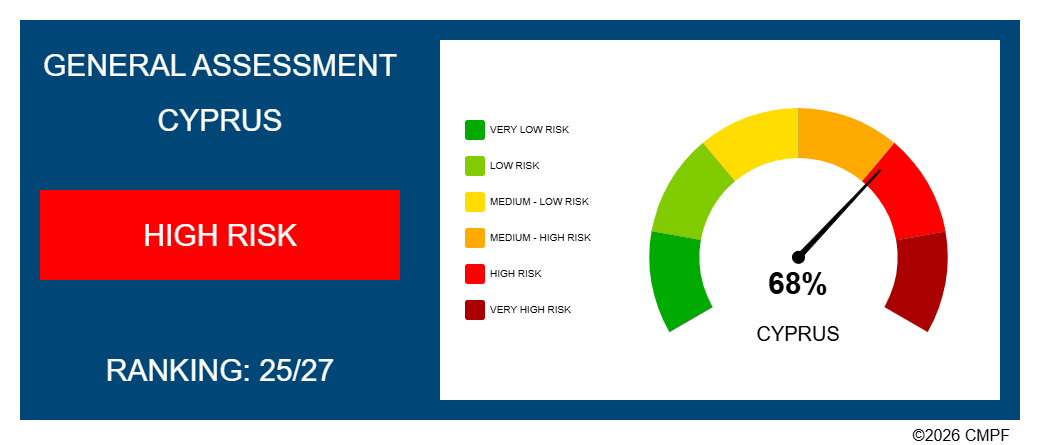
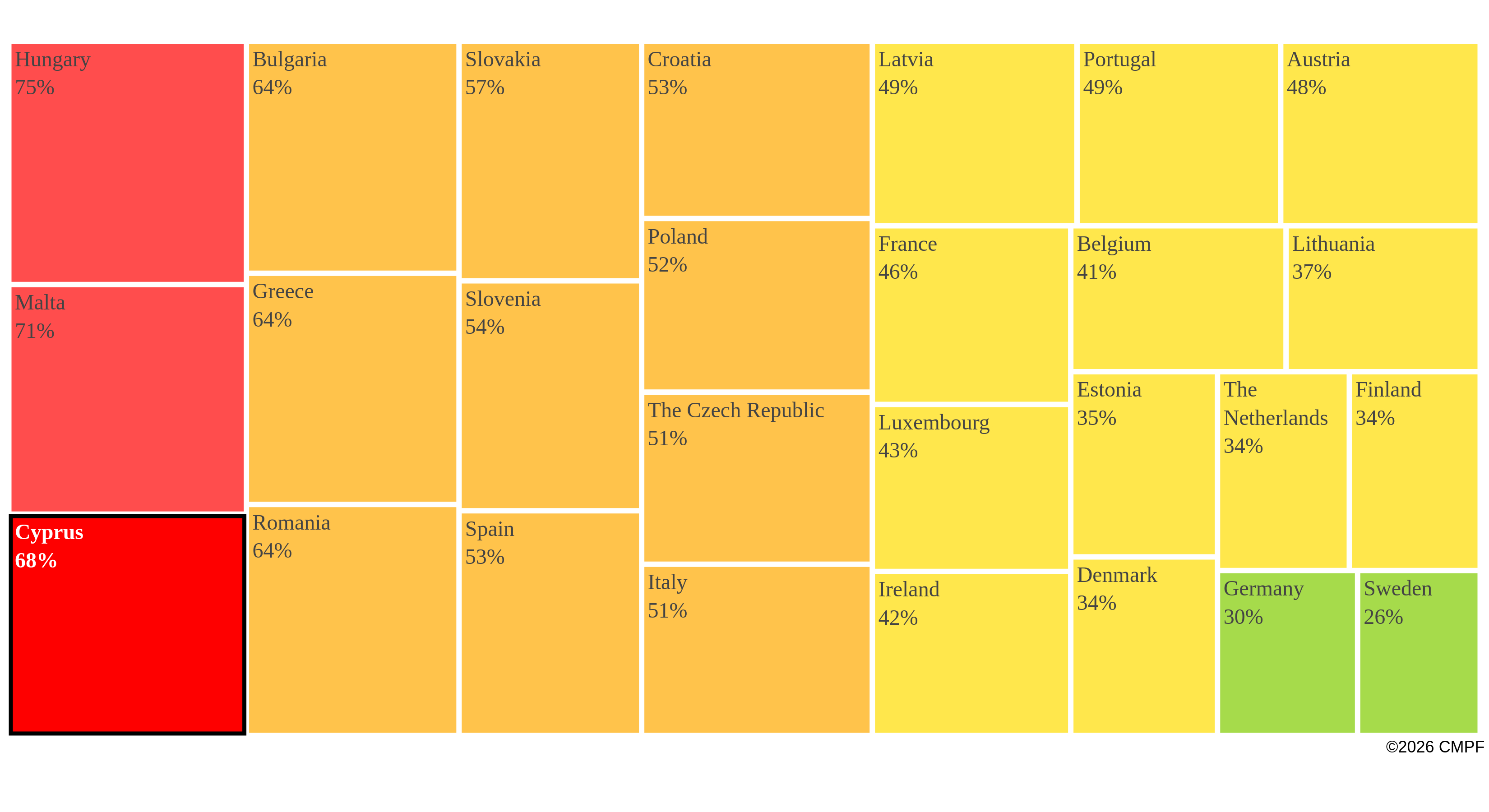
Risk score: 68%
| Fundamental Protection | 49% |
| Market Plurality | 91% |
| Political Independence | 62% |
| Social Inclusiveness | 71% |
In-depth analysis:
Read the full MPM2026 Country report
Country overview
Cyprus has a presidential system of government, with the President of the Republic heading the government. The President is elected for a five-years term and the government does not require a vote of confidence by the House of Representatives; this means that the composition of the Parliament does not impact on the survival of the government. President Nicos Christodoulides was elected in February 2023, entered into office on 1 March 2023 and includes in his Council of Ministers members of the Democratic Party (DIKO), the Socialist Party EDEK and the Democratic Front (DIPA).
Media in Cyprus appear to be a non-issue for the authorities, as testified by almost complete negligence of the sector, except mandatory actions, commanded by the obligation to implement European Union directives, through their transposition, often with long delays, into national law. Legislative attempts in the past couple of years often featured haphazard and circumstantial initiatives that posed serious threats to freedom of expression and freedom of the press.
The legal and regulatory environment bears characteristics of obsolete, inadequate or seriously deficient rules, while opacity is a dominant feature in most areas; there is a lack of audited or verified data or, on occasion, of any data at all about the media market, audiences and other issues. The absence of official reports from the government, the media regulator and other authorities on their actions and policies contribute to the incomplete picture of the sector and represents a deep failure to inform the citizens and ensure transparency in the democratic discourse. The impact of these critical factors on the assessment of risks to media pluralism is very negative for Cyprus’ evaluation.
In mid-2025, the Cyprus Radio Television Authority – CRTA was assigned by law the role of Digital Services Coordinator and was renamed Cyprus Radio and Digital Services Television Authority – CRT&DSA .
In July 2025, the Law on Public gatherings and Processions, L.151(I)/2025 was promulgated. An opinion by OSCE-ODIHR stated that it failed to protect the Constitutional right of peaceful assembly, with some of its provisions in infringement of this right and by extension of freedom of expression. The law was amended in February 2026 .
In February 2026, the discussion in a parliamentary committee on a (second) draft of the law for the Implementation of the European Media Freedom Act (EMFA, Regulation (EU) 2024/1083) was postponed just before the meeting, with no further explanation. The draft law was even more problematic than a first draft, presented one year earlier, on many issues, among which was the vague way of addressing the derogation of article 4 of EMFA, removing protection of media and journalists.
The most significant development for this report is the disclosure by the CRT&DS Authority to the authors of this report that following the amendment of the Law on Radio and television organisations L. 7(I)/1998 in July 2023 there have been 26 significant shareholding and ownership changes in radio and television, complete unknown to the public. This points to a grave failure of the authorities to ensure transparency on a very large scale of changes in the media landscape and non respect of the rights of the public to know who makes the news. It also affects the evaluation of various sections of the report.
In 2025, freedom of expression and freedom of the media were violated in many instances; there has been a case of physical attack against journalists, who have also been targets of intimidation, summoning and questioning by police, online harassment and other acts, even by personnel of the presidential palace. Media professionals experience low or no job security, while in surveys by their union they speak of facing threats and pressures in their work.
Benefits, working conditions and editorial independence are affected by the financial precariousness of the media, which impacts on quality journalism and pluralism. The deputy ministry of culture was involved in one of two cases of censorship.
Fundamental Protection
The risk level in the area of Fundamental Protection remains at medium-low risk; the overall positive picture of the existing legal framework is still incomplete or marked by serious gaps and deficiencies in the implementation. Also, some legislative initiatives raise issues of concern:
- Cyprus is a signatory of international treaties on human rights without reservations.
- Decriminalisation of libel and defamation dates back to 2003.
- Amendments in 2024 and 2025 to the law for the Protection of Persons who report breaches of the national and EU Law aimed at enhancing protection, while no update is available about a study and consultations for the improvement of the law on access to information, L. 184(I)/2017.
- The law on SLAPPs, On the Protection of Persons Engaging in Public Participation Activities from Manifestly Unfounded Lawsuits or Abusive Judicial Proceedings, L. 24(I)/2026 was promulgated on 20 March 2026.
- A last-minute postponement of a discussion in a parliamentary committee of a revised and delayed draft law “for the implementation of EMFA” was received with dismay by stakeholders. Both versions of this draft law, and other law proposals, have raised serious concerns about their focus and provisions that could critically harm freedom of expression and freedom of the media.
- The House of Representatives amended in February 2026 the law on Public Gatherings and processions, promulgated in July 2025, which an opinion by OSCE-ODIHR found in breach of fundamental rights.
- A government initiative in early 2026 aimed at amending article 17 of the Constitution on the secrecy of communications to allow surveillance through authorization by sole the Attorney General.
- Key concerns about obstacles to effective respect of the right of access to information, and the effective protection of whistle-blowers persist. The authorities failed to respond to a request by the authors of this report that data on State advertising should only include spending to media in aggregate form per year and medium, in compliance with article 25 of EMFA.
- The vote of the law for the implementation of the DSA in July 2025 remains the only known act by the authorities regarding online communication. There is no information, no official reports about government policies regarding requests or other actions that interfere with online free expression. Plans or activities to counter disinformation or foreign interference do not exist, which raises high concerns in the current context of hybrid attacks.
- Since July 2025, the former Cyprus Radio and Television Authority became also DS Authority (CRT&DS Authority), the coordinator for the implementation of the Regulation EU-2022 (2065). Despite the independence the Authority enjoys by law, it provides no concrete evidence of effective monitoring, enforcement of and reporting on compliance of media service providers with all their various obligations under the law. Following the entry into force of EMFA in August 2025, the Authority has not presented any concrete example of action in compliance with its provisions. It provided no transparency on its operation and work, no transparency on the media environment and law enforcement. The authors of the present report were surprised to learn from the Authority that from July 2023 to December 2025 there had been full ownership or significant shareholding changes in 26 radio and television licensees, about 30% of the total. No information is publicly available on these changes.
- While cases of serious threats or attacks on journalists had been non-existent for years, an annual survey by the Cyprus Union of Journalists among its members has revealed that significant numbers are facing threats and pressures related to their work, while feeling job insecurity. Still, filing official complaints is rare. In 2025, there has been an attack by police against journalists on duty during a demonstration, journalists were summoned by police for questioning and to confirm the content of radio and television programs they hosted. Journalists also complained about cases of interference and intimidation by officials and online harassment by named and anonymous trolls allegedly linked to the presidential palace. In August 2025, the deputy government spokesperson posted on X images of press articles with the stamp “fake-news”, simply because the reports were not in line with the government’s narrative. A parliamentary committee examined the issue of threats against the public and journalists.
- While the laws and the Constitution offer every person remedies in case of infringement of one’s rights, the extremely slow administration of justice raises grave concerns, as it appears to compromise or even cancel effective enjoyment of fundamental rights related to freedom of expression.
Market Plurality
Market Plurality is the very-high risk band, as it was in the past implementation, with all its indicators passing into very-high risk level. There has been a deterioration in an environment suffering from opacity and very deficient regulation. The key issues are the following:
- With the entry in force of EMFA, requiring specific actions in order to promote and warrant media pluralism, one would have expected that the regulator would enforce, at least, existing rules in Cyprus Law to ensure transparency in radio and television finances and ownership. This did not happen; while there have been ownership and significant shareholding changes in about 40% of radio licensees and significant shareholding changes in all major television, since July 2023, CRT&DS Authority has published no information whatever. The public knows nothing about media resources and relationships critical in assessing the value of the information received. A meeting in a parliamentary committee for the discussion of a draft law for the implementation of EMFA, which could set an obligation of transparency in ownership and finances on print and digital media too, was postponed (February 2026).
- There is a high concentration in the market share of service providers in the audio-visual and the press, which is affecting plurality of information resources. Opacity on the significant number of changes in ownership and shareholding in radio and television do not allow us to assess the extent of concentration and eventual conditions of oligopolies in the whole media sector. Beyond the non-availability of ownership information, the lack of any market or audience data for any media sector, raises concern as to the size of influence exerted by individual media in each media sector.
- The adoption of the law in implementation of the DSA has not yet elucidated the state of affairs in the online digital market, in aspects not regulated by the DSA. Relations between the Cyprus media and VLOPs and AI remain a grey area, and an issue of serious concern. Authorities have not provided any additional data on taxes to digital services other than the adoption of a law.
- Media income and financial resources remain opaque, despite obligations for transparency under the EMFA and existing laws on radio and the audio-visual sector. We have no concrete information to assess the financial health of any media sector.
- The influence of owners and businesses on content has been documented by journalists’ answers to the survey conducted annually by the Cyprus Union of Journalists since 2024.
- Disguised advertising in the media is a relevant issue; in particular, online media make no distinction between news/opinion and advertising. Existing legislation for labour and social protection, could offer effective support of journalists’ rights, but the very slow administration of justice is likely to compromise the resolution of problems through legal action. This negatively affects also their ability to claim their editorial independence.
Political Independence
While the area of Political Independence remains in the zone of medium-high risk, opacity in media ownership might imply a much more problematic situation than the current finding conveys. The main features of this area are the following:
- The legal framework regulating media ownership or control by power holders or politicians in general is either missing or deficient. Most concerning is the opacity covering the issue; while full ownership or shareholding changes affected more than 30% of radio and television organisations since July 2023 no information is publicly available about either the changes or the persons involved. The law does not allow State officials to hold media managerial positions, while conflict of interest, media shareholding or ownership pose no problem. Only political parties, not politicians, cannot own or control a radio or television organisation. No regulation or media control constraints exist for online digital media. We have not seen any measures by the authorities in implementation of relevant EMFA rules.
- All media and their owners and the Union of Journalists abide by the self-regulatory Code of Conduct and accept the competence of the Cyprus Media Complaints Commission, established since 1997; the authority and competence of the Commission is recognised by the Law on Radio and Television Organisations. While journalists stated in surveys about interference in their work, major media have no internal codes, which would warrant to some extent editorial independence.
- Appointments and dismissals of editors-in-chief should comply with labour laws; as in the case of other categories of employees, dismissals are possible only in case of redundancies or for serious offenses.
- On the whole, media coverage of elections on both PSM and commercial media is fair and balanced. However, national rules on political advertising and online campaigning have yet to align with the requirements of Regulation (EU) 2024/900 (TTPA). The non-publication of codes and schedules of media coverage, non-consideration government activities linked to electoral campaigns and, most importantly, complete absence of any kind of monitoring compliance reports are issues of serious concern.
- The allocation of the frequency spectrum follows a fair and transparent procedure, while State subsidies to the media is non-existent. The only exception is a de minimis grant available only to national newspapers. The State allocates advertising based on generic technical criteria, of which authorities publish only a description. A general estimate from raw Official data shows that Google and Meta received over 80% of advertising spending in 2024 and 2025, mostly for promoting tourism.
- The long-overdue new law on the PSM is still parliamentary discussion stage (March 2026), with the situation in all respects unchanged. The legal framework and guidelines that govern the coverage of political actors is obsolete, requiring revision and update. Although it appears fair, we lack information and specialised reports that could document our evaluation. The appointment of the PSM’s governing board by the Council of Ministers in early 2024 from a list of nominees proposed by an advisory council, appears to have added nothing novel. We note a continuous climate of friction within the board and with the management, with disciplinary charges, which are affecting decision-making procedures. The members of the board are usually party affiliated persons; they appoint the Director General and other senior management posts, with political criteria present, despite the rules in schemes of service. The PSM’s governing board is on the list of those bodies that a new government can dismiss within the year of taking office, which is a serious threat to the organisation’s independence.
Social Inclusiveness
The area of Social Inclusiveness has crossed into the high risk band. The main points of the situation are the following:
- Coverage and access to the PSM and to broadband is universal, with a slightly lower rate for broadband on mobile phones. Net neutrality and ISP policies present no problems. Access by people with disabilities to the PSM and commercial radio and television continues to be problematic despite obligations set in EU Directives and in national laws since 2010.
- Minorities recognised by law are represented on PSM radio but have no real voice. Non-recognised and marginalised minorities have no access, other than being represented in news, most often in a negative way. Commercial service providers offer no access to any of the above groups, while representation of non-recognised and marginalised minorities is also often negative. There are laws against hate speech, but neither the authorities nor online intermediaries seem to deploy concrete efforts against online hate speech.
- Local media do not seem to assume the role expected, to serve the needs of local populations, given the scope of national media in a geographically limited area. The local media that do exists do not seem to be at risk, but this is of limited importance. As most do not provide news and current affairs programs, with a similar situation applying to online local media which mostly operate with one or two journalists. The Law recognises no community media.
- Gender equality remains an issue of serious concern; the PSM and commercial media have no policy on the subject, female presence in media governance and management remains limited, while progress in access to media as experts is not sufficient to avoid the high risk label; access in political debates is rare.
- Officials often refer to problems with disinformation by deceptively labelling it a fake-news issue. They appear more eager to push for measures that are seeking to criminalise interpersonal and online exchanges rather than to tackle the deteriorating online communication sphere. Surveys establish that very few persons cross check the veracity of information they come across, while the only existing fact-check initiatives are private and very few. Authorities are so far ignoring the need for media literacy as an urgently required policy or, even, an issue to consider. Media literacy is not part of any curriculum, while no projects exist for vulnerable or other persons in non-formal education. Despite an increase in the related activities of the Pedagogical Institute of the Ministry of Education and of the Cyprus Radio Television and DS Authority, the latter responsible under the law for media education, these cover a very small section of persons, almost exclusively in education.