

Finland 2026
Media Pluralism Monitor 2026 results
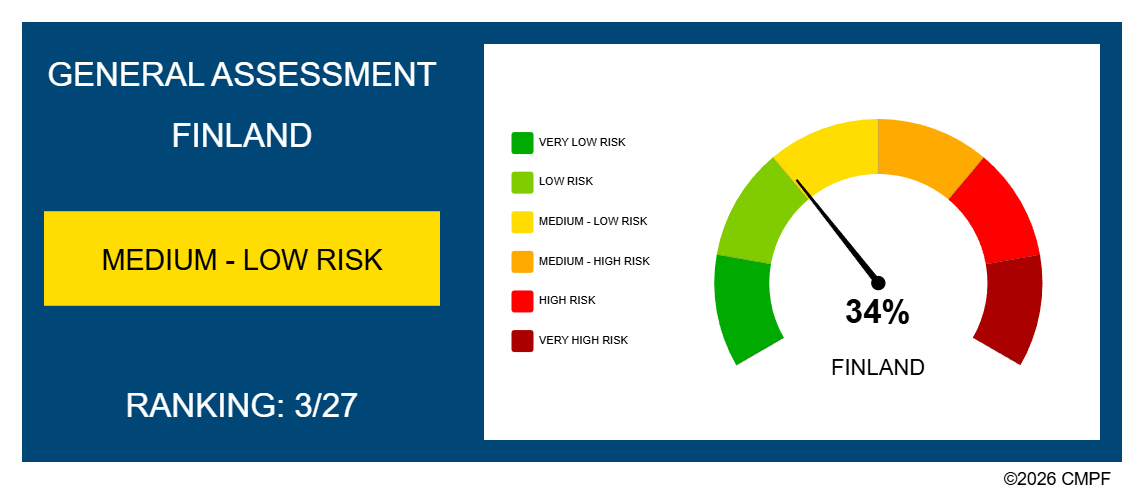
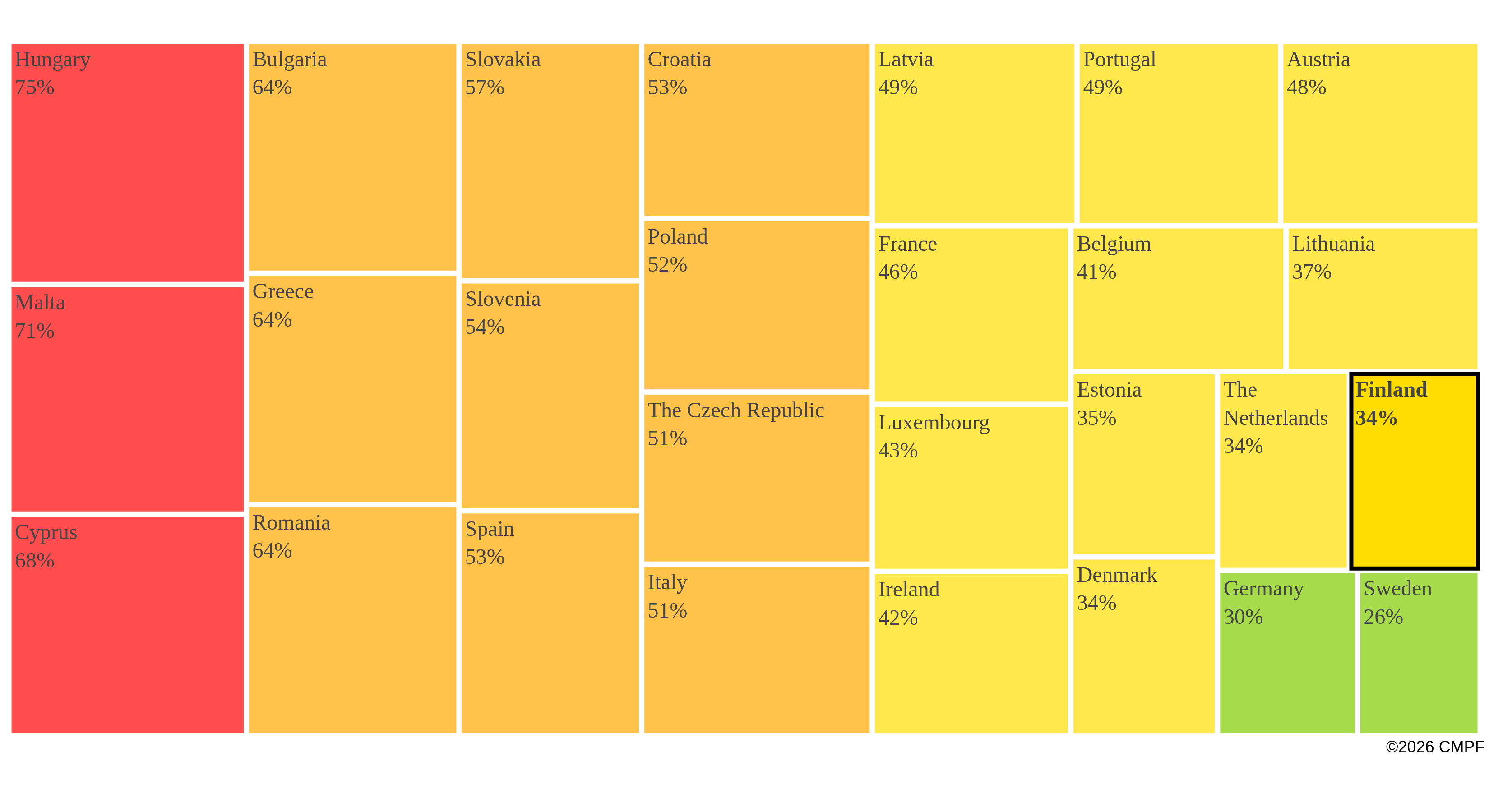
Risk score: 34%
| Fundamental Protection | 22% |
| Market Plurality | 60% |
| Political Independence | 29% |
| Social Inclusiveness | 24% |
In-depth analysis:
Read the full MPM2026 Country report
Country overview
Since 2023, Finland has been governed by a right‑wing coalition consisting of the National Coalition Party, the Finns Party, the Swedish People’s Party, and the Christian Democrats. ‘This coalition signals a significant rightward tilt in Finnish politics, displacing the left-wing Social Democrats, led by outgoing Prime Minister Sanna Marin’, according to the Helsinki Times. In April 2025, municipal and regional elections saw the centre-left Social Democratic Party achieve notable gains, while support for the right-wing populist Finns Party significantly decreased.
Finland has a stable and robust media environment that frequently ranks at the top of international media indexes. Finland ranks 5th in terms of media freedom (RSF, 2025), 2nd in terms of low corruption (Transparency International, 2025), 1st in terms of trust in the media (Reuters Institute, 2024), and 1st in terms of media literacy (Open Society media literacy index, 2023). In general, Finland boasts an inclusive and trusted media ecosystem and has solid safeguards to protect freedom of expression and the political independence of media.
However, Finland is also characterised by a high media concentration and, until now, the absence of a media-specific legal framework to limit horizontal or cross-media concentration. In 2025, the Ministry of Transports and Communications announced that ‘the implementation of the EMFA will be carried out at a minimum level and by making full use of the national room for manoeuvre’. Consequently, Finland has taken two main measures.
First, Act 408/2025 on the Supervision of Media Markets of 27 June 2025 entered into force on 8 August 2025. The Act tasks the Finnish Transport and Communications Agency (Traficom) with assessing how media market concentrations exceeding the turnover limits laid down in the Competition Act affect media pluralism and editorial independence, and with creating a national, open database containing information about media ownership. The Act also contains measures related to the transparency of state advertising, compelling authorities and public bodies to report their expenditures for advertising and announcements.
Second, Act 1380/1993 on the Finnish Broadcasting Company (YLE) was revised by Act 412/2025, amending the Act on Yleisradio Oy on 1 July 2025. The amendments entered into force on 8 August 2025. These amendments reflect the EMFA’s requirement regarding national legislation on the criteria and procedures for the appointment and dismissal of managers of public service media. Other recent legal developments include the transposition of the Anti-SLAPP Directive (EU) 2024/1069, which entered into force on 7 May 2026.
Fundamental Protection
The area of Fundamental Protection is associated with a low risk for Finland, similar to last year’s evaluation. Key events and factors to influence Fundamental Protection in the country in 2025 included the following:
- On 1 July 2025, the Helsinki Court of Appeal confirmed the 2023 conviction of journalists Tuomo Pietiläinen and Laura Halminen in the “Viestikoekeskus case”. Tuomo Pietiläinen was sentenced to a four-month suspended prison sentence and Laura Halminen received a fine for ‘revealing a security secret’ through their reporting of classified information related to the Finnish Defence Forces’ Signal Testing Centre and military intelligence operation and for ‘attempting to reveal a security secret’ through an unpublished follow-up paper.
- Finland transposed the Anti-SLAPP Directive (EU) 2024/1069 on 7 May 2026.
- The revision of the Act on the Openness of Government Activities, which regulates Freedom of Information in Finland, is still a work in progress.
- Given Traficom’s constant warning regarding its budget, a Decree of the Ministry LVM/2025/103 has enacted an increase of Traficom’s fees to stabilise Traficom’s revenues.
- Traficom was also allocated 4,55 million euros in 2026 for the implementation of the EU’s AI Regulation and 3.28 million euros annually from 2027 onwards.
Market Plurality
The area of Market Plurality scores medium-high risk for Finland, down from last year’s high risk. This improvement is largely due to the incorporation of the EMFA into national legislation. Key events and factors to influence Market Plurality in the country in 2025 included the following:
- The national law does not include specific provisions requiring financial reporting obligations for the media sector, apart from the EMFA-related references.
- A media ownership database is under preparation but not yet available.
- Statistics Finland discontinued the collection of media market data in 2024, as such, calculating market shares has become impossible.
- Audiences are concentrated, especially in the audiovisual, audio and print sectors.
- The Act on the Supervision of Media Markets (408/2025) establishes procedural rules for evaluating the impact of media market concentrations on media pluralism and editorial independence.
- The audiovisual, audio and print sectors saw a significant decrease in revenues.
- A large number of jobs were cut in the year 2025 – especially at the public service media and the private MTV television station.
Political Independence
The area of Political Independence scores low risk for Finland, just like last year. Key events and factors to influence Political Independencein the country in 2025 included the following:
- In general, political interference is not common in Finland, but there are no legal provisions preventing party ownership in the media, and neither are there restrictions on the hiring or firing of editors-in-chief.
- There is some opacity in relation to political advertising, especially adspend on social media.
- While the coverage of political parties is considered balanced, there is insufficient scientific evidence in this field.
- The EMFA implementation introducing new rules on state advertising. Subsidies to media are limited.
- The funding mechanism of the public service media does not fully guarantee its independence from discretionary decisions – politically motivated funding cuts led to the loss of 350 jobs at Yle.
Social Inclusiveness
The area of Social Inclusiveness is associated with a low risk in Finland, similar to last year’s evaluation. Key events and factors to influence Social Inclusiveness in the country in 2025 included the following:
- The Ministry of Transport and Communications is currently preparing a study on how the prominence of domestic media services could be improved in line with the Audiovisual Media Services Directive.
- The Criminal code was amended (Act 8/2026 amending Chapter 11 of the Criminal Code) to criminalise denial of genocide, crimes against humanity and war crime.
- Local media are highly concentrated. In Autumn 2025, the Keskisuomalainen Group owned a third (35%) of all member publications of the News Media Finland (220 titles).
- According to the GMMP general report 2025, the GEM index, which measures gender equal representation in the news, has significantly decreased by 9 points, suggesting a significant improvement.
- In terms of media literacy, the state funding for in-service training for teaching staff was abolished in 2025.