



Read more
Blog, Discussion Series
Big Tech, AI, and journalism: visibility, authority, and viability
With Big Tech being the gatekeepers of information and with AI, GenAI, chatbots accelerating, visibility, authority and viability of journalism is ever more at stake. With algorithms prioritising disinformation, toxic news, emotions and lies,...
The 2026 Media Pluralism Monitor (MPM) reports that media concentration is on the rise in Europe and that implementation of the EU regulation requiring a special regime to evaluate media mergers is lagging behind. In this blog post, we analyse recent national cases, with a focus on the role played by the European Board for Media Services (Board). We also consider the challenges ahead of the ‘media plurality test’: how can media plurality and editorial independence be saved or restored in the European public sphere?
High temperatures in the European media markets. The results of the Media Pluralism Monitor 2026
The MPM2026 shows that markets’ concentration poses the highest risks to media pluralism. In the MPM methodology, concentration is assessed for both the media service providers that supply information, and the digital intermediaries that regulate and monetise access to it, respectively, with the indicator “Plurality of media providers” and “Plurality in digital markets”. Both indicators are at the top of the ‘most problematic indicators’ ranking across the MPM and both register a very high risk.
MPM2026. The most problematic indicators
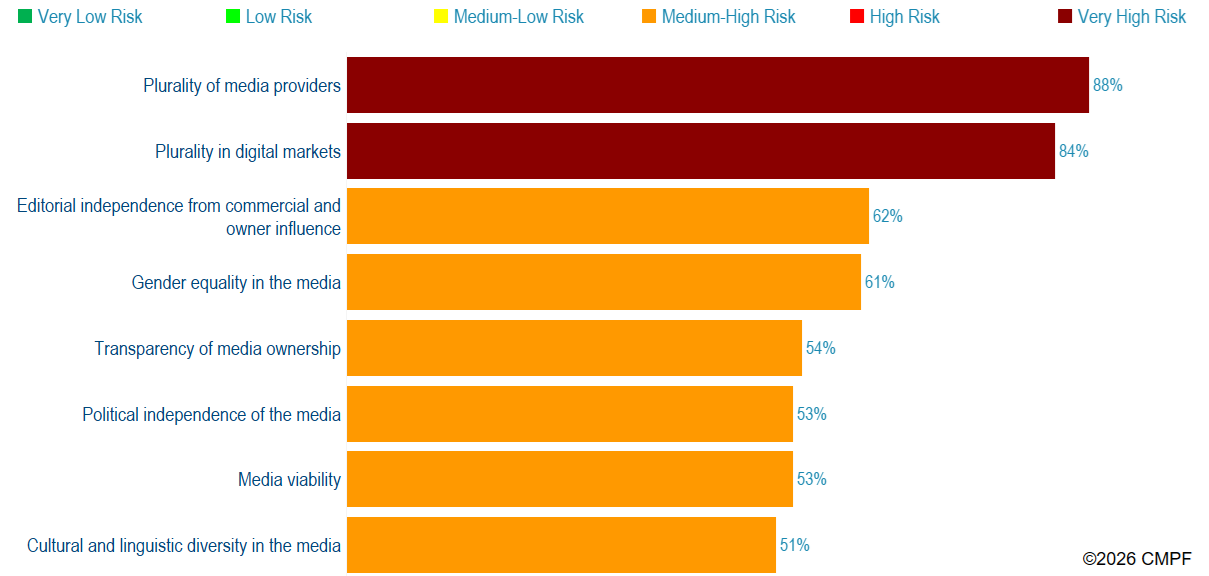
High market concentration in the media sector is a long-lasting tendency, exacerbated by the structural characteristics of the digital information environment. At policy and regulatory level, the EU has been trying to introduce limits and specific procedures in the media sector since the beginning of the century, but only in April 2024 has a special assessment of media market concentrations been introduced, in the European Media Freedom Act (EMFA) (Art. 22 Regulation (EU) 2024/1083, regulating the so-called ‘media plurality test’). However, Article 22 requires implementation at a national level to come into effect: “Member States shall lay down, in national law, substantive and procedural rules which allow for an assessment of media market concentrations that could have a significant impact on media pluralism and editorial independence”.
Although Article 22 entered into application on 8 August 2025, the MPM2026 final report shows that progress has been slow. In 2025, only 4 countries had in their national systems rules and procedures that allow for a separate assessment of media mergers, even though not always fully in line with the criteria of Article 22. In the majority of the countries (16), media mergers are evaluated only based on the economic criteria of the competition assessment; while in the remaining countries, some special procedures exist, but limited to the audiovisual sector (Bleyer-Simon et al. 2026, pp. 58-59). More recent developments are reported in the MPM final report on a table showing the state of implementation of Article 22 by country (updated until June 2026).
(Lack of) operationalisation of the ‘media plurality test’
In spite of some progress, the table shows that the media plurality test is far from being operationalized at the national level. In the MSs where a legislative reform has been approved to introduce the ‘media plurality test’, the new laws simply mirror the phrasing of Article 22, when it comes to the general criteria and the elements to take into account, without adding details and practical guidance on the operationalization of the test. At the EU level, it must be noted that the Commission has not issued the guidelines under Article 23(3), which are crucial for a harmonized and effective application of the test. In this transitional vacuum, the Board developed an internal guidance document for opinions on media market concentrations (see p. 18 of the Board’s Final report). It then adopted its first opinion, concerning the acquisition of Ringier Hungary Kft by Indamedia Network Zrt, on 9th April 2026.
Meanwhile, tough economic conditions in the media markets, digital competition and other factors have led to a wave of mergers and acquisitions, and further market consolidation. Interestingly, many of the most recent operations have a cross-country dimension.
- The Italian Media for Europe, the third largest private audiovisual group in Europe, expanded in Germany, with its take-over of ProSiebenSat.1, that at the time was the second-largest player in the country. This take-over occurred before the entry into application of Article 22 EMFA, and was reviewed by the Commission on Concentration in the Media (KEK) according to the pre-existing German system. However, “the KEK conducted its assessment not only based on national media law (…) but also under the criteria of Article 22 EMFA. (…). In its final evaluation, the Commission confirmed that the influence MFE gained over public opinion through the takeover is harmless. The central reasoning for this decision was that the takeover does not fundamentally alter ProSiebenSat.1’s market position, nor does it objectively strengthen its existing influence on public opinion within the German media landscape”, as reports Kalbhenn in the MPM report on Germany (p. 23). A comprehensive overhaul of Germany’s media concentration law is in the process of being approved, with the 9th amendment to the State Media Treaty.
- Another case that occurred before the entry into application of Article 22 is the acquisition of Dutch media company RTL Nederland (RTL) by DPG Media (DPG), that was cleared by the competition authority in June 2025. The case is interesting because the Dutch competition authority included in its evaluation consideration of media pluralism and editorial independence, attaching conditions to the acquisition, “so that the acquisition will not have any negative effects on media pluralism, and that news consumers continue to have access to sufficient independent news sources.” Yet, such evaluation was performed as part of the competition assessment, and mostly looking at the negative effects on the quality of news selections, which includes media pluralism. The ACM did not perform the media plurality assessment in Article 22 EMFA, but it did ask the national authority for an opinion, and took due account of it.
- In Italy, ‘during 2025, several highly significant ownership reorganisation processes were initiated, which were finalised between the end of the year (entry of LMDV Capital into “Il Giornale”) and the beginning of 2026 (including the transfer of the newspaper “La Stampa” to the SAE group and the sale of the GEDI group to the Greek group Antenna).’ (see the MPM report on Italy, authored by Vigevani et al., p. 6). Even though the Italian anti-concentration media law already has a sort of ‘media plurality test’ (Art. 51 TUSMA), with transparent and objective procedures to assess the impact of media mergers on opinion power, the issue of editorial independence after the merger is not explicitly and formally included in the assessment. The possibility of practically implementing Article 22 of EMFA through existing national law in Italy has been advocated by one of the authors of this blog post, calling on the Italian media authority to also consider the impact of the acquisition (and the commitments of the involved parties) on editorial independence when assessing media mergers under Article 51 TUSMA. Although the AGCOM did not deliberate on the operation, its recently published Annual Report notes that none of the daily publishing groups exceeds the anti-concentration limits set by Italian law (p. 65).
Notwithstanding the fact that the above-mentioned cases had a cross-country dimension, no intervention by the Board is officially reported on the matter so far. Instead, the Board intervened in two subsequent cases, although with different approaches.
- One is the acquisition of Ringier Hungary Kft by Indamedia Network Zrt, adopting an opinion under Article 23 EMFA. As reported by the MPM report for Hungary, the sale of the Hungarian portfolio of the Swiss company Ringier to Indamedia, considered a government-affiliated group, raised concerns for its consequences in terms of political control. The Board, who had been called upon by the stakeholders, adopted a negative opinion, stating that the operation poses risks to media pluralism and editorial independence. With regards to the legal base for its opinion, the Board observed that, under Article 23(1) of the EMFA, in absence of a request by the national media authority, it shall “, on its own initiative or at the request of the Commission, […] draw up an opinion on the impact of a media market concentration on media pluralism and editorial independence, where that media market concentration is likely to affect the functioning of the internal market for media services”. The Board assessed the impact on media pluralism and editorial independence, evaluating market and audience share, but also consumption patterns. Even though this data and the consequent assessment focus on the national level, the Board argued that the intervention at EU level is justified because “ […] the concentration primarily falls within the third scenario identified in Recital 67 EMFA (…), in that it results in a media service provider having a significant influence on the formation of public opinion in the Hungarian media market with potential effects on audiences in the internal market. This finding is based on a cumulative assessment of the following four considerations,[…]: the audience reach and market position of the merged entity; the absence in this case of any national assessment of the media market concentration’s effects; the ownership context and broader pattern of media concentration in Hungary; and the structural conditions and barriers to a level playing field that characterise the Hungarian media market.” (p. 7).
- A different approach was taken in the Rossel/IPM case. Rossel is a European media group with a strong presence in the regional press in France and, indirectly, in the Netherlands. Rossel and IPM are both active in the publishing and distribution of French-language daily newspapers and magazines. As recognised by both the Belgian national competition and media authorities (ABC and CSA, respectively), following the acquisition of IPM, Rossel would solely or jointly hold all French-language printed daily newspaper titles. The current Belgian legal framework for the assessment of media mergers is not compliant with Article 22 EMFA, and no implementation measure has been introduced yet. In lack of a national procedure, the CSA communicated the case to the Board, stating that the Board’s opinion would have provided ‘specific insight into the impact of the proposed media merger on media pluralism and editorial independence, as provided for by European legislation’. However, the Board reached the conclusion that the merger did not meet the threshold for its intervention with a formal opinion, as ‘the case is essentially national in nature’. Yet, in its statement, it also raised concerns about the near-monopolistic position in the French-speaking press and very strong position in online news the merger would have created, ‘in a context already characterised by high ownership concentration, economic pressure on news publishers and limited structural safeguards for media pluralism’. The ABC approved the merger under light conditions, which seem to focus on its impact on editorial independence more than on pluralism. Representatives of journalists at local and European level have expressed strong concerns about the new-born monopoly, complaining about the lack of a formal assessment by the board and deeming the commitments of the merged entity insufficient in terms of editorial independence and job security.
Based on above recollection of cases, the slow implementation of the ‘media plurality test’ at the national level, and the first decisions taken at the Board level, raise two questions: 1) the role of the EU supervision in guaranteeing EMFA implementation and the right of each citizen to have access to a plural and diverse offer of media content; 2) The practical application of the principles and criteria set out in Article 22, particularly with regards to the interplay between media plurality, editorial independence, and economic sustainability.
The Board’s role to guarantee equal protection across the EU
The system designed by the EMFA provides for a specific supervision of media plurality at EU level, and in particular by the Board and the European Commission. A core element lies in the opinion power attributed by the Board under Article 23. However, as emerges from the cases analysed above, the threshold for its application is controversial. The ‘potential effects in the internal markets’ clause can be seen as a balancing act between guaranteeing autonomy in purely national cases, on the one hand, and ensuring an harmonised approach and an equal level of protection across the EU, on the other. While resting on a long-standing case law which interpreted the clause widely, it can still be perceived as a challenging limit.
In addition with the general competence question, the cases analysed in the previous part flag a number of specific circumstances that deserve attention. One could ask, for example, whether the Board should play a more active role when Article 23 threshold is not met, but there is no national authority designated to run the media plurality test under Article 22, or where there is an authority, but not a procedure to apply the test. If neither the relevant national authority nor the Board performs the test, then media plurality might not be properly guaranteed in the country. Hence, in these cases, the Board could act as a second layer of protection, to be activated only in the absence of the first. However, this proactive approach could be perceived as an interference in national matters not supported by an adequate legal basis. A second scenario would be for the Board to act only when requested to do so by the national authority. In this specific case, the possible interference would rather take the form of a cooperation under request. A third possible path could be to rely on higher peer-to-peer pressure within the Board for the relevant national authority to run the media plurality test even in the absence of a national procedure. While this softer path wouldn’t need any legal basis to be implemented, it rests on the goodwill, sensitivity and independence of the authority, which in turn is extremely context and country-specific.
What appears clear is that whatever solution should properly combine two elements: increase legal certainty for all actors, and ensure a sufficient degree of flexibility to adequately cover a variety of circumstances which put the media plurality test at risk.
Lacking any form of intervention by or pressure within the Board, and faced with the consistent lack of implementation of the media plurality test in a member state, the European Commission retains the possibility to intervene with a formal infringement procedure. While effective in the long run, this residual path, which could take months or more likely years to complete, remains inadequate to protect media pluralism in the short and medium term.
Sufficient safeguards and adequate measurement
As expected, the transition period towards the full implementation of the ‘media plurality test’ is complicated and rife with potential issues. As the tendency towards media consolidation in Europe increases and accelerates further, the time lag between market evolution and the enforcement of regulatory change can jeopardise the effectiveness of the new European provisions on media market concentrations. Against the backdrop of deteriorating economic conditions in the media industry, exacerbated by the impact of GenAI on information consumption, there is a growing tendency to approve media mergers on purely economic grounds, subject to conditions that safeguard editorial independence. Clear guidelines on assessing market viability are essential to avoid widespread acceptance of media concentration in the name of economic sustainability, without sufficient consideration of the trade-offs in terms of pluralism and editorial independence, or the introduction of necessary safeguards for both.
To this aim, the Commission, assisted by the Board, should without delay issue the guidelines foreseen under Article 22(3) to help interpreting the interaction and interplay among media pluralism, editorial independence and economic sustainability. Such guidelines should also provide clear indications regarding the nature of remedies needed to safeguard pluralism and independence when a merger is justified on economic grounds.
Moreover, higher attention to media pluralism challenges at EU level could well complement the Commission’s monitoring role under Article 26 EMFA, which includes the overview of risks to media pluralism and the editorial independence of media service providers where they could impact the functioning of the internal market. While the EU can rely on the Media Pluralism Monitor as an effective way to measure media freedom and pluralism across EU member states, a more integrated capacity to measure risks affecting the EU public sphere as a whole remains needed.
Roberta Carlini is an Assistant part-time Professor at the EUI. At CMPF, she contributes to the project “Monitoring media pluralism in the digital era” (Media Pluralism Monitor), where she is in charge of the Market Plurality area, focusing on media ownership concentration, media sustainability, digital markets, working conditions of journalists, and public support to the media sector.
Maria Luisa Stasi is a competition lawyer by background with expertise in media, telecoms, and digital sectors. She is the Head of Law and Policy for Digital Markets at ARTICLE 19.