

The Netherlands
Media Pluralism Monitor 2025 results
Risk score: 33%
| Fundamental Protection | 27% |
| Market Plurality | 57% |
| Political Independence | 20% |
| Social Inclusiveness | 27% |
In-depth analysis:
Read the full MPM2025 Country report
Country Overview
Since the second of July 2024, the Netherlands has a new, right wing oriented government (led by Dick Schoof), formed by the political parties PVV, VVD, NSC and BBB. This government plans significant budget cuts for public broadcasting, as well as a reform of the public broadcasting system, by 2027. This is likely to include a reduction of the number of public broadcasters, while the government does emphasize the high importance of the presence of all voices in society in the content public broadcasters are producing.
The media market in the Netherlands is quite concentrated, with five organisations dominating the media landscape when it comes to newspapers, television, radio and online news. The Dutch competition watchdog ACM is still reviewing the proposed merger between two of these, RTL and DPG Media. While the Dutch media organisations are becoming more successful in generating online revenues, the pressure from the international platforms (VLOPs) remains significant. Generally, none of these media companies have political connections or agendas in the Netherlands. Journalists in the Netherlands do face mainly external threats. PersVeilig reported 249 harassment incidents against journalists in 2024, a notable increase that raises continued concerns about journalist safety and press freedom.
In 2023, effective in 2024, the Netherlands adopted a new anti-doxing law criminalizing the publication of personal data with intent to intimidate — a key step for protecting journalists and whistleblowers. In 2024, the Dutch government also introduced a draft bill to implement the EU Anti-SLAPP Directive (2024/1069), but it drew criticism from civil society and legal experts for offering insufficient protection against abusive lawsuits. In April 2024, the Public Prosecution Service issued new rules requiring judicial approval for the surveillance of journalists, a key step toward safeguarding press freedom and source protection, while in March 2024, the Dutch Senate approved the Temporary Cyber Operations Act (“Cyberwet”), which expanded the intelligence services’ powers under the Intelligence and Security Services Act (Wiv) to include bulk surveillance capabilities, leading to criticism from press organizations and civil society groups. 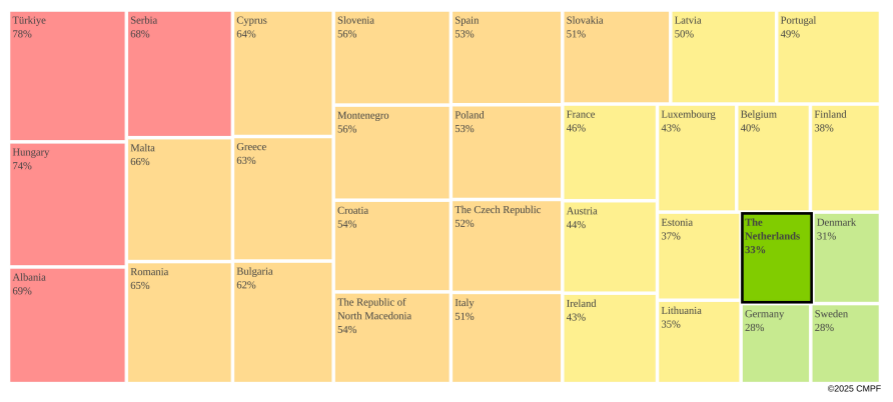
Fundamental Protection
The risk assessment for Fundamental Protection in the Netherlands is that it falls within the low risk band.
- Harassment of journalists has risen significantly in 2024, with 249 reported incidents, including threats, physical assaults, and intimidation. Journalists also continue to face legal and economic pressures, including budget cuts to public broadcasting that may undermine investigative journalism and editorial independence.
- New rules introduced by the Public Prosecution Service in April 2024 require judicial approval for journalist surveillance, a key safeguard for press freedom. Amendments to the Intelligence and Security Services Act (Wiv), approved in early 2024, expanded bulk surveillance powers, triggering public criticism.
- A draft anti-SLAPP bill to implement Directive (EU) 2024/1069 is under discussion but has been criticized for offering inadequate protection.
- The implementation of the Open Government Act (Woo) continues to face challenges, with frequent delays in responses and inconsistent proactive transparency across public authorities.
- The Digital Services Coordinator (ACM) lacks sufficient resources and legal powers to enforce the Digital Services Act effectively, leading to an infringement procedure by the European Commission.
Market Plurality
For the Netherlands, the area with the highest risk assessment is Market Plurality. It falls within the medium-high risk band.
- Dutch news media professionals generally operate free from commercial interests and ownership influence. However, laws and regulations to achieve transparency of media ownership are still by-and large absent. Yet, it is closely monitored by the annual Mediamonitor report published by the Commissariaat voor de Media. It is difficult to evaluate the general financial performance of publishers and commercial broadcasters, because the financial results of Dutch media are often published as part of larger international conglomerates without details for the Dutch market, or Dutch news media specifically.
- Five organizations own a very large share of the Dutch media landscape: i.e., public broadcaster NPO; publishers DPG Media and Mediahuis; and commercial broadcasters Bertelsman/RTL and Talpa Network. This leads to highly concentrated markets for newspapers, TV, audio, and online news.
- While a legal framework is largely missing, big mergers are subject to assessment by the ACM, the independent Market and Competition Authority. In recent years, they advised against allowing the merger between Talpa and RTL, and now they have been considering and commenting on the proposed merger between DPG Media and RTL. No final decision on that merger has been made.
- Whereas the media corporations are still making considerable profits, their profits have decreased in 2024 compared to 2023 by 10-14%. Revenues for the digital audio sector in the Netherlands slightly increased at the same time. In the online domain, the Dutch media organizations are becoming more successful in generating revenues, both regarding subscriptions and advertising revenues.
Political Independence
Regarding Political Independence, the Netherlands is given a medium-low risk assessment in 2024.
- The lack of formal, legal rules guaranteeing the absence of political control remains an important issue in the Netherlands, while in practice, there are no problems regarding political independence, mainly because of the strong traditional of self-regulation, more in particular the editorial statuses that all media have (WRR, 2024).
- Following an earlier impulse by the Dutch Parliament (Motie Kwint), the Commissariaat voor de Media continued their efforts to map “pluriformiteit” (in practice forms of plurality) in the Dutch media landscape, leading to an intermediate report (Commissariaat voor de Media, 2025) presenting some new measurements for the plurality of the media, which will be applied in the near future.
- Regarding political advertising, following the 2023 law on party financing (BWBR0033004), they can not be financed by foreign sources, and all political ads in the Netherlands can be traced back to the political parties themselves.
Social Inclusiveness
For the area of Social Inclusiveness, the Netherlands retain an overall low-risk assessment.
- The Netherlands hold on to their generally high media accessibility and inclusivity, including high standards and follow-up on net neutrality by the independent competition and market regulator ACM. Legal steps have been taken further implementing the European Accessibility Act, requiring service providers (including streaming services) to become fully accessible by mid 2025. Additionally, civil society organisations are involved in efforts to enhance media accessibility in general.
- Steps are taken in the fight against hate speech, with the parliamentary approval of a new law installing heavier punishments for it, but protection does not seem to be complete yet (e.g. transgendernetwerk.nl, 2025).
- While local (public) media are further professionalised and supported, private local media are experiencing viability issues (WRR, 2024). Community media are not legally recognised, which leads to a lack of support and attention.
- Gender equality is an aspect that requires attention in he Netherlands. With still unbalanced gender representation in executive functions (especially for private media) and the aftertaste of the Van Rijn report about a toxic work environment at the public broadcasters, progress is slow and needs to be monitored (which is effectively done by the Commissariaat voor de Media). In terms of representation of females in media content, longitudinal research by the CVDM (2024) reveals a lack of progress, stabilizing the visibility of women in the media around 35%, with additional issues regarding stereotyping and visibility in expert roles.