

The Czech Republic
Media Pluralism Monitor 2025 results
Risk score: 52%
| Fundamental Protection | 34% |
| Market Plurality | 76% |
| Political Independence | 36% |
| Social Inclusiveness | 62% |
In-depth analysis:
Read the full MPM2025 Country report
Country Overview
The political situation remained stable in 2024, and none of the three elections held that year—for the European Parliament, the Senate, and regional councils—posed any significant challenges to the centre-right governing coalition. The coalition continued to enjoy a comfortable majority in Parliament, despite the departure of one minor partner, the Pirate Party, from the government in September. However, public support for the government has been steadily declining, while populist and anti-establishment parties have gained traction. Notably, the newly founded party “Motorists”, running in coalition with another populist movement, “The Oath”, secured a surprising third-place finish in the 2024 European Parliament elections.
In 2024, the Czech economy returned to growth (+1.0% GDP), recovering from the recession it had entered the previous year (Radio Prague International, 2025). The annual inflation rate stabilized at 2.4%, a significant drop from 10.7% in 2023. This economic recovery created more favorable conditions for the Czech media market compared to the previous few years, which were marked by surging energy prices and a cost-of-living crisis. Advertising expenditures rose by 8%; however, this growth was not enough to prevent the closure of several print outlets, most notably the country’s oldest daily, Lidové noviny. The television market, by contrast, continued to develop—particularly in the sports TV segment. Several new pay-TV channels were launched, and some existing brands expanded their portfolios into terrestrial broadcasting, including Warner TV (MediaGuru, 2024).
In terms of legislation, the year 2024 saw several initiatives directly relevant to media pluralism in the Czech Republic. However, their adoption and implementation were, in some cases, hindered by significant delays and political obstruction. In August 2024, the government approved a draft of the Digital Economy Act, intended to finally implement the EU’s Digital Services Act (DSA) into Czech law. Its progress through Parliament, however, was slowed following opposition claims that the Act could threaten freedom of speech.
A similar fate befell the proposed Electoral Campaigns Act, designed to increase transparency in election campaigns and prevent foreign interference. It, too, was stalled in Parliament amid concerns over its potential impact on free expression.
In contrast, the amendment to the Act on Audiovision (Act No. 480/2024 Coll.) passed without major obstacles. Among other changes, it introduced a requirement for global streaming platforms such as Netflix and Disney+ to contribute 2% of their local revenues to the Czech Audiovisual Fund—thus helping to level the playing field between domestic and international streaming providers.
Meanwhile, an effort to raise long-frozen television and radio license fees—unchanged for 17 and 20 years, respectively—faced strong resistance from both the political opposition and commercial broadcasters. This led to a reduction in the originally proposed increase of the fee, and to multiple postponements of the bill. Nevertheless, the revised legislation was ultimately adopted in April 2025. 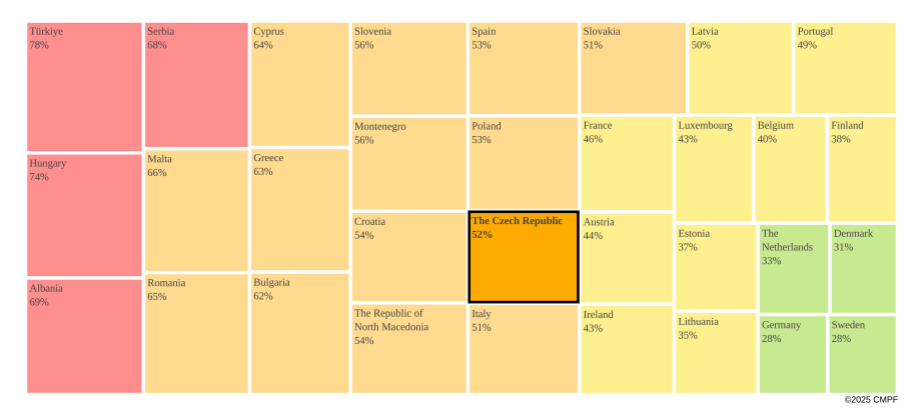
Fundamental Protection
The Fundamental Protection area shows a medium-low level of risk. Key points include:
- The digital environment presents several risks, including frequent online attacks against journalists—particularly targeting women, who are disproportionately affected.
- Female journalists are also vulnerable to offline sexual harassment, an issue that remains underresearched. Additionally, verbal attacks and attempts to undermine quality journalism by public officials continue to be prevalent.
- Other digital environment risks include cyberattacks, lack of transparency and fact-checking of large online platforms, and the continued unchecked spread of disinformation, including pro-Kremlin propaganda, disinformation about the war in Ukraine and disinformation about climate change.
- Despite the commitments of Prime Minister Petr Fiala’s centre-right government to combat disinformation, Czechia still lacks a comprehensive national strategy to address the issue.
- The country has yet to adopt national legislation implementing the EU’s Digital Services Act and also lacks an appropriate anti-SLAPP legal framework.
Market Plurality
The Market Plurality area displays a high level of risk. Key points include:
- Absence of media-specific legislative provisions ensuring full transparency of media ownership.
- Continuing high level of media ownership concentration, both in offline and online media markets, and a lack of relevant regulation to prevent excessive consolidation.
- Some of the key provisions of the Copyright Act with regards to Czech publishers’ rights vis-à-vis the users of their content remain to be implemented, including the obligation by large online platforms to pay the publishers a reasonable remuneration for the use of print publications.
- Economic viability of some parts of the media market remains fragile, particularly in the print segment, and in the sector of local and regional media.
- Risk to editorial independence continues to stem from media proprietors’ conflict of interests, as well as from the lack of self-regulatory instruments to safeguard independence.
Political Independence
The Political independence area shows a medium-low level of risk. Key points include:
- The decision by the Constitutional Court in December 2024, annulling the recent amendment to the Act on the Conflict of Interests (159/2006 Coll.) effectively reopened legal pathways for politicians to own national media again.
- Evidence points towards widespread practices of instrumentalization of local and regional media by local politicians and parties.
- Instruments of self-regulation by the majority of Czech news media do not provide sufficient safeguards against political influence.
- Online election campaigns and political advertising in the digital spaces continue to display lack of transparency, revealing gaps in existing legislation.
- There are no systems of state support for the media sector, and VAT for newspapers has been raised from 10% to 12% in 2024.
Social Inclusiveness
The Social Inclusiveness area recorded a medium-high risk score. Key points include:
- Implementation of Article 7a of the AVMSD (2018/1808/EU) to ensure the appropriate prominence of public service media (PSM) content remains incomplete due to resistance from commercial broadcasters, who see PSM as rivals for audience and ad revenue.
- Internet access exceeds 94% of Czech households, but media accessibility for people with disabilities remains limited despite existing legal frameworks and plans.
- Media representation of minorities and marginalized groups is inconsistent; lack of comprehensive data hampers understanding of their portrayal.
- Although many regions face “news deserts”—areas with limited access to reliable, independent local journalism—2024 saw some positive developments with local newspapers going digital and new independent online outlets emerging.
- Gender imbalance remains a critical issue in Czech media, with women underrepresented in leadership, regulatory bodies, and expert roles on news programs.
- The 2024 Framework Education Programme, which counts as one of the most notable developments in the field of media literacy, emphasizes digital technologies and informatics, while media education remains secondary. Experts continue to highlight deficiencies in teacher training and evaluation methods in media literacy education.