

The Republic of North Macedonia
Media Pluralism Monitor 2025 results
Risk score: 54%
| Fundamental Protection | 37% |
| Market Plurality | 73% |
| Political Independence | 44% |
| Social Inclusiveness | 63% |
In-depth analysis:
Read the full MPM2025 Country report
Country Overview
Political developments and their effect on media pluralism: North Macedonia held double elections in 2024. First, the 8th of May general elections brought about change of government in Skopje – the weakened Social Democrats (SDSM) lost 28 seats in the 120 seat Parliament and were left with a total of 18 MPs. The 45% of the popular vote for the conservative VMRO-DPMNE translated into a total of 58 MP seats, enabling the conservatives to easily get a hold on executive power. Secondly, the 24th of April / 8th of May Presidential elections brought a new conservative-backed president at the helm of the state. This outcome marks an important shift – likely to have repercussions for media pluralism in the country. The VMRO-DPMNE had an unequivocal comeback to power after it was pressed out in 2016 under strain from an unprecedented mobilisation against its authoritarian tendencies. Media capture was a large part of its mode of rule (2006-2016) with a pronounced tendency to establish control over the totality of media production. Many individual members of the “old” party are not part of the new political establishment – still, the new structure has not publicly announced its distance from the old. The attitude of the 2024 government towards media was exposed during the coverage of the 16th of March 2025 Kochani fire incident of disastrous proportions, when there was a clear tendency to control the totality of narratives across all media sectors (Blazevski & Stojancova, 2025) .
Relevant legislation & regulatory changes: One media related legislative change in 2024 may have a deteriorating influence over media’s independence. Prior to the May elections the SDSM led government amended the Law on Audio and Audiovisual Media Services (Law on AAMS) by removing its Article 102 (Magleshov, 2024). This article imposed a ban on state advertising in all audiovisual media. The ban was instated in 2016 during the Macedonian popular anti-government mobilization because the practice of state advertising was systematically misused by the party in power to corrupt media – in fact while it was in place, the government became one of the top four advertisers in the audiovisual sector (VoA, 2013; Micevski & Trpevska, 2015). Second in 2024 the new government sought to make changes in the media legislation by covering the digital media service providers – the initial steps in this direction made in early 2025 suggest that the new government tends to make partial rather than systematic changes in the legal corpus pertaining to media service providers (MKD, 2025). Third, it is noteworthy that processes that the present Parliamentary majority had blocked when opposition, were reactivated after the elections.
The new appointments of the Council of the media regulatory body – the Agency for Audio and Audiovisual Media Services (Agency for AAMS), were blocked throughout the entire rule of the social democrats despite the fact that under their rule the MPs made several attempts to elect new Council Members. The composition of the AAMS Council was 5 years overdue its mandate. On the 8th of Octobre 2024 the new structure of the Parliament opened a call for the appointment of new members of the Council, a process which gives an early indication of future party-political influences in the Council (Magleshov, 2025).
News media market developments: According to relevant surveys (Trpevska, Mitrevski, & Micevski, 2020), the main source of information about domestic events for the general audience in North Macedonia are television and the Internet (about 80% use these two sources every day or almost every day). More precisely, the older audience segments are mostly informed from the news on television, and the younger segments from social networks and digital news media. However, over two-thirds of the audience have little or no trust in the information provided by both television and digital news media. Data concerning market share are available only for the audiovisual sector (Agency for AAMS, 2024b). The total revenues of private TV stations amounted to around 20.6 million euros, of which over 85% are revenues of the 5 private terrestrial TV stations at the national level. All the other TV stations (6 national – cable or satellite, 14 regional – DTT or cable, 15 local – cable) had a joint share in the revenues of around 15%. This represents a trend for the last few years – one that threatens the operation of local news media. The public service – Macedonian Radio and Television (MRT), broadcasts TV and radio programs on 5 television and 3 radio channels. In 2024, MRT’s planned revenues from the Budget amount to around 24.2 million euros. Reliable estimations suggest that, in 2024 there are around 130 digital news media operating in the country, most of which employ up to two journalists (Trpevska & et. al., 2024). There is no data on the audience share of digital media. 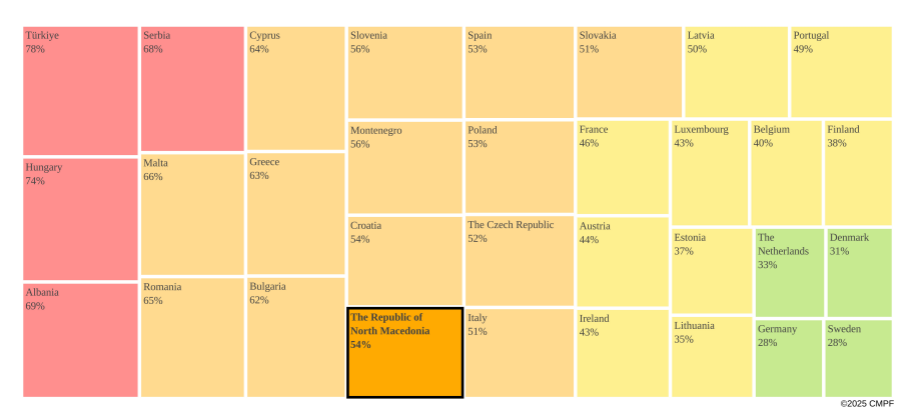
Fundamental Protection
In 2024 the Fundamental Protection area remains within the medium-low risk band. The country needs to put more focused attention to several issues:
- North Macedonia has still not introduced a long overdue legislation pertaining to digital media service providers aiming to establish fairness in the application of legal safeguards relating to the right to freedom of expression. In 2024 such legislation was discussed, however the rudimentary deliberation process was dominated by demands for partial legal changes in favour of only a few online media owners, rather than by normative need to adopt a systematic approach.
- The country has not yet adopted a specific anti-SLAPP legislation to comply with EU’s anti-SLAPP recommendations. Though non-media specific laws serve as a basic dam against SLAPP, these do not offer a sufficient protection. This despite the fact that SLAPPs lawsuits have not been often exercised in practice.
- The country lags behind EU recommendations (GSC of the Council of Europe, 2022) as it lacks a strategic approach towards problems arising from the increasing spread of disinformation and Foreign Information Manipulation and Interference (FIMI) technologies. Past attempts at establishing resilience have been ineffective as was the case with both the 2019 Plan for Resolute Action against the Spread of Disinformation and the 2021 Strategy for Building Resilience and Tackling Hybrid Threats. In the aftermath of the general elections 2024, some steps were undertaken by the new government to strengthen country’s cyber security policy, but by the end of year no concrete measures were implemented.
- North Macedonia has adopted a Law on Protection of Whistleblowers in 2015. However, in 2024 as in the few years prior, the interest by possible whistleblowers to flag institutional misconduct is extremely low.
- A study published in 2024 finds that the greatest source of concern for journalists in North Macedonia is their poor socio-economic status. 70% of journalists and media workers earn less than the national average, with 30% earning the nation’s minimum wage. Media organisations tend not to invest in the safety of journalists and are largely disrespectful of their leisure time. This situation increases insecurity among journalists and makes them more susceptible to political or corporate manipulation.
- The independence of the regulatory authority the Agency for AAMS shows signs of deterioration and that is due to the poorly executed procedure for the appointment of new members of the AAMS Council. The party-political influence on the parliamentary committee hearing on the nomination of candidates held on 8th of October 2024 indicates future issues in the functioning of the regulator.
Market Plurality
North Macedonia continues to struggle concerning the Market Plurality area. In 2024 the country remains within the high-risk band – almost the same as the preceding year. These were the important developments:
- Regardless of the arguments given by the group of experts in their analysis conducted in 2023, in 2024 the process of media reforms was diverted and the legal solutions that would increase transparency of media ownership of the digital media service providers were taken off the political agenda.
- Due to the lack of political initiative for a systemic change in the online sector in 2024 transparency of sources of digital media service providers’ funding is still lacking. This is the case despite the fact that some of the risks are mitigated by the operation of other legislation to which media as any other legal entity must abide.
- In 2024 North Macedonia continues to have a high level of market concentration in the audiovisual sector – the top four players in this sector hold 82% of the total income in the sector. The audience share of the same four players is 46%.
- The current Law on AAMS contains thresholds to prevent horizontal and cross-media concentration of ownership only for the audio and audiovisual media sector which continues to pose a risk.
- Country’s statistical system concerning most of the media sectors is underdeveloped which is why in 2024 the country still lacks data on key developments concerning market plurality.
- The EU’s Copyright directive has still not been transposed into the national legislation, and consequently, financial agreements between media service providers and digital intermediaries (e.g. aggregators, search engines and social networks) are non-existent.
- In 2024 the state did not amend laws to introduce digital services tax.
- To varying degrees and in different ways, all media sectors in North Macedonia are experiencing problems concerning revenue stability and sustainability – except audiovisual media holding a nationwide licence. Local and regional audio and audiovisual media are under constant threat of extinction. In 2024 in comparison to 2023 the number of broadcasters decreased by 10. A year prior, 6 broadcasters were closed.
- Media content is at risk of being steered in line with the commercial and political interests of media owners. This is further exacerbated by the decision of the Government prior to the general elections in 2024 to remove the ban on state advertising in the media (Article 102 of the Law on AAMS) – which is expected to give further incentives to owners to trade ‘services’ with political actors in exchange for increased profit.
Political Independence
The Political Independence area for 2024 falls within the medium-high band. This reflects several developments throughout this year, the most important of which are the following:
- The removal of Article 102 of the Law on AAMS in 2024, produces and increased risk not only in that it enables the distortion of media markets, but also in that it jeopardises political pluralism in the media in general.
- In 2024 media organisations still did not have internal safeguards in defence of their autonomy from political influences – the private media do not have written internal rulebooks ensuring clear bracketing of influence and do not have internal structures or bodies that would oversee and self-regulate their content output in order to preserve editorial autonomy.
- The electoral media monitoring conducted by the Agency for AAMS during the 2024 general and presidential elections, has found that the coverage of the Public Service Broadcaster complied with the relevant provisions of the Electoral Code, but that it was objectively unable to ensure a satisfactory balance in representation especially of smaller political parties. The report suggests that this is due to the restrictive provisions in the Electoral Code, but also due to the fact that the PSB did not have sufficient production and human resources to adequately cover both the presidential and the parliamentary electoral campaigns.
- The electoral monitoring by the Regulator has found that the private audiovisual media were largely unable to ensure balance in their reporting about the contenders’ campaigns.
- In March 2024, the Parliament adopted new amendments to the Law on Media by which financial support for print media is for the first time regulated by a legal act.
- Lack of transparency of state expenditure for advertising on social platforms continues to be a serious problem in 2024 – neither the central nor local government institutions publish information on their annual expenditures for state advertising on online platforms.
- The Parliament did not start the process of appointment of new members of the Council of the Public Service Broadcaster even though the mandate of the present composition of the Council of MRT is long overdue. This body is obliged to oversee impartiality of PSM output including ethical standards and pluralism. With the new majority in Parliament after the 2024 elections, there are indications that in 2025 new members of the Council will be selected.
Social Inclusiveness
The Social Inclusiveness area in 2024 is within the medium-high band. The key vulnerabilities include:
- Though the July 2023 amendments to the Law on AAMS strengthened legislation concerning media access for people with disabilities and though in June 2024 the Regulator followed suit by adopting a bylaw to operationalize Law’s provisions – in practice audiences with hearing impairments have access to only a very small number of news editions on the PSM and on the leading private television channels.
- None of the VLOPs are effective in limiting hate speech spread from locations in the country. Initiatives to combat hate speech largely come from the CSO sector and some of them are media self-regulation initiatives – e.g. the Network for the fight against hate speech led by the media self-regulatory body.
- Access to the media and media content of ethnic minorities in the private media sector has deteriorated further in 2024, as small private local media that publish content in minority languages are unable to survive on the market.
- Community media in North Macedonia are underdeveloped. They are recognized by law only for the broadcasting sector – online forms of community media are not recognized. State policies disregard the development of environment where community media would thrive.
- The Public Service Broadcaster in its Work Program for 2025 does not elaborate on a deliberate approach towards gender equality – this is also the case with its Strategy for Development.
- Under a CSO program funded by foreign donors up until 2024, 8,000 teachers from all schools in North Macedonia were trained on how to organize lessons in the curriculum pertaining to media literacy. However, the state lags behind in its strategic planning of this domain and does not allocate appropriate funds for media literacy development.