

Italy
Media Pluralism Monitor 2025 results
Country overview
Since the general election of September 25, 2022, Italy has been governed by a center-right coalition led by Giorgia Meloni, head of the party Fratelli d’Italia, alongside the Lega, Forza Italia and Noi Moderati. The coalition secured an absolute majority in Parliament. Her government, which has so far shown relative stability, is among the longest-lasting in recent republican history. Nonetheless, tensions have emerged within the coalition on key issues such as military spending and support for Ukraine, highlighting internal divisions. The opposition is fragmented, consisting mainly of the Democratic Party (PD), the Five Star Movement (M5S), Azione–Italia Viva, and the Green-Left Alliance. Their difficulty in building a unified front has facilitated the government’s work. The M5S, in particular, has been attempting to redefine its political stance by shifting toward more progressive, left-wing positions, in comparison with its original ones. On the institutional front, the government has proposed constitutional reforms, including the introduction of a so-called “premiership” system to strengthen the powers of the Prime Minister. These proposals have sparked debate and raised concerns about potential imbalances in democratic checks and balances. In 2024, the government-initiated bill (presented by the Minister without portfolio for regional affairs and autonomy Roberto Calderoli) on the so-called differentiated regionalism was approved. Law no. 86/2024 contains the general principles for the implementation of differentiated autonomy, pursuant to art. 116, third paragraph, of the Constitution, as well as provisions on the procedure for approving agreements between the State and the Regions. The Constitutional Court declared this law partially illegitimate and weakened many of the innovations of the law that had been contested by the parliamentary minority. This report presents the findings of the implementation of the Media Pluralism Monitor (MPM) in Italy for the year 2024. In terms of media pluralism, Italy in 2024 continues the trend observed in previous years. In particular, the critical issues persist and show no indication of improvement. One of the main issues concerns the strong ties between RAI, the national public service media, and politics. The distribution of key positions within the company is based on the balance of power between the parliamentary majority and the opposition. This dynamic has clear consequences on the editorial line, with a tendency to avoid criticism of the government in office and, in some cases, to emphasise the positions of the ruling political forces.
In the private sector, connections with the political realm persist. Despite the death of Silvio Berlusconi, Forza Italia (currently part of the governing majority) continues to receive funding from the Berlusconi family, which still controls the Fininvest group and, through it, a substantial portion of the Italian media landscape. Moreover, many members of parliament hold positions or possess financial and economic interests that overlap with their political activity, further increasing the risk of interference. Although pertaining to 2025 and therefore not having impacted the results of this report, it is necessary to mention that on January 21, 2025, the Italian authorities, through an order issued by the Court of Appeal of Rome, released Osama Almastri Njeem, a Libyan citizen who had been arrested and detained under an international arrest warrant issued by the International Criminal Court on charges of war crimes and crimes against humanity committed at the Mitiga prison (Libya) since February 2011. Shortly after his release, Almasri was repatriated from Italy on an Italian state flight. The opposition parties and the ICC criticised the Italian government for not consulting the court before releasing Almasri. The government failed to promptly and clearly communicate key facts about the case. It only addressed the matter in Parliament after intense pressure, leaving space for speculation, misinformation, and suspicion of secret deals, foreign interference, or hidden agendas.
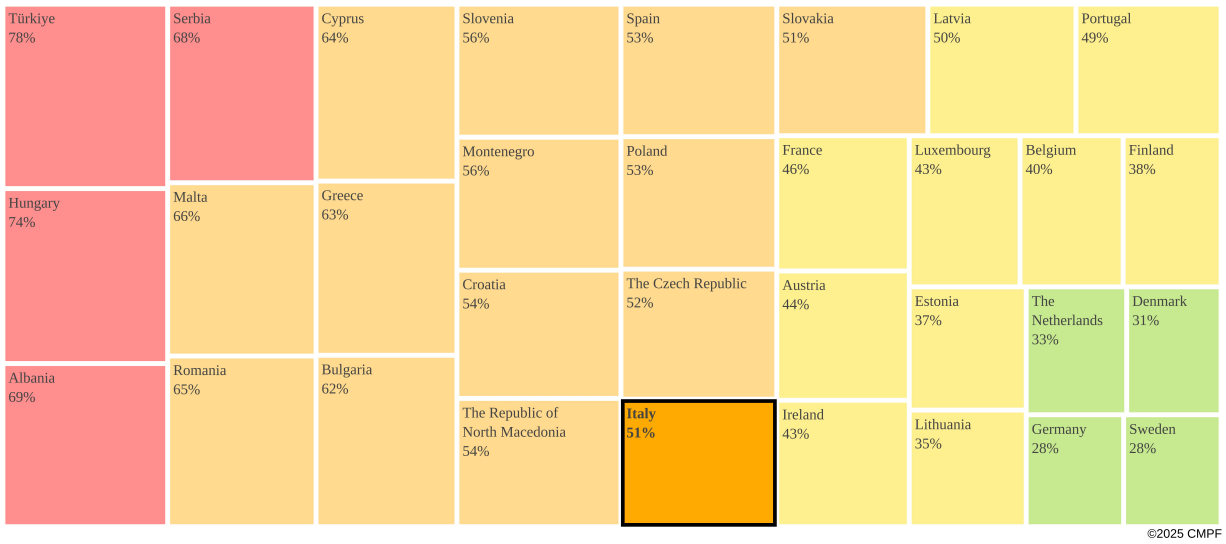
Fundamental Protection
The Fundamental Protection area fell within the medium-low risk band. The overall score remains within the medium-low risk category, reflecting a general framework that nonetheless continues to display certain (longstanding) structural weaknesses. Key points include:
- Italy is known for a high number of SLAPPs (Strategic Lawsuits Against Public Participation) cases, and the trend appears to be worsening. There is, in fact, a growing involvement of high-profile political figures, including members of the government, in initiating defamation proceedings, both civil and criminal. In 2024, the indicator related to the journalistic profession, its standards, and protection remains the most problematic area within the broader framework of Fundamental Protection. Major concerns persist regarding the precarious conditions faced by freelance journalists, a rise in threats and intimidation directed at media professionals, and several serious incidents that exposed significant shortcomings in the protection of sources, as well as cases of surveillance involving journalists and activists.
- The steady decline in working conditions for journalists, particularly freelancers, remains one of the most pressing issues: the average annual gross income of freelance journalists registered with a VAT number was only €16,000, a much lower figure than the GDP per capita in Italy, which was EUR 34,088. The independence of journalistic work is closely tied to the security and stability of the profession. However, a growing number of journalists are working on a freelance basis revealing a structural vulnerability in the profession.
- In 2024, new restrictions were introduced on media coverage of ongoing judicial proceedings. These measures are formally justified as safeguards for the presumption of innocence and the dignity of individuals involved in criminal cases. However, it has been pointed out that such rules appear to exploit these legitimate principles with the actual aim of limiting access to judicial information.
- Threats and intimidation against journalists increased, with 114 incidents of intimidation reported to law enforcement, marking a 16% rise compared to 2023. Even more concerning are the figures provided by the NGO Ossigeno per l’Informazione, which reported 506 threats against journalists in 2024.
Market Plurality
The area of Market Plurality is on the medium-high risk level.
Key points include:
- In 2024, AGCOM introduced guidelines (Resolution 66/24/CONS) to assess significant market power that could harm pluralism, as per Article 51, paragraph 5, TUSMA. The evaluation considers factors like revenues, market competition, entry barriers, sector convergence, synergies between markets, vertical integration, data control, access to essential resources, and the spread of radio and TV programming, including news and online services.
- As in previous years, the SIC assessment was not carried out promptly, with AGCOM publishing the 2022 data only in December 2024 (Resolution 502/24/CONS). The main players in the integrated system for 2022 were: RAI (13.1%), Alphabet/Google (11.3%), Comcast/Sky (9.9%), Fininvest (9.8%), Meta/Facebook (7.6%), Amazon (3.7%), Cairo Communication (3.5%), Netflix (3.2%), GEDI Gruppo Editoriale (2.7%), DAZN (1.9%), Warner Bros. Discovery (1.2%), Telecom Italia (1.0%), and Others (31.0%). However, due to the broad scope of the SIC, the data lacks detailed analysis of individual media markets, limiting its usefulness.
- In September 2024, GEDI also entered into an agreement with OpenAI, under which the Italian media group made its publications available within ChatGPT. However, the Italian Data Protection Authority (GPDP) raised serious concerns in a formal warning addressed to GEDI, arguing that the agreement involves a large volume of personal data and that the data protection impact assessment submitted to the Authority failed to adequately analyze the legal basis that would allow the publisher to share personal data from its archive with OpenAI.
- In 2023 (whose data were released in 2024), total television revenues (€8.236 billion) increased compared to the previous year and 2019, though the leading operators (RAI and Comcast/Sky Italia) saw a slight decline, while Fininvest/MFE experienced modest growth. Online platforms now account for 20% of audiovisual media revenues. Although linear TV viewership declined, online content consumption grew. Radio experienced a rise in both audience and revenue (€635 million in 2023, +4.9%), though revenues have not yet returned to pre-COVID levels. Newspapers continue to face a deep crisis, with both readership and revenues declining year after year. In 2023, sales fell by 13% from the previous year and 32.8% from 2019. These trends are confirmed by the Reuters Digital News Report 2024 and the 2024 Report on the Newspaper Industry in Italy, which highlights significant declines in advertising revenue—21.6% for newspapers and 37% for magazines.
Political Independence
The area of Political Independence is rated at a medium-low risk level, but it is on the threshold of the higher level (medium-high).
Key points include:
- In 2024, the regulatory framework for corruption prevention in Italy remained unchanged. The Group of States against Corruption (GRECO) recognized Italy’s “considerable regulatory framework” but pointed out its complexity, which undermines effectiveness. GRECO also noted the lack of a general definition of conflict of interest in Italian law and recommended adopting a public code of conduct for high-level executives, with clear guidelines on conflicts of interest, gifts, lobbyists, and post-office employment. This code should be supported by effective oversight and sanctions. Additionally, on May 28, 2024, the Chamber of Deputies approved legislative proposal A.C. 304-A (now under the examination of the Senate), mandating the reform of conflict-of-interest regulations for government officials and members of independent authorities, with further details to follow in future legislative decrees. The AGCM will also gain oversight and sanctioning powers.
- In the context of the European elections, an amendment was introduced that would have allowed unlimited news appearances by candidate politicians discussing their institutional activities, benefitting those from the governing majority. The amendment faced significant opposition and criticism. AGCOM ultimately intervened, preventing such an eventuality.
- In 2024, the Board of Directors (Cda) of RAI was renewed through a nomination process involving various Italian institutions. The Italian Parliament elected four members to the Board: Federica Frangi, Roberto Natale, Alessandro Di Majo and Antonio Marano. The elections took place on September 26, 2024, through a secret ballot. The nominations sparked debate. The Ministry of Economy and Finance (MEF) nominated Simona Agnes as a member of the Board. The new Board officially took office on October 1, 2024, for a three-year term. The RAI shareholders’ plenary assembly appointed Giampaolo Rossi as CEO and Simona Agnes as chairwoman, both of whom are considered politically aligned with the ruling parties. Agnes’ appointment requires approval from the RAI Supervisory Commission, but the ruling coalition has blocked the necessary votes, representing a clear case of majority obstructionism. This marks the sixth consecutive time the Supervisory Commission has been prevented from functioning properly.
- It is important to note that the Testo Unico dei Doveri del Giornalista, the primary self-regulatory framework adopted by the Italian Order of Journalists, has been integrated with the Nuovo Codice Etico. In December 2024, the National Council of the Order of Journalists unanimously approved this new Code of Ethics, which replaces the previous Unified Code of Journalists’ Duties. The text is the outcome of an extensive and complex process, during which the legal commission engaged in discussions with various organisations, unions, and associations that have collaborated with the Order over the years. These organisations signed important documents, which were subsequently incorporated into the new code. A central role, therefore, is played by the Code of Ethics and the regulations governing journalists’ duties, which provide certain guarantees – though these remain relatively weak.
Social Inclusiveness
Finally, the area of Social Inclusiveness also registers a medium-low risk, though again close to the medium-high threshold. In recent years, the topic of social inclusiveness in Italian media has gained significant attention and importance in public discussions. As societal awareness around issues of diversity, equity, and representation has grown, there has been a noticeable shift in the way media outlets approach the portrayal of various social groups.
Key points include:
- Women remain systematically underrepresented in governance and in the leadership of major national media outlets. In news and political programs, female voices continue to be significantly less visible than male ones, despite the increased visibility due to figures like Prime Minister Giorgia Meloni and Democratic Party Secretary Elly Schlein. Additionally, critical issues persist regarding media literacy, particularly due to the absence of a coherent national strategy to promote and strengthen these skills. There also remains a significant disparity in representation between recognized and unrecognized minority groups—particularly to the detriment of migrant communities.
- The national territory benefits from radio and television signal coverage (99%). Furthermore, 85% of the population holds a mobile broadband subscription. These figures are significant; however, they are contrasted by ongoing concerns related to the enforcement of net neutrality principles.
- RAI introduced new programming in the Arbëreshë language, aimed at celebrating and preserving the cultural heritage of the Arbëreshë community in Calabria.
- The persistence of language and messaging that delegitimise dissent and activism is evident, particularly in the context of climate justice and socio-economic rights. On Facebook, 33.5% of posts about the right to protest mention climate justice, while 14.4% address economic and social rights. Issues like immigration (2.3%) and women’s rights (2.2%) also attract a notable amount of problematic comments. On Twitter (now X), nearly one-third of protest-related posts involve climate justice.
- Almost all major newspapers are led by men, with only three female editors-in-chief currently in place: Agnese Pini, overseeing the Quotidiano Nazionale newspapers (La Nazione, Il Giorno, Il Resto del Carlino), and Nunzia Vallini, editor-in-chief of Giornale di Brescia. Together, they represent just 2 out of 35 top editorial positions. Until September 2024, Il Secolo XIX was also led by a woman, but following a change in ownership, Michele Brambilla was appointed as the new editor-in-chief.
- A persistent structural weakness remains, along with the lack of meaningful interventions to tackle longstanding challenges. Despite some positive initiatives, the general population’s and students’ media literacy continues to be insufficient. These deficiencies are deeply ingrained in historical factors and, in the current era of widespread education, raise questions about the overall effectiveness of national educational strategies.
Italy
(September 2014)
Introduction
The implementation of the MPM2014 for Italy shows a medium/high risk for media pluralism in the country. Of 34 indicators, 30% (10) show high, 61% (20) medium and 9% (3) low risk. One indicator was not scored, due to lack of data.
Legal Type of Indicators Assessing Risks to Media Pluralism
The legal indicators for Italy show a medium/high risk for media pluralism in the country.
Low risk was identified only in the basic first legal indicator on regulatory safeguards for freedom of expression, which recaps the fundamentals on this right. Medium risk was identified for the indicators: Regulatory safeguards on freedom to information (2), Recognition of media pluralism as intrinsic part of media freedoms and/or as policy objective of media legislation and/or regulation (3), Regulatory safeguards for journalistic profession (4), Regulatory safeguards for the independence and efficiency of the relevant national authorities’ (5), Policies and support measures for media literacy (or digital literacy, in particular) among different groups of population (6), Safeguards for access to airtime on PSM by the various cultural and social groups (7), Regulatory safeguards for minority and community media (8), Regulatory safeguards and policies for regional and local media (9), Regulatory safeguards for locally oriented and locally produced news on PSM channels and services (10), Regulatory safeguards for universal coverage of the media (11), Regulatory safeguards against high concentration of ownership and/or control in media (12), Regulatory safeguards against high degree of cross-ownership between television and other media (13), Regulatory safeguards for transparency of ownership and/or control (14), Regulatory safeguards for fair, balanced and impartial political reporting in media(15), ‘Policy measures for the impartial circulation of internet data, without regard to content, destination or source (20). High risk was identified for indicators on Regulatory safeguards against excessive ownership and/or control of mainstream media by politicians (16), on Fair, objective and transparent appointment procedures for PSM professionals and management boards (17), on Regulatory safeguards for the distribution of public interest channels on cable, DSL and/or satellite platforms (18) and Regulatory safeguards for the objective and independent allocation of (adequate, consistent and sufficient) financial resources to PSM(19).
With regard to indicator 1, freedom of expression is protected by article 21 of the Constitution, and Italy is committed to fostering it, having signed and ratified the relevant international treaties that defend human rights and freedom of expression as, for example, the European Convention on Human Rights. The ECHR, in particular, according to the case law of the Constitutional Court, works as a sub-parameter for assessing the constitutionality of a law. When it comes to assessing the limits of freedom of expression, privacy laws still enable, to a great extent, public debate on issues of public concern, and freedom of speech is generally respected for online expressions. The case law of the Superior Courts has slowly developed during the last fifteen years towards more consistent interpretations of the scope and limits of freedom of expression online.
This indicator scores low risk, notwithstanding that defamation is a criminal offence, and notwithstanding the chilling effect that this may provoke. The impact of this law is partially balanced by case law as, under specific circumstances, the application of the constitutional principle of freedom of expression prevails in the public interest over the claim of defamation.
Medium risk: indicator 2 was assessed as showing a medium risk. Article 21 of the Constitution is interpreted as covering freedom to access information and the laws in force guarantee access to acts, documents and information held by the public administrations by those who have a qualified interest. Recently, Legislative Decree 33 of 2013 made a step further in the direction of freedom of information, acknowledging that “everybody” has the right of access to documents and information of the public administrations. Nonetheless, the Italian law stresses more transparency obligations by the administration than the right to access to information. In this regard, the right to access is strictly linked to what the public administration is asked to disclose. It must be stressed therefore, that Italy still lacks of a proper freedom of information act (FOIA) according to international standards.
As regards indicator 3, media pluralism is a principle that was interpreted by the Constitutional Court as stemming from Article 21 Const., on freedom of speech. Moreover, the principle is recalled in general media regulation. Notwithstanding that media pluralism is a principle that is enshrined in laws and that is often recalled in case law, the indicator scores a medium risk, due to variable on the effectiveness in its implementation.
Indicator 4 presents medium risk, due to potentially restrictive regulation: in Italy, the journalistic profession is ‘closed’ by law (a professional journalist must be enrolled in the Albo dei Giornalisti (Register of Journalists), kept by the Ordine dei Giornalisti) (Order of Journalists).
Regulatory safeguards for the independence and efficiency of the relevant national authorities (5) exist, but they are not well implemented in practice. The score is medium, as, while the law formally foresees for the media authority appointment procedures that should guarantee transparency, should be democratic and objective and designed to minimize the risk of political or commercial interference, in practice, according to commentators and scholars, the appointment of the commissioners follows political and economic criteria.
Media and digital literacy (indicator 6) is a very broad an important topic. It was assessed that the existing policies are not tackling the problem in a systematic way.
Indicator 7 Safeguards for access to airtime on PSM by the various cultural and social groups shows a fragmentation of competencies among the bodies that regulate access to PSM.
Regulatory safeguards for minority and community media (8) are variously present in the legislation. Nonetheless, it is difficult to assess if the independence of the minority or community media is safeguarded in practice.
Indicator 9 shows that the legislation provides regulatory safeguards for local and regional media, in the light of geographical pluralism. Regional and local television and radio, for instance, are a very important part of the market in Italy, in terms of the number of operators, and the administrative and socio-political structure of the country itself, which calls for regional-level media. Policies on the development of local and regional media have become less clear in recent years. Regulatory safeguards for locally oriented and locally produced news on PSM channels and services (10), Regulatory safeguards for universal coverage of the media (11) exist, but policies and remedies to safeguard them could be improved.
Indicator 12 shows the existence of regulatory safeguards on media ownership concentration; nonetheless, the sanctioning/enforcement powers by the media authorities to impose proportionate remedies, has not been very effective. Regulatory safeguards against a high degree of cross-ownership between television and other media (13) are in place, but there are some cases where their poor implementation has been politically sensitive. In particular, the law that bans cross ownership with newspapers for those that run a national television business and get more than the 8% of the revenue of the “integrated system of communications” has been raising many criticisms in public opinion, as it is a temporary rule that every year is renewed by a governmental law-decree and because its elusion in the case of the ownership of the newspaper “Il Giornale” has been highly relevant in political terms. When it comes to Regulatory safeguards for transparency of ownership and/or control (14), it must be stressed that the Constitution itself calls for laws that can disclose the financing methods of the press. A corpus of laws that aim to disclose the structure of a media firm is in force. Nonetheless, this is not enough in terms of the disclosure of effective influence on the media. The law could provide obligations to ensure better accessibility to the data by the general public. For instance, the data available in the Register of Communication Operators, kept by AGCOM, are only partially available to the public.
Indicator 15 deals with the rules for political communication and electoral campaign. This indicator assesses the existence of regulatory safeguards for fair and objective coverage of political viewpoints, taking into consideration also electoral campaigns. Regulatory measures exist but the risk is that, when violated, the sanctions are not very effective.
Policy measures on indicator 20 Regulatory safeguards for the impartial transmission of information are nascent, and not very well defined and developed.
High risk. The regulatory safeguards against excessive ownership and/or control of mainstream media by politicians (indicator 16) scores high risk due to a lack of regulation on this area. The law on the conflict of interest can be taken into consideration to some extent, but this is a general law and it does not contain specific limitations to direct and indirect ownership/control of media by politicians, sanctioning only ‘privileged support’ of the politician by the media outlets.
As regards indicator 17, it must be noted that the composition of the Council of Administration of RAI usually reflects the political situation in the Parliament. Moreover, a representative of the government is part of it. These can be considered to be limits to the independence of PSM.
Indicator 18 scores high risk on must carry rules. This indicator aims to assess the existence and effective implementation of regulatory safeguards (in accordance with Article 31 Universal Service Directive) for access of public interest channels to cable, DSL and/or satellite platforms. There are no specific rules stemming directly from the EU Directive. Regarding the transition period from analogue to digital broadcasting, there was an obligation for the national digital operators to reserve 40% of capacity on a multiplex for independent channels. There are also rules in place for reserves of network capacity for local operators. RAI has must offer obligations.
A specific mention should be devoted to indicator 19, which was measured again after the Law Decree 66 of 2014 regarding urgent measures on competitiveness and social justice came into force. This legislative decree, in fact reduced the fee-revenue to the PSM for 2014 by 150 million euros. This indicator shows how a government’s unilateral decision, taken after no specific public debate, can break an established method of financing. This, in the logic of the MPM, can be seen as a potential threat to the independence of PSM.
Economic Type of Indicators Assessing Risks to Media Pluralism
Economic indicators show a risk concerning ownership concentrations, including Ownership Concentration (21), Readership/Audience Concentration (22) and Cross-Ownership Concentration Number of Sectors in which Top 8/owners are active (23). High risk is also assessed concerning the Availability and Quality of the broadband (24), which showed that broadband infrastructure, is still less accessed and slower than the EU average. The indicator assessing the Centralisation of the National Media System shows a low risk, while the lack of data on this matter has not made the implementation of the indicator assessing Minority and Community Media possible.
High risk. The high risk assessed by indicator 21 on Ownership Concentration is generated by combining the high risk that is highlighted by measuring the Ownership Concentration in the Television, Radio and Internet Service Providers (ISPs). In contrast, the large numbers of newspapers have resulted in low risk in the press.
Similarly to the Ownership Concentration, indicator 22 on Readership/Audience Concentration also shows high risk in the television, radio and ISPs sectors, while a medium risk is assessed in newspapers.
Taking into consideration the revenues of the TOP 8 media outlets of the entire media sector in Italy, the market’s revenues are split as follows: TV 3,257.26m Euros, radio 461.26m Euros, newspapers 983.02m Euros, internet 1,465.78m Euros. Internet here refers to search engines (such as: Google and Yahoo), and social media (such as Facebook). These data lead to the highlighting of a high risk in cross-ownership concentration.
Indicator 24 shows a high risk due to the limited access to Broadband infrastructure, including landlines and mobile connectivity, which is below the EU average. Indicators assessing the quality of the broadband, namely, the landline broadband speed, also show high risk, given that this is lower than the EU average.
Low risk: indicator 26 is the only low risk assessed among the economic indicators. This shows a high decentralisation of media system, due to the high distribution of local media outlets. This outcome is justified by the rich presence of local newspapers, regional television and radio. Although national media outlets play a dominant role in the Italian media system, local media outlets are widely distributed.
As already mentioned, it was not possible to assess indicator 25 on Minority and Community Media, due to the lack of data.
Socio-political Type of Indicators Assessing Risks to Media Pluralism
The socio-political indicators generally show a medium risk for media pluralism in Italy (five of eight indicators score as ‘medium’). The exceptions are the indicator on Independence and ownership of news agencies, showing a low risk, and the indicators Presence of professional associations providing advocacy for editorial independence and respect of professional standards and ‘Political bias in the media,’ showing a high risk.
The low-risk indicator 34 Independence and ownership of news agencies is mainly based on the assessment of the market share of the leading news agency and its political affiliation. The leading news agency in Italy is Agenzia Nazionale Stampa Associata (ANSA), although no recent data about its market share could be found to confirm this. Given that ANSA is a cooperative company consisting of 34 shareholders, it does not seem connectable to any specific political affiliation.
Medium-risk indicators focus on guarantees for universal access and coverage of media, political control in the media, and the level of independence of PSM. Indicator 27 Guarantees for universal access to media regarding special needs groups scores as medium because public service TV channels provide quite extensive measures to promote access to media content and services by special needs groups, but no relevant data could be found on the two leading private terrestrial TV channels (also part of the sample). Indicator 28 Guarantees for universal coverage of PSM and broadband networks regarding geographic coverage shows a medium risk given that one of the sub-indicators scores as medium (DSL coverage in rural areas), one sub-indicator is lacking data (public radio signal coverage), while the other two sub-indicators score as high-risk (public TV signal coverage and rural population passed by cable) as, in Italy, cable has not traditionally been developed.
Indicator 30 Political control over media and distribution networks ownership has too many sub-indicators to go into the detail of each one in this report. The sub-indicators all show low to medium risk. Generally, the data on ownership and audience shares in Italy are publicly available, even if it is not easy to find them online. However, when it comes to the political affiliation of media owners, there seem to be no official sources of data and, apart from a few very well known cases, the political affiliation of media owners is disclosed only as result of journalist investigation or press articles.
In terms of indicator 31 Political control over media funding by advertising, in Italy, there is no regulation, nor are there parameters, that establish the relationship between state advertising and audience shares. Moreover, there seem to be no relevant statistics. The Department of Information and Publishing (Dipartimento per l’informazione e l’editoria pubblica) collects quantitative information on different communication campaigns, but the data are provided only to the public entity in charge of the campaign in order to do quantitative analysis of the campaign’s impact. Hence, Variable 1 cannot be scored. Moreover, there are no rules regarding the distribution of state advertising (high risk). Given the absence of data on the first variable and the high risk of the second, this indicator could potentially score as high-risk.
The level of independence of PSM (indicator 33) shows a high risk with regard to the PSM finance mechanism. Although the relevant Ministerial Decree suggests economic considerations, in practice the level of public financing is subject to political discretion. This is evident from the fact that, in 2014, the government decided that the revenues from the license fee to RAI should be cut by EUR 150 million, suddenly and without any public discussion. The other two sub-indicators are low-risk, given that there is no direct government financing for the PSM and that the government does not decide on the wages for PSM employees.
High risk indicators: The first high-risk indicator is 32 Presence of professional associations providing advocacy for editorial independence and respect of professional standards, which shows a medium risk with regard to the sub-indicator on presence and activity of professional associations providing advocacy for editorial independence and the respect of professional standards. The reach of the Ordine dei giornalisti and the National Federation of the Italian Press (FNSI) is limited. The other variable, which evaluates the mechanisms that allow professional associations to conduct advocacy for editorial independence, shows a high risk. However, given that the key term ‘mechanisms’ is not defined (as pointed out by the respondent and three of the panel experts), the assessment leaves space for subjective interpretation. This indicator relies on expert opinion. The second high-risk indicator 29 Political bias in the media shows a high risk that is related to unbalanced representation of the different groups of political actors in the selected media sample; and a medium risk related to the one-sided portrayal of political actors in the media. However, the data here is based on a rather small sample and cannot be used to derive conclusions.
Italy
Download the report in .pdf
English
Author: Elda Brogi[1]
December 2016
1. About the Project
- Overview of the project
The Media Pluralism Monitor (MPM) is a research tool that was designed to identify potential risks to media pluralism in the Member States of the European Union. This narrative report has been produced within the framework of the first pan-European implementation of the MPM, carried out in 2016. The implementation was conducted in 28 EU Member States, Montenegro and Turkey, with the support of a grant awarded by the European Union to the Centre for Media Pluralism and Media Freedom (CMPF) at the European University Institute.
- Methodological note
The research was based on a standardized questionnaire and apposite guidelines that were developed by the CMPF. The data collection for Italy was carried out centrally by the CMPF team.
To ensure accurate and reliable findings, a group of national experts reviewed the answers to particularly evaluative questions (see Annex 2 for the list of experts).
Risks to media pluralism are examined in four main thematic areas, which represent the main areas of risk for media pluralism and media freedom: Basic Protection, Market Plurality, Political Independence and Social Inclusiveness. The results are based on the assessment of 20 indicators – five per each thematic area:
| Basic Protection | Market Plurality | Political Independence | Social Inclusiveness |
| Protection of freedom of expression | Transparency of media ownership | Political control over media outlets | Access to media for minorities |
| Protection of right to information | Media ownership concentration (horizontal) | Editorial autonomy
|
Access to media for local/regional communities and for community media |
| Journalistic profession, standards and protection | Cross-media concentration of ownership and competition enforcement | Media and democratic electoral process | Access to media for people with disabilities |
| Independence and effectiveness of the media authority | Commercial & owner influence over editorial content | State regulation of resources and support for the media sector | Access to media for women
|
| Universal reach of traditional media and access to the Internet | Media viability
|
Independence of PSM governance and funding | Media literacy
|
The results for each area and indicator are presented on a scale from 0 to 100%. Scores between 0 and 33% are considered low risk, 34 to 66% are medium risk, while those between 67 and 100% are high risk. On the level of indicators, scores of 0 were rated 3% and scores of 100 were rated 97%, by default, to avoid an assessment of either a total absence or a total certainty of risk[2].
Disclaimer: The content of the report does not necessarily reflect the views of the EC.
2. Introduction
Italy covers an area of 301.338-km² South of the Alps and along the Mediterranean Sea. It has a population of 62,007,540 inhabitants (July, 2016, est.). [3].
Italian is the most spoken language. According to the Italian Constitution, the Republic guarantees, through specific laws, the linguistic minorities (Art. 6). Since the ‘90s, Italy has been facing a rise in the flow of immigrants from EU Central Eastern countries (Romania), from South Eastern Europe (Albania), and Northern Africa[4]. Being close to Africa, and because of its extended coastline, Italy has become the entry point for many refugees and migrants from Africa and the Middle East. As of 2016, according to ISTAT data[5], around 5 million residents are foreigners. They represent 8.3 % of the total population of the country. The most relevant groups of residents are Romanians, Albanians, Moroccans, Chinese, and Ukrainians.
Italy is the third largest economy in the Euro area, but it has been heavily hit by the recent economic crisis. In addition to this, the country has to deal with a high public debt and some structural deficiencies that hinder growth, e.g., political instability, corruption, labour market inefficiencies, unemployment, tax evasion.
There are three main parties competing for government of the Country: the Democratic Party (which is currently in power, thanks to a heterogeneous coalition with other small political parties), the right-wing party that still refers to Berlusconi’s leadership, and the Five Star Movement. The role of Silvio Berlusconi (the well-known Italian media tycoon) in the Italian political arena has decreased in the last few years since he was convicted of tax fraud and is thus forbidden to be a political candidate in elections[6].
The Five-Star Movement is the political actor that now most characterizes the Italian political landscape. The Movement was created as the initiative of a comedian, Beppe Grillo, who used his personal blog as a tool with which to gather and organize the political participation of his followers. The Movement has been gaining credibility amongst the electorate in the last few years, and it has established itself as the second main political force in the country, aiming to win the next national general election. Apart from being a new and strong actor in the Italian political landscape, the Five Star Movement is also a peculiar and unique example of a strategic use of the web as a political platform and as a tool for political communication.
The Italian media environment suffers due to market concentration and the economic crisis, but it is relatively vibrant. In terms of consumption, the audiovisual media are the main source of information in the country, while newspaper readership is declining, vis à vis a growing consumption of news online[7]. Media policy, in the last two years, has been characterized by the quite active role of the centre-left government of Matteo Renzi (Democratic Party). Renzi has been ruling with the support of a coalition that gathers together the Democratic Party and other small centrist parties. He resigned after the results of the 2016 Constitutional Referendum rejected the revision of some parts of the 1948 Italian Constitution. The Government of Matteo Renzi has promoted reforms that have affected the media sector. To mention just some of these: the reform of the governance of Public Service Media (PSM), the reform of the law on freedom of information and the introduction of a Freedom of Information Act (FOIA), the reform of press public funding, and the introduction of a “fund for pluralism”. Some reforms, like the one that aims to cancel detention for the crime of defamation, or to reform the law on conflict of interest, are still in the pipeline in Parliament.
The Italian media market has recently been facing important changes. In 2016, Urbano Cairo (Cairo Communication), a publisher who is already active in the TV sector, gained control of the RCS MediaGroup S.p.A., the holding that owns the most read Italian newspaper, Il Corriere della Sera. La Repubblica and La Stampa, the second and third most read papers in the country now belong to the same group, L’Espresso.
In March, 2016, the Italian Competition Authority approved, upon the fulfilment of some conditions, the acquisition of RCS books by Mondadori, the main publishing house in Italy, which is controlled by the Fininvest group (Berlusconi). The audiovisual sector has been facing some major changes too: the French company, Vivendi, which is already the owner of Telecom Italia, is trying to gain control over Mediaset, one of the biggest players in the Italian audiovisual market.
3. Results from the data collection: assessment of the risks to media pluralism
The application of the MPM2016 showed that media pluralism in Italy is at low risk in the area of Basic Protection, and at medium risk in all of the three remaining areas of investigation. Overall, seven indicators are at low risk, nine are at medium risk, and four are at high risk. High scores are reported in the Political Independence and Social Inclusiveness areas. As regards Political Independence, risks for media pluralism come from political control over media outlets and a lack of independence in PSM governance. In the Social Inclusiveness area, risks for media pluralism come from insufficient media literacy. It must be noted that, within the Market Plurality area, media ownership concentration scores 60%, a percentage that defines a medium/high risk. Risks originating from a lack of ownership transparency vis à vis the general public, are high too. Within the Basic area, the indicator that describes the status of journalists and the standards of the profession is alarmingly high for a Basic Protection indicator: Italian journalism is facing crises in terms of working conditions, professionalization, autonomy, independence and safety.
The picture that arises from the MPM2016 confirms the Italian media system is characterized by high political parallelism (Hallin and Mancini, 2004), media concentration, although this is reduced in comparison with the recent past. The analysis of the MPM2016 shows that new problems are emerging, such as a lack of media literacy, both in terms of individual digital skills and of state policies to boost critical use of the media, and of online media in particular.
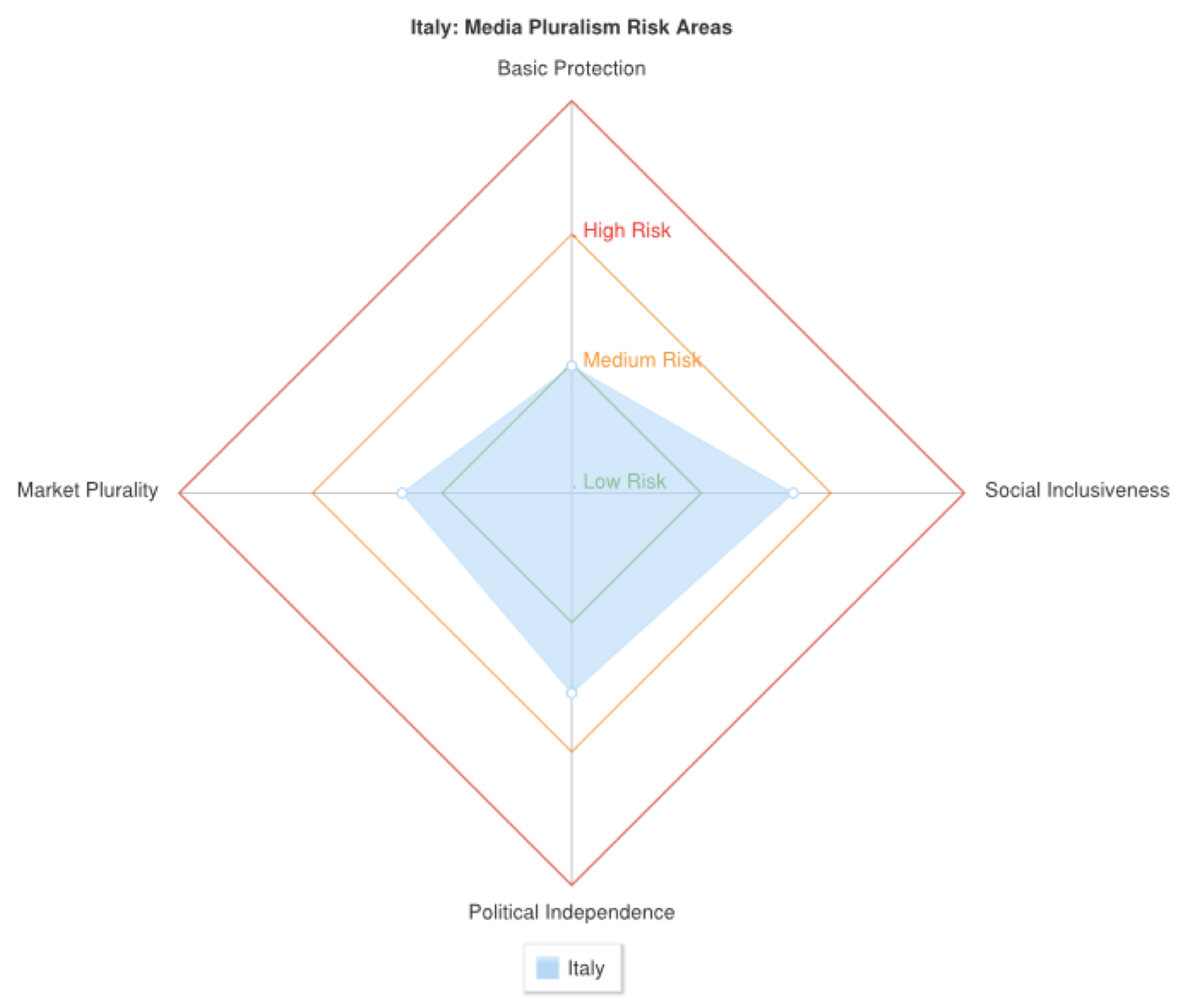
3.1 Basic Protection (32% risk – low risk)
The Basic Protection indicators represent the regulatory backbone of the media sector in every contemporary democracy. They measure a number of potential areas of risk, including the existence and effectiveness of the implementation of regulatory safeguards for freedom of expression and the right to information; the status of journalists in each country, including their protection and ability to work; the independence and effectiveness of the national regulatory bodies that have competence to regulate the media sector; and the reach of traditional media and access to the Internet.
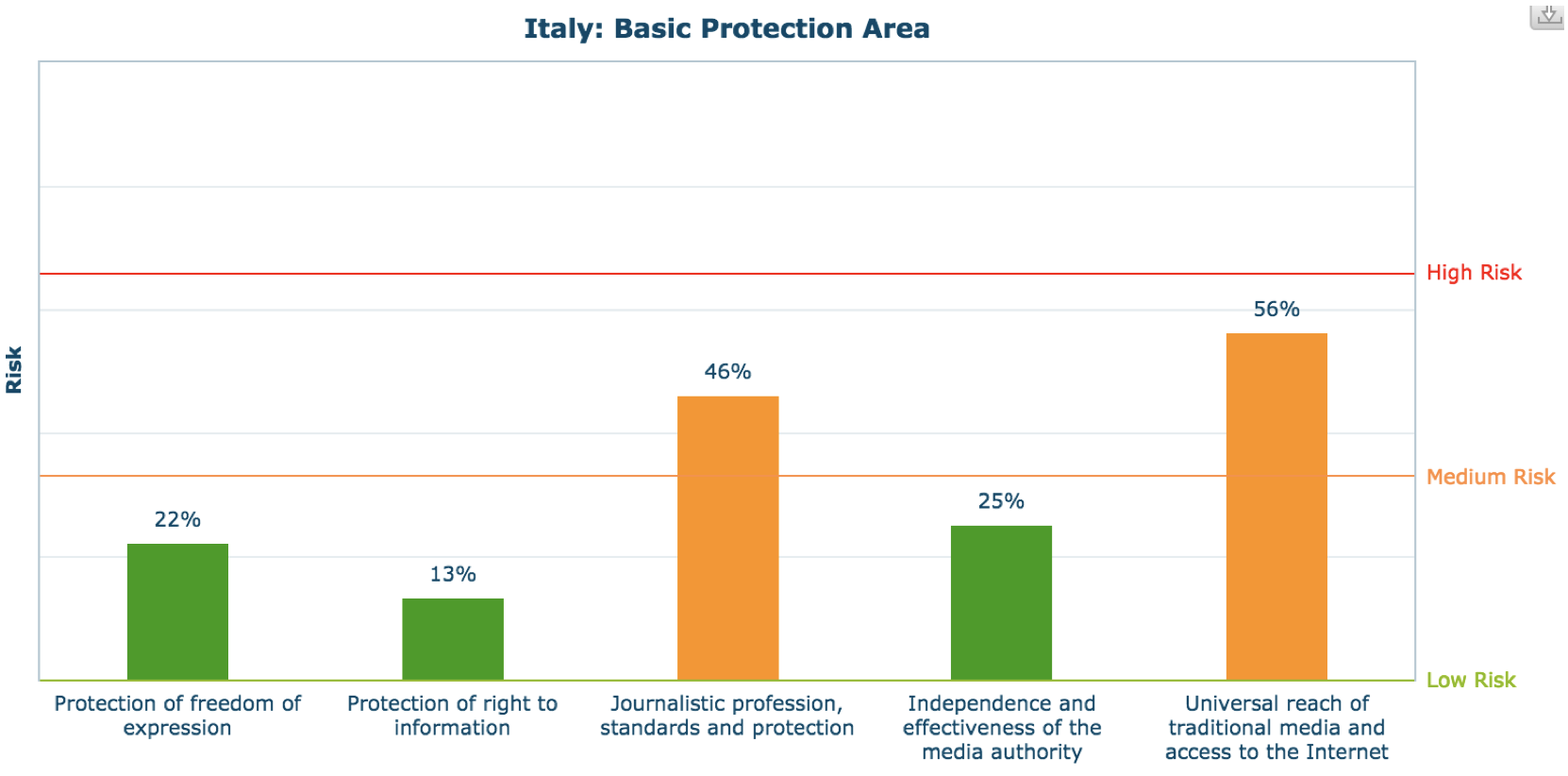
Within the area of Basic Protection, three indicators score low risk for Italy (Protection of the freedom of expression, the protection of rights to information, and the Independence and effectiveness of the media authority), while two score medium risk (Journalistic profession, standards and protection, and the Universal reach of traditional media and access to the internet). Overall, the area receives a score that is still within the low risk band (32%), but that is alarmingly close to the medium one.
The Italian legal framework on the protection of freedom of expression (22%, low risk) is generally in line with international standards and the rule of Law. Art. 21 of the Italian Constitution, which protects freedom of expression, limiting it just for the sake of public (sexual) morality (Art. 21 Par. 6). Restrictive measures to protect dignity, privacy, public and private secrets are prescribed by laws. The rule of law for the freedom of expression online is generally respected too. Nonetheless, some articles of the criminal code do not fully comply with international standards and Art 10 European Convention on Human Rights: in particular, the defamation of another person (Art. 595) is a criminal offence that is punishable by imprisonment, which cannot be considered a proportionate sanction for defamation. The criminalization of defamation poses some risks for journalists’ freedom of expression, and it creates a “chilling effect” that can be detrimental for the effective and free exercise of journalistic activity[8]. The Italian Parliament has been discussing a reform of the law on defamation, aiming to repeal imprisonment as a punishment for defamation, but the Bill has not yet been approved. The crime of insults against the honour and decorum of others (Art. 594 of the Criminal Code) was, instead, repealed in early 2016 [9].
Protection of the right to information scores a risk of 13%: the low risk for this indicator is an improvement over the assessment on the same indicator under MPM2014 (medium risk) (CMPF, 2015). The decreased risk is due to a better score in terms of the existence and effective implementation of a law on the freedom of information. In 2016, the Government approved a legislative decree on transparency (D.lgs n. 97/2016) that details the “transparency” reform which had already been started in 2013 (see MPM2014). This aims to combat corruption in the Public Administration. The 2016 decree empowers citizens with access to the data and documents of the Public Administration relevant to public and private interests (“civic access”). Any refusals by the Administration to provide data must be duly motivated and may be subject to the scrutiny of an official who is responsible for the prevention of corruption and for transparency within the administration.
The indicator on the Journalistic profession, standards and protection, scores medium risk (46%). The indicator takes into consideration many different variables that depict the condition of journalists in a given country, in terms of access to the profession, professional standards, threats and legal safeguards. The picture described by the MPM for Italy is not particularly reassuring: unlike most of the EU countries, access to the profession is not totally free (enrolment in the Ordine dei Giornalisti is required to qualify as a professional journalist); the working conditions of Italian journalists are becoming increasingly precarious and poor, while the average salary is decreasing [10]; journalists occasionally face threats and intimidation (this chilling effect coming from complaints in regard to defamation; physical threats, and threats to digital safety[11]). According to data from Ossigeno per l’informazione, 412 journalists were the victims of threats in 2016[12].
The independence and effectiveness of the media authority scores 25% risk (low risk). The law defines appointments’ procedures to safeguard the independence and efficiency of the media authority, namely, the Autorità per le garanzie nelle comunicazioni (AGCOM): in practice the nominations and appointments are made by major political parties. The fact that the President and the Board of the authority are appointed by political bodies raises the problem of actual independence from politics. This may lead to decisions that are not fully independent from political influence. However, over the past two years (the timeframe of the MPM assessment) there have been no blatant cases or evidence to prove a lack of independence in AGCOM’s decisions affecting the mass media sector. Nonetheless, when this report was written, AGCOM had not completed an evaluation of the levels of concentration in the audiovisual media market, which was started in 2015: AGCOM has suspended it in order to allow the media market to stabilise after the recent acquisitions and mergers[13].
Low average Internet connection speed, low broadband subscription rates and high ownership concentration among Internet Service Providers (ISPs) in the market contribute to the raising of the score for the indicator on the Universal reach of traditional media and access to the internet (56%, medium risk).
3.2 Market Plurality (43% risk – medium risk)
The Market Plurality indicators examine the existence and effectiveness of the implementation of transparency and disclosure provisions with regard to media ownership. In addition, they assess the existence and effectiveness of regulatory safeguards to prevent horizontal and cross-media concentration of ownership and the role of competition enforcement and State aid control in protecting media pluralism. Moreover, they seek to evaluate the viability of the media market under examination as well as whether and if so, to what extent commercial forces, including media owners and advertisers, influence editorial decision-making.
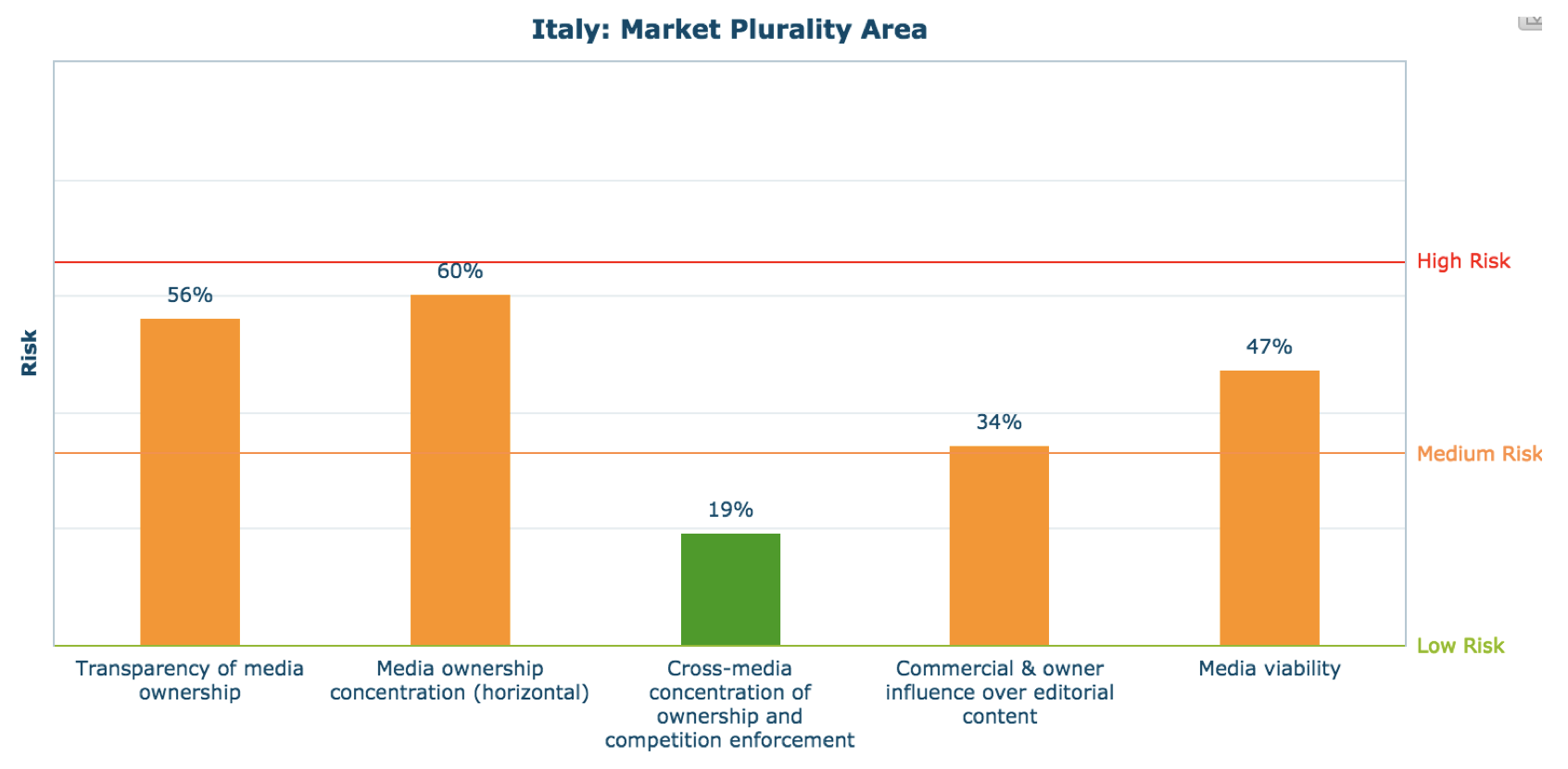
In relation to the ownership of media companies, the Italian media market is partially transparent: complying to the law (l.249/97) and the AGCOM rules (666/08/CONS), AGCOM collects information on the ownership structure of media companies. The Authority keeps a register of the companies that are part of the SIC (Sistema integrato delle comunicazioni / Integrated System of Communications), which includes a wide range of operators in the media and electronic communication sector, including advertising and Internet companies. No similar obligation exists vis à vis the general public, as a guarantee of transparency. In considering this last element, the indicator on the Transparency of media ownership scores a medium risk (56%).
A low level of plurality has affected the Italian media market for the last thirty years: concentration of the audiovisual market is in few hands, combined with the political ownership of one of the main media companies and the parallelism of the PSM with political powers have been a peculiarity of the Italian media system. As already mentioned, the media market in Italy has recently faced some changes, which originate both from technological developments and from the rise of new companies in the media sector. Although the digital terrestrial audiovisual market is still dominated by the two main operators in Italy (RAI [the PSM] and Mediaset), the switch over to digital terrestrial television and the increase in pay-tv and on-demand audiovisual services have challenged the rigid duopoly of the Italian audiovisual media market. In particular, at least in terms of revenues, SKY Italia has established itself as the third main component of the Italian audiovisual market (32.5% of the resources in 2015), overtaking RAI (27.8%) and Mediaset (28.4%) (See data of AGCOM, 2016). Nonetheless, the market is still highly concentrated. The regulatory framework calls for the Authority both to monitor that a media operator does not exceed 20% of the revenues of the SIC (Sistema integrato delle comunicazioni, see above) and to check whether an operator is exceeding a dominant position within a given media market. While the first threshold (20% of the SIC) has always been perceived by scholars as being too loose, as the SIC covers a very large market, the second has never been effectively implemented. In particular, the Authority has currently suspended the analysis of the relevant markets, waiting for the final definition of the Vivendi-Mediaset operation. The radio market is not as highly concentrated as the audiovisual one. The newspaper market, as mentioned, is facing some important challenges: Itedi, the publisher of La Stampa (Italy’s third largest newspaper) merged with The Gruppo L’Espresso, publisher of La Repubblica (the second largest newspaper). The operation, under scrutiny by the Italian Competition Authority for some of its implications in the advertising market at the local level[14], has established Gruppo L’Espresso as the biggest in Italy, in terms of revenues. The merger will raise the C4 ratio for the newspaper market from 54 to 60 (revenues) and from 58.7 to 64.5 (readership), still in the medium risk band, according to the MPM methodology. The general risk for the indicator on horizontal media ownership concentration is medium (60%).
The indicator on cross media ownership scores an overall low risk (19%). However, the indicator entails one sub-indicator on the existence and effectiveness of a regulatory framework that may prevent cross-ownership concentration: this sub-indicator scores medium risk (54%), as the regulatory framework has proven to be partially ineffective. The regulatory framework, in this regard, sets a threshold of 20% of the SIC market for the SIC operators: the rule is ineffective in limiting cross-media ownership, due to the wide scope of the SIC market. Specific cross-ownership thresholds, as the one limiting the newspaper ownership to those audiovisual operators who represent more than 8% of SIC, have been either circumvented in the past, or do not apply to recent cases (like RCS/Cairo Communication, as Cairo Communication’ s La7 does not reach 8% of SIC).
The law that forbids a telecoms operator from owning more than 40% of the telecoms market, to earn more than 10% of the revenues of the SIC, may prove effective in hindering Vivendi from gaining control of Mediaset[15].
The score of the indicator is lowered by the good scores for the variables on competition enforcement, and by the existence and implementation of regulatory safeguards ensuring that State funds granted to PSM do not exceed what is necessary to provide a public service.
The indicator on Commercial and owner influence over editorial content scores medium risk (34%): journalists can rely on some mechanisms in the general agreement granting social protection in the case of changes in ownership or editorial line; advertorials are not permitted. However, the structure of the Italian publishing industry does not guarantee an environment with full autonomy and independence for journalism: the major investors in the media industry are mostly entrepreneurs in production fields other than media and they are very often linked (sometimes in a non-transparent way) with political parties.
Media viability scores medium risk (47%). The media market suffers both from the general economic crisis and the disruption arising from online media. Interestingly enough, radio revenues and, of course, online advertising ones, are increasing. Recently, the Parliament passed a law on publishing that aims to reform the support system for the media, establishing a “fund for pluralism and innovation”.
3.3 Political Independence (51% risk – medium risk)
The Political Independence indicators assess the existence and effectiveness of regulatory safeguards against political bias and political control over the media outlets, news agencies and distribution networks. They are also concerned with the existence and effectiveness of self-regulation in ensuring editorial independence. Moreover, they seek to evaluate the influence of the State (and, more generally, of political power) over the functioning of the media market and the independence of public service media.
The level of political influence on the media in Italy is very high. The relationship between political (and economic) powers and information and the media can sometimes be very close. Nonetheless, it is difficult to clearly define whether a given media outlet is influenced by politicians, or whether it is voluntarily part of the political game. This is apart from the cases where politicians are blatantly the owners, or clearly control the ownership, of a given media outlet, there are cases of newspapers acting almost as political parties or, at least, supporting a political party while not being a party-press[16].
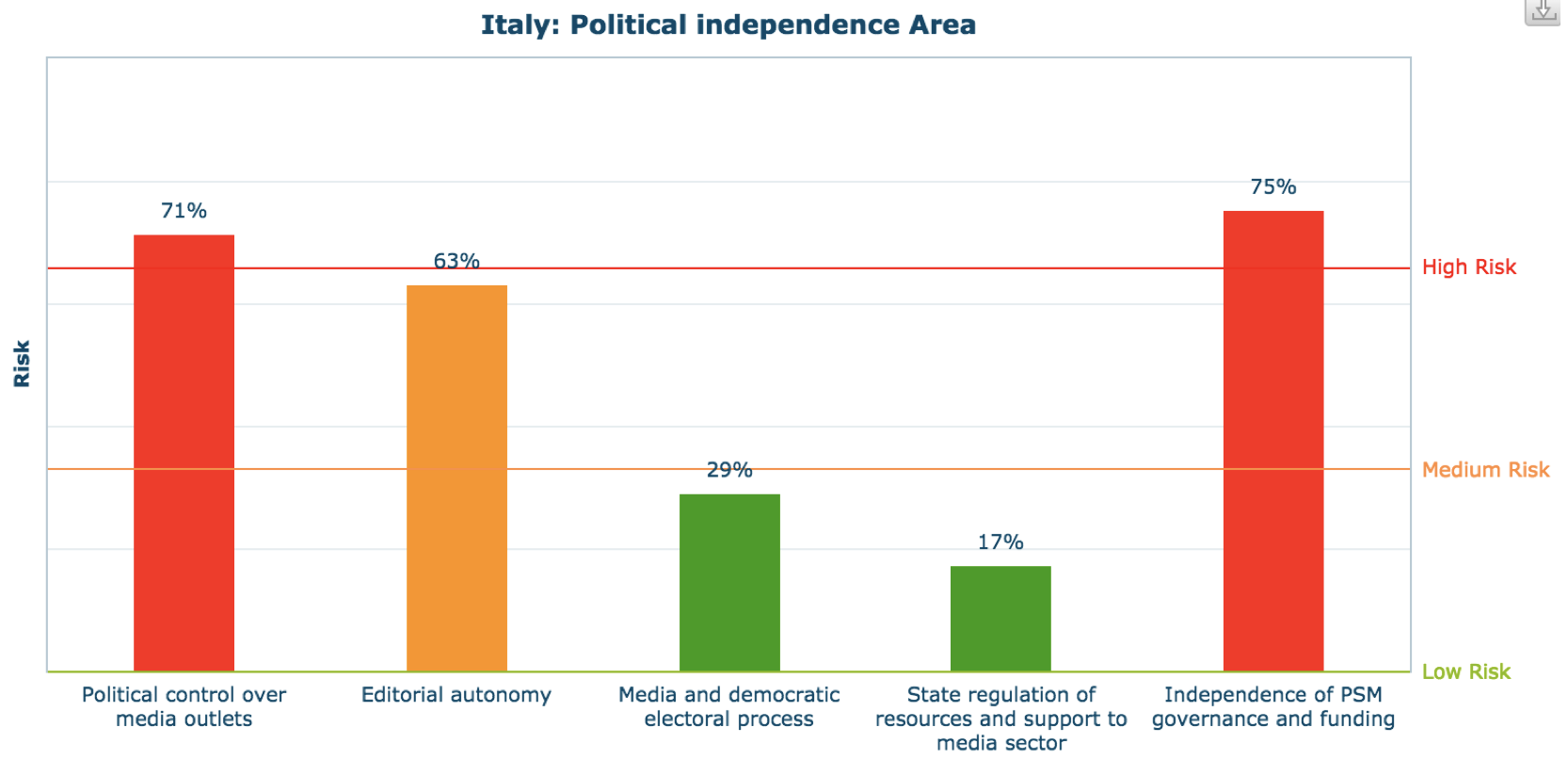
It is not, therefore, surprising, that the indicator on political control over media outlets scores high risk (71%), and the one on Editorial autonomy scores medium risk, with 63% pointing to higher risks. The regulatory framework lacks an effective law on the conflict of interest: the Frattini law was criticised by the Venice Commission[17] and the reform of this matter is still pending in the Parliament. Editors in chief have been replaced, in some cases, as a result of alleged political pressures.
The indicator on media and democratic electoral process scores low risk (29%). The low score (although it is a high percentage within the low risk band) is due to the composition of the indicator, as it deals mostly with PSM coverage during the electoral period. The Italian legal framework contains a specific rule on the fair distribution of airtime to political parties and candidates during the electoral period (l.28/2000). Data provided by AGCOM show a relatively fair system for the allocation of airtime in RAI during the recent campaign on the constitutional referendum[18]. The main element of risk has been related to the over-representation of the Prime Minister on PSM (and on commercial channels, too).
The indicator on the State regulation of resources and support for the media sector scores low risk (17%): the Italian scenario for radio and television has changed after the switch to digital terrestrial broadcasting. Although the transition to digital has been complicated and it has consisted of a sort of projection of the existing duopoly in analogue broadcasting, the linear AVMS offer is now open to a higher number of operators. While, in the last decade, Italy has been struggling with the transition to DTT, the main debate today is concentrated on how to make the 700 band available for mobile telephony, in line with the EU strategy. Major broadcasters are hindering this policy and trying to postpone this conversion, at least until 2022[19]. In terms of support for the media sector, public subsidies, in general, relate to newspapers and local audiovisual media (details in Sileoni and Vigevani, (2016)). The public funding mechanisms have been heavily criticized in the past, as it mostly benefitted the party press. The new law n198/206 (Institution of a Fund for Pluralism) abolishes public funding for the political party press and for unions and seeks to benefit “pure” publishers, who do not have other interests in other commercial fields.
The independence of PSM governance and funding scores a high risk (75%): the Board of the PSM, RAI, currently includes 9 members who were appointed entirely for their politics: 7 members were appointed by a Parliamentary committee overseeing the PSM’s activities (Commissione parlamentare per l’indirizzo generale e la vigilanza dei servizi radiotelevisivi”) and 2 members were appointed by the Ministry of the Economy, the main shareholder in the company. The President was appointed from amongst the latter two. It must be noticed that the appointment procedures for the Board of Administration of RAI were reformed in 2015 (7 members, 4 appointed by the parliamentary commission, 1 by the employees of RAI, two by the government): the reform is not considered an effective shift to a governance system independent of politics (Grandinetti, 2016). One of the recent reforms that has affected Italian PSM is related to the collection of the license fee, which is now paid with the electricity bill. This procedure has proved to be effective as, according to recent data, the revenue from the license fee collection was higher in 2016 than in the past[20].
3.4 Social Inclusiveness (56% risk – medium risk)
The Social Inclusiveness indicators are concerned with access to media by various groups in society. The indicators assess regulatory and policy safeguards for community media, and for access to media by minorities, local and regional communities, women and people with disabilities. In addition to access to media by specific groups, the media literacy context is important for the state of media pluralism. The Social Inclusiveness area therefore also examines the country’s media literacy environment, as well as the digital skills of the overall population.
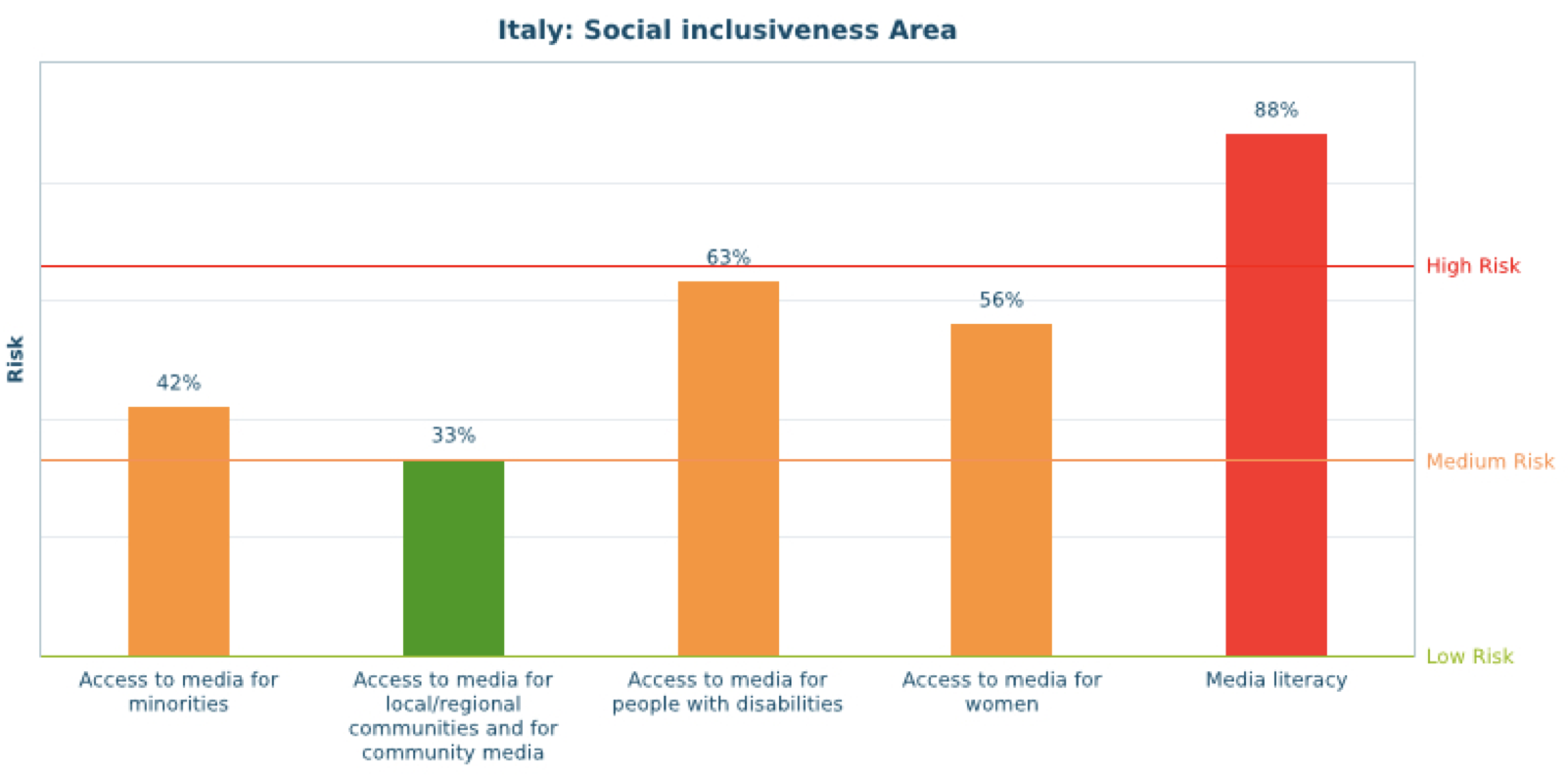
Social Inclusiveness is the area that scores the highest risk in Italy. Media literacy (88%) is the indicator that scores the highest in the MPM for Italy.
The indicator on the Access to media for minorities is at medium risk (42%): the Italian media landscape is characterized by a very high number of TV and local radio stations, which provide viewers with a relatively wide variety of content that targets minorities too. RAI has a specific role in assuring that minorities are included in its offer: according to the latest corporate report (“Bilancio sociale”), RAI has dedicated a significant number of hours to TV and radio programs in German, Slovenian, Ladin and French.[21] Fewer programs are available for other minorities who do not qualify as historical language minorities.
Local media are safeguarded by Legislative Decree 177/2005, which reserves one third of the network capacity for them. The law recognizes also the existence of community media, but does not contain any specific provision that grants them either independence or access to platforms. RAI has a specific role and mission to have local branches and to locally broadcast news and programs in minority languages.
Access to media for people with disabilities scores medium risk (63%). Art.32, Par.6 of the D.lgs 177/2005, states that AVMS providers have to adopt adequate measures to protect such users. The RAI Service Contract (Agreement with the Ministry of the Economy) sets stricter rules for PSM: according to Art. 13 of the latest version of the Contract, RAI is requested to provide subtitles to at least 70% of the airtime in generalist channels, from 6 a.m. to 12 p.m, and to provide subtitles and translation in ISL (Italian Sign language) for at least one bulletin per day on the 3 main channels. However, as per the audio descriptions, the Contract generically asks Rai to increase its offer of audio described programming, without imposing any quantitative threshold or deadline. AGCOM is currently working with Confindustria on a code of conduct that will provide a set of measures allowing users with disabilities to access the media[22].
The medium score for Access to media for women (56%) comes from the low shares of women as both subjects and sources in news, and this covers newspapers, radio and television news, of women as subjects and sources in Internet news websites and news media tweets, and from the low ratio of women among news reporters[23]. According to Law 120/2011, at least a third of the members of the executive board of public companies should be women. Although the Italian PSM, RAI, seems willing to introduce “female quotas”, women now make up less than a third of the members of RAI’s Executive Board.
Finally, the indicator on Media literacy is the one that scores the highest in the MPM2016 with 88% (high risk). There are no legal documents framing Media Education/Media Literacy policies, and there no clear authority that oversees Media Education initiatives in Italy. National policies deal mostly with the promotion of digital literacy, which focuses on the incorporation of technologies into the learning environment. The absence of institutional coordination on Media Education practices has motivated civil society to come up with the Carta di Bellaria[24], an agreement made in April, 2002, by a large group of political representatives, educators and broadcasters with the aim of regulating the criteria, practices, qualitative parameters, ethical principles and legal frameworks of Media Education projects and products. This is not a binding agreement and has no legal foundation, however, it can be considered the first official act that has given recognition to all the institutional and non-institutional subjects that are actively involved in Media Education projects and it has provided them with a coordinated framework of organizational standards and general aims for their work (Aroldi, Murru, 2014). Media literacy is absent from the compulsory education curriculum. In 2007, the Italian Ministry of Education launched a National Plan for Digital Schools (Piano Nazionale Scuola Digitale) to mainstream Information Communication Technology (ICT) in Italian classrooms and to use technology as a catalyst for innovation in Italian education, that will hopefully be conducive to new teaching practices, new models of school organization, new products and tools that can support quality teaching[25].
The indicator score also takes into account the percentage of the population that has at least basic digital usage skills (55%) and, within this, the percentage of the population that has at least basic digital communication skills (63%). These are values that are still below the EU median (77%).
4. Conclusions
Italy has been at center stage on issues that are related to media pluralism for the last two or three decades. Technological development in the media sector has helped to boost market plurality; recent reforms have reinforced the basic prerequisites for an enabling environment for journalists (for instance, the new freedom of information law); the new law that establishes a fund for pluralism of information and innovation has created high expectations for the fairer distribution of state resources to newspapers and local broadcasting (Sileoni and Vigevani, 2016. Although some elements point to positive developments for pluralism in the Italian media landscape, the assessment of the MPM2016 still shows several spheres for concern in the four main areas of analysis. MPM2016 confirms some negative trends that had already been picked up by MPM2014 (CMPF, 2015).
As already mentioned, above, the standards of the journalistic profession are becoming poorer in terms of professionalism and working conditions. This is a trend that is particularly negative in Italy, and MPM2016 confirms the findings of MPM2014. Nonetheless, it must be stressed that Italy can rely on initiatives (like LSDI[26] and Ossigeno per l’ informazione[27]) that actively monitor journalists’ working conditions and threats to journalists, allowing an informed debate on this alarming situation. As regards Basic Protection, while the crime of insult has been repealed, the draft law on the reform of the crime of defamation has been pending in Parliament for years. The final Parliamentary vote on this draft could be a further step towards a legal framework that is more consistent with international standards.
Another reform that is pending in Parliament is on conflict of interest: the latter is a problem in Italy, since many political and economic interests are still intertwined.
Recent changes in the ownership of some media outlets may also affect media pluralism in the country (Gruppo L’ Espresso/Itedi), in the short term at a local level, considering the mostly local circulation of La Stampa. As regards the Cairo Communication/RCS operation, considering La7 has a small percentage of the SIC and a small audience, no imminent dangers for media pluralism can be envisaged. .
PSM’s parallelism with politics has probably not been solved by the recent reform of RAI governance. In this regard, the Parliament and the Government should propose reforms, aiming to create a PSM that is really independent from politics. This is particularly important in this age of “post-truth”, where the political debate is heavily marked by online political communication.
A very important step forward should be made as regards media literacy: the existing, very limited, policies are not tackling the problem of the lack of basic digital skills and a critical understanding from media users, while a strong investment in media literacy should be fundamental to really empowering the citizens. This result, in line with the similar result obtained during the MPM2014 implementation, constitutes an alarming trend that should be seriously, and as soon as possible, tackled by the institutions. The population’s level of media literacy dramatically affects effective pluralism, especially in the online environment; a lack of media education for the younger generations could really affect media pluralism and democracy in the near future. Again, strong policies on media literacy become basic conditions for media pluralism in a political landscape, like the Italian one, where one of the main political parties is a movement that was born as an online platform.
References
Aroldi, P., Murru, M.F. (2014) Media and Information Literacy Policies in Italy (2013), , available at https://ppemi.ens-cachan.fr/data/media/colloque140528/rapports/ITALY_2014.pdf (last access, 20 march 2017)
AGCOM, (2016), Relazione annuale 2016 sull’ attività svolta e sui programmi di lavoro available at https://www.agcom.it/relazioni-annuali
Casarosa, F. and Brogi, E. (2011), Does media policy promote media freedom and independence? The case of Italy, https://www.mediadem.eliamep.gr/wp-content/uploads/2012/01/Italy.pdf
CMPF, (2015) Monitoring Media Pluralism in Europe – Testing and Implementation of the Media Pluralism Monitor 2014 available athttps://hdl.handle.net/1814/38886
CMPF, (2016) Monitoring Media Pluralism in Europe – Testing and Implementation of the Media Pluralism Monitor 2015, available at https://cadmus.eui.eu/handle/1814/40864
Grandinetti, O., (2016), La governance della RAI e la riforma del 2015, Rivista trimestrale di Diritto pubblico, 2016, 3, pp 833-873
Hallin, D.C. and Mancini, P. (2004) Comparing Media Systems: Three Models of Media and Politics , Cambridge University Press
Sileoni, S., Vigevani, G.E., (2016) Media Pluralism in Italy, in Bard, P., Bayer, J., Carrera, S., A comparative analysis of media freedom and pluralism in the EU Member States, 2016 available at https://www.europarl.europa.eu/RegData/etudes/STUD/2016/571376/IPOL_STU(2016)571376_EN.pdf PE571376
Rea, P. (ed), Rapporto LSDI sul giornalismo in Italia. La professione giornalistica in Italia (aggiornamento 2015), LSDI available at https://www.lsdi.it/2017/giornalismo-italia-il-nuovo-rapporto-di-lsdi/
Annexe 1. Country Team
| First name | Last name | Position | Institution | MPM2016 CT Leader (please indicate with X) |
| Elda | Brogi | Scientific Coordinator | CMPF | |
| Davide | Morisi | Research Associate (until December 2016) | CMPF | |
Annexe 2. Group of Experts
| First name | Last name | Position | Institution |
| Gennaro | Carotenuto | Researcher | Università di Macerata |
| Benedetta | Liberatore | Director (audiovisual content) | AGCOM |
| Giovanni | Gangemi | Official | AGCOM |
| Sergio | Splendore | Researcher | Università di Milano |
| Giulio Enea | Vigevani | Professor | Università di Milano Bicocca |
| Vittorio | Pasteris | Journalist | Member of LSDI |
| Giulia | Ottaviani | FIEG |
—
[1] Davide Morisi (CMPF) collaborated in the data collection.
[2] For more information on MPM methodology, see the CMPF report “Monitoring Media Pluralism in Europe: Application of the Media Pluralism Monitor 2016 in EU-28, Montenegro and Turkey”, https://monitor.cmpf.eui.eu/
[3] CIA Fact Sheet-Italy https://www.cia.gov/library/publications/the-world-factbook/geos/print_it.html
[4] As of beginning of 2016, Morocco (510.450), Albania (482.959), China (333.986), Ukraine (240.141) e India (169.394). Data: ISTAT https://www.istat.it/it/archivio/190676
[5] https://www.istat.it/it/archivio/180494
[6] Berlusconi has appealed to the Court of Human Rights in Strasbourg, as he claims this interdict is illegal, since this sanction was inflicted under a law that was passed after the crime that he was condemned for was committed.
[7] Reuters, Digital News Report 2016, https://www.digitalnewsreport.org/survey/2016/italy-2016/#fnref-4051-2
[8] Ossigeno per l’informazione, (2016) Taci o ti querelo! Gli effetti delle leggi sulla diffamazione a mezzo stampa in Italia Ogni anno 6813 procedimenti, 155 condanne, 100 anni di carcere https://notiziario.ossigeno.info/wp-content/uploads/2016/10/DOSSIER_TACI_O_TI_QUERELO.pdf
[9] Dlgs 15 gennaio 2016, n. 7 Disposizioni in materia di abrogazione di reati e introduzione di illeciti con sanzioni pecuniarie civili, a norma dell’articolo 2, comma 3, della legge 28 aprile 2014, n. 67 (GU n.17 del 22-1-2016)
[10] Rea, P. (ed), Rapporto LSDI sul giornalismo in Italia. La professione giornalistica in Italia (aggiornamento 2015), LSDI https://www.lsdi.it/2017/giornalismo-italia-il-nuovo-rapporto-di-lsdi/
[11] For a detailed analysis of threats to journalists, see the reports of Ossigeno per l’ Informazione https://www.ossigenoinformazione.it/
[12] https://notiziario.ossigeno.info/tutti-i-numeri-delle-minacce/dati-aggregati-tavola-3/
[13] https://www.agcom.it/documents/10179/6758530/Comunicato+stampa+31-01-2017/8e82b33b-3010-488b-9e92-51ecf81f9f02?version=1.0.
[14] Pending the publication of this report, AGCM approved the merger, with conditions case, https://www.ansa.it/sito/notizie/topnews/2017/03/09/antitrustok-condizionato-espresso-itedi_aea1c725-5017-461d-9245-5bcad920b72a.html. Moreover, AGCOM has acknowledged that the merger does not breach the specific anti-concentration rules of the press market (l.416/81) https://www.agcom.it/documents/10179/7677581/Documento+generico+08-05-2017/b16391ea-7499-4de7-a59d-9ced9052921e?version=1.0
[15] Pending the publication of this report, AGCOM has acknowledged that Vivendi is violating the law Del. 178/17/CONS https://www.agcom.it/documents/10179/7421815/Delibera+178-17-CONS/bb20ae9f-21eb-4d39-baf9-ee3fc9d8737a?version=1.0
[16] This is a confirmed trend. See Casarosa, F. and Brogi, E. Does media policy promote media freedom and independence? The case of Italy, https://www.mediadem.eliamep.gr/wp-content/uploads/2012/01/Italy.pdf , p.46.
[17] European Commission for Democracy through Law, Opinion on the compatibility of the laws “Gasparri” and “Frattini” of Italy with the Council of Europe standards in the field of freedom of expression and pluralism of the media, Adopted by the Venice Commission at its 63rd Plenary Session (Venice, 10-11 June 2005) https://www.venice.coe.int/webforms/documents/default.aspx?pdffile=CDL-AD(2005)017-e
[18] https://www.agcom.it/risultati?q=par%20condicio%20referendum%20costituzionale
[19] https://confindustriaradiotv.it/frequenzeil-governo-chiedera-alla-commissione-europa-rilasciare-la-banda-700-alle-tlc-non-del-2022/
[20] https://www.corriere.it/economia/17_febbraio_09/gettito-record-il-fisco-2016-incassati-oltre-450-miliardi-euro-38dec0e8-eeae-11e6-b691-ec49635e90c8.shtml
[21] See https://www.bilanciosociale.rai.it/it/l-attenzione-offerta-radiotelevisiva-specifici-temi).
[22] Information provided by Benedetta Liberatore and Giovanni Gangemi, AGCOM, members of the MPM group of experts for Italy (see Annexe 2).
[23] Secondary data from the Global Media Monitoring Project (GMMP). The Global Media Monitoring Project (GMMP) is the world’s longest running and most extensive research on gender in the news media (since 1995), 2015. https://cdn.agilitycms.com/who-makes-the-news/Imported/reports_2015/regional/Europe.pdf
[24] https://www.mediaeducationmed.it/documenti-pdf/documenti-ufficiali/doc_view/8-20020413-carta-di-bellaria.html
[25] This indicator has been assessed based on the input of Sara Gabai Sukhothai Thammathirat of the Open University, Thailand. Her contribution has been reported almost verbatim. CMPF thanks Sara Gabai for the precious information she has provided.
[26] https://www.lsdi.it/
[27] https://www.ossigenoinformazione.it/