

Greece
Media Pluralism Monitor 2025 results
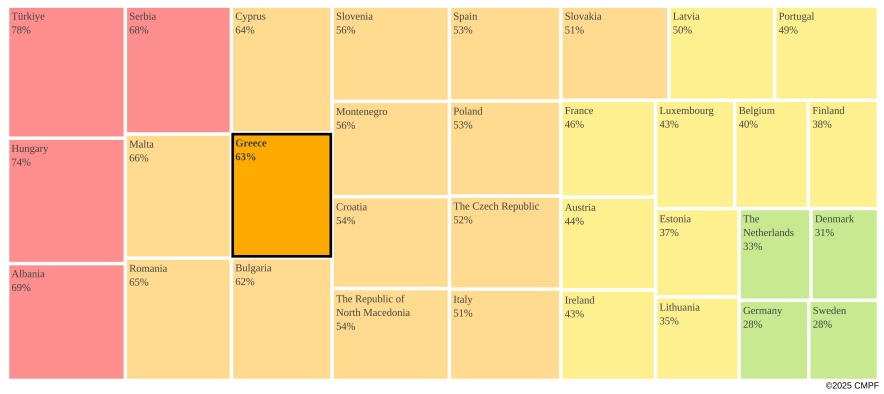
Risk score: 63%
| Fundamental Protection | 62% |
| Market Plurality | 67% |
| Political Independence | 57% |
| Social Inclusiveness | 66% |
In-depth analysis:
Read the full MPM2025 Country report
Country overview
2024 in Greece was marked by intense polarization and a historic low in voter turnout. The European Parliament elections held in June saw abstention reach nearly 59%, with non-voters outnumbering voters for the first time (Ministry of Interior, 2024). The ruling New Democracy party suffered significant losses, losing nearly one million votes compared to the 2023 national elections, while SYRIZA’s support dropped to less than half. The elections also triggered major changes in the opposition. On March 1st, eleven SYRIZA MPs left the party and founded a new political formation called New Left. In September, following a vote of no confidence, party leader Stefanos Kasselakis resigned from SYRIZA and founded his own party. PASOK also held internal elections, re-electing Nikos Androulakis as party president. These shifts in parliamentary group composition led to PASOK becoming the official opposition. Meanwhile, the far-right party Elliniki Lysi more than doubled its vote share, while smaller parties like Niki and Plefsi Eleftherias saw slight declines. Overall, the elections revealed increasing political disengagement, deepening party fragmentation, and growing public dissatisfaction with mainstream political forces.
The media landscape in 2024 remained highly concentrated, with persistent concerns over political influence and low levels of public trust in news (Newman et al, 2024). Media debates were shaped by a prolonged election cycle and polarized narratives on press freedom. The controversial appointment of a new board at the National Council for Radio and Television highlighted continuing concerns about regulatory independence. Digital transformation in the media was slow. Most outlets remain hesitant to introduce paywalls, though some, such as Kathimerini, experimented with soft subscription models. News consumption continues to shift toward platforms like Instagram and TikTok, especially among younger audiences, but Greek publishers still struggle to build engagement there. State subsidies for TV content were significantly reduced, potentially redirecting focus toward cheaper news programming. Public broadcaster ERT expanded its reach through ERTNEWS and the streaming platform Ertflix, prompting criticism from private broadcasters. Meanwhile, media ownership concentration intensified through further acquisitions by powerful figures like Evangelos Marinakis. Despite isolated innovations, the market continues to face challenges related to trust, diversity, and long-term sustainability.
In 2024, Greece underwent several significant legal, regulatory, and political changes that impacted the media landscape. Key legal developments included the Law 5062/2023, aimed at enhancing protections for journalistic sources and promoting media independence, although concerns about enforcement remain. Additionally, Law 5095/2024 extended the 2022 Whistleblower Protection Act, now covering violations related to bribery and influence trading. The National Transparency Authority (NTA), operational since August 2023, manages an external reporting channel for whistleblower reports on violations of both EU and national laws, enhancing legal protections for whistleblowers. Additionally, Ministerial Decisions were made to clarify the procedural aspects of the whistleblower law. The National Council for Radio and Television (NCRT) has continued to face significant challenges related to its independence and operational effectiveness, with ongoing concerns about political influence in its selection process. The European Media Freedom Act (EMFA), enacted by the EU in 2024, introduces new requirements for Greece to ensure greater transparency in media subsidies and reduce state influence over media outlets, with the goal of strengthening media freedom. However, despite these legislative and regulatory advancements, several issues remain unresolved. These include the concentration of media ownership, the lack of transparency in the ownership of digital-native media, limited media pluralism and diversity, weak enforcement of existing laws, pressures on journalists, and insufficient regulatory independence. Additionally, transparency in state funding remains a persistent challenge.
Fundamental Protection
The Fundamental Protection area scores within the medium-high risk band. Key points include:
- Law 5090/2024 decriminalized simple defamation, retaining, however, penalties for aggravated defamation. Concerns remain about potential misuse to silence dissent and investigative journalism.
- Lack of anti-SLAPP legislation leaves journalists vulnerable to legal harassment. On the positive side, the Court of First Instance of Athens dismissed one of the many SLAPP lawsuits that the former director of the prime minister’s office, Grigoris Dimitriadis, who is also the nephew of the PM, filed against media outlets and a journalist who revealed the Predator spyware scandal in Greece.
- No journalist was killed in 2024; however, the murders of George Karaivaz in 2021 and Sokratis Giolias in 2010 remain unresolved, creating a wider climate of impunity that emboldens perpetrators. Journalists continue to face significant challenges and threats in the course of their work. Physical assaults by police authorities highlight an ongoing pattern of violence and intimidation that remains largely unaddressed.
- A new collective labour agreement was signed between the Greek State and journalists’ unions introducing several key provisions aimed at improving the working conditions of public sector journalists.
- Greece’s main regulatory body, the National Council for Radio and Television (NCRTV), continues to face criticism for ongoing political interference, particularly in the appointment process of its members, and its lack of effectiveness due to limited resources, among other reasons.
- Greece’s government was condemned for interfering in the investigation into the Predator spyware scandal. Meanwhile, Law 5002/2022, aiming to protect citizens from surveillance software, lacks specific provisions for the protection of journalists and media workers.
Market Plurality
The Market Plurality area escalated to high risk. Key points include:
- Media ownership remains highly concentrated, with four major broadcasters controlling the audiovisual sector and cross-media ownership lacking transparency. Existing laws (e.g., Law 3592/2007) fail to regulate digital-native media, allowing unchecked expansion.
- Digital markets lack regulatory oversight, with global platforms like Google and Meta dominating news distribution and advertising. While not exclusive to local outlets, the absence of a taxation framework or fair revenue-sharing mechanisms disproportionately affects smaller, regional, and independent media, which rely more heavily on local advertising and have limited bargaining power with platforms.
- Editorial independence continues to decline, as political and commercial interests influence newsroom decisions. The weak enforcement of transparency laws and delays in implementing the European Media Freedom Act (EMFA) exacerbate risks.
- State funding remains unpredictable, with slow allocations and a lack of support for digital media. The viability of print media continues to decline due to falling revenues and insufficient investment in alternative business models.
Political Independence
The Political Independence area scores within the medium-high risk band. Key points include:
- Greece’s Public Service Media (PSM) continue to face severe criticism for being susceptible to political bias. In 2024, ERT’s administration changed; however, the process further emphasized government control. The data on the percentage of political officials’ appearances on ERT in 2023 reveal a significant imbalance in media representation, favoring the government.
- Despite new laws aiming to shed light on media ownership, there is still much progress to be made. The concentration of media ownership remains a pressing issue, as various press freedom watchdogs highlight that media capture is very high in Greece, undermining media diversity and resulting in limited political viewpoints being represented.
- Political advertising on online platforms remains unregulated, as politicians are not explicitly required to report these kinds of expenses. Platforms, on the other hand, lack full transparency. Regulation (EU) 2024/900 on political advertising transparency is set to be implemented by 2025 and aims to tackle these gaps.
- Greece’s national elections took place in June 2023. Data regarding the distribution of media coverage across political parties highlight the dominance of major parties, limiting political pluralism and restricting the diversity of viewpoints presented to the public.
- Political control over media remains a significant issue, as many outlets are owned by media moguls who maintain strong ties to the ruling New Democracy party, often steering media outlets to serve political interests rather than prioritizing objective, public-interest journalism.
Social Inclusiveness
The Social Inclusiveness area scores within the medium-high risk band. Key points include:
- Access to media remains unequal, with broadband disparities affecting rural areas and affordability challenges limiting mobile internet access.
- Private broadcasters fail to meet media accessibility standards for people with disabilities.
- Representation of minorities remains limited, with Roma, LGBTQIA individuals, and migrant communities frequently misrepresented or excluded from mainstream narratives.
- Hate speech regulations exist but are poorly enforced.
- Local and regional media face financial instability, with a lack of state support leading to closures or shifts toward entertainment content to survive.
- Gender equality in the media remains a challenge, with women underrepresented in leadership and newsroom decision-making roles. No legal quotas exist to ensure gender balance in media content or employment.
- Media literacy lacks a coordinated national strategy, leading to fragmented initiatives and low public engagement in fact-checking, increasing vulnerability to misinformation.

Greece
(June 2014)
Introduction
The implementation of the MPM2014 for Greece shows a medium/high risk for media pluralism in the country. The results collected by implementing the MPM in Greece, show risks in the country as follows: 44% (15) of the indicators assess a high risk; 38% (13) of indicators indicate a medium risk, and 9% (3) refer to low risk. Three indicators were not scored due to lack of data.
The pilot-test implementation of the MPM on Greece is valuable in terms of suggestions on methodology, structure and formula for the MPM’s fine-tuning.
Legal Type of Indicator Assessing Risks to Media Pluralism
Overall, the regulatory safeguards for freedom of expression in the Greek legal system pose a medium risk for media pluralism. Freedom of expression is explicitly recognised in the Constitution and Greece has signed and ratified the relevant international treaty obligations. Citizens have legal remedies in cases of the infringement of their freedom of expression, and free speech is generally respected, including on the internet. However, there are interpretive problems regarding national security laws. The rules on blasphemy are also not very narrowly defined and defamation provisions abound in the Greek penal code (1-medium risk).
The right to information is explicitly recognised in the Constitution and in national laws. There are appeal mechanisms in place. However, these are slow. Moreover, the parallel existence of multiple legal provisions on the right to information/access to public documents ends by creating problems in regard to the implementation of this right. In addition, there is evidence of systematic non-compliance with the relevant rules. The score for this indicator appears to be “low risk”. In our view, the risk is higher than the one calculated by the MPM (2).
Media pluralism is explicitly recognised both as an intrinsic part of media freedom and as a policy objective. In practice, however, not all aspects of media pluralism are respected. Media pluralism is mostly threatened in Greece by the high concentration of media power and the underlying interdependence between political, economic and media elites (3-medium risk).
There is currently no licensing of journalists in Greece and access to the journalistic profession is open. However, those who want to become members of the journalists’ associations (membership is optional) need to fulfil the membership criteria set by the respective associations, which also function as journalists’ trade unions. According to the self-regulatory Code of Conduct of the Journalistic Profession, journalists should not accept money or any other type of compensation, which may affect their credibility/independence/objectivity. In principle, Greek courts recognise the protection of journalistic sources. However, the relevant variable was considered as not fulfilled, because the law was not considered to be in line with ECHR standards. The protection of press freedom also includes the protection of access to all sources. There is systematic evidence that media entrepreneurs intervene in their employees work (4-high risk)[1].
As far as the independence of the relevant national authorities is concerned:
- The National Council for Radio and Television is fully funded by the State and its members are selected by the Conference of Chairmen of the Greek Parliament, a cross-party parliamentary college, seeking unanimity or an increased majority of four fifths of its members. The ability of the political parties that are in opposition to veto the nominations of their counterparts does not preclude nominations based on political affiliation and ideological identification. Furthermore, there is a lack of transparency in the process of nomination.
- The Chairman and the Vice-Chairman of the Hellenic Competition Commission are elected by the Conference of Chairmen of the Greek Parliament. The remaining board members are appointed by the Minister of Finance.
- The President and the two Vice-Presidents of the National Telecommunications and Post Commission are appointed by the Council of Ministers upon the proposal of the Minister of Infrastructure, Transport and Networks. The other six board members are appointed by the Minister of Infrastructure, Transport and Networks.
The above factors, combined, constitute a high risk to media pluralism (5). The existing policies on media literacy are only nascent and the measures taken are fragmented (6-medium risk). NERIT, the Greek PSM, is bound by law to serve the democratic, social and cultural needs of the society and to contribute to pluralism. The scarce rules regarding the accessibility of minority groups and the content of programmes seem to be complied with. However, given that the existing rules on cultural pluralism are restricted mainly to the accessibility of the disabled, one cannot safely conclude that such compliance amounts to an adequate representation of different cultural groupings (7-medium risk).
The Greek media law does not contain any specific provisions on minority or community media. In fact, there appears to be no particular policy strategy for minority media or community media (8-high risk).
Media legislation does not ensure access by regional and/or local media to platforms of electronic communication network providers. It also does not prohibit networking or affiliation arrangements between regional/local media and national media (9-high risk).
NERIT is not obliged a) to have a minimum proportion of regional and/or local communities involved in the production and distribution of its programme; b) to have its own regional correspondents; or c) to have the balance of journalists coming from various geographical groups (10-high risk).
With respect to universal coverage, NERIT’s coverage is the entire geographical area of Greece.
Greek regions participate in the operational programme “Digital Convergence”, which seeks to promote the use of ICTs. The Rural Broadband infrastructure project aims to reduce the digital gap in rural and remote areas. The Greek print media is supported by considerable indirect state subsidies in the form of distribution subsidies (11-medium risk).
Different ownership rules apply to electronic (TV and radio) ‘information’ media and electronic ‘non-information’ media (12-medium (for the most part)). There are also some restrictions on the ownership of the printed media, depending on type and geographical reach. The media legislation does not contain specific thresholds or limits to prevent a high level of horizontal concentration of ownership and/or control as regards ISPs (12.3-high risk). However, it has introduced media-specific competition rules to curb a high degree of cross-media ownership (13-medium).
As far as transparency of media ownership/control is concerned, newspapers and magazines must indicate their owner, publisher and director. They must also indicate the director of the undertaking responsible for printing. The capacity of owner, partner, main shareholder or management executive of an information media enterprise is incompatible with the capacity of owner, partner, main shareholder or management executive of an enterprise that undertakes works towards the public sector. In order to be licensed, TV and radio undertakings must submit to the NCRT a statement on their shareholders. Any transfer of ownership (above 1% of the capital of a licensed TV or radio undertaking) has to be notified to, and approved by, the National Council for Radio and Television (14-medium risk).
Concerning political reporting, according to Art. 15(2) of the Constitution, state control over public and private radio and television ‘shall aim at the objective and on equal terms transmission of information and news reports’. As regards PSM in particular, NERIT shall serve the democratic, social and cultural needs of the society and contribute to pluralism. Art. 15(2) of the Constitution also provides for the mandatory and free-of-charge transmission of the electoral campaign messages of the political parties. In pre-election periods, the PSM and the free-to-air commercial channels, as well as the providers of radio and television subscription services of any kind are required to make time available for the transmission of messages from political parties free of charge. “Access to airtime on PSM (and commercial channels and services during election campaigns) for political parties is determined on the basis of their performance at the previous elections. The extent to which these rules promote political pluralism is questioned as they are, each time, determined by means of the agreement reached by a cross-party committee”[2] (high risk). The interpretation of the data for this indicator shows that indicator 15’s formula needs to be fine-tuned for future implementations and that the risk should be assessed as lower.
On the issue of excessive political control of the mainstream media, the Constitution renders incompatible the duties of member of Parliament and those of owner/manager partner or shareholder or governor or administrator or member of the board of directors or a deputy thereof, of an enterprise that either publishes a newspaper of country-wide circulation or engages in radio or television broadcasting services. The aforementioned duties are also incompatible with the duties of a Member of the European Parliament. As regards PSM in particular, the duties of a member of the Supervisory Board and the Management Board of NERIT are incompatible with those of member of the Ministerial Council, Deputy Minister, Secretary (General and Particular) of a Ministry or Secretariat, Member of Parliament, Mayor and Deputy Mayor, Head and Deputy Head of a region and civil servant (16-high risk). It must be stressed that the interpretation of the data provided for this indicator show that the score coming from the application of the MPM is too high. The text of the indicator should be fine-tuned to include the assessment of the constitutional level of regulation. Moreover, when the report was finished (June, 2014), it was not possible to assess how the PSB’s incompatibility rule was going to be implemented[3].
With respect to PSM appointment procedures, these are for the most part transparent (17-medium risk).
There are currently no specific must carry rules in media legislation guaranteeing distribution of public interest channels on cable, DSL and/or satellite platforms (18-high risk)
Concerning PSM financial resources, NERIT enjoys financial autonomy and derives income through a mandatory licence fee, advertising and other sources. The level of the licence fee is determined by the Minister of Finance and the Minister responsible for NERIT upon proposal of its management board. NERIT’s yearly budget is subject to approval by an inter-ministerial committee (19 -high risk).
There is no regulation on net neutrality in Greece. Nevertheless, the National Communications and Post Commission, the regulator on electronic communications networks and services, monitors developments on net neutrality at the European level and has declared a commitment on coming up with a five-year action plan (20-medium risk).
Economic Type of Indicator Assessing Risks to Media Pluralism
There is a high ownership concentration in television, radio and ISPs and a medium ownership concentration in newspapers (21-high risk). It should be noted, however, that in Greece there is no data on the total revenue of media outlets. Market shares are calculated on the basis of imputed advertising expenditure (i.e., sales of advertising space/time by media outlets to advertisers).
A medium level risk to media pluralism stems from audience/readership concentration. In particular, there is a high audience concentration in television and subscriber concentration in internet service provision, and a medium readership concentration in newspapers. There is currently no available data on the audience shares of radio outlets (22).
The concentration of media ownership across the different media sectors cannot be scored due to the non-disclosure of data as regards ISPs (23).
Both fixed and mobile broadband penetration is lower than the respective EU average penetration (this is a high risk to media pluralism). Concerning the two variables that assess the national average fixed internet speed measured in Mbps in download/upload compared with the respective EU average (24), Greece scores low risk in upload and high risk in download.[4]
None of the questions concerning minority and community media (25) can be answered. This indicator provides for the scoring of the ratio of television channels/newspapers/radio channels, which are dedicated to ethnic/linguistic/national minorities to the total number of domestic television channels/newspapers/radio channels. First, the only recognised minority in Greece is a religious minority (the Muslim population of Thrace). Second, there are no television/radio channels/newspapers of national range formally recognised as minority media.
Similarly, the indicator concerning the centralisation of the national media system (26) cannot be scored due to the non-availability of data.
Socio-political Type of Indicators Assessing Risks to Media Pluralism
With respect to indicator 27 Guarantees for universal access to media regarding special needs groups, policy-making bodies are aware of the issue and have started taking measures, but the existing policies are only nascent and the measures taken are fragmented. The risk is therefore evaluated as a medium one.
On the issue of universal coverage, addressed by indicator 28 Guarantees for universal coverage of PSM and broadband networks regarding geographical coverage, NERIT, which only started operating in May, 2014, is bound by its law to have a 100% geographical coverage. However, this aim has not yet been achieved. As a result, currently there is no effective coverage with PSM transmissions. The rural coverage of DSL is higher than 95%, but availability of cable internet is rather low. Based on all this, the risk for indicator 28 is evaluated as high[5].
Another indicator with a score of high risk is indicator 29 Representation of political views in the media. The content analysis exercise has shown that Greek media are deeply politically biased. However, it needs to be noted that this indicator has been applied within a rather constrained methodological frame and the issue needs further exploration.
On indicator 30 Political control over media and distribution networks ownership, the connections of media owners with political elites in the country have formed the object of substantive investigation by journalists and media activists. Rather than disclosing media owners’ allegiance to specific political parties, reports have focused on the interplay of the media with politicians, and the development and evolution of interconnecting interests between the media, the government and the business sector. The lack of sufficient transparency and data however, prevents addressing and reflecting on these concerns in the scoring of the indicator.
With respect to indicator 31 Political control over media funding by advertising, despite the fact that there are clear and transparent rules regarding the distribution of public advertising, their actual implementation does not portray an equally transparent environment. The lack of readily available and reliable statistical data across the different media sectors prevents the proper evaluation of this indicator.
Concerning indicator 32 Presence of professional associations providing advocacy for editorial independence and respect of professional standards, vying for editorial standards and editorial independence, the unions of journalists have been quite active in campaigning on matters related to journalists’ employment conditions. At the same time, however, they have proved ineffective in enforcing the Code of Conduct of Journalists, which is the reason for the less than perfect evaluation of the risk here. However, the indicator itself needs further specifications and fine-tuning of the descriptions of the different ways and degrees of professional associations’ involvement, in order to better reflect cases like Greece.
On indicator 33, measuring the Level of independence of PSM considering the mechanisms of its financing, Greece scores a high risk. The reason for this is that the government decides on the licence fee of the PSM without any public discussion.
High risk to media pluralism is also demonstrated by indicator 34 Independence and ownership of news agencies, as there is only one Greek-based national news agency. In addition, ANAMPA (the only news agency) is owned by the government, and the government is involved in the personnel appointment and/or editorial policy.
[1] The formula of this indicator should be fine-tuned for further applications, as it is too strict.
[2] Source: MPM implementation Greece.
[3] CMPF
[4] This variable has been assessed by the CMPF according to the guidebook, suggesting the use of the centralised available database offered by “Ookla”.
[5] The country correspondents provided the elaborated data, but the CMPF team assigned the indicator score.
Greece
Download the report in .pdf
English – Greek
Authors: Anna Kandyla and Evangelia Psychogiopoulou
December, 2016
1. About the Project
- Overview of the project
The Media Pluralism Monitor (MPM) is a research tool that was designed to identify potential risks to media pluralism in the Member States of the European Union. This narrative report has been produced within the framework of the first pan-European implementation of the MPM. The implementation was conducted in 28 EU Member States, Montenegro and Turkey with the support of a grant awarded by the European Union to the Centre for Media Pluralism and Media Freedom (CMPF) at the European University Institute.
- Methodological note
The CMPF cooperated with experienced, independent national researchers to carry out the data collection and to author the narrative reports, except in the cases of Malta and Italy where data collection was carried out centrally by the CMPF team. The research was based on a standardised questionnaire and apposite guidelines that were developed by the CMPF. Data collection in Greece was finalised on 31 July 2016.
In Greece, the CMPF partnered with the Hellenic Foundation for European and Foreign Policy (ELIAMEP)[1], which conducted the data collection, commented the variables in the questionnaire and interviewed relevant experts. The report was reviewed by CMPF staff. Moreover, to ensure accurate and reliable findings, a group of national experts in each country reviewed the answers to particularly evaluative questions (see Annexe 2 for the list of experts).
To gather the voices of multiple stakeholders, the Greek team organized a stakeholder meeting, on September 14, 2016 in Athens. An overview of this meeting and a summary of the key points of discussion appear in Annexe 3.
Risks to media pluralism are examined in four main thematic areas, which represent the main areas of risk for media pluralism and media freedom: Basic Protection, Market Plurality, Political Independence and Social Inclusiveness. The results are based on the assessment of 20 indicators – five per each thematic area:
| Basic Protection | Market Plurality | Political Independence | Social Inclusiveness |
| Protection of freedom of expression | Transparency of media ownership | Political control over media outlets | Access to media for minorities |
| Protection of the right to information | Media ownership concentration (horizontal) | Editorial autonomy
|
Access to media for local/regional communities and for community media |
| Journalistic profession, standards and protection | Cross-media concentration of ownership and competition enforcement | Media and democratic electoral process | Access to media for people with disabilities |
| Independence and effectiveness of the media authority | Commercial & owner influence over editorial content | State regulation of resources and support to media sector | Access to media for women
|
| Universal reach of traditional media and access to the Internet | Media viability
|
Independence of PSM governance and funding | Media literacy
|
The results for each area and indicator are presented on a scale from 0% to 100%. Scores between 0 and 33% are considered low risk, 34 to 66% are medium risk, while those between 67 and 100% are high risk. On the level of indicators, scores of 0 were rated 3% and scores of 100 were rated 97% by default, to avoid an assessment of total absence or certainty of risk[2].
Disclaimer: The content of the report does not necessarily reflect the views of the CMPF or the EC, but represents the views of the national country team that carried out the data collection and authored the report.
2. Introduction
Greece has a population of 10.82 million inhabitants. Greek is spoken by the overwhelming majority of the population. The Muslim minority of Western Thrace, with an estimated population of 100,000 persons, is the only minority that enjoys official recognition (UN, 2009). It consists of three main ethnic groups, each with its own language: Turkish, Pomakish and Roma. Other minority communities such as the non-Muslim Roma exist but their population is unknown due to the lack of official ethno-linguistically disaggregated census data. The number of foreign nationals residing in Greece is 822,000 (7.6% of the population) of which 623,200 are citizens of non-EU member countries (Eurostat, 2016).
Greece is undergoing a profound sovereign debt and financial crisis which has destroyed one quarter of its GDP (BBC, 2015). The crisis has affected both the public and private sectors of the economy, leading to a significant rise in unemployment. The economic hurdles of the country, its reliance on assistance from European and international rescue funds, and the relationship with its creditors have generated a crisis of political representation with repeated elections. The current governing coalition of the left-wing election victor Syriza and the national-conservative party Independent Greeks faces the adoption of further austerity measures and the handling of the acute refugee crisis.
Τhe media suffers reduced revenue from advertising and other sources due to the economic recession. This has resulted in layoffs, output reduction and media closures, engendering concern about the state of journalism and media independence (Iosifidis & Boucas, 2015). According to the November 2015 Eurobarometer survey, a large section of the population reports growing distrust in the media, especially in television (80%) (European Commission, 2015). Television is, nonetheless, the dominant market player. It attracted 50% of the media advertising expenditure in 2014, followed by magazines (23%), newspapers (20%) and radio (7%) (Media Services, 2016). Broadband coverage is almost ubiquitous and the number of internet users is on the rise, although it still lags behind the EU-28 average (Eurostat, 2014). Whereas single-copy newspaper sales figures are declining, a growing number of citizens cite the internet as their main source of political news (European Commission, 2015).
The reform of the media market has been a key issue in the agenda of the current government. One of the first actions taken was the reinstitution in June 2015 of the public service operator, Hellenic Broadcasting Corporation (ERT), which was abruptly shut down in 2013 on account of maladministration. As regards private audiovisual media, in October 2015 the government passed new legislation on the licensing of content providers of digital terrestrial television. It should be noted that existing television stations still operated with ‘temporary’ licences under legislative provisions that had been declared unconstitutional by the Council of State (i.e. the supreme administrative court in Greece). The new law foresaw that the relevant auction procedure would be carried out by the media regulatory authority (Ethniko Radiotileoptiko Symvoulio), ESR, which would also give its opinion to the Minister competent for the media on the number of licences to be granted. This presupposed reaching an intra-party decision on the replacement of those members of the authority’s board whose term of office had long expired. Following failure to reach such an agreement, the government adopted in February 2016 new laws which assigned the determination of the number of licences to the Parliament and the licensing procedure to the Minister responsible for the media. These laws spawned criticism for potential favouritism on the part of the government. The Council of State ruled in October 2016 that the sidelining of ESR is unconstitutional.
3. Results from the data collection: assessment of the risks to media pluralism
Τhe implementation of the MPM in Greece shows overall a medium risk for media pluralism. The lowest risk for media pluralism is identified in the area of Basic protection. The analysis indicates a higher risk, yet still within the medium risk threshold, for the domains of Market plurality”, and Political independence”. A high risk score emerges in the area of Social inclusiveness.
A high risk score is identified for some indicators. “Transparency of media ownership”, an indicator of the domain of Market plurality, is one of them. The score reflects primarily the lack of measures to ensure that the public knows who actually owns the media. As regards Political independence, “editorial autonomy” is at high risk due to the lack of formalized collective or individualized self-regulatory schemes at industry level. The indicator on the “independence of PSM governance and funding” is also flagged as a high risk. This is because the possibility of government interference with ERT’s operation through politically-motivated appointments to its board cannot be precluded. Regarding the Social inclusiveness area, the dominant ideology in the country about its ethnic and cultural homogeneity has led to resistance in acknowledging the existence of and granting rights to minorities. The high risk score for the indicator on “access to media for minorities” reflects this situation. The high risk identified for the indicator “access to media for local/regional communities and for community media” is also due to non-existent policies in this respect. Domestic media law further fails to make any specific provisions on community media, i.e. media that is non-profit and accountable to the community.
Overall, the analysis points to a situation that is not entirely satisfactory. In the sections that follow we elaborate on the scores obtained giving emphasis on the issue areas where there is room for improvement.
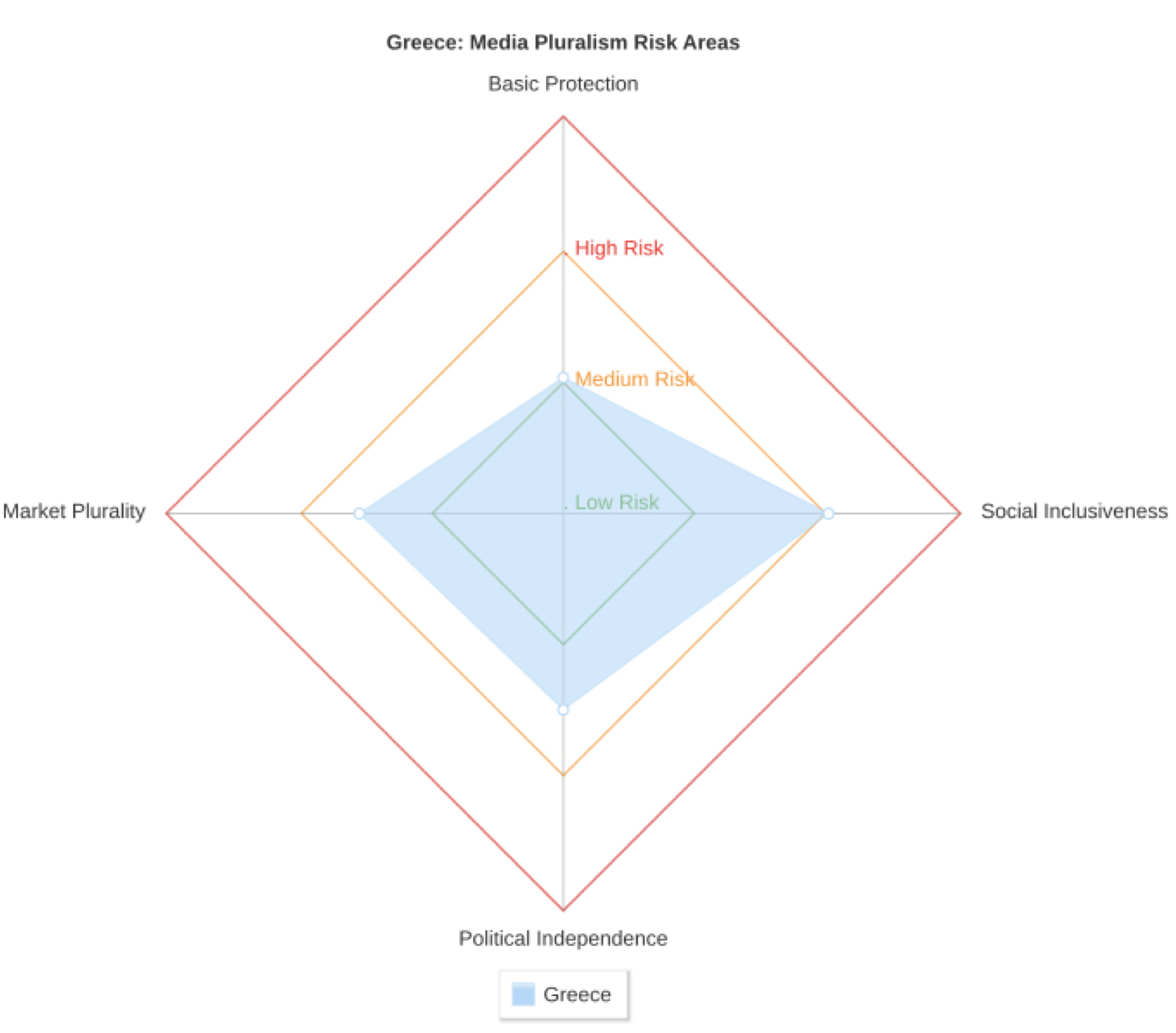
3.1. Basic Protection (34% – medium risk)
The Basic Protection indicators represent the regulatory backbone of the media sector in every contemporary democracy. They measure a number of potential areas of risk, including the existence and effectiveness of the implementation of regulatory safeguards for freedom of expression and the right to information; the status of journalists in each country, including their protection and ability to work; the independence and effectiveness of the national regulatory bodies that have competence to regulate the media sector; and the reach of traditional media and access to the Internet.
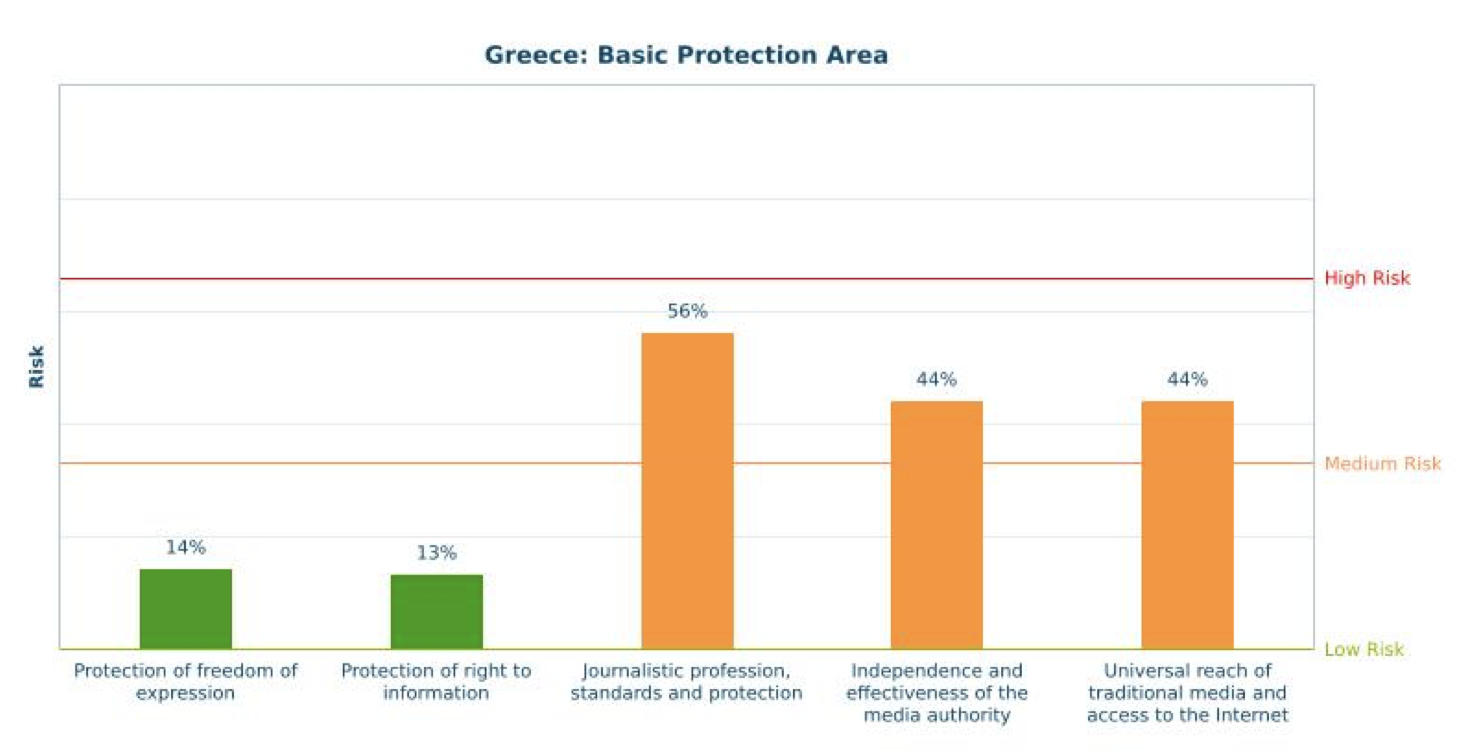
The risk to the Protection of freedom of expression in Greece is quite low (14%). Freedom of expression is explicitly recognised in the Constitution and the country has signed and ratified both the International Covenant on Civil and Political Rights and the European Convention on Human Rights (ECHR). Citizens have legal remedies in cases of infringement of their freedom of expression and free speech is generally respected, including on the Internet. Although there have been interpretive problems regarding defamation provisions in the past, recent case-law suggests that the proportionality criterion is taken into account in line with Article 10(2) ECHR. However, the state has not decriminalised defamation. Moreover, rules on blasphemy exist and they are not narrowly defined.
The indicator on the Right to information scores a low risk (13%). The right to information is explicitly recognised in the Constitution and in national laws and there are appeal mechanisms in place if public authorities refuse to grant access to documents.
The indicator on Journalistic profession, standards and protection is scored as medium risk (56%). In Greece, there is no licensing of journalists and access to the profession is open. Although the confidentiality of sources is not officially protected, the courts recognise that it constitutes an intrinsic part of free speech. However, journalists tend to operate under conditions which are far from satisfactory. First, the crisis has imposed flexibility on working conditions and job insecurity. It also appears to have contributed to threats and violence against journalists. Reporters, for instance, covering protests against austerity have at times been the victims of both riot police violence and violence by demonstrators accusing them of colluding with the government. Secondly, respect for professional standards is not effectively guaranteed. Journalists’ professional associations which are responsible for ensuring respect for editorial independence and professional standards through self-regulation are rather weak. Moreover, they cannot ensure the full commitment of media houses to relevant standards because their monitoring and sanctioning powers apply only to journalists who are their members.
The combined lack of budgetary autonomy and safeguards for independence give Greece a medium risk score (44%) for the indicator on the Independence and effectiveness of the media authority. The duties and powers of the media regulatory authority, ESR, are defined in detail in law. The authority enjoys quasi-regulatory and monitoring powers and can impose sanctions in case of violations. It is transparent about its activities. Its decisions – which constitute executable administrative acts – can be appealed before the Council of State. However, ESR is fully funded by the state and as such the possibility of political interference cannot be precluded. Its board members are selected by the Conference of Chairmen of the Parliament, a cross-party college, by an increased majority of four fifths of its members. Due to the ability of political parties to veto candidates, there have been considerable delays in the appointment of new members. For instance, at the time of data collection for the purposes of this report, the authority operated without a legally constituted board. Moreover, the nomination process lacks transparency and the qualifications for board membership are determined in general terms, which creates room for politically-driven appointments.
The indicator on Universal reach of traditional media and access to the Internet shows a medium risk (44%). Universal coverage of the PSM is guaranteed and broadband coverage is almost ubiquitous. Broadband penetration is low with only 56% of the population having a subscription. The average connection speed of 8mbps is also low compared to other European countries and there is a high ownership concentration in the ISPs market.
3.2. Market Plurality (51% – medium risk)
The Market Plurality indicators examine the existence and effectiveness of the implementation of transparency and disclosure provisions with regard to media ownership. In addition, they assess the existence and effectiveness of regulatory safeguards to prevent horizontal and cross-media concentration of ownership and the role of competition enforcement and State aid control in protecting media pluralism. Moreover, they seek to evaluate the viability of the media market under examination as well as whether and if so, to what extent commercial forces, including media owners and advertisers, influence editorial decision-making.
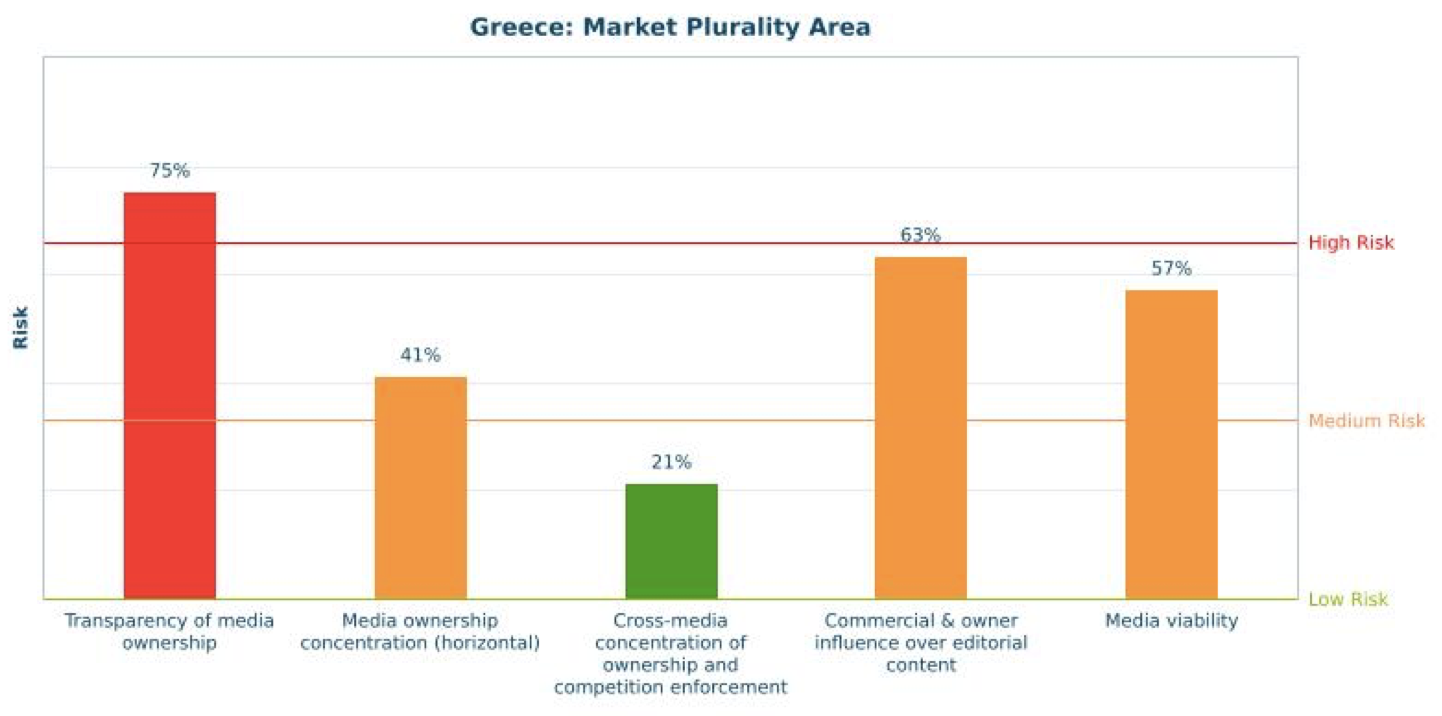
The indicator on Transparency of media ownership scores a high risk (75%). Broadcast media (TV and radio) are not required to make their ownership information accessible to the public. They are only mandated to report ownership structures and changes therein to the ESR. Sanctions apply in case of violations. However, the absence of agreements with foreign authorities, ESR’s limited ability to cross-check ownership information with other domestic bodies, and restrained capacity to scrutinize the information available due to insufficient resources undermine ESR’s monitoring activity. Disclosure obligations for the print media are limited to indicating the director and the publisher/owner on their copies without going to the level of final ownership.
The indicator on Concentration of media ownership (horizontal) shows a medium risk (41%). Media legislation (Laws 3592/2007 and 2328/1995) contains specific ownership limitations to prevent horizontal concentration in the broadcast media market. Compliance is checked by the ESR at the time of licensing and when changes in ownership structures occur. Yet, in practice the authority’s capacity to properly discharge its duty is hampered by the incoherence and incompleteness of the legal framework. Ownership limitations are further foreseen to prevent excessive horizontal concentration of ownership in the newspaper market (Law 2328/1995). However, no public authority is explicitly charged with supervising compliance with these restrictions. An important risk-increasing factor is the limited availability of data on ownership concentration in the broadcasting sector. Data on the market and audience shares of audiovisual service providers is not collected by public authorities and is not publicly available. The market share of the top 4 radio channels indicates a high level of horizontal concentration (67%) but no data on audience shares is available to complete the picture. As to the newspaper market, a medium level of ownership concentration is identified: the top 4 newspapers have a market share (measured by share of advertising expenditure in 2015) of 41% and a readership share of 25%.
The indicator on Cross-media concentration of ownership and competition enforcement shows a low risk (21%). This good score can be attributed to several factors. First, media legislation (Law 3592/2007) establishes specific thresholds to prevent excessive cross-media ownership concentration. Second, these provisions, along with general competition rules, apply in the case of mergers. Third, the monitoring of compliance with these rules is assigned to the Hellenic Competition Commission (HCC), which enjoys sanctioning powers and can impose proportionate remedies where the applicable thresholds are not respected. It can be argued, nonetheless, that the low risk calculated by the tool underestimates the situation. Specific ownership restrictions may well exist but their effectiveness is questionable. They have been, for instance, criticised for affording a much more lenient approach to cross-media ownership compared to general competition rules (see Tsevas, 2010). Furthermore, the evaluation of the actual cross-media concentration is not possible due to lack of data.
Regarding Commercial and owner influence, Greece scores at the upper end of the medium risk range (63%). The journalist’s self-regulatory code of conduct proclaims the obligation of journalists not to accept any compensation that may affect their objectivity and their duty to resist any interference by their employers or superiors. It also stipulates that journalists can be involved in advertising only for charitable purposes. Moreover, advertorials are prohibited by law. What increases the risk is the lack of mechanisms for granting protection to journalists in case of changes in ownership and the editorial line. Safeguards to ensure that decisions on appointments/dismissals of editors are not influenced by commercial interests are similarly non-existent. In addition, cases disclosing interference of commercial enterprises with news content have been recently reported. Notwithstanding, hard evidence about the exercise of influence over editorial content is difficult to find.
The indicator on Media viability scores a medium risk (57%). Whereas radio advertising expenditure increased over the past two years, newspaper advertising decreased by almost 22%. Data on TV and online advertising revenue is lacking. The number of individuals regularly using the internet increased over the past two years and this is also the case as regards access to the internet on the move. At the same time, media support schemes for overcoming market difficulties or facilitating market entry are not available. Mainstream media enterprises, for their part, have not developed sources of revenue other than traditional revenue streams. Yet, some co-operative newspapers and magazines have been founded, aspiring to promote independent journalism.
3.3. Political Independence (49% – medium risk)
The Political Independence indicators assess the existence and effectiveness of regulatory safeguards against political bias and political control over the media outlets, news agencies and distribution networks. They are also concerned with the existence and effectiveness of self-regulation in ensuring editorial independence. Moreover, they seek to evaluate the influence of the State (and, more generally, of political power) over the functioning of the media market and the independence of public service media.
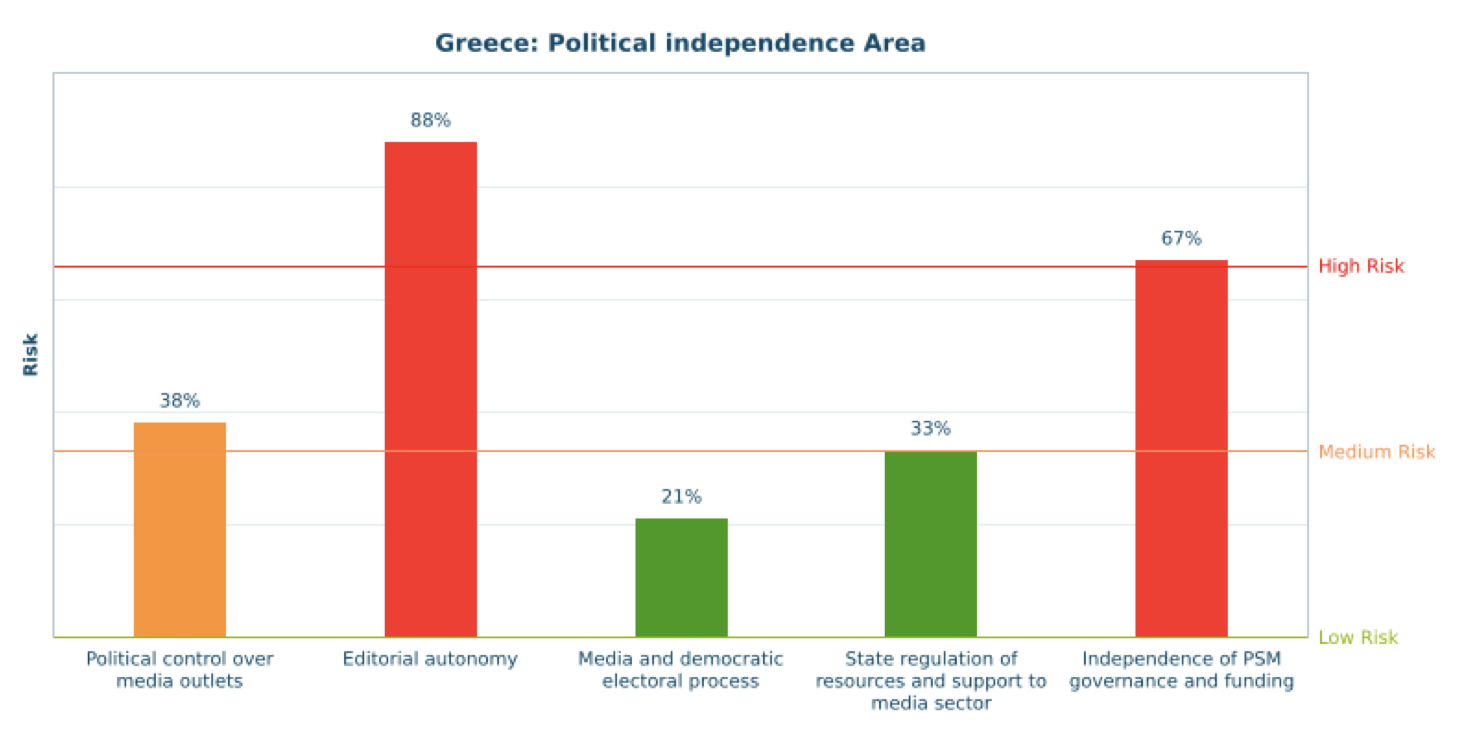
The Political independence area scores a medium risk. A high risk is identified for the indicators on “editorial autonomy” and “independence of PSM governance and funding”.
The high risk score (88%) for the indicator on Editorial autonomy can be primarily attributed to the lack of protective mechanisms. Safeguards seeking to prevent political influence over the appointments and dismissals of editors-in-chief have not been established. Collective or individualised media industry self-regulatory schemes are similarly non-existent. The lack of a formalised and effective industry-level system protecting editorial independence, combined with the interconnections between the political elites and media owners (which the term “diaploki” has been coined to describe) create space for potential direct and indirect political influence on editorial activity. In practice, however, the extent to which such influence takes place cannot be assessed due to limited available evidence.
The indicator on the Independence of PSM governance and funding shows a high risk (67%). This score is not due to financial dependence. ERT enjoys financial autonomy (through a licence fee) and safeguards protecting the adequacy of its funding vis-à-vis the fulfilment of its remit exist. The worrying factor is that legislation does not guarantee the objective and transparent selection of the members of ERT’s management board. The involvement of the Parliamentary Committee on Institutions and Transparency in the selection procedure seeks in principle to guarantee democratic control and transparency. However, ERT’s board members are nominated by the Minister responsible for the media. Politically-motivated appointments cannot therefore be precluded.
The indicator Political control over the media outlets shows a medium risk (38%). The Constitution renders the duties of Member of Parliament incompatible with participation in/ownership of a TV, radio or country-wide circulation newspaper. It is not prohibited, on the other hand, for (ruling) political parties to own media. Currently, media outlets directly owned by political parties and Parliamentarians do not enjoy a leading position in the market. It should be noted, however, that the existence of indirect control (i.e. through intermediaries) of leading media enterprises by political parties and Parliamentarians cannot be assessed due to lack of data. Another risk-increasing factor is the lack of safeguards for ensuring the political independence of the country’s only news agency, ANA-MPA, in terms of governance. The members of ANA-MPA’s board are selected by the Minister responsible for the media.
The indicator on State regulation of resources and support to the media sector scores at the upper end of the low risk score (33%). As regards spectrum allocation, domestic legislation provides transparent rules and mandates respect for the principles of flexibility and efficiency and the promotion of competition to maximize consumer benefits. A key characteristic of the Greek media policy has, nonetheless, been the failure to allocate licences to broadcasters in the analogue era, a situation which persists in the digital terrestrial television market to date. The regulatory uncertainty in which content providers operate creates ample room for political interference. At the same time, in anticipation of positive coverage, content providers may be allowed to operate disregarding the rules. As regards state subsidies, the Greek media are supported by indirect subsidies in the form of reduced value added tax, postal distribution and reduced telecommunication rates. Whereas, however, rules for the fair distribution of these subsidies along objective criteria have been adopted, the process of their implementation lacks transparency. Problems of implementation exist also with respect to the distribution of state advertising to media outlets.
The lowest risk score under the area of Political independence concerns the indicator on the Media and the democratic political process (21%). This is attributed mainly to two factors. First, ERT is obliged to provide a fair representation of political viewpoints in news and current affairs programmes. Secondly, paid political advertising during all types of election campaigns and referendums is prohibited. Both ERT and private broadcasters are required to make time available for the transmission of political messages free of charge. The allocation of airtime to political parties is determined each time on the basis of the principle of proportional equality. ESR data indicate that this principle tends to be respected on ERT’s channels. This has not consistently been the case with private TV channels.
3.4. Social Inclusiveness (67% – high risk)
The Social Inclusiveness indicators are concerned with access to media by various groups in society. The indicators assess regulatory and policy safeguards for community media, and for access to media by minorities, local and regional communities, women and people with disabilities. In addition to access to media by specific groups, the media literacy context is important for the state of media pluralism. The Social Inclusiveness area therefore also examines the country’s media literacy environment, as well as the digital skills of the overall population.
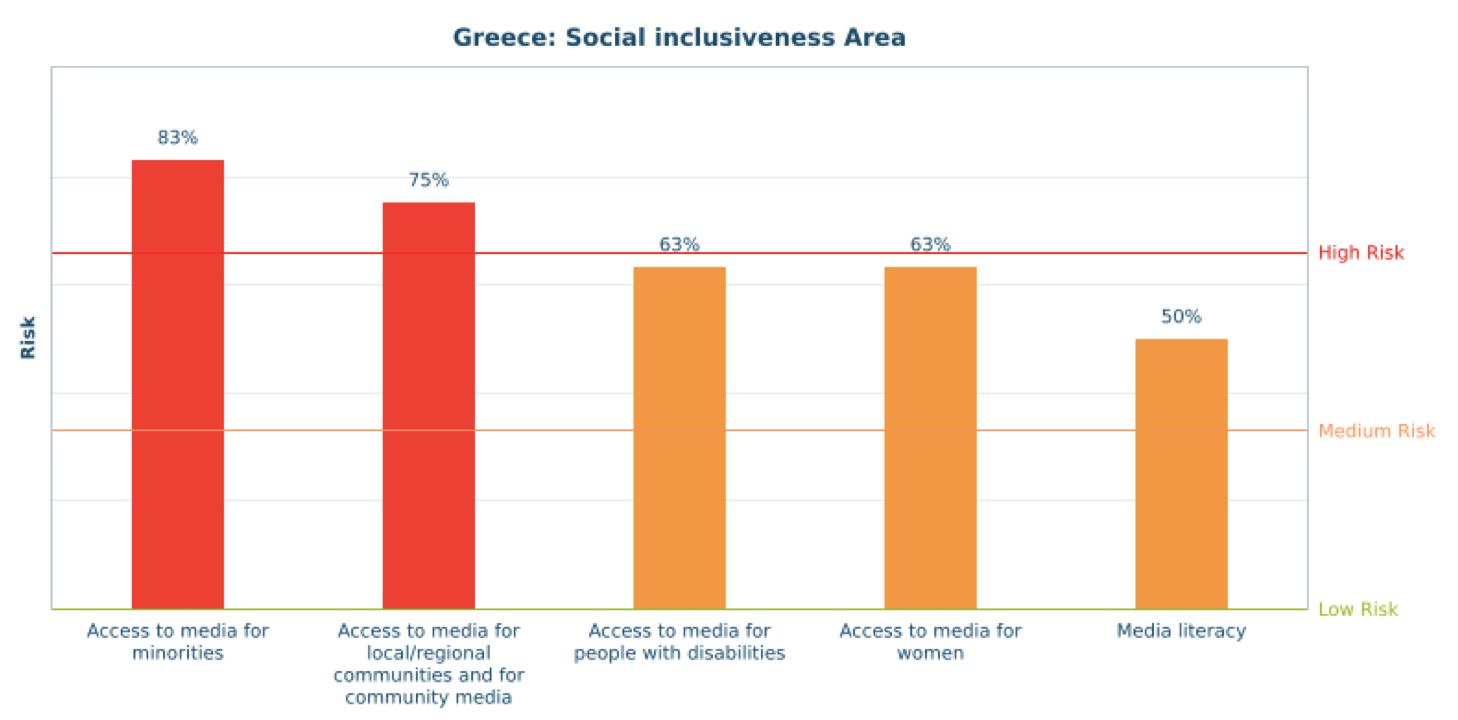
The analysis shows a high risk in the area of Social inclusiveness.
The indicator on Access to media for minorities shows a high risk (83%). First, ERT, the Greek PSM, is not obliged to broadcast content for minorities or content that is created by minorities. Private TV broadcasters are similarly not subject to any such requirements. An impediment to programming dedicated to minorities is the obligation for TV and radio channels to broadcast mainly in the Greek language. The law is silently not implemented for local radio in the region of Thrace: some radio channels broadcast solely or mainly in Turkish for the Turkish-speaking Muslim minority. Some local Turkish-language newspapers are also published in Thrace.
The indicator on Access to media for local/regional communities and for community media also scores a high risk (75%). Domestic media legislation does not impose any must-carry obligations for regional or local TV or radio channels on network providers. Only a limited number of policy measures aim to support regional/local media. These include the rules concerning the allocation of public sector advertising and postal distribution subsidies which tend to favour local and regional media. ERT operates several regional radio stations for regional audiences but it is not mandated to have its own local/regional correspondents. No particular policy for community media exists.
Regarding Access to media for people with disabilities, Greece scores at the upper end of the medium risk range (63%). Domestic media legislation requires the PSM and private broadcasters to provide accessible content for people with hearing disabilities. This includes the provision of daily sign language bulletins subtitled in Greek and subtitled television content (e.g. current affairs, entertainment, etc.). However, the provision of subtitling is not universal. It applies to a limited part of broadcasting content. Moreover, requirements for audio description for the blind and partially sighted people do not exist.
The indicator on Access to media for women also shows a medium risk (63%). The principle of equality between men and women in employment is established in the Constitution and national legislation. It applies to employment relations governed by public and private law including in the media sector. As regards gender equality in PSM, ERT is generally committed to protecting equality in the selection of personnel but specific policies and monitoring mechanisms for the promotion of gender equality have not been adopted. At the same time, the representation of women in ERT’s management board is highly unequal.
The indicator on Media literacy scores medium risk (50%). Although there is no formal media literacy policy at state level, public authorities pursue various media literacy-related initiatives addressing citizens, and young people in particular. International cooperation on media literacy issues is also promoted. Media education is not autonomously studied. It is, nonetheless, integrated as a cross-curricular subject in several modules in both primary and secondary education. Several media literacy projects targeting students and educators further take place in non-formal educational settings. However, with respect to basic digital communication and digital usage skills, the percentage of Greek Internet users having such skills is below the EU average.[3]
4. Conclusions
The research carried out in Greece in the framework of the implementation of the MPM assessed risks to media pluralism based on a set of indicators. Overall, the results disclose a number of actual threats to media pluralism in the country. These require careful attention by policy-makers and relevant stakeholders. Our findings also reveal several potential threats to media pluralism. In such instances, policy measures are desirable to promote a pluralistic media environment.
First, there is a clear need to facilitate and strengthen media ownership scrutiny and transparency. In this context, it is important to ensure that the Greek public knows who effectively owns the media. Public disclosure of the ultimate owners of traditional and online media should, thus, be required. Moreover, public authorities should keep updated records of media ownership structures.
Secondly, mechanisms that protect and promote editorial independence from political and commercial influence as well as owner interference are needed. Part of the problem lies in the lack of media industry self-regulation. The establishment of voluntary collective self-regulatory schemes at the media industry level should therefore be encouraged. Consideration should also be given to measures aimed at ensuring that journalists’ self-regulation effectively protects the autonomy of journalists’ and editors-in-chief. Efforts to support editorial independence within individual media organisations should also be deployed.
Thirdly, given concerns over pluralism in the private media sector, the insulation of ERT’s management board from governmental influence is highly topical. Despite significant reforms brought about by the law that re-instituted ERT, the possibility of government interference with ERT’s operation through politically-motivated appointments to and dismissals from its board cannot be entirely precluded. Safeguards for open, transparent and de-politicized appointment procedures should, thus, be introduced.
Fourthly, domestic media policy is characterized by the absence of measures targeting community media and access to media for minorities. Concerning the former, it is vital to raise awareness of community media as a formal “third sector”. Explicit legal recognition of community media whose mission lies in their independent and participatory character should be made. Policy-makers should also give attention to the access of minority populations to media platforms and content. The influx of migrants and refugees into Greece renders the issue of cultural diversity through the media more salient.
Finally, our results indicate that improvements are desirable in a number of areas. Although, for instance, this might sound like wishful thinking in a period of profound economic crisis, consideration should be given to the adoption of measures that address the precarious state of journalism. It is also advisable to improve domestic legislation on the accessibility of the Greek media to the disabled in accordance with technological developments. Policy discussion concerning gender equality in the media should also start. Measures to encourage women’s access to, and representation in, PSM could be given consideration in this respect.
References
BBC (2015). The Greek debt crisis story in numbers. Available at: https://www.bbc.com/news/world-europe-33407742 [Accessed 1 August 2016].
European Commission (2015). Standard Eurobarometer 84, November 2015, Greece report. TNS OPINION & SOCIAL, Brussels. Available at: https://ec.europa.eu/COMMFrontOffice/PublicOpinion/index.cfm/Survey/getSurveyDetail/instruments/STANDARD/surveyKy/2098 [Accessed 1 August 2016].
Eurostat (2016). Migration and migrant population statistics . Available at: https://ec.europa.eu/eurostat/statistics-explained/index.php/Migration_and_migrant_population_statistics#Migrant_population [Accessed 14 March 2017].Eurostat (2014). Survey on ICT (information and communication technology) usage in households and by individuals. Available at: https://ec.europa.eu/eurostat/statistics-explained/index.php/Internet_and_cloud_services_-_statistics_on_the_use_by_individuals#Internet_use_by_individuals [Accessed 1 August 2016].
Iosifidis, P. and Boucas, D. (2015). Media policy and independent journalism in Greece. Open Society Foundations. Available at: https://www.opensocietyfoundations.org/sites/default/files/media-policy-independent-journalism-greece-20150511.pdf [Accessed 1 August 2016].
Media Services (2016). 2014 TV, radio and newspapers imputed advertising expenditure. Data provided upon request.
Tsevas, Athanasios (2010). Πολυφωνία και έλεγχος συγκέντρωσης στα μέσα ενημέρωσης [Pluralism and media concentration control]. Available at: https://www.constitutionalism.gr/1606-polyfwnia-kai-eleghos-sygkentrwsis-sta-mesa-enimer/. [Accessed 20 March 2016].
United Nations (2009). Reports submitted by States parties under article 9 of the Convention: International Convention on the Elimination of all Forms of Racial Discrimination : 19th periodic reports of States parties due in 2007: Greece. Available at: https://www.refworld.org/cgi-bin/texis/vtx/rwmain?page=publisher&docid=4aa7b7562&skip=0&publisher=CERD&querysi=greece&searchin=title&sort=date [Accessed 1 August 2016].
Annexe 1. Country Team
The Country team is composed of one or more national researchers that carried out the data collection and authored the country report.
| First name | Last name | Position | Institution | MPM2016 CT Leader (please indicate with X) |
| Evangelia | Psychogiopoulou | Senior Research Fellow | ELIAMEP | X |
| Anna | Kandyla | Research Fellow | ELIAMEP | |
| George | Tzogopoulos | Research Fellow | ELIAMEP |
Annexe 2. Group of Experts
The Group of Experts is composed of specialists with a substantial knowledge and experience in the field of media. The role of the Group of Experts was to review especially sensitive/subjective evaluations drafted by the Country Team in order to maximize the objectivity of the replies given, ensuring the accuracy of the final results.
| First name | Last name | Position | Institution |
| Dimitra | Dimitrakopoulou | Assistant Professor | Aristotle University of Thessaloniki |
| Petros | Iosifidis | Professor | City University London |
| Giannis | Kotsifos | Director | Journalists’ Union of Macedonia and Thrace Daily Newspapers |
| Alexandros | Oikonomou | Legal Officer | National Council for Radio and Television (ESR) |
| Katharine | Sarikakis | Professor | University of Vienna |
Note that the Group of Experts for Greece does not feature representatives of publishing and broadcasting organizations. The associations of publishers and broadcasters contacted for the purposes of this study did not respond to our invitation.
Annexe 3. Summary of the stakeholders meeting
ELIAMEP held a closed event on 14 September 2016 to present the results of the implementation of the Media Pluralism Monitor (MPM) in Greece. The event, which took place at ELIAMEP’s premises in Athens, considered the main threats to media pluralism and media freedom in the country and served as a platform for debate for the challenges facing the Greek media policy in the context of the crisis and the online media.
The first part of the event was devoted to the MPM2016 project. It began with a description of the MPM by Dr Konstantina Bania, research assistant at CMPF, which set the scene for the presentations and the discussion that followed. Dr Bania provided some historical background to the development of the monitoring tool and explained the scope of the MPM2016, the areas of interest and the methodology. Then Anna Kandyla, research assistant at ELIAMEP, presented the results of the implementation of the MPM in Greece. Ms Kandyla elaborated on the areas identified as deficient in each of the domains evaluated by the tool and drew attention to the problems facing data collection and how they impacted the scores provided. The second part of the event featured presentations regarding the challenges and perspectives of media pluralism in Greece. Dr Alexandros Oikonomou, legal officer at the media regulatory authority, ESR, talked about the factors impacting the operation of the ESR as an independent and effective media regulator. Dr Markos Vogiatzoglou, advisor at the General Secretariat for Information and Communication, elaborated on the policy priorities and outcomes of the broadcasting content licensing tender that the government launched. He also presented future governmental initiatives as regards media pluralism and diversity.
The workshop brought together policy makers, journalists and academics. Overall, the reaction to the results of the implementation of the MPM was positive. Participants emphasized the importance of raising awareness about issues of media pluralism and the need for evidence-based research such as the MPM.
—
[1] The authors wish to thank the panel of experts and consulted institutions, professionals and academics for providing information.
[2] For more information on MPM methodology, see the CMPF report “Monitoring Media Pluralism in Europe: Application of the Media Pluralism Monitor 2016 in EU-28, Montenegro and Turkey”, https://monitor.cmpf.eui.eu/
[3] The share of Greek Internet user who has basic or advanced digital usage skills is 59% compared to a European median of 67%; and the share with basic or advanced digital communication skills is 61% compared to a European median of 77%.