

Albania
Media Pluralism Monitor 2025 results
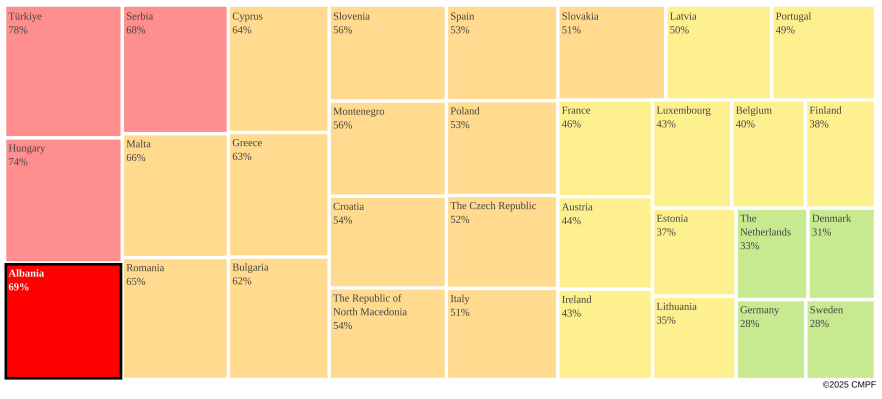
Risk score: 69%
| Fundamental Protection | 55% |
| Market Plurality | 87% |
| Political Independence | 69% |
| Social Inclusiveness | 67% |
In-depth analysis:
Read the full MPM2025 Country report
Country overview
In October 2024, the European Union opened accession negotiations with Albania, signaling a boost for the EU ambitions of the Western Balkan country, amidst a changing security and geopolitical situation in Europe, defined by the Russian aggression in Ukraine. Following a decision of the EU Council to decouple Albania’s path toward the Union from North Macedonia, on October 15th 2024 Tirana opened the negotiations with Brussels on Cluster 1 of thematic chapters for negotiations, the so called “Fundamentals,” and on December 17th negotiations were also opened for Cluster 6, “External Relations”. A key component of Cluster 1 is the chapter on the Judiciary and Fundamental Rights, which includes also Freedom of Expression. Albania is evaluated as between having some level of preparation and a moderate level of preparation in the area of Freedom of Expression (European Commission, 2024). The country has registered little improvement in this area in recent years. This is due to inherited structural problems in the media market – including high concentration of ownership and audiences, but also a lack of political will to adopt amendment to the legal framework to fully decriminalize defamation or introduce legislation against SLAPP lawsuits. In light of the EU accession process and the opening of negotiations with the union, Albania has approved two roadmaps to align its legislation with EU standards. The Rule of Law Roadmap, approved in December 2023, includes provisions on media ownership concentration, transparent audience measurement, structured dialogue for media freedom, the safety of journalists, working conditions and access to information. The Functioning of Democratic Institutions Roadmap, approved in October 2024, includes provisions on media regulation during the electoral processes. Working conditions for journalists remain one of the most concerning areas, with data from the most recent survey the lack of social contracts, long working hours, and low job security remain structural issues in major media outlets (BIRN Albania and SCiDEV, 2024). Due to such challenges, many journalists in the mainstream media resort to self-censorship, while critical voices face intimidation and smear campaigns. In order to address the lack of progress in the freedom of expression chapter, the European Union, in cooperation with the Council of Europe and the Department of Journalism at the University of Tirana, announced in October 2024 the launch of a structured dialogue involving the state authorities and all relevant actors of the media sector (OSCE, 2024). According to the 2024 Balkan Public Barometer (Regional Cooperation Council, 2024), 53% of Albanian ‘tend not to trust’ or totally ‘distrust the media’ and 50% say that they have noticed an increase in of various “fake news” and disinformation in the past 12 month. Most Albanians access news and information through social media platforms, followed by television, online media and print, which has registered a major decline in the post COVID-19 years, both in readership and revenue (Global Media Register and BIRN Albania, 2023). In 2024, the Albanian Audiovisual Media Authority (AMA) has taken some additional regulatory steps to enhance the transparency of media ownership in the audiovisual media sector and legal compliance through the adoption of the regulation “On the requirements and procedures for reviewing changes in ownership structure and transparency of ownership data of audiovisual media operators”, adopted through the Decision No. 40 of AMA’s board, on April 26, 2024 (Audivisual Media Authority, 2024). This decision aligns partially with the provisions of the Audiovisual Media Services Directive and of the European Media Freedom Act (EMFA). In October 2024, the General Prosecutors Office approved a directive on the investigation of cases related to the safety of journalists and media (General Prosecutor, October 27). The directive aims to improve coordination for the strengthening of institutional capacities for the protection of journalists from threats and any other illegal activity that hampers their ability to practice their profession. The General Prosecutor’s office has also appointed a contact person for cases related to attacks against journalists. In December 2024, Albania’s parliament approved a new law “On the protection of personal data”, aligning the country’s legislation with the General Data Protection Regulation (Law No. 124, 19.12.2024). Additionally, a Special Parliamentary Committee to Counter Foreign Interference and Disinformation in Democratic Processes was created in March 2024, tasked with drafting a national strategy to counter Foreign Information Manipulation and Interference (Albanian Parliament, 2024a).
Fundamental protection
The Fundamental Protection area scores within the medium-high risk band. Key points include:
- Freedom of expression is guaranteed by Albania’s constitution and legal framework; however, in practice violations persisted in 2024 and media’s independence was under threat, due to the confluence of the political and economic interests of media owners and pressure from politics and organized crime that pushes many journalists toward self-censorship.
- Although punishable through a fine, defamation remain partially criminalized in Albania, while the country has made no progress in adopting specific anti-SLAPP legislation.
- Albania has yet to fully harmonize its legislation with the EU and as a result online platforms generally do not moderate content in a diligent, objective and proportionate manner.
- Despite a robust legal framework, challenges persisted in the practical implementation of the law on the right to information in 2024, because public authorities do not always comply promptly with information requests, and there are instances where access is denied without sufficient justification.
- Although several journalists’ associations have existed in Albania since 1994, and a new association and a union of journalists were established in 2024, they have struggled to ensure respect for journalists’ working conditions and safety in the country.
- Although no journalist was killed or imprisoned due to his professional activities in 2024, Albanian journalists frequently face physical and non-physical threats, both online and offline, including harassment and smear campaigns, often perpetuated by other media outlets.
- Nearly half of Albanian journalists reported that working conditions have deteriorated in 2024, with media watchdogs calling for a stricter implementation of the labor code.
- The Audiovisual Media Authority (AMA) has yet to establish itself as a genuinely independent regulatory body for the audiovisual media sector, due to the political affiliation of its board.
- The Broadcasting Code stipulates that the activity of audiovisual media should guarantee the objective and independent information is available to the public, the media regulator has done little in 2024 to cut down on the practice of media outlets that broadcast the live feed or pre-recorded content produced by the government or political parties without labeling.
Market Plurality
Market Plurality is associated with a very high risk band as the most sensitive area among the four assessed. Key points include:
- Regulation on media ownership transparency has improved moderately, particularly in broadcasting, due to the approval of regulatory changes by the Audiovisual Media Authority, which partially aligned Albania’s legislation with the EU’s Audiovisual Media Services Directive and incorporates provisions from the European Media Freedom Act (EMFA).
- Despite the provisions, ownership transparency for audiovisual media is not fully enforced. Regulations for print and digital media are lacking, as well as there are no provisions on cross-media concentration, leading to less transparent ownership structures.
- Concentration in the audiovisual and print market is high, with revenues and audience share concentrated in the hands of handful of family-owned media conglomerates.
- Revenues in the audiovisual and radio market were stationary, however, the print market registered a decrease in revenues in recent years. Data for 2024 were not available.
- Editorial independence remains vulnerable to commercial and owners’ influence, with insufficient legal or self-regulatory safeguards against arbitrary interventions on the editorial line, exacerbated by
political pressures.
Political Independence
The Political Independence area registered a high risk score, with on its indictors – Editorial Autonomy – passing the very high-risk threshold. Key points include:
- The lack of a robust regulatory and enforcement mechanisms and weak self-regulatory safeguards expose Albanian journalists to political and commercial pressures, undermining their professionalism and failing the media’s commitment to serving the public interest, and ultimately compromising the quality of journalistic content.
- Although a a code of conduct stipulating editorial independence exists and a self-regulatory body has been established in 2020, the largest mainstream news organizations are not its members, which makes it ineffective in preventing political influence or systematic interference on editorial autonomy.
- A regulatory framework exists for the fair representation of different political actors and viewpoints in audiovisual media, both in private broadcasters and the PSM; however, different actors are represented in a biased and non-proportional way.
- In Albania there is no state support for the media sector; however, television and print companies enjoy a privileged tax regime compared to online media.
- There is no transparency nor plurality in the distribution of state advertising to the media.
- The appointments and dismissals of PSM board, management and director general remain highly politicized processes.
Social Inclusiveness
The Social Inclusiveness registered a high risk score. Key points include:
- Although broadcast media cover most of the county’s territory and broadband is widely available, the Law ‘On Electronic Communications in the Republic of Albania’, updated in 2024, do not guarantee safeguards regarding net neutrality.
- Access to media services for people with hearing or visual impairment is still very limited, despite few improvements registered in 2024.
- Representation of minorities in broadcast media or news reporting and airtime is not always proportionate to the size of their populations in the country, particularly in private TV and radio stations.
- There are a limited number of audiovisual media outlets that operate outside the capital Tirana and have a local focus and most local media outlets face serious sustainability and viability issues.
- In the Albanian media, women are underrepresented in current affairs broadcasts and in many cases are depicted in a stereotyped way.
- Media literacy policies are underdeveloped and its inclusion in school curriculum remains inadequate.